Unit Circle Explorer
The point at angle θ on the unit circle is (cos θ, sin θ). Drag it to read sin, cos and tan in degrees and radians, with exact values and quadrant signs.
Visualiser
Drag the point round the circle or along the graph. The arrow keys move it one degree, Page Up and Page Down jump between special angles, and Home and End go to 0° and 360°.
- Angle θ Measured anticlockwise from the positive x axis, so a clockwise angle is negative. The same point is also −330°, one full turn away.
- 30°
- θ in radians On a circle of radius 1 an angle in radians is the length of arc it cuts off. The arc from (1, 0) round to the point is 0.5236 long.
- π/6 ≈ 0.5236 rad
- sin θ The y coordinate of the point, and the height of the sine curve at θ.
- 1/2 = 0.5
- cos θ The x coordinate of the point, and the height of the cosine curve at θ.
- √3/2 ≈ 0.866
- tan θ sin θ / cos θ, which is the height at which the line through the point meets the tangent line x = 1.
- √3/3 ≈ 0.5774
- Quadrant Quadrant I: sin, cos and tan are all positive.
- I
- Reference angle The angle between the radius and the nearer half of the x axis. sin, cos and tan of θ are those of this angle, with the quadrant’s signs.
- 30°
Three things to try. Set 150° and compare it with 30°: the same numbers, with cos and tan changing sign. Step through with Next special angle and watch the exact values come round again in every quadrant. Then drag towards 90° and watch tan θ grow past the edge of the panel, then stop existing at 90° itself.
Citing this tool
Last updated . Add the date you accessed it as well, which a citation of a page that can change asks for. If a specific result matters, cite the permalink from the tool’s share row instead of this page: it reproduces the exact parameters.
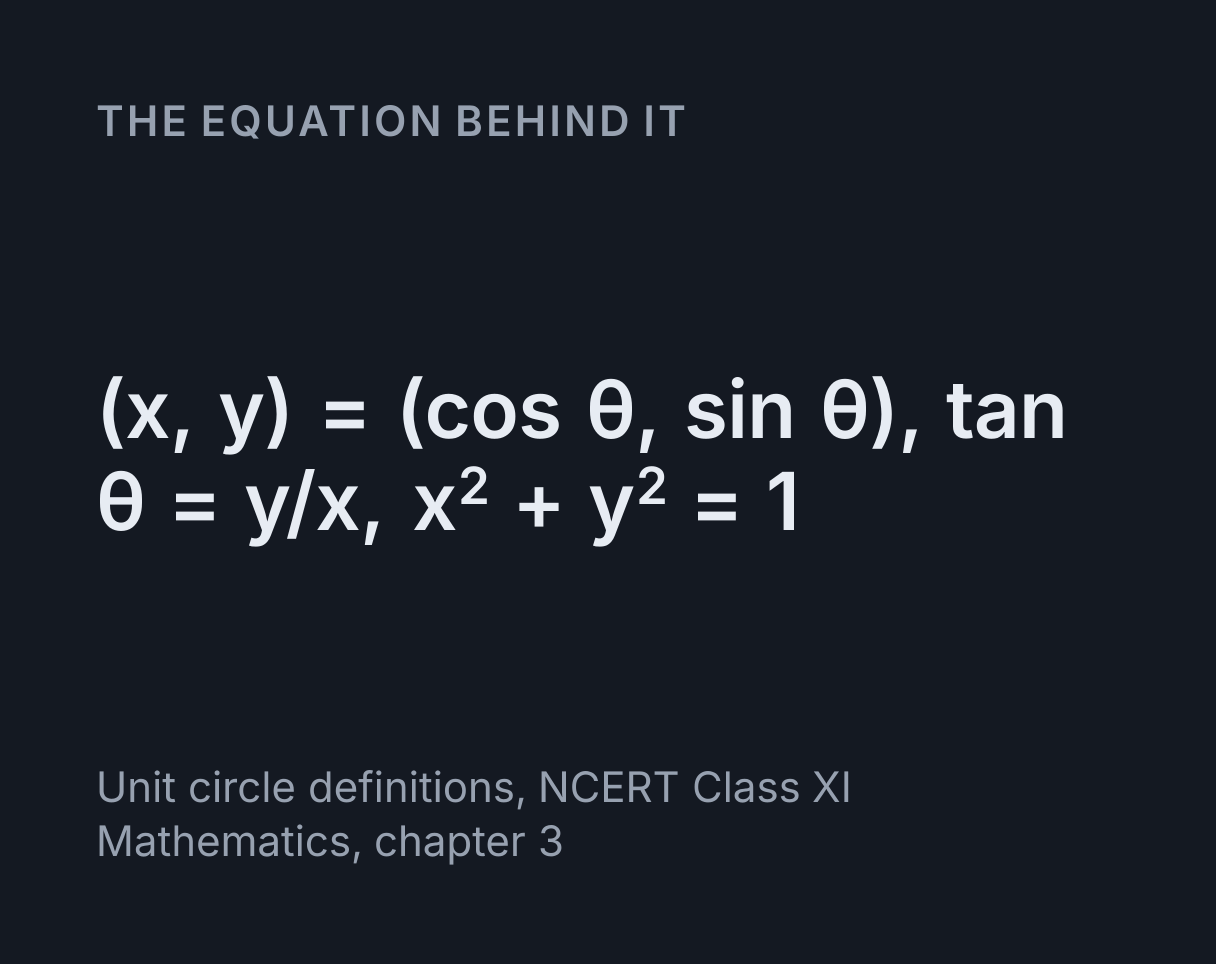
The equation
Unit circle definitions, NCERT Class XI Mathematics, chapter 3
What is the unit circle?
The unit circle is the circle of radius 1 centred on the origin, and it defines sine and cosine
for every angle. Measure an angle θ anticlockwise from the positive x axis, and the point where it
meets the circle is (cos θ, sin θ): cos θ is the x coordinate, sin θ is the y
coordinate, and tan θ = sin θ / cos θ.
That is the right-triangle definition with the hypotenuse set to 1. SOH CAH TOA divides the opposite and adjacent sides by the hypotenuse, and dividing by 1 changes nothing, so the two legs of the triangle in the scene are sin θ and cos θ themselves. What the circle adds is everything past 90°. A right triangle cannot hold an obtuse angle, but the point can keep going round, and its coordinates, negative ones included, are the values of the functions there.
Sine, cosine and tangent as lengths
Each of sin θ, cos θ and tan θ is a length you can see. cos θ is the horizontal leg, from the centre along the x axis to directly below or above the point. sin θ is the vertical leg, from the x axis to the point. Both are signed, so a leg that points left or down is negative.
tan θ lives on a line of its own. The vertical line x = 1 touches the circle at
(1, 0), and the radius, extended, meets it at a height of exactly tan θ. That is
similar triangles: the small one has legs cos θ and sin θ, the large one has legs 1 and tan θ, so
tan θ / 1 = sin θ / cos θ. In quadrants II and III the radius points away from that
line, so it is extended backwards through the centre instead, which is where the sign of tan θ
comes from there.
Because the hypotenuse is 1, Pythagoras gives the identity that holds at every angle:
cos²θ + sin²θ = 1. The point is on the circle, and that equation is the circle.
Why tan 90° is undefined
At 90° the radius is vertical, parallel to the tangent line, and parallel lines never meet, so
there is no height to read. The algebra says the same: cos 90° is 0, and 1 / 0 has no
value. Step towards 90° with the arrow keys and the tangent segment grows until it runs off the top
of the panel: tan 89° is already 57.29. Step past it and the segment comes back from the bottom,
with tan 91° at −57.29. The two
sides head for opposite infinities, so no single number could stand for tan 90°. The same happens
at 270°, the other point on the y axis.
Degrees and radians
To convert, multiply degrees by π/180: θ in radians = θ in degrees × π/180. A full
turn is 360°, or 2π ≈ 6.283 radians, and one radian is about 57.30°.
The radian is not an arbitrary unit. It is the angle subtended at the centre of a circle by an arc
equal in length to the radius, which is how NIST Special Publication 330 defines it. On a circle
of radius 1 that makes an angle in radians exactly the length of arc from (1, 0)
round to the point, and the scene draws that arc in a thicker line so you can see it. At 30°
the arc is π/6 ≈ 0.5236 long. For other conversions there is the
angle conversion table.
Unit circle chart: exact values at the special angles
The multiples of 30° and 45° are the special angles. At each of them sin and cos have exact values, written with at most a square root of 2 or 3, and so does tan wherever it is defined, which is everywhere but 90° and 270°. They all come from two triangles with a hypotenuse of 1. Half a square has angles of 45°, 45° and 90° and both legs √2/2. Half an equilateral triangle has angles of 30°, 60° and 90° and legs of 1/2 and √3/2. Learn the first quadrant and the rest of the circle follows from the reference angle and the quadrant’s signs.
| Angle | cos θ | sin θ | tan θ |
|---|---|---|---|
| 0° = 0 | 1 | 0 | 0 |
| 30° = π/6 | √3/2 | 1/2 | √3/3 |
| 45° = π/4 | √2/2 | √2/2 | 1 |
| 60° = π/3 | 1/2 | √3/2 | √3 |
| 90° = π/2 | 0 | 1 | undefined |
| 120° = 2π/3 | −1/2 | √3/2 | −√3 |
| 135° = 3π/4 | −√2/2 | √2/2 | −1 |
| 150° = 5π/6 | −√3/2 | 1/2 | −√3/3 |
| 180° = π | −1 | 0 | 0 |
| 210° = 7π/6 | −√3/2 | −1/2 | √3/3 |
| 225° = 5π/4 | −√2/2 | −√2/2 | 1 |
| 240° = 4π/3 | −1/2 | −√3/2 | √3 |
| 270° = 3π/2 | 0 | −1 | undefined |
| 300° = 5π/3 | 1/2 | −√3/2 | −√3 |
| 315° = 7π/4 | √2/2 | −√2/2 | −1 |
| 330° = 11π/6 | √3/2 | −1/2 | −√3/3 |
| 360° = 2π | 1 | 0 | 0 |
tan 30° is written √3/3 here, rationalised, as the NIST Digital Library of
Mathematical Functions prints it. It is the same number as 1/√3, the form many
textbooks use.
Which functions are positive in each quadrant
Sine is positive above the x axis and cosine to the right of the y axis, because they are the y and x coordinates. Tangent is their quotient, so it is positive where the two share a sign. That gives the pattern all, sin, tan, cos, anticlockwise from quadrant I:
- Quadrant I, 0° to 90°: all three positive.
- Quadrant II, 90° to 180°: sin positive, cos and tan negative.
- Quadrant III, 180° to 270°: tan positive, sin and cos negative.
- Quadrant IV, 270° to 360°: cos positive, sin and tan negative.
The CAST diagram writes the same pattern starting from quadrant IV, and All Students Take Calculus starts from quadrant I. Neither is needed once you can see where it comes from: with the quadrant signs shown, the shaded quarter always matches the signs in the readouts. On an axis the point is in no quadrant at all: on the x axis sin θ and tan θ are 0, and on the y axis cos θ is 0 and tan θ is undefined.
Reference angles: every angle has a twin in the first quadrant
The reference angle is the angle between the radius and the nearer half of the x axis, from 0° to 90°. sin, cos and tan of any angle have the same size as those of its reference angle and differ at most in sign, which is why the first quadrant is all there is to learn. For θ between 0° and 360°, after adding or taking away whole turns if it is not:
- Quadrant I: the reference angle is θ itself.
- Quadrant II: the reference angle is
180° − θ. - Quadrant III: the reference angle is
θ − 180°. - Quadrant IV: the reference angle is
360° − θ.
These are the related-angle rules in another form: sin(180° − θ) = sin θ and
cos(180° − θ) = −cos θ, and likewise round the rest of the circle.
Worked example: sin, cos and tan of 150°
150° lies between 90° and 180°, so it is in quadrant II, and its reference angle is
180° − 150° = 30°. In quadrant II only sine is positive, so:
sin 150° = sin 30° = 1/2 = 0.5cos 150° = −cos 30° = −√3/2 ≈ −0.866tan 150° = sin 150° / cos 150° = −√3/3 ≈ −0.5774
In radians, 150 × π/180 = 5π/6 ≈ 2.618, which is also the length of arc from
(1, 0) round to the point. Going clockwise instead reaches the same point at −210°, one
full turn away. Set the angle to 150 and every one of these figures appears in the readouts.
An angle with no exact form works the same way. 200° is in quadrant III with a reference angle of
20°, so sin 200° = −sin 20° ≈ −0.342, cos 200° = −cos 20° ≈ −0.9397 and
tan 200° = tan 20° ≈ 0.364, positive, as quadrant III says it should be. In radians
it is 10π/9 ≈ 3.491.
The graphs are the circle unrolled
Plot the height of the point against the angle and you get the sine curve; plot its x coordinate and you get the cosine curve. On a wide screen the graph shares the circle’s scale and a level line joins the point to the sine curve, so you can see they are the same height at every angle. The bold part of each curve is the part the point has traced since 0°.
Three facts about the graphs are facts about the circle. Sine and cosine repeat every 360°, or 2π,
because a full turn brings the point back where it started, while tan repeats every 180°, because
the point and the one opposite it give the same line through the centre. Sine is odd,
sin(−θ) = −sin θ, and cosine is even, cos(−θ) = cos θ, because a
negative angle reflects the point in the x axis, which flips its height and leaves its x
coordinate alone. The graph runs from −360° to 360° so that both symmetries are on screen.
The same two coordinates resolve angled quantities all through physics: a launch at angle θ splits
into v₀ cos θ across and v₀ sin θ up in the
projectile motion simulator, and the dot and
cross products carry cos θ and sin θ of the angle between two vectors in the
vector cross product explorer. The
derivative and tangent line explorer shows the
next fact about these curves, that the gradient of sin x, with x in radians, is cos x.
Common mistakes
- A calculator in radian mode. sin 30 in radians is
−0.988, the sine of about 1718.87°. If a familiar value comes out strange, check the mode first. - Dropping the sign with the reference angle. cos 150° is
−√3/2, not√3/2. The reference angle gives the size; the quadrant gives the sign. - Swapping the coordinates. The point is
(cos θ, sin θ), cosine first, because x comes first. At 30° that is(√3/2, 1/2). - Treating tan 90° as a very large number. It has no value at all. tan 89° is about 57.29 and tan 91° about −57.29, so the two sides do not even agree on a sign.
- Reading sin²θ as sin(θ²). It means
(sin θ)², which is whycos²θ + sin²θ = 1is Pythagoras. - Treating a negative angle as an error. −30° is measured clockwise and lands on the same point as 330°, with the same sin, cos and tan.
What this does not cover
The angle moves in whole degrees between −360° and 360°, which is what the slider and a shared
link can hold. For an angle given in radians, or a fraction of a degree, the
graphing calculator plots sin(x) with x in
radians and reads its value wherever you tap or hover on the curve. The graph beside the circle
draws sin θ and cos θ only. The graphing calculator plots tan(x) as well, with a break
at every odd multiple of π/2, where tan has no value.
Only sin, cos and tan are drawn. The other three are their reciprocals,
sec θ = 1/cos θ, csc θ = 1/sin θ and cot θ = cos θ / sin θ,
and one of them is already in the picture: the distance from the centre to where the radius line
meets x = 1 is |sec θ|, since sec²θ = 1 + tan²θ. Exact forms are given at the
16 special angles only. The other multiples of 15° have exact forms as well,
such as sin 15° = (√6 − √2)/4, but most whole-degree angles, 20° among them, have none
worth writing down, so the readouts give those as decimals to four significant figures. Inverse
functions, which turn a value back into an angle, are not covered.
Sources
The definitions follow NCERT’s Class XI Mathematics textbook, chapter 3, which defines cos x and sin x as the coordinates of a point on the unit circle and one radian as the angle an arc of length 1 subtends at its centre. The exact values, the signs in each quadrant and the related-angle rules are those tabulated in chapter 4 of the NIST Digital Library of Mathematical Functions, in Tables 4.16.1, 4.16.2 and 4.17.1, and the degree is π/180 radians as NIST Special Publication 330 gives it. The Department for Education’s GCSE mathematics subject content (2013) expects students to know the exact values of sin θ and cos θ at 0°, 30°, 45°, 60° and 90°, and of tan θ at 0°, 30°, 45° and 60°.
Common questions
What is the unit circle?
A circle of radius 1 centred on the origin, used to define sine and cosine for every angle. The point where an angle θ, measured anticlockwise from the positive x axis, meets the circle is (cos θ, sin θ), so cosine is its x coordinate and sine its y coordinate. Because the radius is 1, the right triangle from the origin to that point has legs of exactly cos θ and sin θ, which is why SOH CAH TOA reduces to plain lengths here. Unlike a right triangle, the circle carries on past 90°, and the signs of the coordinates become the signs of the functions.
Why is tan 90° undefined?
Because cos 90° is 0, and tan θ is sin θ divided by cos θ, so at 90° it would mean dividing 1 by 0. On the circle, tan θ is the height at which the line through the origin and the point meets the tangent line x = 1, and at 90° that line is vertical, parallel to x = 1, so the two never meet. Either side of 90° the value grows without limit as θ closes in, positive below 90° and negative above it: tan 89° ≈ 57.29 and tan 91° ≈ −57.29, so no single number could stand in for it. The same happens at 270°.
Which trig functions are positive in each quadrant?
All three in quadrant I, only sine in quadrant II, only tangent in quadrant III and only cosine in quadrant IV. The reason is the coordinates: sine is the y coordinate, so it is positive above the x axis; cosine is the x coordinate, positive to the right of the y axis; and tangent, their quotient, is positive where the two share a sign. Two mnemonics carry the pattern: the CAST diagram, read anticlockwise from quadrant IV, and All Students Take Calculus, read anticlockwise from quadrant I. On an axis the point is in no quadrant: on the x axis sine and tangent are 0, and on the y axis cosine is 0 and tangent is undefined.
What are the exact values of sin, cos and tan at 30°, 45° and 60°?
At 30°, sin is 1/2, cos is √3/2 and tan is √3/3, the same number as 1/√3. At 45°, sin and cos are both √2/2 and tan is 1. At 60°, sin is √3/2, cos is 1/2 and tan is √3. They come from two triangles with a hypotenuse of 1: half a square, with angles of 45°, 45° and 90°, and half an equilateral triangle, with angles of 30°, 60° and 90°. Every special angle in the other three quadrants, such as 150° or 225°, has one of these sets of values, with the signs its quadrant gives.
Why does my calculator say sin 30 is −0.988?
Because it is in radian mode, so it has worked out the sine of 30 radians rather than 30 degrees. Thirty radians is about 1718.87°, which is four whole turns plus about 278.87°, a point in quadrant IV where sine is negative, and the sine of 30 radians is −0.98803. Switch the calculator to degrees and sin 30 gives 0.5. To convert by hand, multiply degrees by π/180, so 30° is π/6, about 0.5236 radians.