Molarity Calculator
Solve for molarity, mass, molar mass or volume, from nanomolar to molar. Shows the rearranged equation and the exact amount to weigh for your volume.
Calculator
NaCl 58.44, glucose 180.16, Tris 121.14, EDTA 292.24.
Volume of the finished solution, not the solvent you add.
Solving m = c × M × V
- Weigh out
- 2.922 g
- Moles needed
- 50 mmol
- Final concentration
- 100 mM
- Final volume
- 500 mL
Protocol
- Weigh out 2.922 g of solute.
- Dissolve in roughly 400 mL of solvent, less than the final volume.
- Once fully dissolved, make up to 500 mL in a volumetric flask.
Citing this tool
Last updated . Add the date you accessed it as well, which a citation of a page that can change asks for. If a specific result matters, cite the permalink from the tool’s share row instead of this page: it reproduces the exact parameters.
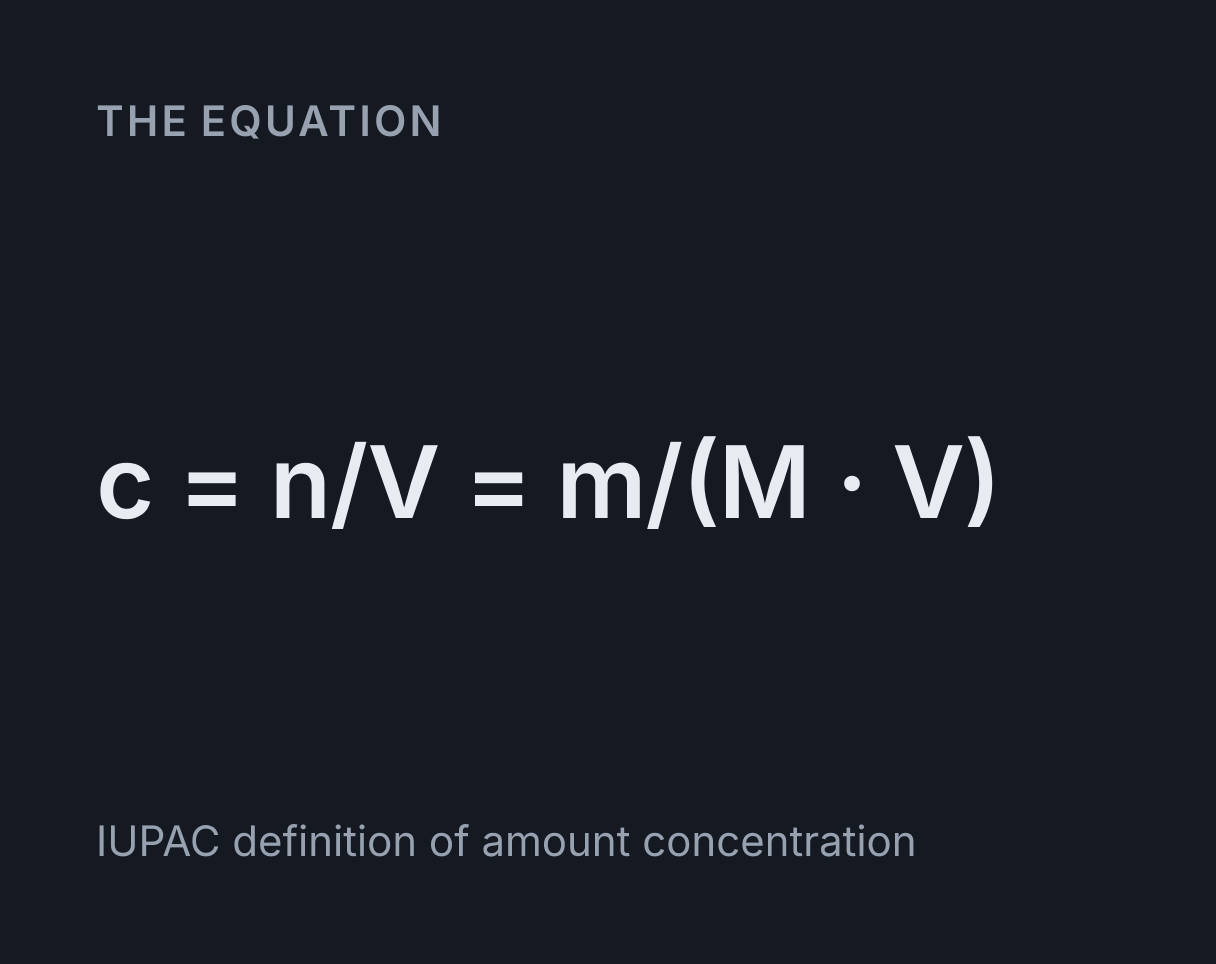
The equation
IUPAC definition of amount concentration
What molarity actually measures
Molarity is moles of solute per litre of solution, not per litre of solvent. A 1 M solution contains one mole of solute in a total volume of one litre, which is why you dissolve first and make up to the mark afterwards. For dilute aqueous solutions the difference is small; for concentrated ones it is not.
Because moles are mass divided by
molar mass, the working equation is
m = c × M × V. Every quantity has to be in consistent units
before you multiply, which is where most errors creep in. This calculator
converts everything to mol/L, grams and litres internally, so mixing µL
with mM is safe.
Worked example
To make 500 mL of 100 mM NaCl (molar mass 58.44 g/mol):
- Convert: 100 mM is 0.1 mol/L, and 500 mL is 0.5 L.
- Moles needed:
0.1 × 0.5 = 0.05 mol. - Mass:
0.05 × 58.44 = 2.922 g.
Weigh 2.922 g, dissolve in roughly 400 mL of water, then make up to the 500 mL mark once it has fully dissolved.
Molarity, molality and percent
Molarity (M) is per litre of solution and changes with temperature, because the solution expands. Molality (mol/kg) is per kilogram of solvent and does not, which is why it appears in colligative-property work like freezing point depression. Percent w/v is grams per 100 mL and carries no information about molar mass at all, so it cannot be compared across different solutes without converting.
Common mistakes
- Adding the solvent to the mark before dissolving. The volume changes as the solid goes into solution, so the final concentration will be off.
- Using the anhydrous molar mass for a hydrate. CuSO₄ is 159.60 g/mol but CuSO₄·5H₂O is 249.68. Using the wrong one makes you weigh about 36% too little.
- Ignoring purity for reagents supplied below 100%. Divide the calculated mass by the fractional purity.
- Assuming molarity is temperature-independent. For work that spans a wide temperature range, use molality.
Converting units first? Use the concentration, volume and mass conversion tables.
Common questions
What is the difference between molarity and molality?
Molarity is moles of solute per litre of solution, which is what this calculator computes, while molality is moles of solute per kilogram of solvent. Molality is preferred when temperature varies, because the mass of solvent does not change with temperature while the volume of solution does.
Should I add solvent to the mark before or after dissolving?
Dissolve the solid in less than the target volume first, then top up to the calibrated mark once fully dissolved. Molarity is defined per litre of final solution, not per litre of solvent added, and many solutes change the total volume measurably as they dissolve.