Projectile Motion Simulator
Simulate projectile motion with adjustable speed, angle and height. Watch the trajectory animate with live range, apex and flight-time readouts.
Simulator
- Range
- 40.77 m
- Max height
- 10.19 m
- Flight time
- 2.883 s
- Impact speed
- 20 m/s
- Impact angle
- 45 °
- Solution Closed-form solution; matches textbook values exactly.
- Exact
- Height
- Speed
Citing this tool
Last updated . Add the date you accessed it as well, which a citation of a page that can change asks for. If a specific result matters, cite the permalink from the tool’s share row instead of this page: it reproduces the exact parameters.
The equation
Galileo, Two New Sciences (1638)
How projectile motion works
Projectile motion is the flight of an object launched at speed
v₀ and angle θ above the horizontal with only
gravity acting on it, which on level ground gives a range of
R = v₀²sin 2θ / g. A projectile has two independent motions
happening at once. Horizontally nothing accelerates it, so it covers equal
distances in equal times. Vertically gravity pulls it down at a constant
9.81 m/s² on Earth. Separating the launch velocity into
those two components, v₀cos θ horizontally and
v₀sin θ vertically, turns one awkward curved problem into two
straightforward straight-line ones.
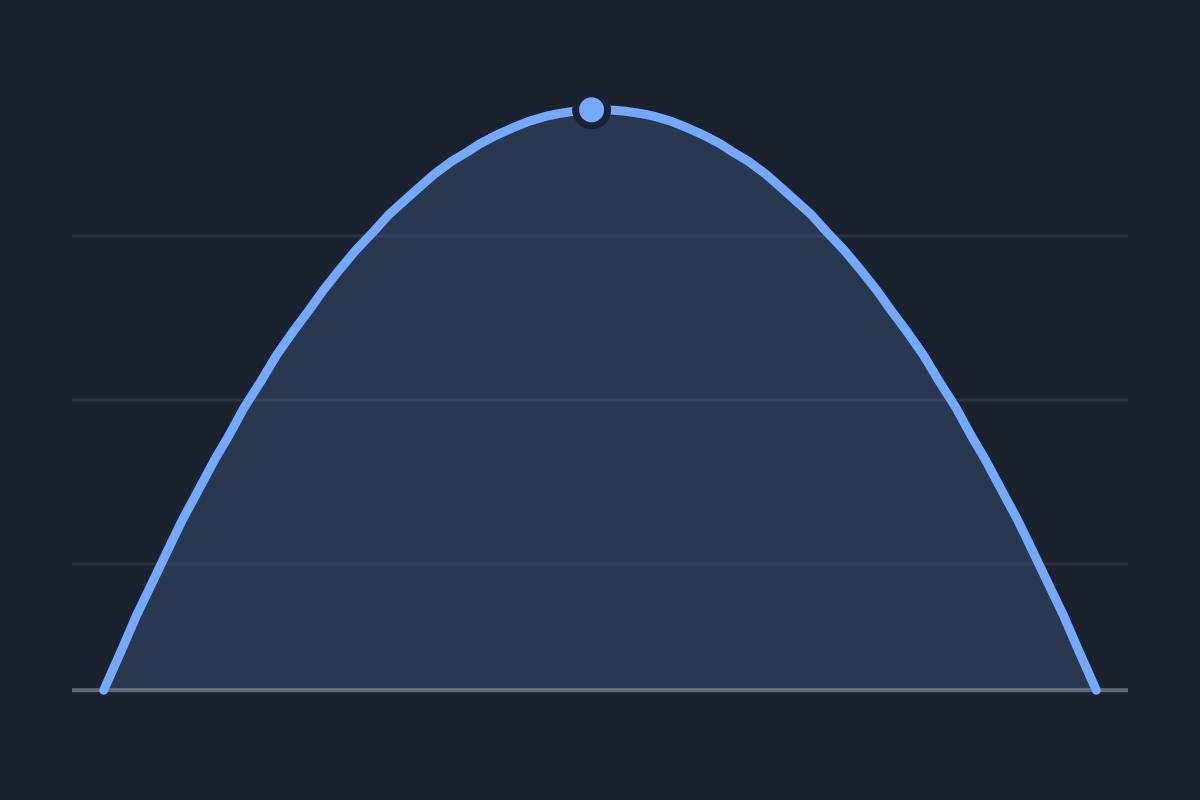
The path traced out is a parabola. That is a consequence, not an
assumption: solving the horizontal equation for time and substituting it
into the vertical one gives a quadratic in x.
Worked example
Launch at 20 m/s at 45° from ground level, with no air resistance.
- Components:
v₀cos 45° = 14.14 m/sandv₀sin 45° = 14.14 m/s. -
Time to apex: the vertical velocity reaches zero at
t = 14.14 / 9.81 = 1.44 s. - Total flight time is double that by symmetry,
2.88 s. - Range:
14.14 × 2.883 = 40.8 m, using the flight time to one more figure (2.88 s would give 40.7 m). - Apex:
14.14² / (2 × 9.81) = 10.2 m.
The simulator reports 40.77 m and 10.19 m for these inputs, because with air resistance switched off it evaluates the closed-form solution rather than integrating numerically. Those figures should match a hand calculation to every digit shown.
What changes with air resistance
Switch on air resistance and the neat symmetry disappears. Drag grows with the square of speed, so it bites hardest early in the flight when the projectile is moving fastest. The descent becomes steeper than the ascent, the projectile lands at a sharper angle than it launched, and the range falls well short of the vacuum prediction. The optimal launch angle drops too, typically into the 35 to 42° range for a dense sphere rather than 45°.
Mass suddenly matters. Drag force does not depend on mass, but the resulting deceleration does, so a heavier object of the same size is slowed less. This is why a baseball and a beach ball of similar diameter behave completely differently, and it is also why mass is irrelevant the moment you turn drag off.
Common mistakes
- Using the range formula when the launch and landing heights
differ.
R = v₀²sin 2θ / gassumes the projectile returns to its launch height. Launch from a cliff and it will be wrong. - Forgetting that vertical velocity is zero at the apex, not the total velocity. The horizontal component keeps going unchanged.
- Mixing up the sign of gravity. Pick upward as positive and stay consistent for the whole problem.
- Assuming 45° is always optimal. True only for equal launch and landing heights with no drag.
Model and assumptions
- Method
- Exact where a closed form exists, Runge-Kutta 4th order otherwise
- Largest step
- 0.001 s
- Repeatability
- Deterministic. The same link gives the same numbers on any machine.
What it assumes
- With drag switched off the trajectory is the exact parabola, solved in closed form rather than stepped.
- With drag switched on the force is quadratic in speed, using sea-level air density of 1.225 kg/m^3 and a sphere drag coefficient of 0.47.
- With drag on, the step is 1 ms at most and shortens to a twentieth of the drag timescale while drag is strong, so a light sphere thrown hard is still stepped finely.
- Gravity is uniform, the ground is flat, and the projectile is a point with no spin, so there is no Magnus force.
Where it stops holding. A spinning or non-spherical body, or speeds where the drag coefficient stops being roughly constant.
Numerical accuracy
- Measured error bound
- 2.7e-7 m in the range, about 8.3e-9 of the largest value reached
- How that was obtained
- Recomputed at five steps between 3.0e-4 s and 1.0e-3 s. The reported range moved across a window of 2.7e-7 m, which bounds the error without assuming a convergence order.
- Conditions
- 20 m/s at 45 degrees, 145 g, 74 mm sphere, DRAG ON. Drag is off by default, and without it the trajectory is solved in closed form with no integration error at all
The trajectory is fourth-order accurate, but the range is read where the flight crosses the ground, which lies between two samples. That crossing is interpolated, so the residual depends on where the sample grid happens to fall rather than shrinking smoothly as the step shrinks, and no single convergence order describes it.
Common questions
What launch angle gives the maximum range?
With no air resistance and equal launch and landing heights, 45 degrees gives the maximum range. Launching from above the landing height lowers the optimum below 45 degrees, and adding air drag lowers it further, typically to somewhere between 35 and 42 degrees for a dense sphere.
Why do two different angles give the same range?
Range depends on sin(2θ), and sin(2θ) is symmetric about 45 degrees. So 30 and 60 degrees produce the same range, as do 20 and 70. The steeper angle always takes longer and reaches a higher apex.
Does mass affect the trajectory?
Not in a vacuum. Removing drag leaves acceleration equal to g for every object, so mass cancels out. Once air resistance is enabled, mass matters, because drag force is independent of mass while the resulting deceleration is not.