Kinematics Calculator
Solve SUVAT kinematics problems: enter any three of u, v, a, s and t for the other two, with the equation used named and both roots shown when needed.
Calculator
Three given, so time (t) and final velocity (v) follow.
Time, t s
Final velocity, v m/s
Working, one equation at a time
- Using s = u t + a t^2 / 2, which has only one unknown left.
- t = (0 +/- sqrt(0^2 + 2 x 9.81 x 45)) / 9.81 = 3.0289 s
- Using v = u + a t, which has only one unknown left.
- v = 0 + 9.81 x 3.0289 = 29.714 m/s
Each of the five equations leaves out one quantity. With three known, exactly one of them has a single unknown left, and that is the one to use. Picking it is the part worth learning.
Citing this tool
Last updated . Add the date you accessed it as well, which a citation of a page that can change asks for. If a specific result matters, cite the permalink from the tool’s share row instead of this page: it reproduces the exact parameters.
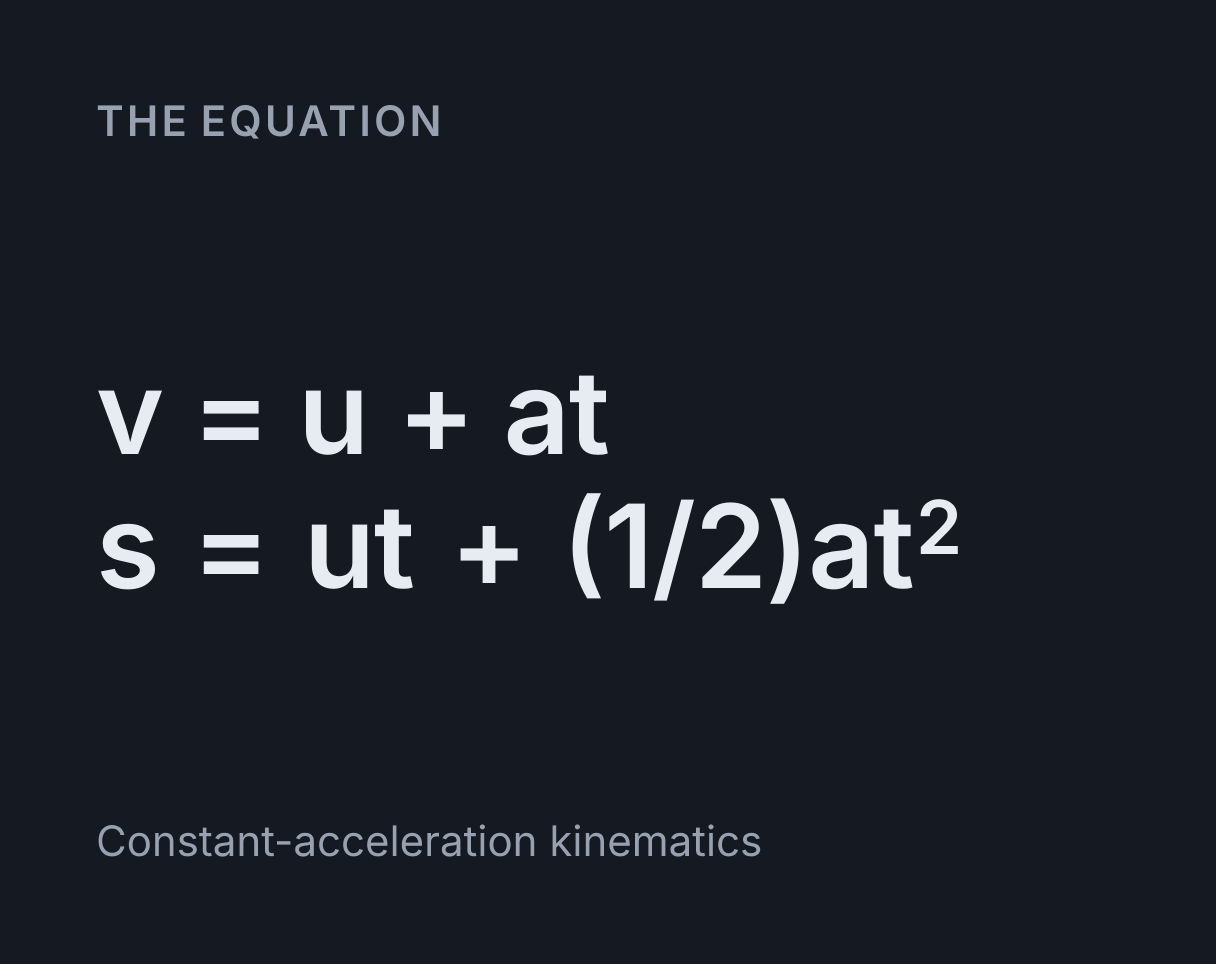
The equation
Constant-acceleration kinematics
Five equations, and the skill is picking one
Uniform acceleration links five quantities: initial velocity u, final
velocity v, acceleration a, displacement s
and time t. Any three of them fix the motion, so the other two are
forced. There are five standard equations, and each one leaves out exactly one
quantity.
v = u + athas no ss = ut + at²/2has no vv² = u² + 2ashas no ts = (u + v)t/2has no as = vt − at²/2has no u
That pattern is the whole method. Look at what you know and what you want, find the quantity that appears in neither list, and use the equation that omits it. It will have one unknown, which means no simultaneous equations and no rearranging two formulas into each other. The working above names the equation it chose each time, because that choice is where marks are actually lost.
Worked example: dropped from 45 m
Take u = 0, a = 9.81 m/s² and s = 45 m, with
downwards positive. Time is wanted and final velocity is not known, so the equation
without v applies: 45 = 0 × t + 4.905t², giving
t = √(45 / 4.905) = 3.0289 s. Now four quantities are known, so v comes
from the simplest equation left: v = 0 + 9.81 × 3.0289 = 29.714 m/s.
Note what did not happen. Nobody had to guess an intermediate value or work in two stages with a rounded number carried between them. Solving for the quantity the question omits first, then finishing with any equation that fits, keeps the full precision through to both answers.
Signs are a choice, and then they are not
Displacement, velocity and acceleration are vectors, so in one dimension each one carries a sign. Which direction is positive is entirely yours to pick, but once picked it applies to all five quantities. Mixing frames halfway through is the most common way a SUVAT answer comes out with the wrong sign or an impossible negative time.
For a dropped object, calling downwards positive keeps everything positive and is
the easier arithmetic. For anything thrown upwards, calling upwards positive is more
natural, which makes a = −9.81 m/s² throughout, including while the
object is still rising. Gravity does not change direction at the top of the flight;
only the velocity does.
When there really are two answers
Two of the five equations can produce genuine ambiguity, and this calculator reports both answers when both are possible rather than choosing quietly.
Solving s = ut + at²/2 for time is a quadratic. Throw a ball up at
20 m/s and ask when it is 15 m high: it is there at 0.9907 s on the way up and again
at 3.0868 s on the way down. Both are real. Which one the question wants depends on
whether it asked for the first time or the last, and that is information the algebra
does not contain.
Solving v² = u² + 2as for a velocity takes a square root, so the equation
alone leaves the sign open, and the time each root implies settles it. A car that
comes to rest in 25 m while decelerating at 2 m/s² gives u² = 100, but
only 10 m/s is possible: −10 m/s would need the motion to last −5 s. A ball that
lands 5 m below the hand at 10 m/s is different. Taking upwards as positive, it was
thrown up at 1.3784 m/s or down at 1.3784 m/s, landing 1.1599 s or 0.87886 s later,
and only the question can say which.
What uniform acceleration excludes
Every equation here assumes acceleration is constant over the whole interval. That is a good description of free fall over short distances, of a trolley on a ramp and of steady braking. It is not a description of a car pulling away in traffic, of a falling body that has reached terminal velocity, or of a spring, where the acceleration changes continuously with position.
Air resistance is the usual reason a real measurement disagrees with these numbers. It grows with speed, so the error is small for a dense object over a short drop and large for anything light or any fall over a few seconds. If the numbers matter, the projectile simulator lets you switch drag on and watch how far the ideal answer drifts from the realistic one.
Common mistakes
- Using distance where the equations mean displacement. A ball thrown up 20 m and caught again has travelled 40 m but has a displacement of zero. Every s in these equations is the displacement.
- Making
apositive on the way up and negative on the way down. Acceleration due to gravity has one value for the whole flight. Splitting the motion into two halves with different signs double-counts the turn. - Taking
t = 0as the answer to a quadratic. It is a true root, and it describes the instant before anything happened. For a ball back at its starting height the useful root is the later one. - Assuming the positive square root. An object moving in the
negative direction has a negative velocity even though
v²is positive, which is why both roots are checked, and both are shown when both are possible. - Mixing units. A speed in km/h with a time in seconds is out by a factor of 3.6. Convert everything to metres and seconds before substituting, or use the unit converter first.
- Using g = 10 without saying so. It is a reasonable approximation that shifts answers by about two percent, which is enough to lose a mark when the expected answer used 9.81. The acceleration field is editable for exactly this reason.
Common questions
Which SUVAT equation should I use?
The one that leaves out the quantity you neither know nor want. Each of the five omits exactly one of u, v, a, s and t, so with three values known there is always one equation containing a single unknown. Knowing u, a and t and wanting s, the equation without v is s = ut + at²/2. This calculator picks on that rule and names its choice in the working, because choosing the equation is the step people get wrong rather than the algebra.
Why does it give two answers for the time sometimes?
Because s = ut + at²/2 is a quadratic in t, and when both roots are positive both are real moments at which the object is at that displacement. A ball thrown up at 20 m/s passes 15 m at 0.99 s on the way up and again at 3.09 s coming down. Both are printed, since a calculator that silently returns one of them teaches that the other does not exist.
Why do I only need three values, and what if I have four?
Three fix the motion completely, so the remaining two are forced. A fourth is either consistent, in which case it adds nothing, or inconsistent, in which case one of your four numbers is wrong. This tool asks you to clear one rather than quietly ignoring it, because ignoring the extra value would hide that contradiction instead of showing it.
Do I have to make downwards negative?
You have to be consistent, and nothing else. Pick a positive direction and give every quantity its sign in that frame. For a dropped object it is simplest to call downwards positive, so a is +9.81 and s is positive. For something thrown upwards, call upwards positive, so a is −9.81 and a displacement below the launch point is negative.