Unit Converter
Convert between 27 quantities including length, mass, pressure, energy and temperature, with every unit in the group shown side by side.
Calculator
1 m = 100 cm
| Unit | Value |
|---|---|
| nm | 1 × 10⁹ |
| µm | 1 × 10⁶ |
| mm | 1000 |
| cm | 100 |
| m | 1 |
Citing this tool
Last updated . Add the date you accessed it as well, which a citation of a page that can change asks for. If a specific result matters, cite the permalink from the tool’s share row instead of this page: it reproduces the exact parameters.
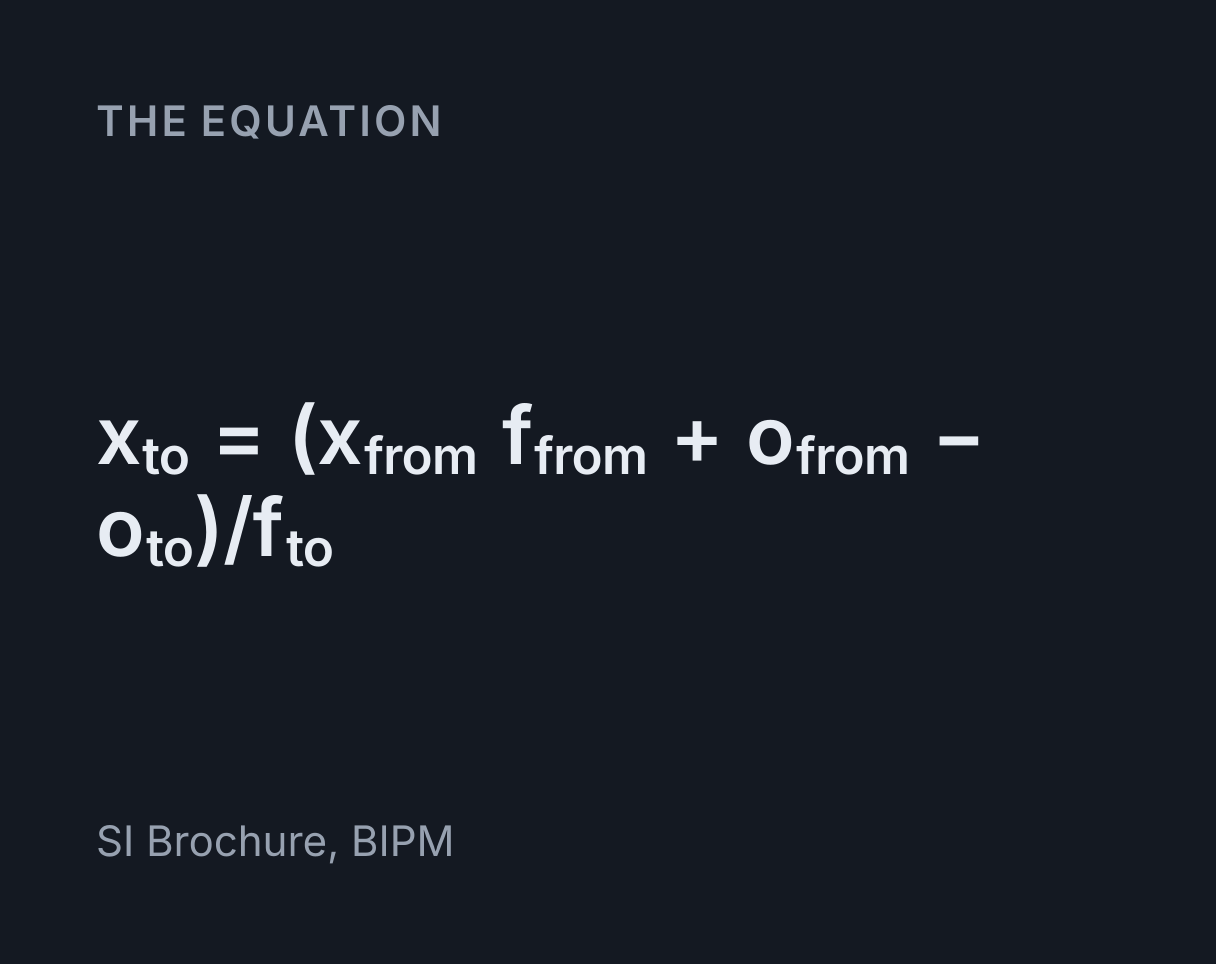
The equation
SI Brochure, BIPM
What a conversion factor actually is
To convert a value between two units of one quantity, go through the base unit: multiply by the source unit’s factor to reach it, then divide by the target unit’s factor; temperature scales need an offset too. Every unit in a group is defined as some multiple of one base unit. Length is based on the metre, so a centimetre is 0.01 of it and a nanometre is 0.000000001 of it. That is why this tool never divides one unit directly by another, and why adding a new unit to a group requires exactly one number.
Some factors are exact by definition and some are conventional. One inch is exactly 25.4 mm, fixed by international agreement in 1959. One standard atmosphere is exactly 101,325 Pa. One thermochemical calorie is exactly 4.184 J. A millimetre of mercury, by contrast, has no exact definition, because it depends on the density of mercury and the local gravity, so the conventional value of 133.322387415 Pa is used instead.
Worked example
A datasheet gives a burst pressure of 2500 psi and you need it in bar.
- To the base:
2500 × 6894.757 = 17,236,893 Pa - Out of the base:
17,236,893 ÷ 100,000 = 172.4 bar
The table beneath the fields shows the same quantity in pascals, kilopascals, bar, atmospheres, millimetres of mercury and torr at the same time. That is usually the faster answer, because the number you want next is often not the one you asked for.
Temperature is the exception
Every other quantity here scales through the origin: zero of one unit is
zero of all of them. Temperature does not. Its scales have an offset as
well as a factor, so a conversion is
base = value × factor + offset rather than a plain multiply.
Zero degrees Celsius is 273.15 K, and zero degrees Fahrenheit is 255.372 K.
This is why the quantity list carries temperature twice. A thermometer reading needs the offset. A rise, a fall or a ΔT does not, because the offsets cancel when you subtract two readings: a rise of 10 °C is a rise of exactly 10 K. Using the absolute scale for a difference is a standing error in calorimetry work, and it is out by 273.15 every time.
Common mistakes
- Forgetting that area and volume scale as powers. There are 100 centimetres in a metre but 10,000 square centimetres in a square metre and a million cubic centimetres in a cubic metre. Converting a length factor and using it on an area is out by a factor of 100.
- Treating a gauge reading as absolute. Converting 32 psi to kilopascals gives 220.6 kPa, but a tyre gauge reads the excess over atmospheric, so the absolute pressure is nearer 322 kPa. The conversion is right and the interpretation is wrong.
- Mixing mass and weight. Kilograms are mass and newtons are force. They appear in different groups here for that reason, and no conversion between them exists without a value for gravitational acceleration.
- Rounding early. Converting through a rounded intermediate value compounds the error. This tool converts in one step through the base at full double precision and rounds only for display.
Common questions
Why is temperature listed twice?
Because a reading and a change are different quantities. A temperature of 10 °C is 283.15 K, while a rise of 10 °C is a rise of 10 K. Temperature carries the 273.15 offset and Temperature difference does not, so picking the wrong one is out by 273.15. Use the first for a thermometer reading and the second for anything described as a rise, a fall or a ΔT.
Are the conversion factors exact?
Where the definition is exact, yes. One inch is exactly 25.4 mm, one standard atmosphere is exactly 101,325 Pa, one thermochemical calorie is exactly 4.184 J, and the electronvolt is exact under the 2019 SI. Conventional values are used where no exact definition exists, such as 133.322387415 Pa for a millimetre of mercury.
Why does the table show so many decimal places?
It shows seven significant figures in fixed notation and switches to scientific notation outside the range where fixed digits stay readable. A conversion table spans many orders of magnitude by design: one metre is a billion nanometres. Showing the whole group at once also makes an error of a thousand obvious at a glance.