Density Calculator
Calculate density, mass or volume with automatic unit conversion, and see the result in g/cm³ and kg/m³ plus whether the material floats in water.
Calculator
Water 1.00, aluminium 2.70, iron 7.87, lead 11.34, gold 19.32.
Working, with your numbers
- rho = m / V
- = 270 g / 100 cm3
- = 2.7 g/cm3 = 2700 kg/m3
Values are converted into the units the equation is worked in before the arithmetic.
- In kg/m³ 1 g/cm³ = 1000 kg/m³ = 1 kg/L exactly.
- 2700 kg/m³
- Relative to water Specific gravity. Above 1 sinks in water, below 1 floats.
- 2.7
- Floats in water
- No
Citing this tool
Last updated . Add the date you accessed it as well, which a citation of a page that can change asks for. If a specific result matters, cite the permalink from the tool’s share row instead of this page: it reproduces the exact parameters.
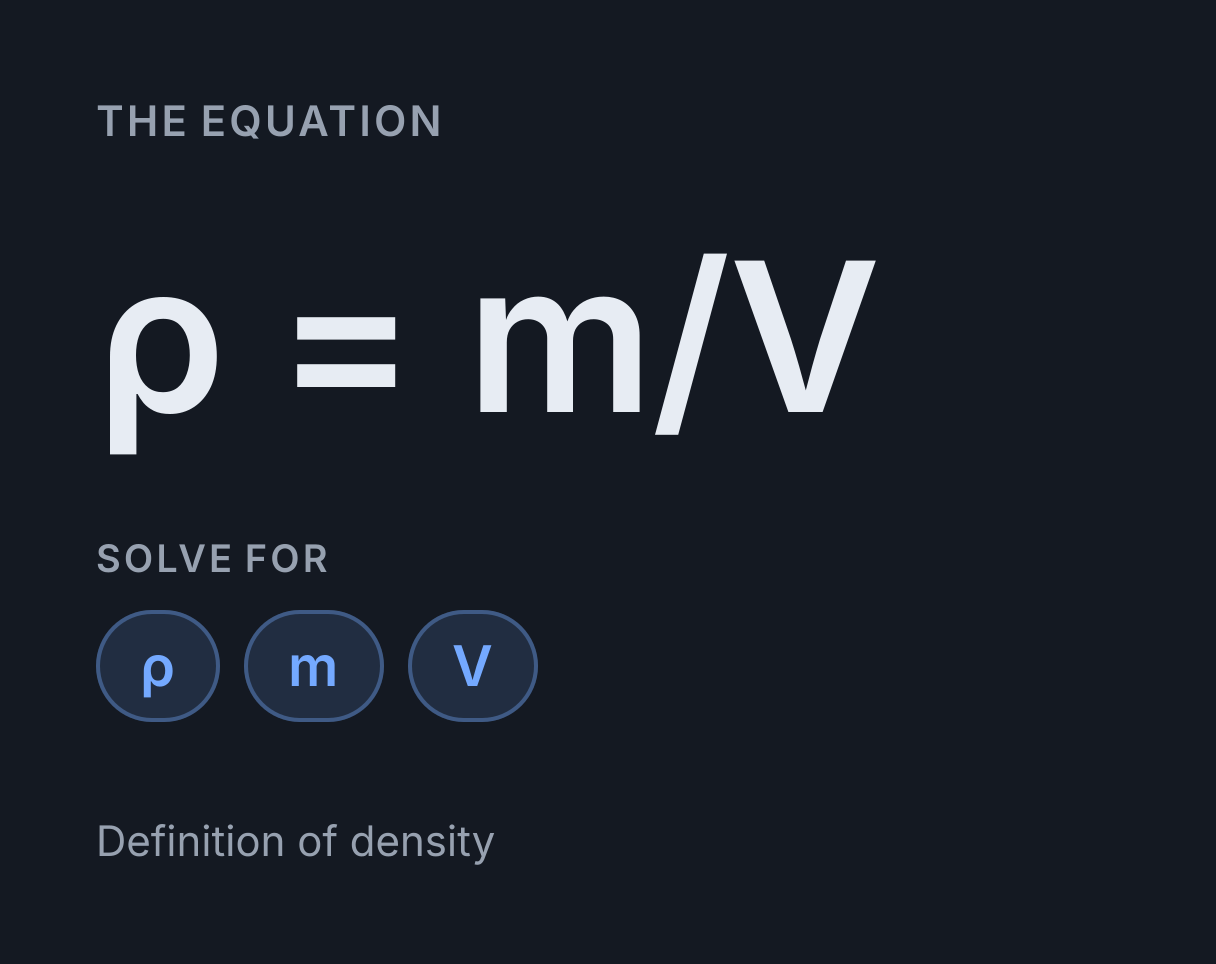
The equation
Definition of density
What density measures
Density is mass per unit volume, written ρ = m / V. It answers
how much matter is packed into a given space, which is why it separates
materials that look similar but behave differently. The relation rearranges
into m = ρV to find the mass of a known volume and
V = m / ρ to find the volume a known mass occupies.
Two unit facts remove most of the arithmetic difficulty. One cubic centimetre is one millilitre exactly, by definition of the litre, so a volume read off a measuring cylinder in millilitres is already in cubic centimetres. And 1 g/cm³ = 1000 kg/m³ = 1 kg/L, so converting between the laboratory unit and the SI unit is a factor of a thousand in one direction only.
Common reference densities in g/cm³ are water 1.00, ice 0.92, aluminium 2.70, iron 7.87, lead 11.34, gold 19.32 and air 0.0012. Ice sitting below water is the reason ice floats, and the gap between lead and gold is large enough that weighing a known volume distinguishes them.
Worked example
A block of aluminium has a mass of 270 g and displaces 100 mL of water. Find its density.
- 100 mL of volume is 100 cm³, since the two units are identical.
ρ = m / V = 270 / 100 = 2.70 g/cm³-
Convert to SI:
2.70 × 1000 = 2700 kg/m³. - The figure matches the reference value for aluminium, so the sample is consistent with solid aluminium rather than an alloy of very different composition.
Specific gravity and measuring awkward volumes
Specific gravity is density expressed relative to water, so it is numerically the same as the density in g/cm³ but carries no units. Aluminium has a density of 2.70 g/cm³ and a specific gravity of 2.70. The useful consequence is a floating rule: a value below 1 means the material floats in water, and a value above 1 means it sinks. Hydrometers used for brewing and battery testing read this quantity directly.
Measuring the volume of a regular shape is a matter of geometry, but an irregular solid needs displacement. Lowering the object into a partly filled cylinder and recording the rise in level gives the volume directly, which is the practical form of the Archimedes principle. For an object denser than water this is accurate and quick; for one that floats it has to be held under with a thin rod or weighted, and the weight’s own volume subtracted.
Common mistakes
- Confusing mass with weight. Density uses mass in grams or kilograms. A weight in newtons has to be divided by the local gravitational acceleration before it can be used here.
- Using the outer dimensions of a hollow or porous object. Measuring a foam block or a pipe by its overall size gives bulk density, not the density of the material itself. The two differ by whatever fraction of the volume is air.
- Forgetting the temperature dependence. Most substances expand when heated and so become less dense. Water is unusual in being densest near 4 °C, which is why quoted water densities specify a temperature.
- Mixing g/cm³ with kg/m³. The two differ by a factor of a thousand, so a density reported as 2.70 kg/m³ instead of 2700 kg/m³ describes something only about twice as dense as air, not a block of aluminium.
Converting units first? Use the volume and mass conversion tables.
Worked examples
Each one runs through the calculator above, so the arithmetic here is the arithmetic it does.
What is the density of a block with a mass of 270 g and a volume of 100 cm3?
- rho = m / V
- = 270 g / 100 cm3
- = 2.7 g/cm3 = 2700 kg/m3
2.7 g/cm³ identifies the block as aluminium. Density is the standard way to identify an unknown solid, because it depends on what the material is and not on how much of it you have.
What volume does 1 kg of mercury occupy?
- V = m / rho
- = 1000 / 13.534
- = 73.888 cm3 = 73.888 mL
About 74 cm³, which is under a third of a mug. Mercury’s density is why a barometer only needs a tube 760 mm tall where a water barometer would need over ten metres.
Will a 5 kg object with a volume of 6 litres float in water?
- rho = m / V
- = 5000 g / 6000 cm3
- = 0.83333 g/cm3 = 833.33 kg/m3
833 kg/m³, which is below water’s 1000, so it floats with about a sixth of its volume above the surface. Floating is decided by density rather than by weight, which is why a steel ship floats and a steel bolt does not.
Practise this with Mechanics Practice Problems, questions generated from this calculator and 10 other calculators in Mechanics.
Common questions
Why is 1 g/cm³ the same as 1000 kg/m³?
A cubic metre contains a million cubic centimetres, and a kilogram is a thousand grams, so the conversion factor is a million divided by a thousand, which is a thousand. Water is 1 g/cm³ and therefore 1000 kg/m³.
What is specific gravity?
Density relative to water, so it is the same number as density in g/cm³ but dimensionless. Anything below 1 floats in water and anything above sinks, which is why the figure is quoted so often for minerals and liquids.