Crystal Lattice Explorer
Turn a cubic unit cell in three dimensions and see which line the atoms touch along, which is what fixes packing efficiency and the cell edge.
Visualiser
Drag the cell to turn it, or use the arrow keys. Space plays and pauses.
- Packing efficiency A property of the arrangement alone. The cell edge cancels out, so the element does not matter.
- 74.05 %
- Atoms per cell 8 x 1/8 + 6 x 1/2 = 4
- 4
- Coordination number Touching along a face diagonal.
- 12
- Cell edge Derived from the radius through the contact line, not from twice the radius.
- 362 pm
- Nearest neighbour Always exactly two radii, whichever lattice this is.
- 256 pm
- Density Atoms per cell times molar mass, over Avogadro times the cell volume.
- 8.9 g/cm3
Atoms per cell 8 x 1/8 + 6 x 1/2 = 4
- Simple cubic touches along a cube edge. Found in polonium, and almost nothing else.
- Body centred touches along the body diagonal. Found in iron at room temperature, chromium, tungsten, the alkali metals.
- Face centred touches along a face diagonal. Found in copper, aluminium, silver, gold, nickel, lead.
- Diamond touches along a quarter of the body diagonal. Found in diamond, silicon, germanium, grey tin.
Citing this tool
Last updated . Add the date you accessed it as well, which a citation of a page that can change asks for. If a specific result matters, cite the permalink from the tool’s share row instead of this page: it reproduces the exact parameters.
The equation
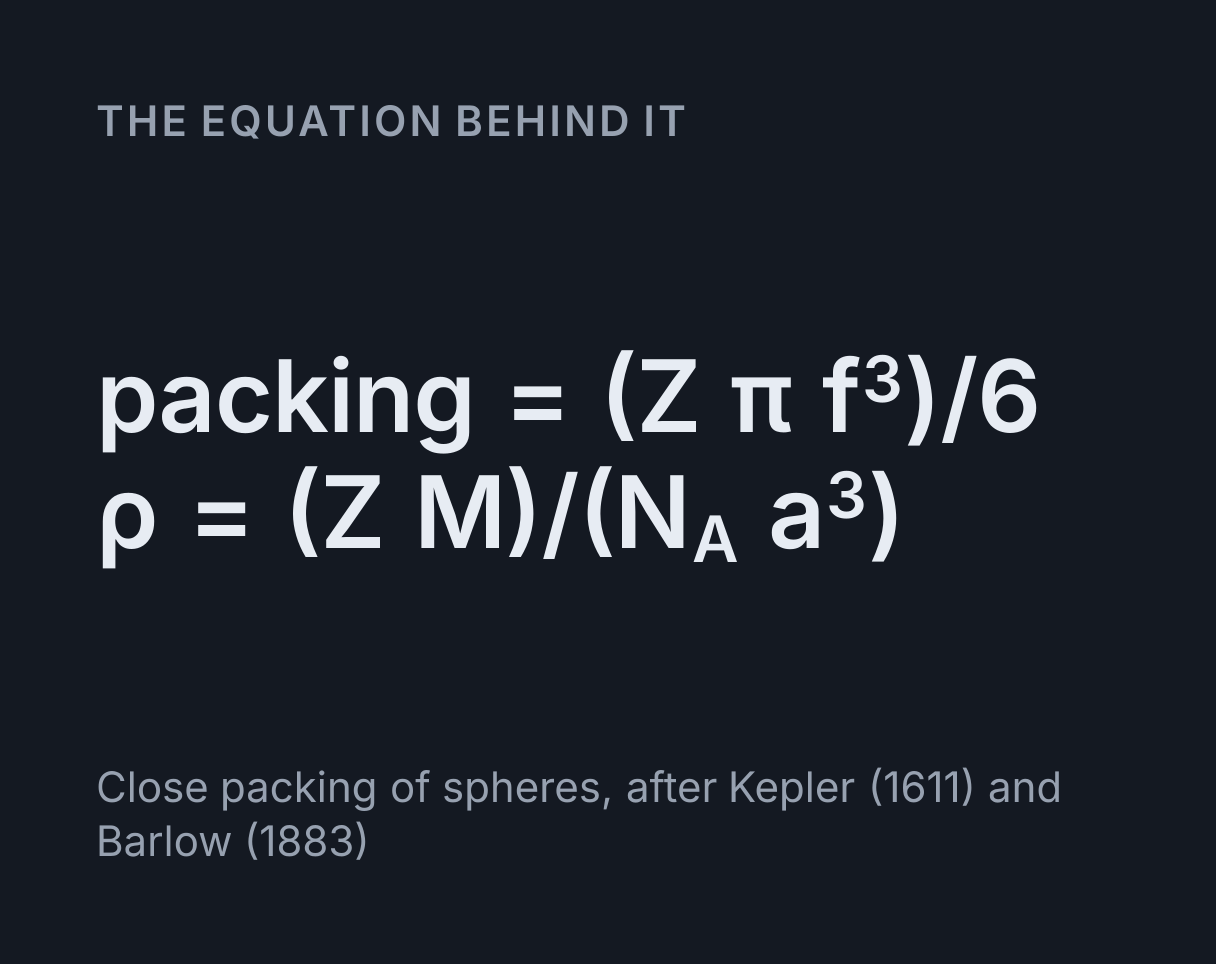
Close packing of spheres, after Kepler (1611) and Barlow (1883)
One fact decides everything else
Which line the atoms touch along. That is the whole topic, and it is the one thing a flat diagram cannot show you.
In a simple cubic cell the atoms sitting along a cube edge are in contact,
so the edge is two radii and a = 2r. In a body-centred cell
the corner atoms do not touch each other at all. Each one touches the atom
at the centre of the cube, and that line of contact runs along the body
diagonal. In a face-centred cell the contact runs across a face diagonal.
Turn the cell until each of those lines points towards you and the
difference stops being something to memorise.
| Lattice | Touches along | Relation |
|---|---|---|
| Simple cubic | Cube edge | a = 2r |
| Body centred | Body diagonal | √3 a = 4r |
| Face centred | Face diagonal | √2 a = 4r |
| Diamond | Quarter of the body diagonal | √3 a = 8r |
Writing a = 2r for every lattice is the most common error in
this topic, and it is only right for simple cubic. Every wrong packing
efficiency and every wrong density traces back to it.
Why packing efficiency has no units and no element
Packing efficiency is the volume the atoms occupy divided by the volume of the cell. Substitute the radius in terms of the edge length, and every factor of the edge cancels. What survives depends only on how many atoms are in the cell and which line they touch along.
So all four numbers come from one expression. With Z atoms per
cell and f the nearest-neighbour distance as a fraction of the
edge, the efficiency is Z π f³ / 6. Textbooks usually derive
52.4, 68.0 and 74.0 percent as three separate results with three separate
diagrams. They are one result evaluated three times.
This is why 74.05 percent gets quoted for face-centred cubic without naming a metal. Copper, aluminium, silver and gold have quite different cell sizes and pack to exactly the same fraction.
Counting atoms by how they are shared
An atom drawn at a corner is not one atom belonging to this cell. Eight cells meet at that corner, so it contributes an eighth. A face is shared by two cells, so half. An edge by four. An atom wholly inside belongs to its cell alone.
Face-centred cubic is then eight corners at an eighth, which is one, plus six faces at a half, which is three. Four atoms per cell. The readout shows that sum rather than just the four, because reproducing the sum is what an examination question is asking for.
The colours follow the same idea. Atoms shared with neighbouring cells are drawn in one colour and atoms belonging entirely to this cell in another, so a body centre or the inner four of a diamond cell are visibly different from the corners.
Why the spheres shrink
At true touching size a face-centred cell is a solid mass with nothing visible inside it. That is an honest picture of how full it is and a useless picture of how it is arranged, which is why textbooks print reduced-sphere and space-filling models side by side.
The sphere size control moves continuously between those two figures. Slide it down to see where the atoms sit, slide it up to see how little room is left. Watching one become the other is what connects the arrangement to the 74 percent.
Density is the check that the rest is right
Everything above could be internally consistent and still wrong. Density
is where the model meets a number you can look up:
ρ = ZM / (N_A a³).
Copper as face-centred with a 128 pm radius gives a cell edge of 362 pm against a measured 361.5, and a density of 8.90 against 8.96. Silicon as diamond cubic lands within about one percent.
Iron and tungsten come out about four percent low, and the reason is worth knowing rather than ignoring. Tabulated metallic radii are conventionally quoted for twelve-coordinate packing. Using one for a body-centred metal, where each atom has eight neighbours, overestimates the cell slightly and so underestimates the density. The model is not wrong; the radius is being used outside the convention it was measured under.
Common mistakes
- Using
a = 2reverywhere. True only for simple cubic. In the other lattices the atoms touch along a diagonal, not along the edge. - Counting eight atoms in a simple cubic cell. There are eight drawn, and each is shared by eight cells, so the cell contains one.
- Thinking the corner atoms touch each other in body-centred cubic. They do not. Each corner atom touches only the atom at the centre, which is why the coordination number is eight and not six.
- Assuming more atoms per cell means denser packing. Diamond has eight atoms per cell, twice face-centred cubic, and fills only 34 percent of the space. The count and the efficiency are different questions.
- Expecting hexagonal close packing to beat face-centred cubic. They tie exactly, both at 74.05 percent with twelve neighbours. Different structures, identical efficiency.
- Mixing up the radius conventions. Covalent, metallic, ionic and van der Waals radii for the same element differ substantially. A lattice calculation wants the one measured for that kind of bonding.
Common questions
Why is the relation between radius and edge length different for each lattice?
Because the atoms touch along a different line in each one, and touching is what sets the distance. In simple cubic the atoms along a cube edge are in contact, so the edge is two radii and a equals 2r. In body-centred cubic the corner atoms do not touch each other at all; each one touches the atom at the centre of the cell, and that contact runs along the body diagonal, which is the square root of three times the edge and carries four radii. In face-centred cubic the contact is along a face diagonal, which is the square root of two times the edge and also carries four radii. Writing a equals 2r for all three is the single most common mistake in this topic, and it is only correct for simple cubic.
Why does packing efficiency not depend on which element it is?
Because the cell edge cancels out of the calculation. Packing efficiency is the volume of the atoms in the cell divided by the volume of the cell, and once you substitute the radius in terms of the edge length, every factor of the edge disappears. What is left depends only on how many atoms are in the cell and which line they touch along, both of which are properties of the arrangement. That is why 74.05 percent is quoted for face-centred cubic without ever naming a metal: copper, aluminium, silver and gold all pack to exactly the same fraction while having quite different cell sizes.
How do I count atoms per unit cell?
Count how many cells share each atom and add the fractions. An atom at a corner is shared by the eight cells meeting there, so it contributes an eighth. One on a face is shared by two cells and contributes a half. One on an edge is shared by four. One wholly inside belongs to that cell alone and contributes one. Face-centred cubic then reads as eight corners at an eighth each, giving one, plus six faces at a half each, giving three, so four atoms per cell. The readout on this page shows that sum rather than just the answer, because the sum is what the question is actually testing.
Why does diamond pack so much worse than the metals?
Because its bonds have directions and metallic bonding does not. A metal atom is held by electrons shared in all directions, so the atoms simply arrange themselves as densely as spheres can, which is 74 percent. Each atom in diamond forms four covalent bonds pointing at the corners of a tetrahedron, and those angles are fixed by the bonding rather than chosen for efficiency, so each atom has only four neighbours and the structure is left about 66 percent empty. This is not a curiosity: the open framework is why silicon and germanium are semiconductors rather than metals, and the same rigid, directional bonding is why diamond is so hard. Open does not mean light, though: carbon atoms are so small that diamond holds about twice as many atoms per cubic centimetre as iron, and it is denser than graphite.
Why does the density here differ slightly from the published value?
Two reasons, and both are worth knowing. The model treats atoms as hard spheres in a perfect, defect-free cell, while a real crystal has vacancies and thermal expansion. More importantly, published atomic radii are themselves derived from measured spacings by a convention, and the usual tabulated metallic radius is quoted for twelve-coordinate packing. Using it for a body-centred metal, where the coordination number is eight, overestimates the cell slightly and so underestimates the density by a few percent. Copper and aluminium come out within one percent here; iron and tungsten sit about four percent low for exactly that reason.
Does hexagonal close packing pack better than face-centred cubic?
No, they are exactly equal, both at 74.05 percent, and that is a more interesting answer than it looks. Hexagonal close packing and face-centred cubic are genuinely different structures, with different unit cells and different stacking sequences, ABAB against ABCABC, and yet they fill space to precisely the same fraction and give every atom twelve neighbours. Close packing of identical spheres cannot be beaten, which Kepler conjectured in 1611 and which was only proved in the late twentieth century, and there are infinitely many stacking sequences that achieve it. Only the cubic lattices are shown here, because a hexagonal cell needs a different outline.