Ohm’s Law Calculator
Solve Ohm’s law, V = IR, for voltage, current or resistance from microamps to megohms, with the power dissipated and the working shown.
Calculator
Working, with your numbers
- R = V / I
- = 12 / 0.05
- = 240 ohm
Values are converted into the units the equation is worked in before the arithmetic.
- Power P = VI = I²R = V²/R. All three forms give the same number.
- 0.6 W
- In milliwatts
- 600 mW
- Conductance
- 4.167 mS
Citing this tool
Last updated . Add the date you accessed it as well, which a citation of a page that can change asks for. If a specific result matters, cite the permalink from the tool’s share row instead of this page: it reproduces the exact parameters.
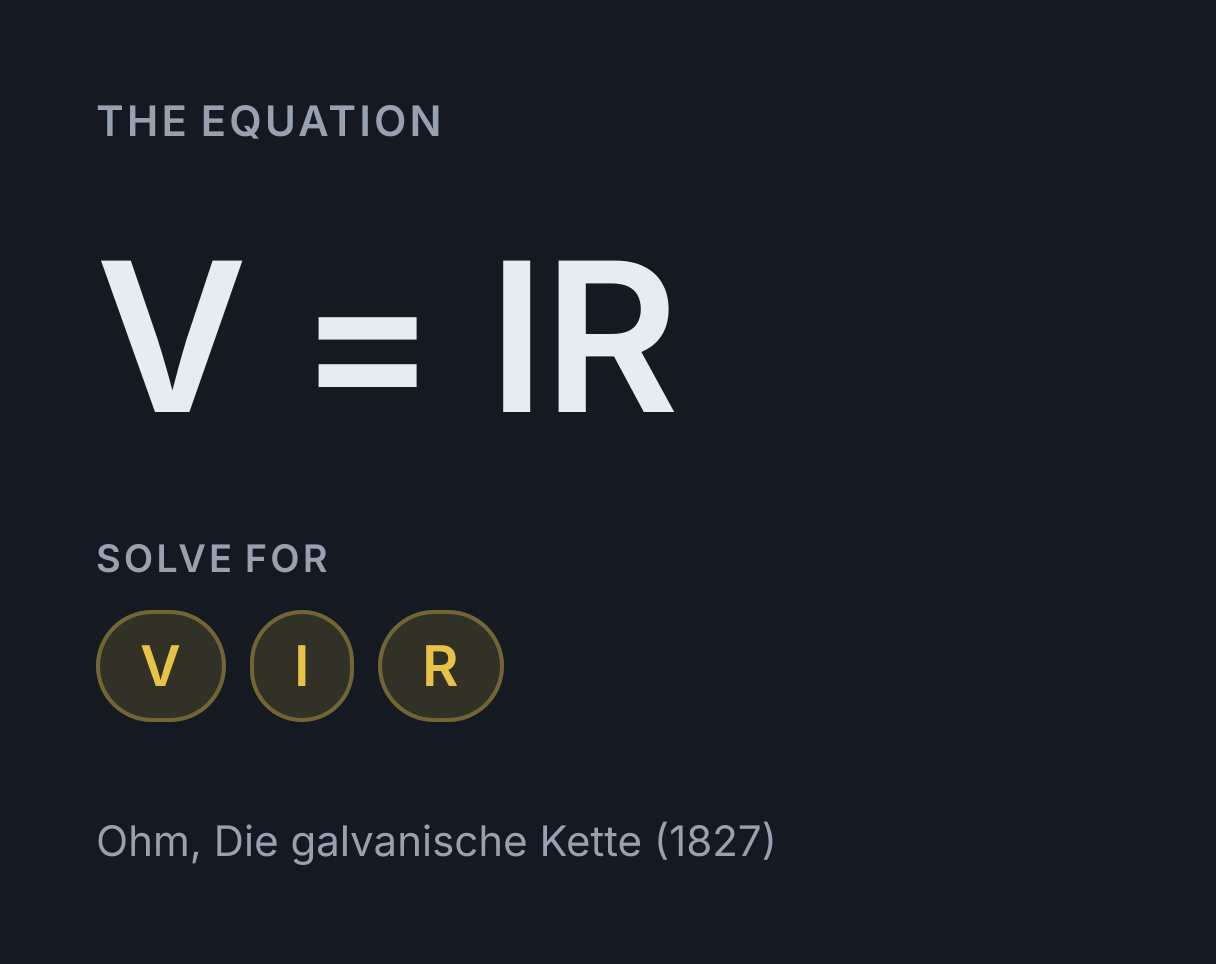
The equation
Ohm, Die galvanische Kette (1827)
What V = IR is saying
Ohm’s law, V = IR, says the voltage V across a
conductor equals the current I through it multiplied by its
resistance R, in volts, amperes and ohms. So for a fixed
resistance the current is proportional to the applied voltage. Double the
voltage and the current doubles. The same relation rearranges into
I = V / R when the current is unknown and
R = V / I when the resistance is unknown, so a single
statement covers all three cases.
The units follow directly. One ohm is the resistance that passes one ampere when one volt is applied across it, which means a volt is an ampere times an ohm. Resistance measures how strongly a component opposes the movement of charge, and in a metal it comes from collisions between conduction electrons and the vibrating lattice. Because those vibrations grow with temperature, resistance in metals rises as they heat up.
Worked example
A resistor has 12 V across it and draws 50 mA. Find its resistance and the power it dissipates.
- Convert the current to amperes first: 50 mA is 0.05 A.
R = V / I = 12 / 0.05 = 240 ΩP = VI = 12 × 0.05 = 0.6 W, which is 600 mW.-
Check against a second power form:
P = I²R = 0.05² × 240 = 0.6 W. The two agree, as they must.
Picking a power form, and where the law holds
The three expressions P = VI, P = I²R and
P = V²/R are algebraically identical. Substituting
V = IR into the first produces the second, and substituting
I = V/R produces the third. There is no reason to prefer one
on physical grounds, so the useful rule is to pick whichever form uses the
two values already in hand. Sizing a resistor is usually an
I²R job, because the current through a branch is typically
what the design fixes.
Ohm’s law applies to ohmic components only, meaning those whose resistance stays constant as voltage varies. Fixed resistors and metal wires at steady temperature qualify. Diodes, LEDs, transistors and filament lamps do not: their resistance changes with the applied voltage or with the temperature the current itself produces, so a single resistance value does not describe them. For those parts the current-voltage curve has to be used instead, and Ohm’s law is at best a local approximation at one operating point.
Common mistakes
- Mixing milliamperes with amperes. Entering 50 where 0.05 belongs shifts the answer by a factor of a thousand. Convert current, voltage and resistance to base units before substituting.
- Applying it to an LED. An LED has a roughly fixed forward voltage, not a fixed resistance. Dividing its forward voltage by the desired current gives a meaningless figure; the series resistor is sized from the supply voltage minus the forward voltage.
- Ignoring the resistor power rating. A 240 Ω resistor dissipating 0.6 W will overheat in a quarter-watt package. Compute the power as well as the resistance and choose a part rated above it.
- Using cold resistance for a hot filament. A lamp filament measures a few ohms cold and many times that at operating temperature, which is why the inrush current far exceeds the steady running current.
Converting units first? Use the resistance, electric current and voltage conversion tables.
Worked examples
Each one runs through the calculator above, so the arithmetic here is the arithmetic it does.
What resistance draws 50 mA from a 12 V supply?
- R = V / I
- = 12 / 0.05
- = 240 ohm
The milliamps must become amps first. Dividing 12 by 50 gives 0.24, and a reader who writes that down has an answer a thousand times too small with no obvious sign anything went wrong.
How much current flows through a 220 ohm resistor at 5 V?
- I = V / R
- = 5 / 220
- = 0.022727 A = 22.73 mA
About 23 mA on its own. With a red indicator LED’s roughly 2 V forward drop in series it falls to about 14 mA, comfortably inside the usual 20 mA rating, which is why 220 ohm is the common choice on a 5 V supply.
What voltage is across a 1.5 kilohm resistor carrying 8 mA?
- V = I x R
- = 0.008 x 1500
- = 12 V
Two prefixes at once, and they happen to cancel: milliamps times kilohms gives volts directly. That shortcut is worth knowing and worth being careful with, because it only works where the prefixes cancel: microamps with megohms also give volts, but milliamps with megohms give kilovolts.
Practise this with Electricity Practice Problems, questions generated from this calculator and 6 other calculators in Electricity.
Common questions
Which power formula should I use?
P = VI, P = I²R and P = V²/R all give the same answer for the same circuit, so pick whichever uses the two values you already know. P = I²R is the usual choice for sizing a resistor, because current and resistance are what you specified.
Does Ohm’s law apply to everything?
No. It describes ohmic components, where current is proportional to voltage. Resistors and metal wires qualify over normal operating ranges. Diodes, LEDs, transistors and filament lamps do not, because their resistance changes with voltage or temperature.