Wire Resistance Calculator
Calculate conductor resistance from resistivity, length and area, with ohms per kilometre, the equivalent diameter and the voltage drop at 10 A.
Calculator
Copper 1.678, aluminium 2.65, gold 2.44, iron 9.71, nichrome 110 µΩ·cm at 20 °C.
Total conductor length. For a two-core cable run, that is twice the distance.
Working, with your numbers
- R = rho x L / A
- = 1.678 uohm-cm x 30 m / 1 mm2
- = 1.678 × 10⁻⁸ x 30 / (1 × 10⁻⁶)
- = 0.5034 ohm
Values are converted into the units the equation is worked in before the arithmetic.
- Per kilometre
- 16.78 Ω/km
- Equivalent diameter For a solid round conductor of this cross-section.
- 1.128 mm
- Drop at 10 A Voltage lost along the conductor at ten amps.
- 5.034 V
Citing this tool
Last updated . Add the date you accessed it as well, which a citation of a page that can change asks for. If a specific result matters, cite the permalink from the tool’s share row instead of this page: it reproduces the exact parameters.
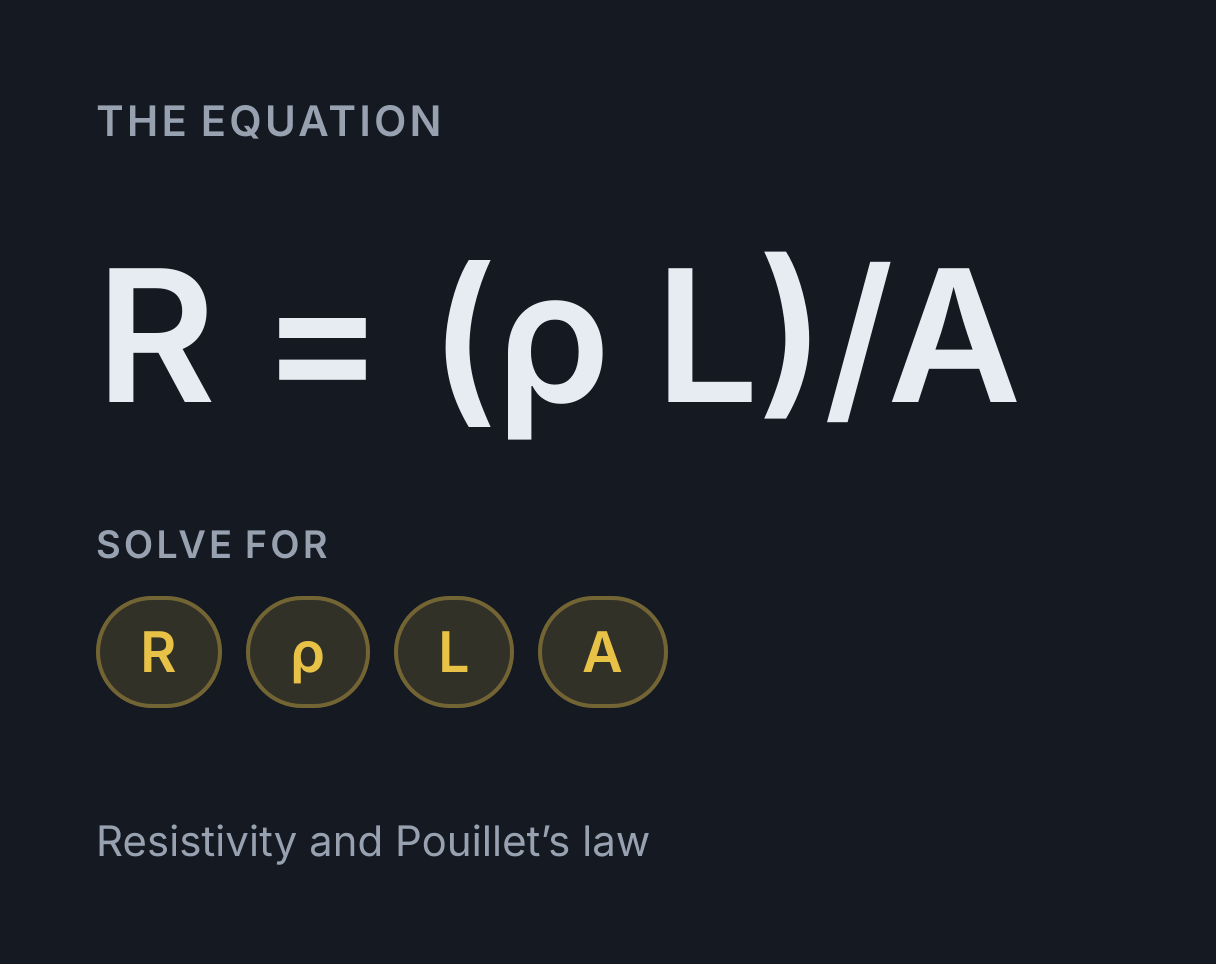
The equation
Resistivity and Pouillet’s law
Resistance separates the material from the shape
R = ρL/A splits a conductor’s resistance into two independent
parts. Resistivity ρ is a property of the material alone: it is
what copper is, whether drawn into a hair-thin strand or cast into a bar.
Length and cross-section are the geometry you choose. Resistance rises in
proportion to length because the carriers have further to travel against the
lattice, and falls in proportion to area because a wider conductor offers
more parallel paths.
That inverse relationship with area catches people out, because cable is sold by diameter while the formula wants area. Doubling the diameter quadruples the area and so quarters the resistance. Resistivity here is quoted in microohm centimetres at 20 °C, the convention used in materials tables: copper 1.678, aluminium 2.65, gold 2.44, iron 9.71 and nichrome 110. Nichrome is about 66 times as resistive as copper, which is why it makes heating elements and copper does not.
Worked example
Thirty metres of 1 mm² annealed copper, the values loaded above.
- Convert the resistivity:
1.678 µΩ·cm = 1.678 × 10⁻⁸ Ω·m - Convert the area:
1 mm² = 1 × 10⁻⁶ m² R = (1.678 × 10⁻⁸ × 30) / (1 × 10⁻⁶)R = 0.5034 Ω, which is16.78 Ω/km- Drop at 10 A:
V = IR = 10 × 0.5034 = 5.034 V
A solid round conductor of that cross-section would be
1.128 mm across, from d = 2√(A/π). The 5.034 V
figure is 2.2 percent of a 230 V supply, which is the number an installer
cares about, and it is close to the limits most wiring rules set for a final
circuit.
The two corrections real cable runs need
First, use the total conductor length, not the distance to the load. Current goes out along one core and returns along the other, so a socket 15 metres away is 30 metres of copper. Entering the one-way figure halves the calculated drop, and it is the single most common error in cable sizing.
Second, correct for temperature. Copper’s resistance rises about 0.393 percent per degree Celsius, and the tabulated resistivity is a 20 °C figure. A conductor working at 70 °C, unremarkable for insulated cable in a bunched run, sits 50 degrees above that and so carries roughly 20 percent more resistance: the example above becomes about 0.602 Ω and drops 6.02 V at 10 A. The effect is self-reinforcing, since a higher resistance dissipates more heat at the same current.
Aluminium is the standard choice for overhead transmission despite 1.6 times the resistivity of copper. Matching a copper conductor’s resistance takes about 1.6 times the cross-section, but aluminium is roughly a third of the density, so the aluminium conductor still weighs under half as much. For a span hanging between towers, mass per metre sets the cost, and conductivity per unit volume is not the figure that binds.
Common mistakes
- Using the one-way distance. Double it for any voltage-drop calculation on a two-core run. The length field wants the full path.
- Entering a diameter where the area belongs. A 2 mm wire is
not 2 mm². Its area is
π(1 mm)² = 3.14 mm², and getting this wrong scales the answer by whatever the squared factor happens to be. - Mixing centimetre and metre resistivity units. One
microohm centimetre is
10⁻⁸ Ω·m, not10⁻⁶. Check which convention a quoted figure uses before trusting it. - Ignoring operating temperature. A cable already close to its drop limit at 20 °C will exceed it when warm. Design against the hot resistance, not the table value.
- Assuming resistance sets the current limit. It sets the voltage drop. Current capacity is a thermal question about insulation and heat shedding, and a run can pass the drop check while still being too thin to carry the load safely.
Converting units first? Use the length, resistance, area and resistivity conversion tables.
Worked examples
Each one runs through the calculator above, so the arithmetic here is the arithmetic it does.
What length of 0.5 mm² nichrome wire gives a resistance of 20 ohms?
- L = R x A / rho
- = 20 ohm x 0.5 mm2 / 110 uohm-cm
- = 1 × 10⁻⁵ / (1.1 × 10⁻⁶)
- = 9.0909 m
About 9.1 m. Nichrome’s resistivity is about 66 times copper’s, which is why a heating element reaches a useful resistance in a coil that fits inside an appliance. The same 20 ohms from 0.5 mm² copper would take nearly 600 m of wire.
What cross-sectional area keeps 50 m of copper wire under 0.5 ohms?
- A = rho x L / R
- = 1.678 uohm-cm x 50 m / 0.5 ohm
- = 8.39 × 10⁻⁷ / 0.5
- = 1.678 × 10⁻⁶ m2 = 1.678 mm2
1.68 mm², which is not a standard size, so the next metric size up, 2.5 mm², is the one to use. The 50 m is conductor length, not distance: on a two-core cable it covers a run of only 25 m, because the current goes out along one core and back along the other.
Practise this with Electricity Practice Problems, questions generated from this calculator and 6 other calculators in Electricity.
Common questions
Should I use the one-way distance or double it?
Double it for a voltage-drop calculation. Current flows out along one conductor and back along the other, so a socket 15 metres away means 30 metres of copper. Using the one-way figure halves the calculated drop, which is the most common error in cable sizing.
Does resistance change with temperature?
Yes, and for copper it rises about 0.393 percent per degree Celsius. The resistivity figures here are quoted at 20 °C, so a conductor running hot at 70 °C has roughly 20 percent more resistance than this calculation shows. That matters for a cable already close to its drop limit.
Why is aluminium used for power lines if copper conducts better?
Because weight and price win over conductivity. Aluminium has about 1.6 times the resistivity of copper, so an aluminium conductor needs a larger cross-section for the same resistance, but it is roughly a third of the density and much cheaper. For a cable hanging between towers, mass per metre is the binding constraint.