Wavelength and Frequency Calculator
Convert between wavelength and frequency for light, sound or any wave. Shows the spectrum region, photon energy and wavenumber for the result.
Calculator
Visible light runs roughly 380 nm (violet) to 780 nm (red).
Defaults to the speed of light in vacuum. Change it for sound or for light in glass.
Working, with your numbers
- f = v / lambda
- = 2.99792 × 10⁸ m/s / 550 nm
- = 2.99792 × 10⁸ / (5.5 × 10⁻⁷ m)
- = 5.4508 × 10¹⁴ Hz = 545.08 THz
Values are converted into the units the equation is worked in before the arithmetic.
- Region Named from the frequency, through the vacuum wavelength c/f, so light keeps its colour in glass. The boundaries are conventional, and sources differ by tens of nanometres.
- Green
- Photon energy
- 2.254 eV
- Wavenumber Reciprocal centimetres, the unit used in vibrational spectroscopy. Worked out from the vacuum wavelength c/f, as spectra quote it, so it follows the frequency rather than the wavelength inside a medium.
- 18,180 cm⁻¹
Citing this tool
Last updated . Add the date you accessed it as well, which a citation of a page that can change asks for. If a specific result matters, cite the permalink from the tool’s share row instead of this page: it reproduces the exact parameters.
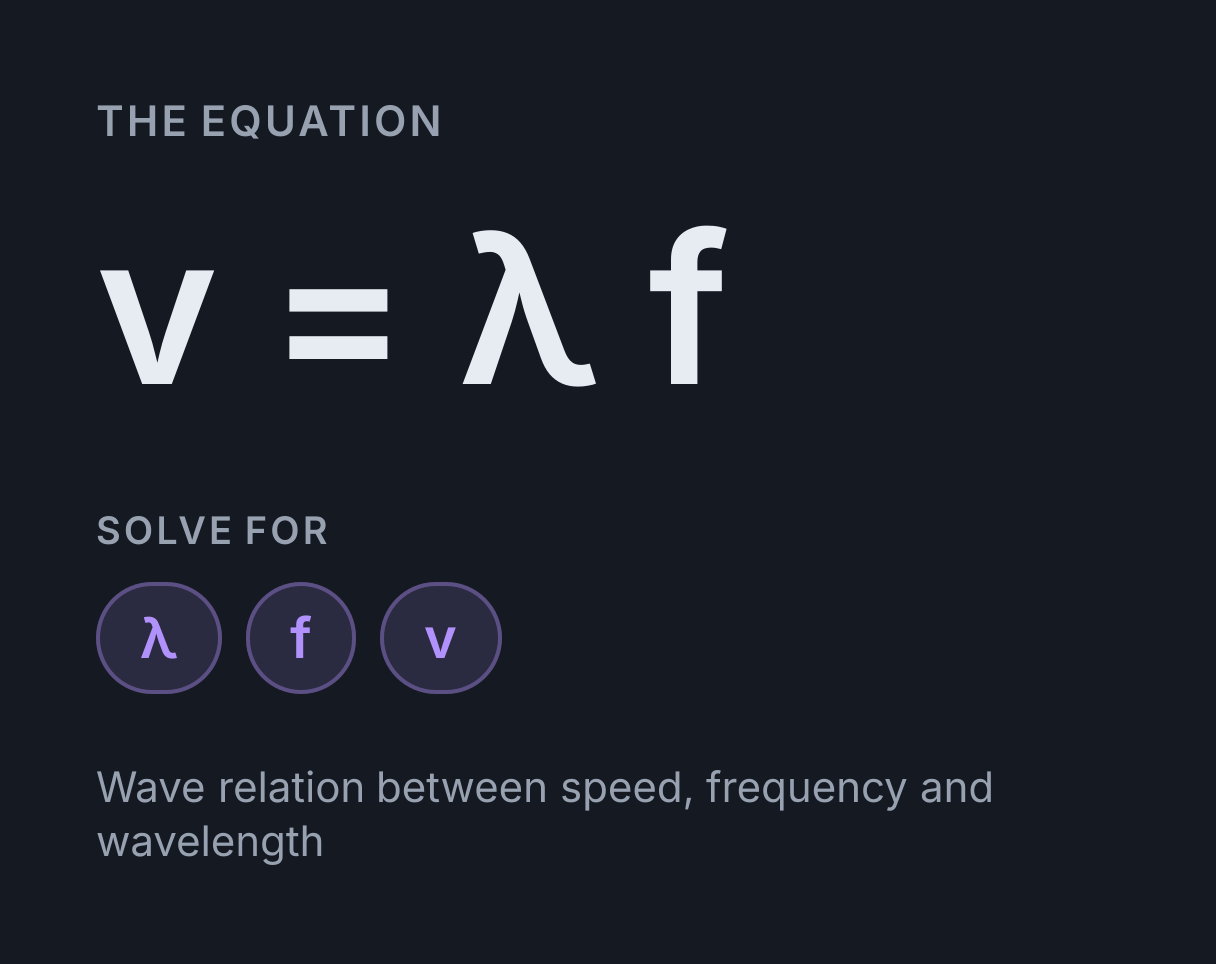
The equation
Wave relation between speed, frequency and wavelength
What v = λf is saying
A wave’s speed equals its wavelength times its frequency,
v = λf, so the frequency is the speed divided by the
wavelength and the wavelength is the speed divided by the frequency. A
travelling wave has a repeating shape. The wavelength
λ is the distance between two matching points on that shape,
and the frequency f is how many of those repeats pass a fixed
point each second. Multiply a distance per cycle by cycles per second and
the units give metres per second, which is the wave speed. That is the
whole content of v = λf: speed, wavelength and frequency are
not three independent quantities, and fixing any two fixes the third.
The speed depends on the medium, not on the wave. Light in vacuum travels at 299,792,458 m/s exactly, since the metre is defined from that figure. Sound in dry air at 20 °C travels at about 343 m/s, and in water at about 1480 m/s. Because the speeds differ by six orders of magnitude, a 1 kHz sound wave is about 34 cm long while a 1 kHz radio wave is 300 km long.
Worked example
Green light with a wavelength of 550 nm in vacuum has what frequency?
- Convert the wavelength: 550 nm is
550e-9 m. f = v / λ = 299792458 / 550e-9f = 5.451e14 Hz, which is 545.1 THz.
The same equation run the other way handles sound:
- A 440 Hz note in air at 343 m/s gives
λ = v / f = 343 / 440. λ = 0.780 m, so concert A is about 78 cm long.
What changes when the medium changes
When a wave crosses into a new medium the frequency is unchanged, because
the frequency is set by the source rather than by the material. The speed
does change, so the wavelength must change in proportion to keep
v = λf true. Light entering glass with a refractive index of
about 1.5 slows by a factor of 1.5, so its wavelength shortens by that
same factor while its colour, which follows the frequency, stays the same.
A 550 nm beam in vacuum is a 367 nm wave inside the glass and returns to
550 nm on leaving it.
Vibrational spectroscopy usually reports wavenumber instead of wavelength.
Wavenumber is 1/λ expressed in cm⁻¹, so it is proportional to
frequency and to photon energy, which makes peak spacings additive. For
550 nm the wavenumber is 1 / 550e-7 cm, about
18,180 cm⁻¹. Infrared spectra are quoted the same way,
with the C=O stretch near 1700 cm⁻¹ rather than at 5.9 µm.
Common mistakes
- Leaving the wavelength in nanometres. A wavelength in nm must be divided by 1e9 before it meets a speed in m/s. Skipping that step moves the answer by nine orders of magnitude.
- Using the vacuum speed of light inside a medium. In glass
or water the speed is
c / n. Pairing the vacuum figure with a wavelength measured in the medium gives a frequency that is too high. - Assuming frequency changes on refraction. Refraction changes speed and wavelength together and leaves frequency alone. Only the source can change the frequency.
- Confusing wavenumber with wavelength. They are reciprocals, so a larger wavenumber means a shorter wave. Treating a cm⁻¹ figure as a length inverts the whole comparison.
Converting units first? Use the length, frequency and speed conversion tables.
Worked examples
Each one runs through the calculator above, so the arithmetic here is the arithmetic it does.
What is the wavelength of a 2.4 GHz Wi-Fi signal?
- lambda = v / f
- = 2.99792 × 10⁸ m/s / 2.4 GHz
- = 2.99792 × 10⁸ / (2.4 × 10⁹)
- = 0.1249 m = 124.91 mm
12.5 cm. Radio waves are electromagnetic, so they travel at the speed of light like the rest of the spectrum, and only the gigahertz needs converting, to 2.4 × 10⁹ Hz. Microwave ovens run at 2.45 GHz, in the same band, which is why a running oven can disrupt a 2.4 GHz network nearby.
What is the wavelength of 5 MHz ultrasound in soft tissue?
- lambda = v / f
- = 1540 m/s / 5 MHz
- = 1540 / (5 × 10⁶)
- = 0.000308 m = 308 um
0.31 mm, with the wave speed set to 1540 m/s, the speed of sound that scanners assume for soft tissue. Left at the default speed of light, the same frequency gives about 60 m. The wavelength sets the finest detail an image can show, which is why higher frequency probes resolve more but penetrate less deeply.
Practise this with Waves Practice Problems, questions generated from this calculator and 4 other calculators in Waves & Optics.
Common questions
Does changing medium change wavelength or frequency?
The wavelength changes and the frequency does not, because frequency is set by the source and stays the same when a wave crosses into a new medium. Speed changes, so wavelength must change in proportion. Light entering glass keeps its frequency and colour but its wavelength shortens by the refractive index.
What wave speed should I use?
For light in vacuum, 299,792,458 m/s, which is the default here. In glass divide by the refractive index, roughly 1.5. For sound in air at 20 °C use about 343 m/s, and in water about 1480 m/s.