Photon Energy Calculator
Convert wavelength to photon energy in electronvolts or joules, with the energy per mole for comparison against bond energies.
Calculator
Working, with your numbers
- E = h c / lambda
- h c = 6.62607 × 10⁻³⁴ x 2.99792 × 10⁸ = 1.9864 × 10⁻²⁵ J m
- = 1.9864 × 10⁻²⁵ / (5.5 × 10⁻⁷ m)
- = 3.612 × 10⁻¹⁹ J = 2.2543 eV
Values are converted into the units the equation is worked in before the arithmetic.
- Region
- Green
- Frequency
- 545.1 THz
- Per mole Energy of one mole of these photons. Comparable with bond energies.
- 217.5 kJ/mol
Citing this tool
Last updated . Add the date you accessed it as well, which a citation of a page that can change asks for. If a specific result matters, cite the permalink from the tool’s share row instead of this page: it reproduces the exact parameters.
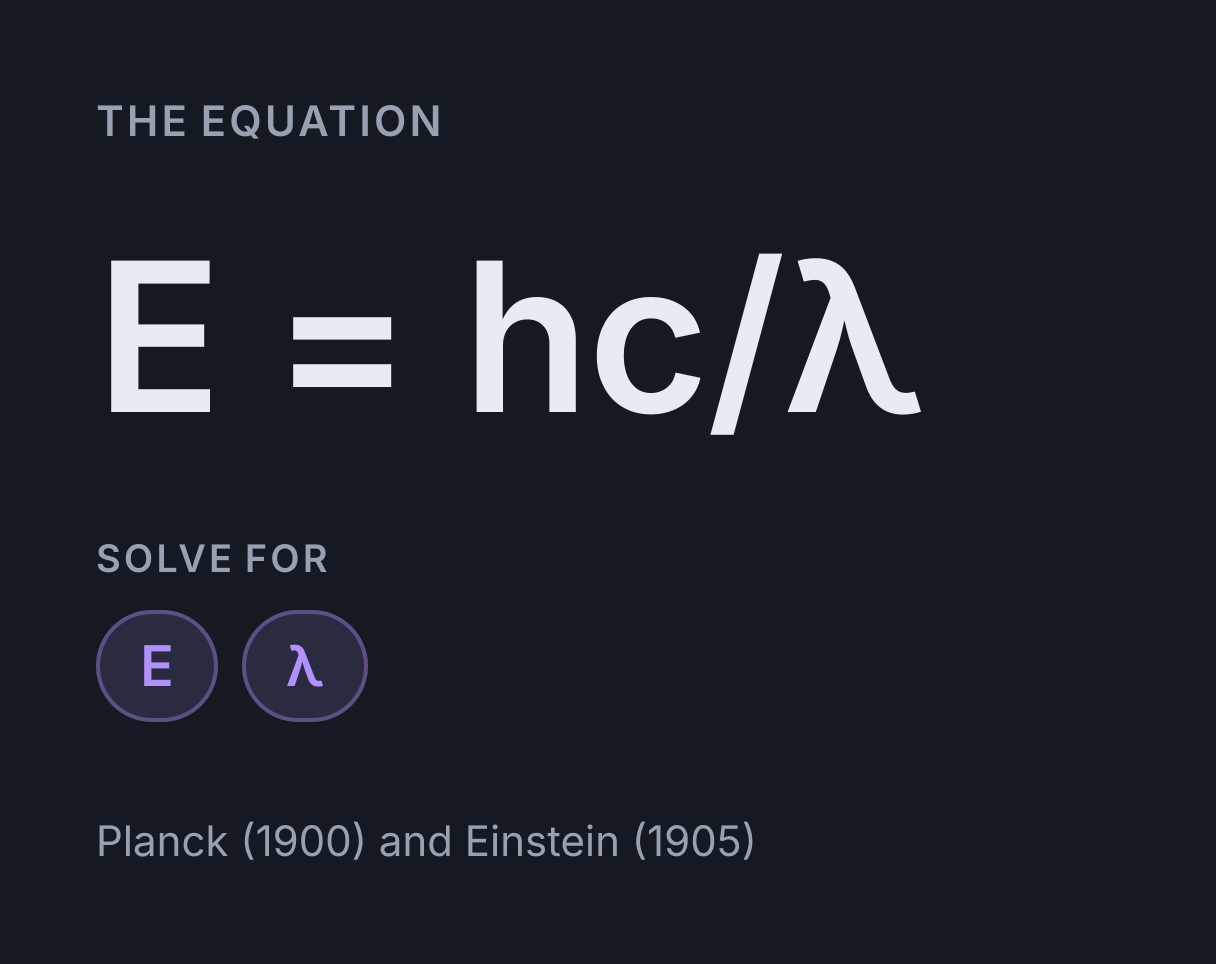
The equation
Planck (1900) and Einstein (1905)
What E = hc/λ is saying
The energy of one photon is E = hc/λ, Planck’s constant
h times the speed of light c divided by the
wavelength λ, which in electronvolts comes to about 1240
divided by the wavelength in nanometres. Light carries energy in discrete
amounts. A single photon of frequency
f carries E = hf, and since
f = c/λ for light in vacuum the same statement in terms of
wavelength is E = hc/λ. Energy is therefore inversely
proportional to wavelength: shorter waves carry more energy per photon.
Nothing about the brightness of the beam appears in the equation.
Both constants are exact under the 2019 SI. The
Planck constant is
h = 6.62607015e-34 J·s and the speed of light is
c = 299792458 m/s, so their product
hc = 1.9864e-25 J·m is exact as well. That single product does
all the work, which is why the calculator can report the same photon in
joules, electronvolts and kilojoules per mole at once.
Worked example
What energy does a 550 nm green photon carry?
- Convert the wavelength: 550 nm is
550e-9 m. E = hc / λ = 1.9864e-25 / 550e-9E = 3.6117e-19 Jfor one photon.-
In electronvolts:
3.6117e-19 / 1.602177e-19 = 2.254 eV. -
Per mole:
3.6117e-19 × 6.02214e23 = 217,500 J, which is 217.5 kJ/mol.
The 1240 shortcut and what it tells you about damage
Expressing hc in the units of the problem removes the
conversions. In electronvolts and nanometres,
hc = 1239.84 eV·nm, so energy in eV is
1240 / λ in nm to within a tenth of a percent. A 620 nm red
photon is about 2 eV, a 550 nm green photon is 2.25 eV, and a 400 nm violet
photon is 3.1 eV. The whole visible range sits between roughly 1.6 and
3.1 eV.
The per-mole figure is the one that explains photochemistry, because bond strengths are tabulated per mole. A mole of 550 nm photons carries 217 kJ, while a typical carbon-carbon single bond needs about 350 kJ/mol to break. Visible light therefore cannot break one, however bright the source. A 300 nm ultraviolet photon carries about 400 kJ/mol, which is above that threshold, so UV can drive bond cleavage that visible light cannot. That difference is the reason ultraviolet exposure causes photodamage to skin and to polymers while visible light of the same intensity leaves them intact.
Common mistakes
- Leaving the wavelength in nanometres. Using 550 rather
than
550e-9inE = hc/λputs the answer out by a factor of 1e9. - Mixing electronvolts and joules. The two differ by 1.602177e-19. Feeding an eV figure into an equation expecting joules, or comparing one directly with a kJ/mol bond energy, gives a meaningless number.
- Putting a wavelength into E = hf. That form takes a frequency in hertz. Substituting a wavelength there inverts the dependence and makes long waves look energetic.
- Treating brighter light as higher-energy light. Brightness is the number of photons per second. The energy of each photon depends only on wavelength, so a dim ultraviolet lamp can cause damage that a bright red one cannot.
Converting units first? Use the energy and length conversion tables.
Worked examples
Each one runs through the calculator above, so the arithmetic here is the arithmetic it does.
How much energy does a 500 nm photon carry?
- E = h c / lambda
- h c = 6.62607 × 10⁻³⁴ x 2.99792 × 10⁸ = 1.9864 × 10⁻²⁵ J m
- = 1.9864 × 10⁻²⁵ / (5 × 10⁻⁷ m)
- = 3.973 × 10⁻¹⁹ J = 2.4797 eV
3.97 × 10⁻¹⁹ J, or 2.48 eV. The figure is for one photon, which is why it is so small: a single milliwatt of this light is about 2.5 × 10¹⁵ photons every second. Brightness is that count, while the wavelength alone sets the energy each photon carries.
What is the longest wavelength silicon can absorb, with a 1.12 eV band gap?
- lambda = h c / E
- h c = 1.9864 × 10⁻²⁵ J m
- = 1.9864 × 10⁻²⁵ / (1.794 × 10⁻¹⁹ J)
- = 1.107 × 10⁻⁶ m = 1107 nm
About 1107 nm, in the near infrared. A photon of longer wavelength carries less energy than the band gap and cannot lift an electron across it, so silicon is transparent beyond this point, and silicon camera sensors and solar cells stop responding a little past 1100 nm.
Practise this with Waves Practice Problems, questions generated from this calculator and 4 other calculators in Waves & Optics.
Common questions
Where does the 1240 eV·nm shortcut come from?
It is hc expressed in convenient units. Since hc = 1239.84 eV·nm, the energy in electronvolts is 1240 divided by the wavelength in nanometres. A 620 nm red photon is therefore about 2 eV, which is worth memorising.
Why compare photon energy to kJ per mole?
Because bond energies are quoted that way. A mole of 550 nm green photons carries about 217 kJ, which is below a typical carbon-carbon bond at 350 kJ/mol, so visible light alone will not break one. Ultraviolet photons at 300 nm carry about 400 kJ/mol and will.