De Broglie Wavelength Calculator
The de Broglie wavelength is λ = h/p = h/mv. Work it out for an electron, proton, neutron or any mass from speed, energy or voltage, relativity included.
Calculator
From rest, in a vacuum. A charge q gains a kinetic energy of qV.
The classical h/√(2mqV) gives 0.122643 nm, 0.0049% longer. The classical formula is fine at this speed.
- Wavelength in metres The same wavelength in SI units, as the working prints it.
- 1.2264 × 10⁻¹⁰ m
- Speed v = p/(γm), which never reaches c however large the energy.
- 5.93 × 10⁶ m/s
- Fraction of c v/c. Close to c it is shown as 1 minus the shortfall, which four figures would round away.
- 0.01978
- Kinetic energy K = (γ − 1)mc², the energy of motion without the rest energy.
- 100 eV
- Momentum p = γmv, and the wavelength is exactly h/p.
- 5.403 × 10⁻²⁴ kg·m/s
- Lorentz factor γ γ = 1/√(1 − v²/c²). For a given speed the classical h/(mv) is too long by this factor; for a given energy, by √((γ + 1)/2).
- 1 + 0.000196
Working, with your numbers
- Electron: m = 9.1094 × 10⁻³¹ kg, charge −e.
- K = qV = 1 e x 100 V = 100 eV
- K = 100 x 1.6022 × 10⁻¹⁹ = 1.6022 × 10⁻¹⁷ J
- mc^2 = 9.1094 × 10⁻³¹ x (2.9979 × 10⁸)^2 = 8.1871 × 10⁻¹⁴ J
- K / (2mc^2) = 1.6022 × 10⁻¹⁷ / (2 x 8.1871 × 10⁻¹⁴) = 9.7848 × 10⁻⁵
- p = sqrt(2mK(1 + K/(2mc^2))) = sqrt(2 x 9.1094 × 10⁻³¹ x 1.6022 × 10⁻¹⁷ x (1 + 9.7848 × 10⁻⁵)) = 5.403 × 10⁻²⁴ kg·m/s
- lambda = h / p = 6.6261 × 10⁻³⁴ / (5.403 × 10⁻²⁴) = 1.2264 × 10⁻¹⁰ m
- lambda = 0.12264 nm
- Classical h / sqrt(2mqV) = 0.12264 nm, 0.0049% longer.
Worked in SI units with the exact relativistic formulas. The last line says how far the classical formula is out.
Citing this tool
Last updated . Add the date you accessed it as well, which a citation of a page that can change asks for. If a specific result matters, cite the permalink from the tool’s share row instead of this page: it reproduces the exact parameters.
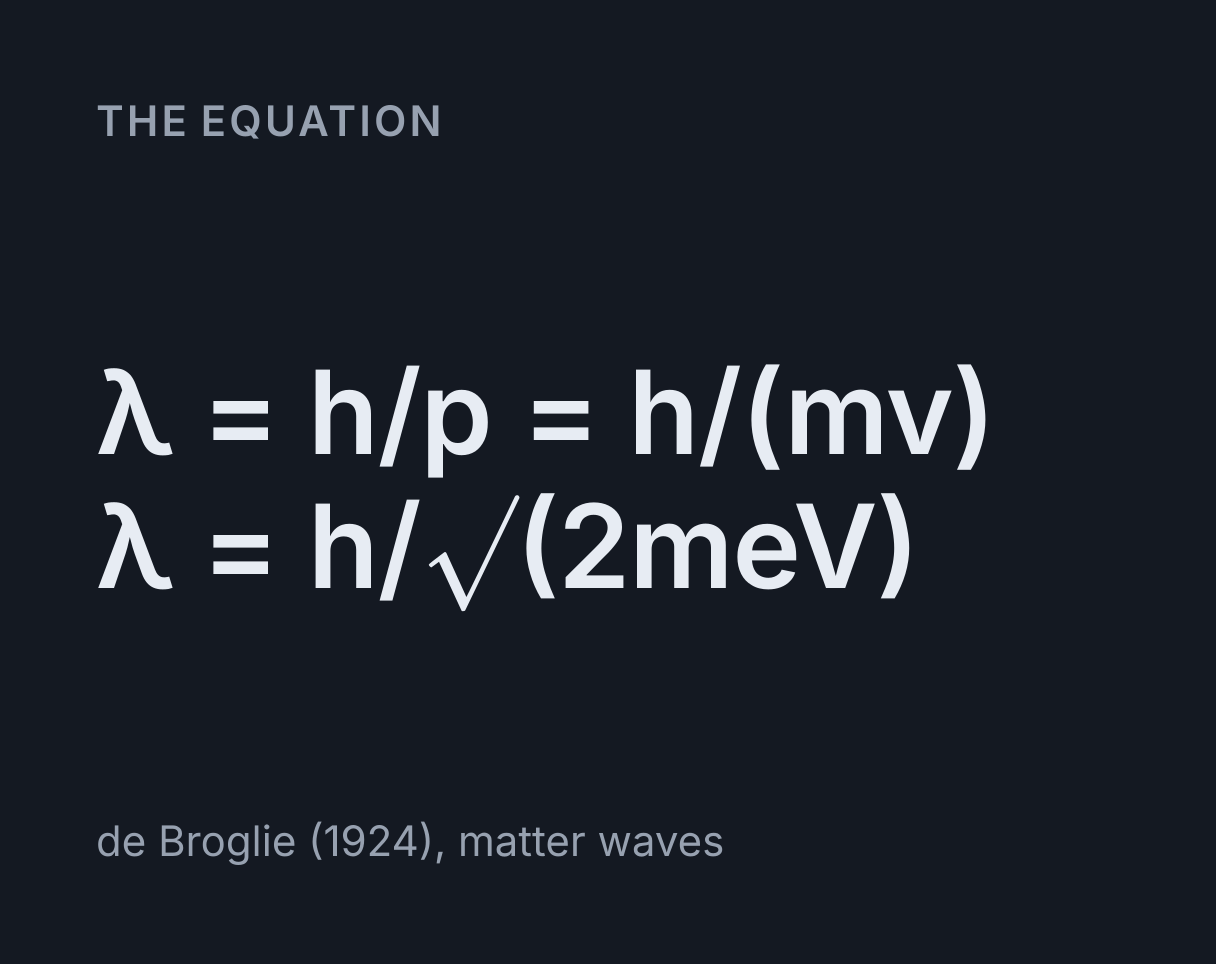
The equation
de Broglie (1924), matter waves
What the de Broglie wavelength is
The de Broglie wavelength of a particle is Planck’s constant divided by its momentum,
λ = h/p. For anything moving well below the speed of light the momentum is
mass times speed, so λ = h/(mv), and an electron accelerated from rest
through a voltage V has λ = h/√(2meV), about 1.226/√V nm with V
in volts.
Louis de Broglie proposed in 1924 that matter has a wavelength just as light does, tied to its momentum by the same relation a photon obeys. In 1927 Clinton Davisson and Lester Germer, with a nickel crystal, and George Thomson and Alexander Reid, with thin films, found that electrons diffract just as that wavelength predicts. It sets the spacing of a diffraction pattern, and it is why an electron microscope can resolve far finer detail than a light microscope.
How to use the calculator
Choose the particle, then how its motion is known: its speed, its kinetic energy, the voltage that accelerated it from rest, or its momentum. The wavelength appears in the unit you pick, from femtometres to metres, and the readouts give the same motion as a speed, a fraction of the speed of light, a kinetic energy, a momentum and a Lorentz factor. For an atom, a molecule or a ball, choose another particle or object and give its mass in atomic mass units (u), MeV/c², grams or kilograms.
To work backwards, press Solve for this on the motion field and type the wavelength: the calculator gives the speed, energy, voltage or momentum that produces it. An electron needs 150.39 V for a wavelength of 0.1 nm, for example. Every answer is the exact relativistic one, and the line under the fields gives the classical figure and how far it is out.
Worked example: an electron at 5.4 × 10⁶ m/s
The momentum is p = mv = 9.109 × 10⁻³¹ × 5.4 × 10⁶ = 4.919 × 10⁻²⁴ kg·m/s, and
the wavelength is λ = h/p = 6.626 × 10⁻³⁴ / (4.919 × 10⁻²⁴) = 1.347 × 10⁻¹⁰ m,
or 0.1347 nm, which rounds to 0.135 nm. That is about the spacing of atoms in a solid, and
similar to the wavelength of an X-ray.
At 1.8 percent of the speed of light the Lorentz factor is γ = 1.00016, so the
exact momentum is 0.016 percent larger and the exact wavelength, the one the calculator
shows, is 0.13468 nm. The classical answer is fine here: the two agree to four significant
figures.
Worked example: the electrons Davisson and Germer diffracted
Davisson and Germer accelerated their electrons through 54 V, so each carried
K = eV = 54 eV, which is 54 × 1.6022 × 10⁻¹⁹ = 8.652 × 10⁻¹⁸ J. The
momentum is
p = √(2mK) = √(2 × 9.109 × 10⁻³¹ × 8.652 × 10⁻¹⁸) = 3.970 × 10⁻²⁴ kg·m/s, so
λ = h/p = 6.626 × 10⁻³⁴ / (3.970 × 10⁻²⁴) = 1.669 × 10⁻¹⁰ m, or 1.669 Å. The
shortcut gives 1.226/√54 = 0.1668 nm, the same to three figures. The 1.227
that some textbooks give comes from rounded constants: with h = 6.63 × 10⁻³⁴ J·s,
m = 9.11 × 10⁻³¹ kg and e = 1.602 × 10⁻¹⁹ C the constant is 1.2272.
Their nickel crystal had rows of atoms 2.15 Å apart, and at 54 V the scattered electrons
peaked at a scattering angle of 50°, which puts the measured wavelength at
2.15 × sin 50° = 1.65 Å, about 1.3 percent below the prediction. The
relativistic correction at this voltage is only 0.003 percent, so the calculator’s exact
1.66891 Å matches the classical figure to four significant figures.
When relativity matters
λ = h/p holds at any speed. What changes near the speed of light is how the
momentum depends on speed and energy: p = γmv, with
γ = 1/√(1 − v²/c²), and from a kinetic energy
p = √(2mK(1 + K/(2mc²))). The classical formulas leave out γ and the bracket,
so they overestimate the wavelength, by the factor γ for a given speed and by
√(1 + K/(2mc²)) for a given energy.
An electron’s rest energy, mc², is 511 keV. The classical formula is 1 percent out at about 20 kV and 5 percent out at about 105 kV, so school problems at tens or hundreds of volts are safely classical, while transmission electron microscopes, typically run at 100 to 300 kV, are not. A proton’s rest energy is 1836 times larger, so the same 1 percent takes about 38 MV.
Take a microscope at 200 kV. The classical h/√(2meV) gives 2.742 pm. But
eV/(2mc²) = 200/1022 = 0.1957, so the exact momentum is √1.1957 = 1.0935 times
the classical one, and the wavelength is 2.742/1.0935 = 2.508 pm. The classical
answer is 9.3 percent too long, and the electrons are travelling at 0.695 c.
Why electrons diffract and balls do not
A wave only diffracts noticeably when its wavelength is comparable with the spacing of whatever it passes through. An electron accelerated through 100 V has a wavelength of 0.1226 nm, close to the distance between atoms in a crystal, so a crystal diffracts it. So does a thermal neutron at 2200 m/s, with 0.180 nm, which is why neutron beams are used to work out crystal structures.
A 150 g ball at 30 m/s has λ = 6.626 × 10⁻³⁴ / (0.15 × 30) = 1.47 × 10⁻³⁴ m,
about 10¹⁹ times smaller than a proton. Nothing has openings that fine, so its wave nature
can never be seen. Molecules sit in between: in 1999 Markus Arndt and colleagues diffracted
C₆₀ fullerene molecules, 720 u each, at a wavelength of about 2.5 pm, which the calculator
gives for 720 u at 220 m/s.
For the classical side of the same motion, the momentum calculator adds the impulse and force needed to stop it, and the kinetic energy calculator the equivalent drop height. For the pattern a wavelength produces, the double slit simulator shows fringes whose spacing grows with the wavelength, as an electron beam’s does.
What this does not cover
The particle is free, and for a voltage it starts from rest in a vacuum, so all of qV becomes kinetic energy. An electron bound in an atom has no single momentum and so no single wavelength; the picture of a whole number of wavelengths fitting round a Bohr orbit reproduces the Bohr energies but is not how quantum mechanics describes an atom.
The thermal de Broglie wavelength of statistical physics, Λ = h/√(2πmkT), is
a different quantity with a different factor. For the wavelength of a gas particle with the
average kinetic energy, (3/2)kT, work that energy out and enter it. Light is
left to the photon energy calculator: a
photon has no rest mass, so its momentum is E/c and λ = h/p
becomes λ = hc/E. The constants are CODATA 2022, and
Planck’s constant, the speed of light and the
elementary charge are exact.
Common mistakes
- Leaving the energy in electronvolts.
λ = h/√(2mK)needs K in joules, so multiply electronvolts by 1.602 × 10⁻¹⁹ first. Putting in 100 for a 100 eV electron gives a wavelength about 2.5 × 10⁹ times too short. - Taking the voltage as the energy for a particle with more than one charge. An alpha particle carries 2e, so 100 V gives it 200 eV, not 100 eV.
- Putting the mass in the wrong unit. An atomic mass in u, or a molar mass in g/mol, has to become kilograms per particle: 1 u is 1.6605 × 10⁻²⁷ kg.
- Using the classical formula at high energy. From about 10 kV upwards,
h/√(2meV)overestimates an electron’s wavelength by about half a percent or more, and at 200 kV it is 9.3 percent out. - Using ½mv² and mv near the speed of light. The kinetic energy is
(γ − 1)mc²and the momentumγmv. The classical relations can even give a speed above c: an electron with a wavelength of 1 pm would need 2.43 c byp/m, when its real speed is 0.925 c. - Confusing λ with the wavelength of a photon of the same energy. A 100 eV
electron has λ = 0.123 nm, but a 100 eV photon has
λ = hc/E = 12.4 nm, about a hundred times longer.
Common questions
What is the de Broglie wavelength of an electron accelerated through 100 V?
About 0.123 nm, or 122.6 pm. The electron gains 100 eV of kinetic energy, and λ = h/√(2meV) gives 1.226/√100 = 0.1226 nm; the exact relativistic answer is only 0.005 percent shorter. That is close to the spacing of atoms in a crystal, which is why electrons at this energy diffract from one.
How do you find the de Broglie wavelength from kinetic energy?
Use λ = h/√(2mK), with the kinetic energy K in joules and the mass m in kilograms. A neutron with 0.0253 eV, which is 4.054 × 10⁻²¹ J, has λ = 6.626 × 10⁻³⁴ / √(2 × 1.675 × 10⁻²⁷ × 4.054 × 10⁻²¹) = 0.180 nm. When K is not small next to the rest energy mc², use the exact λ = h/√(2mK(1 + K/(2mc²))) instead.
When do you need the relativistic de Broglie wavelength?
Whenever the kinetic energy is not small next to the particle’s rest energy. The classical λ = h/√(2mK) is too long by a factor √(1 + K/(2mc²)). For an electron, whose rest energy is 511 keV, that is about 1 percent at 20 kV and 5 percent at 105 kV, so electron microscopes need the exact form; for a proton the same 1 percent takes about 38 MV.
What is the ratio of the de Broglie wavelengths of a proton and an alpha particle accelerated through the same voltage?
About 2.82, the proton’s being the longer. Through a voltage V each gains kinetic energy qV, so λ = h/√(2mqV) and the ratio is √(mα qα/(mp qp)) = √(2 × 3.973) = 2.82. With the alpha particle’s mass rounded to four proton masses, the ratio becomes 2√2, about 2.83.
Does λ = h/p apply to light?
Yes. A photon’s momentum is p = E/c, so λ = h/p gives λ = hc/E, the photon energy relation, and a photon with the same 0.123 nm wavelength as a 100 eV electron carries 10.1 keV. What does not carry over is λ = h/(mv), because a photon has no rest mass and always travels at c.