Bohr Model and Hydrogen Spectrum Simulator
The Bohr model puts hydrogen’s levels at Eₙ = −13.6/n² eV. Jump the electron between any two to see the photon’s energy, wavelength and spectral series.
Simulator
Tap a level or an orbit to send the electron there, or a line in the spectrum to pick it. The up and down arrow keys move the electron one level; left and right step along the series. Space plays and pauses.
- Wavelength In vacuum, from 1/λ = RZ²(1/2² − 1/3²) with R = 109,677.6 cm⁻¹ and Z = 1.
- 656.47 nm
- In air In standard air, 15 °C and 101,325 Pa, as tables of lines between 200 nm and 2 µm give it.
- 656.29 nm
- Photon emitted The atom’s energy falls by exactly this much, from −1.5109 eV to −3.3996 eV.
- 1.8887 eV
- In joules
- 3.026 × 10⁻¹⁹ J
- Frequency f = E/h, the photon energy over the Planck constant.
- 4.5667 × 10¹⁴ Hz
- Wavenumber 1/λ, the number the Rydberg formula gives directly.
- 15,233 cm⁻¹
- Line The Balmer series is every line ending on n = 2, closing on its limit at 364.71 nm.
- Balmer α (Hα)
- Region
- Red
- Start, n = 3 Orbit radius 476.52 pm, electron speed 729.23 km/s, 1.5109 eV below ionisation.
- −1.5109 eV
- End, n = 2 Orbit radius 211.79 pm, electron speed 1093.8 km/s, 3.3996 eV below ionisation.
- −3.3996 eV
- Rydberg formula
- Lines of the series
Citing this tool
Last updated . Add the date you accessed it as well, which a citation of a page that can change asks for. If a specific result matters, cite the permalink from the tool’s share row instead of this page: it reproduces the exact parameters.
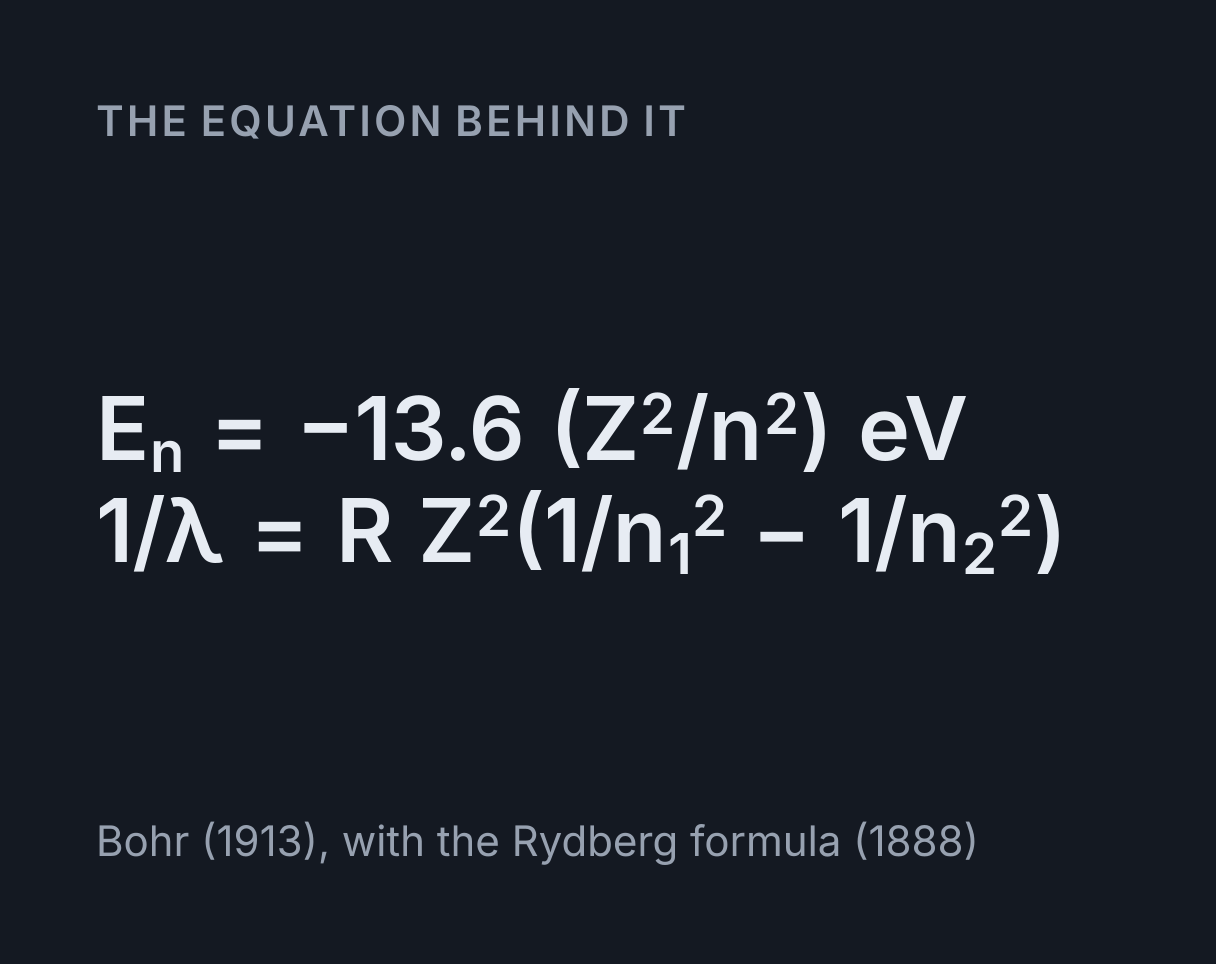
The equation
Bohr (1913), with the Rydberg formula (1888)
What the Bohr model says
The Bohr model says the electron in a hydrogen atom can only circle the nucleus on certain
orbits, each with a fixed energy, Eₙ = −13.6 Z²/n² eV, and that the atom gives out
or takes in light only when the electron jumps from one orbit to another. The photon carries
exactly the energy between the two levels, which is why hydrogen’s light is a set of sharp lines
rather than a rainbow, and its wavelength follows from the Rydberg formula,
1/λ = RZ²(1/n₁² − 1/n₂²), with n₁ the lower level and n₂ the upper.
Niels Bohr reached it in 1913 from two conditions. The pull of the nucleus supplies the force that keeps the electron on its circle, and the orbit’s angular momentum is a whole number of ℏ, the reduced Planck constant. The first ties the speed to the radius; the second picks out the allowed orbits, numbered n = 1, 2, 3 and so on, with radii growing as n² and energies closing in on zero as 1/n². The same two conditions work for any atom with a single electron, such as He⁺ and Li²⁺, with Z the charge of the nucleus.
Using the simulator
Choose the atom, the level the electron starts in and the level it ends in. When the end is below the start the atom emits a photon, and when it is above, the atom absorbs one. The atom on the left shows the jump with the orbits to scale, the diagram on the right shows the same jump as an arrow between two energies, and the strip underneath shows where the line falls among the others in its series. Tap a level or an orbit to send the electron there from wherever it is now, or tap a line in the strip to pick it; the arrow keys do the same from the keyboard.
- Wavelength is in a vacuum, straight from the Rydberg formula, and In air is what a table of lines prints between 200 nm and 2 µm.
- Photon emitted or Photon absorbed is its energy in electronvolts, with joules, frequency and wavenumber beside it, the four forms exam questions ask for.
- Line names it: the series comes from the lower level and the Greek letter from how many levels the jump spans, so 3 to 2 is Balmer α, which for hydrogen is called Hα.
- Start and End give each level’s energy, with its orbit’s radius and the electron’s speed in the hint.
The plot turns the series into a straight line. Rydberg’s formula says the wavenumber falls linearly with 1/n₂², so every line of a series lies on one line of slope −RZ², and where it meets the axis, at 1/n₂² = 0, is the series limit. Plotted this way, lines measured with a spectrometer give R from the slope.
Worked example: the red line of hydrogen
Hydrogen falling from n = 3 to n = 2, which is where the simulator starts. With the proton’s
recoil included, hydrogen’s Rydberg constant is R_H = 109,677.58 cm⁻¹, so
1/λ = 109,677.58 cm⁻¹ × (1/2² − 1/3²) = 109,677.58 × 5/36 = 15,233.00 cm⁻¹
and λ = 1/15,233.00 cm = 656.47 nm in a vacuum, the red Hα line. In air it is
656.29 nm, the 656.3 nm printed in most tables. The energy route gives the same photon: the two
levels are at E₃ = −1.51092 eV and E₂ = −3.39957 eV, so the atom loses
1.88865 eV, which is 3.02595 × 10⁻¹⁹ J, and λ = hc/E = 1239.842 eV nm ÷ 1.88865 eV = 656.47 nm.
Its frequency is c/λ = 4.5667 × 10¹⁴ Hz. The simulator shows each of these to five
figures; the working carries six so that the last step still comes out at 656.47 nm.
Set the start level to 5 for Hγ, the jump NCERT works in Problem 2.10 of its chemistry chapter on the structure of the atom: the photon carries 2.8556 eV, which is 4.5752 × 10⁻¹⁹ J, at 434.17 nm. NCERT, using 2.18 × 10⁻¹⁸ J for the Rydberg energy, gets 4.58 × 10⁻¹⁹ J and 6.91 × 10¹⁴ Hz, where the simulator gives 6.9049 × 10¹⁴ Hz.
The energy levels of hydrogen
| Level | Energy (eV) | Orbit radius (pm) | Electron speed (km/s) |
|---|---|---|---|
| n = 1 | −13.598 | 52.95 | 2188 |
| n = 2 | −3.3996 | 211.8 | 1094 |
| n = 3 | −1.5109 | 476.5 | 729.2 |
| n = 4 | −0.84989 | 847.1 | 546.9 |
| n = 5 | −0.54393 | 1324 | 437.5 |
| n = 6 | −0.37773 | 1906 | 364.6 |
The energies close in on zero, the electron at rest far from the nucleus, so the gaps between levels shrink as n grows while the orbits spread out as n². With the nucleus held still the first radius is the Bohr radius, 52.918 pm, which textbooks round to 52.9 pm. The kinetic energy in any orbit is the size of its total energy and the potential energy is twice the total, so the ground state has 13.598 eV of kinetic energy and −27.197 eV of potential energy.
Hydrogen’s spectral series
Every line that ends on the same level belongs to one series, named after the scientist who first described it. Each series starts with its longest wavelength, the α line, and its lines crowd together towards a limit, the photon an electron gives out when it is captured from rest far away.
| Series | Ends on | First line (nm) | Limit (nm) | Region |
|---|---|---|---|---|
| Lyman | n = 1 | 121.57 | 91.176 | Ultraviolet |
| Balmer | n = 2 | 656.47 | 364.71 | Visible, closing in the ultraviolet |
| Paschen | n = 3 | 1875.6 | 820.59 | Infrared |
| Brackett | n = 4 | 4052.3 | 1458.8 | Infrared |
| Pfund | n = 5 | 7459.9 | 2279.4 | Infrared |
| Humphreys | n = 6 | 12,372 | 3282.3 | Infrared |
Only the Balmer series reaches the visible, and only its first four lines are easy to see: Hα red, Hβ blue, Hγ and Hδ violet. To turn any of these wavelengths into a photon energy or a frequency on its own, use the photon energy calculator or the wavelength and frequency calculator.
Why hydrogen has more than one Rydberg constant
The Rydberg constant R∞ = 109,737 cm⁻¹, the CODATA 2022 value, belongs to a nucleus infinitely
heavier than the electron. A real nucleus circles the centre of mass as well, so the electron
behaves as if its mass were the reduced mass, μ = mₑM/(mₑ + M), and every energy and
wavenumber is scaled by μ/mₑ, a little less than 1. For hydrogen that is 0.054 percent, which
makes R_H = 109,678 cm⁻¹ and puts Hα 0.36 nm further to the red than R∞ does. Switch the
correction off to see it move.
The heavier the nucleus, the smaller the shift, and two discoveries turned on it. Deuterium’s nucleus has about twice the proton’s mass, which moves its Hα line 0.179 nm short of hydrogen’s, and that shift is how Urey, Brickwedde and Murphy found deuterium, reporting it in 1932. And in 1896 Edward Pickering found lines in the star ζ Puppis that sat between hydrogen’s Balmer lines, which Bohr showed in 1913 came from He⁺: its lines ending on n = 4 fall alternately on and between the Balmer lines. Choose He⁺ and set 6 to 4: with the correction off, the line has exactly the wavelength of hydrogen’s Hα with the correction off, and with it on, the line is at 656.20 nm, 0.27 nm short of Hα, because the helium nucleus recoils less than the proton.
Vacuum and air wavelengths
The Rydberg formula gives wavelengths in a vacuum. Light is about 0.03 percent slower in air, so its wavelength there is shorter by the same fraction, and the NIST Atomic Spectra Database gives air wavelengths between 200 nm and 2 µm and vacuum wavelengths outside that range. The simulator does the same: its air value is for standard air, 15 °C and 101,325 Pa, from the formula of Peck and Reeder (1972) that NIST uses. That is why Hα is 656.47 nm from the formula and 656.28 nm in a table: 0.18 nm of the gap is the air, and the last hundredth comes mostly from fine structure, which the Bohr model leaves out.
Common mistakes
- Giving an emitted photon a negative energy. The change in the atom’s energy, Ef − Ei, is negative when it emits; the photon’s energy is the size of that change, and its wavelength is always positive.
- Swapping n₁ and n₂. n₁ is the lower level, the one the series is named after. The other way round, 1/λ comes out negative.
- Forgetting Z² for an ion. He⁺ levels are four times deeper than hydrogen’s and Li²⁺ levels nine times, so their lines sit at about a quarter and a ninth of hydrogen’s wavelengths.
- Using 13.6 eV where more figures matter. It is 13.606 eV for a nucleus held still and 13.598 eV for hydrogen. The 0.054 percent between them is larger than the 0.028 percent between Hα in air and in a vacuum.
- Comparing a vacuum wavelength with a table in air. Between 200 nm and 2 µm a table’s wavelength is shorter than the formula’s by about 0.03 percent. Say which one you mean.
- Reading the orbits as real paths. Quantum mechanics replaces them with orbitals, and it gives hydrogen’s ground state no orbital angular momentum at all, where Bohr’s gives it ℏ.
What this simulator leaves out
Everything the Bohr model does not have. Fine structure and the Lamb shift split each hydrogen line into components: NIST lists eight for Hα, spread over 0.020 nm. Hyperfine structure gives hydrogen its 21 cm radio line, a transition inside the ground state that no orbit picture can make. The model says nothing about how bright each line is, how long a level lasts or how wide a line is, and it cannot describe an atom with two or more electrons, which repel each other; how those electrons fill shells and subshells is what the electron configuration calculator works out. For heavy ions relativity starts to matter: C⁵⁺ is bound 0.043 percent more tightly than the model says.
The force holding the electron in place is Coulomb’s law, which the Coulomb’s law calculator works out for two charges, and the nucleus it pulls towards is the one the Rutherford scattering simulator finds. Light behaving as particles is the subject of the photoelectric effect simulator, and the electron behaving as a wave, which is one way to picture why only whole numbers of ℏ are allowed, is the subject of the de Broglie wavelength calculator.
Model and assumptions
- Method
- Exact expression, no time stepping
- Repeatability
- Deterministic. The same link gives the same numbers on any machine.
What it assumes
- One electron circles a point nucleus of charge Ze on an orbit whose angular momentum is a whole number of ℏ, and every energy, radius and speed follows exactly from those two conditions.
- A photon carries exactly the energy between two levels, so each wavelength comes from the Rydberg formula, 1/λ = RZ²(1/n₁² − 1/n₂²), with no fine structure, Lamb shift or hyperfine splitting.
- With the reduced-mass correction on, the electron’s mass is replaced by the reduced mass of electron and nucleus, from the CODATA 2022 masses of the proton, deuteron and alpha particle and NIST atomic masses for lithium-7 to carbon-12; with it off, the nucleus is infinitely heavy.
- Air wavelengths are for standard air, 15 °C and 101,325 Pa, from the formula of Peck and Reeder (1972) that NIST uses, and are given only between 200 nm and 2 µm, where NIST gives them.
- The drawing keeps the orbits to scale but not the time: the electron is slowed by the factor the scene prints, between about 10¹³ and 4 × 10¹⁷ times, and the jump is instantaneous because the model says nothing about a path between orbits.
Where it stops holding. Atoms with more than one electron, whose electrons repel each other so that the levels depend on more than n, and the fine detail of one-electron atoms: fine structure splits each hydrogen line into close components, eight for Hα spread over 0.020 nm, and relativity deepens the ground state of the heavier ions by about (Zα)²/4, 0.05 percent for C⁵⁺. The model also gives the ground state an orbital angular momentum of ℏ, where quantum mechanics and experiment give zero, and it says nothing about how bright each line is.
Numerical accuracy
No method error to report: the result is a closed-form expression evaluated directly, with no time stepping to accumulate error. What remains is double-precision rounding, of order one part in 10^16 per operation.
Common questions
What are the energy levels of the hydrogen atom?
In the Bohr model they are Eₙ = −13.6/n² eV: −13.6 eV for n = 1, −3.40 eV for n = 2, −1.51 eV for n = 3 and −0.85 eV for n = 4, closing in on zero, where the electron is free. With the proton’s recoil included the scale is 13.598 eV rather than 13.606 eV. For an ion with one electron multiply by Z², so He⁺ starts at −54.4 eV.
How do you calculate the wavelength of the photon from a transition?
Use the Rydberg formula, 1/λ = RZ²(1/n₁² − 1/n₂²), with n₁ the lower level and n₂ the upper. For hydrogen falling from n = 3 to n = 2, 1/λ = 109,678 cm⁻¹ × (1/4 − 1/9) = 15,233 cm⁻¹, so λ = 656.47 nm in a vacuum: the red Hα line. The energy route gives the same answer, since the photon carries 13.598 × (1/4 − 1/9) = 1.889 eV and λ = hc/E.
Why are the Balmer lines usually listed as 656.3, 486.1, 434.0 and 410.2 nm?
Because those are wavelengths in air, and the Rydberg formula gives them in a vacuum. Light travels about 0.03 percent slower in air, so tables print every line between 200 nm and 2 µm about that much shorter: the model’s 656.47, 486.27, 434.17 and 410.29 nm in a vacuum become 656.29, 486.14, 434.05 and 410.18 nm in standard air. The measured air wavelengths are 656.28, 486.13, 434.05 and 410.17 nm, and the last hundredth comes mostly from fine structure, which the Bohr model leaves out.
What is the Rydberg constant for hydrogen?
1.0967758 × 10⁷ m⁻¹, or 109,677.6 cm⁻¹. That is the Rydberg constant R∞ = 1.0973732 × 10⁷ m⁻¹ multiplied by mₚ/(mₚ + mₑ) = 0.99945568, because the proton is not infinitely heavy; NCERT prints it as 109,677 cm⁻¹. Deuterium’s is 109,707.4 cm⁻¹, which moves its Hα line 0.179 nm short of hydrogen’s: the shift Urey, Brickwedde and Murphy reported in 1932 when they found deuterium.
Why does the Bohr model not work for helium or other atoms?
Because it has one electron and one force, the pull of the nucleus, and in every other atom the electrons also repel each other. It works for hydrogen and for ions with one electron, such as He⁺ and Li²⁺, but neutral helium gives up its first electron for 24.59 eV, less than half the 54.42 eV it takes to remove the second, and nothing in the model can produce the first number. Even for hydrogen it misses fine structure, and it gives the ground state an orbital angular momentum of ℏ where the true value is zero.