Rutherford Scattering Simulator
Fire alpha particles at a gold nucleus: each follows an exact hyperbola, turned through θ where tan(θ/2) = d/2b, and the counts fall as 1/sin⁴(θ/2).
Simulator
Drag up or down on the left of the scene to aim the traced alpha, or use the up and down arrow keys; Page Up and Page Down move it 5 fm. Space plays and pauses.
- Scattering angle 2 arctan(d/2b) for the traced alpha: the angle between the line it arrives on and the line it leaves on.
- 89.13 °
- Closest approach d/2 + √((d/2)² + b²), the nearest the traced alpha comes to the centre of the nucleus. Head on it equals d.
- 35.83 fm
- Head-on closest approach d = 2Ze²/(4πε₀K) with Z = 79: where an alpha aimed dead centre stops and turns back, its 7.7 MeV all turned into electric potential energy.
- 29.55 fm
- Clear of the nucleus by The closest approach less the radii of the gold nucleus, 6.98 fm, and the alpha, 1.90 fm, each 1.2 A^(1/3) fm. At zero or below they touch, the strong nuclear force acts and this model no longer applies.
- 26.9 fm
- Alpha speed √(2K/m), 6.4 percent of the speed of light. Relativity makes it 0.15 percent slower than that, so the classical formulas hold closely. The picture is slowed 10²⁰ times.
- 1.93 × 10⁷ m/s
- Cross-section beyond 90° π(d/2)²: an alpha aimed anywhere inside a disc of this area around the nucleus is turned back past 90°.
- 686 fm²
- Alphas counted Every alpha fired at the nucleus, at random impact parameters spread evenly over the beam’s cross-section, 150 fm in radius.
- 0
- Counted beyond 90° Alphas turned back by more than a right angle, the ones that told Rutherford the atom has a nucleus.
- 0
- Rutherford predicts N(d/2R)² for N alphas over a beam of radius R: the share of the beam inside the 90° disc. The count scatters about it by roughly its square root.
- 0
Scattering angle 89.13 degrees. Closest approach 35.8 femtometres.
- Detector counts
- Rutherford’s formula
- θ = 2 arctan(d/2b)
- 90°
Citing this tool
Last updated . Add the date you accessed it as well, which a citation of a page that can change asks for. If a specific result matters, cite the permalink from the tool’s share row instead of this page: it reproduces the exact parameters.
The equation
Rutherford (1911), tested by Geiger and Marsden (1913)
What Rutherford scattering is
Rutherford scattering is the deflection of alpha particles by the electric repulsion of an
atomic nucleus, and this simulator fires them at a single nucleus and draws each exact path.
An alpha of kinetic energy K heading straight for a nucleus of charge
Ze stops and turns back at the distance of closest approach,
d = 2Ze²/(4πε₀K). One aimed a distance b from the centre, the impact
parameter, follows a hyperbola and is turned through the scattering angle θ, with
tan(θ/2) = d/(2b).
Spread a beam evenly over the nucleus and those two results give the formula Rutherford
published in 1911: the number of alphas reaching a detector of fixed size at angle
θ goes as 1/sin⁴(θ/2), as the square of the nuclear charge and as
1/K². Geiger and Marsden tested each of those in 1913. It is the evidence for the
atomic nucleus: only a tiny, heavy, positive centre can turn an alpha back.
How to use the simulator
Choose the target nucleus and the alpha energy, from 1 to 10 MeV, then aim the traced alpha, the one drawn thick, with the impact parameter slider, by dragging up or down on the left of the scene, or with the arrow keys. The Coulomb’s Law Calculator gives the force behind every one of these paths.
- The scene is drawn to one scale, 150 fm either side of the
beam’s axis, with a 50 fm ruler, so a change of energy or target changes the size of what is
drawn and never the ruler. The nucleus is to scale too. The dashed circle has radius
d: no alpha of that energy comes nearer the centre. The traced alpha’s two asymptotes are dashed, withb,θandr_minmarked on it. - The beam sends 4 alphas a second at random impact parameters spread
evenly over a disc 150 fm in radius, so there are more at large
bthan small. Each alpha is drawn in its own plane of scattering, turned into the page, and the picture is slowed 10²⁰ times. - The detector counts every alpha by the direction it leaves in. It opens with 100,000 already counted at the settings on screen, fired without being drawn; Fire adds another 100,000, Clear empties it, and changing the target or the energy starts it again. The upper plot divides each 10° band’s count by the solid angle the band covers and shows it on a logarithmic scale, with Rutherford’s formula for the same beam dashed over it.
- The lower plot is
θ = 2 arctan(d/2b)for the energy and target chosen, with a dot on the traced alpha. - The readouts give the traced alpha’s angle and closest approach, the head-on
distance
d, how far the alpha stays from the nuclear surface, its speed, the cross-section for scattering beyond 90°, and the detector’s count beyond 90° beside the number the formula predicts.
Worked example: a 7.7 MeV alpha and a gold nucleus
How close does a 7.7 MeV alpha get to a gold nucleus, and where does one aimed 15 fm off centre
go? These are the simulator’s opening settings. With e²/(4πε₀) = 1.440 MeV·fm, the
energy can stay in MeV and every distance comes out in femtometres.
-
Head on:
d = 2 × 79 × 1.440 MeV·fm ÷ 7.7 MeV = 29.5 fm, more than three times the 8.9 fm at which the alpha and the gold nucleus would touch. -
Aimed 15 fm off centre:
tan(θ/2) = 29.55 ÷ 30 = 0.985, soθ = 89.1°, very nearly a right angle. -
Its closest approach:
r_min = 14.77 + √(14.77² + 15²) = 35.8 fm. -
Exactly 90° needs
b = d/2 = 14.8 fm, so every alpha aimed within 14.8 fm of the centre is turned back, a target ofπ × 14.77² = 686 fm². -
The beam here is a disc 150 fm in radius, so the share it turns back is
(14.77/150)² = 0.0097: about 970 of every 100,000 alphas, the figure in the “Rutherford predicts” readout. The detector’s own count scatters about that by roughly √970, which is about 31.
NCERT’s Class 12 physics textbook works the head-on case with 1/(4πε₀) = 9.0 × 10⁹ N m²/C², e = 1.6 × 10⁻¹⁹ C and the 7.7 MeV rounded to 1.2 × 10⁻¹² J, and gets 3.0 × 10⁻¹⁴ m, or 30 fm. The exact constants give 29.5 fm, which is the readout here.
Worked example: how many alphas a gold foil turns back
What share of 7.7 MeV alphas does a gold foil 2.1 × 10⁻⁷ m thick turn through more than 90°? That is the foil of Geiger and Marsden’s absolute measurement, and the thickness NCERT quotes. Each nucleus presents the 686 fm² target of the first example, and a thin foil holds so few nuclei per square metre that their targets do not overlap:
-
n = ρN_A/M = 19.282 g/cm³ × 6.022 × 10²³ mol⁻¹ ÷ 196.97 g/mol = 5.895 × 10²² cm⁻³, which is 5.895 × 10²⁸ gold nuclei per cubic metre; -
nt = 5.895 × 10²⁸ m⁻³ × 2.1 × 10⁻⁷ m = 1.238 × 10²² m⁻², the nuclei behind each square metre of foil; -
so the share turned back is
nt × π(d/2)² = 1.238 × 10²² m⁻² × 6.857 × 10⁻²⁸ m² = 8.49 × 10⁻⁶, about 1 alpha in 118,000.
The same arithmetic with the formula at 45° gives Geiger and Marsden’s absolute measurement. They
found that 3.7 × 10⁻⁷ of the alphas from radium C, at about 7.7 MeV, were scattered by that foil
through 45° onto a screen of 1 mm² at 1 cm, a solid angle of 0.01 sr. With
dσ/dΩ = (d/4)²/sin⁴(22.5°) = 2544 fm²/sr, the formula predicts
1.238 × 10²² m⁻² × 2.544 × 10⁻²⁷ m²/sr × 0.01 sr = 3.15 × 10⁻⁷. From their figure
they put the charge of the gold nucleus at about half its atomic weight, a result they judged
probably correct to 20 percent. Half of gold’s atomic weight is about 98; the modern value is 79.
What Geiger and Marsden measured
Geiger and Marsden counted flashes by eye, through a microscope, on a zinc sulfide screen that
turned about the foil inside an evacuated box, at angles from 5° to 150°, and counted over
100,000 of them. Their collected results for gold are below. The count falls by a factor of
about 4,000 between 15° and 150°, while the product N sin⁴(φ/2), which Rutherford’s
formula says is constant, stays between 27.5 and 39.6. It rises a little at the smaller angles,
which they judged to be within their experimental error.
| Angle φ | 1/sin⁴(φ/2) | Scintillations N | N sin⁴(φ/2) |
|---|---|---|---|
| 150° | 1.15 | 33.1 | 28.8 |
| 135° | 1.38 | 43.0 | 31.2 |
| 120° | 1.79 | 51.9 | 29.0 |
| 105° | 2.53 | 69.5 | 27.5 |
| 75° | 7.25 | 211 | 29.1 |
| 60° | 16.0 | 477 | 29.8 |
| 45° | 46.6 | 1435 | 30.8 |
| 37.5° | 93.7 | 3300 | 35.3 |
| 30° | 223 | 7800 | 35.0 |
| 22.5° | 690 | 27300 | 39.6 |
| 15° | 3445 | 132000 | 38.4 |
Their source was radon with its decay products, which emit alphas of several energies; each group scatters by the same angular law, so the mixture did not matter for this test. In other parts of the same paper they showed that the scattering is proportional to the foil’s thickness, to roughly the square of the atomic weight, and to the inverse fourth power of the alphas’ speed. The alphas themselves come from alpha decay, which the Radioactive Decay Simulator models one nucleus at a time.
The four targets
The counts at any angle go as Z², so gold scatters about
37 times as many alphas as
aluminium into the same detector. The atomic numbers are on the
periodic table, and each nucleus is drawn with the radius
R = 1.2 A^(1/3) fm of its most common isotope.
| Target | Z | Isotope | Nuclear radius | d at 7.7 MeV | Head-on alpha touches above |
|---|---|---|---|---|---|
| Gold | 79 | Au-197 | 6.98 fm | 29.5 fm | 25.6 MeV |
| Silver | 47 | Ag-107 | 5.7 fm | 17.6 fm | 17.8 MeV |
| Copper | 29 | Cu-63 | 4.77 fm | 10.8 fm | 12.5 MeV |
| Aluminium | 13 | Al-27 | 3.6 fm | 4.86 fm | 6.8 MeV |
Why a spread-out charge cannot turn an alpha back
Before 1911 the favoured picture was Thomson’s, in which the atom’s positive charge fills its
whole volume with the electrons embedded in it. Charge spread through a sphere of radius
R deflects an alpha most when it grazes the edge, where it acts like a point charge
at that distance, and then only by about d/R radians. For a 7.7 MeV alpha and gold,
with R = 10⁻¹⁰ m, that is 29.5 fm ÷ 100,000 fm = 3.0 × 10⁻⁴ rad, or 0.017°.
Turning an alpha back needs b below d/2, about 15 fm, and even an
alpha aimed at exactly d/2 comes no nearer the centre than 36 fm, so the charge has to be packed
within a few tens of femtometres of it. NCERT gives the size of the nucleus that
Rutherford’s experiments suggested as 10⁻¹⁵ to 10⁻¹⁴ m.
The path is a hyperbola with the nucleus at a focus, the curve an unbound body follows past a star, but on the branch that bends away from the centre, because the force repels. The Orbit Simulator shows the attractive inverse-square law, where the hyperbola bends round the star instead.
What this simulation leaves out
- The nucleus recoiling. The nucleus is held still, as if infinitely heavy. A
real one takes up some of the momentum, and the energy that can become potential energy is the
kinetic energy in the centre-of-mass frame, a share
M/(M + m)of the alpha’s: 98 percent for gold, sodis about 2 percent larger than shown, and 87 percent for aluminium, about 15 percent. Geiger and Marsden noted that for light atoms “the laws of scattering will require some modification to take into account the relative motion of the atom itself”. Head on, the exchange is the one the Collision Simulator shows in one dimension: with masses of 0.4 kg and 19.7 kg, in the ratio of an alpha to a gold nucleus, and a restitution of 1, the light body bounces back with 96 percent of its speed and 92 percent of its energy. - The nuclear force. The alpha is repelled by a bare point charge all the way in. Once its closest approach falls below the two nuclear radii added, the short-range nuclear force acts and the scattering departs from Rutherford’s formula, and NCERT’s chapter on nuclei explains that nuclear sizes can be inferred from where that begins. Within these settings only aluminium above 6.8 MeV lets an alpha get so close; a head-on alpha would need 25.6 MeV to touch a gold nucleus.
- The electrons. They screen the nucleus only for alphas passing it at distances comparable with the atom, around 10⁵ fm, and those are deflected by about 0.02° at most, far below the angles counted here.
- The other nuclei in a foil. Each alpha here meets one nucleus. In a real foil it also collects many tiny deflections from the nuclei it passes far from, the compound scattering Geiger had measured in thicker foils, of the order of a few degrees. The large angles come from a single close encounter, which is what the formula describes.
- Relativity. The speed is classical: 6.4 percent of the speed of light at
7.7 MeV, and the relativistic correction to
dis 0.1 percent even at 10 MeV. - Quantum mechanics. A quantum calculation for a pure Coulomb field gives exactly
Rutherford’s cross-section, as Gordon and Mott showed in 1928, and the reduced wavelength of a
7.7 MeV alpha, 0.82 fm, is small beside
d, so a definite path is a fair picture. - Time. A real 7.7 MeV alpha travels 100 fm in 5 × 10⁻²¹ s. The picture is slowed 10²⁰ times so that it can be followed.
Common mistakes
- Confusing the impact parameter with the distance of closest approach.
bis where the alpha is aimed andr_minis how close it gets, which is always more than bothbandd, except head on, where it equalsd. - Forgetting that the alpha carries 2e. The potential energy is
2Ze²/(4πε₀r), so leaving out the 2 halvesd. - Mixing MeV with SI constants. With 1/(4πε₀) in N m²/C² and e in coulombs, the
energy has to be in joules: 7.7 MeV is 1.234 × 10⁻¹² J. Or keep
e²/(4πε₀) = 1.44 MeV·fmand work in MeV and femtometres throughout. - Thinking a backscattered alpha hit the nucleus. A 7.7 MeV alpha turns back 29.5 fm from the centre of a gold nucleus, more than three times the 8.9 fm at which the two would touch. It is pushed back by the electric field, not by contact.
- Reading the 1/sin⁴(θ/2) law as counts per degree. It is per unit solid angle. A 10° band next to 90° covers 11 times the solid angle of the band from 170° to 180°, so raw counts per band fall less steeply than the formula.
- Measuring θ from the nucleus. The scattering angle is between the direction the alpha arrives in and the direction it leaves in. The two asymptotes cross between the nucleus and the point of closest approach, and that is where the scene marks the angle.
Model and assumptions
- Method
- Monte Carlo over individual events
- Repeatability
- Random. A shared link reproduces the settings, not the particular run.
What it assumes
- The nucleus is a fixed point charge that does not recoil, so every alpha follows an exact hyperbola with the nucleus at its outer focus.
- The only force is the Coulomb repulsion between the alpha and the nucleus: the atom’s electrons, the nuclear force and every other nucleus in a foil are left out.
- The alpha’s speed is classical, from K = ½mv², which runs 0.2 percent above the relativistic speed at 10 MeV, the top of the range, and less below it.
- Every readout is a closed form, and the animated alphas are placed on their paths by the exact time law of a repulsive inverse-square orbit, solved by Newton’s method to rounding error.
- The detector counts alphas fired at random impact parameters spread evenly over a beam 150 fm in radius, each scattered through its exact angle.
Where it stops holding. Light nuclei, which recoil: holding the nucleus still makes the head-on distance about 2 percent too small for gold and 15 percent too small for aluminium. And alphas that come closer than the two nuclear radii added, which within these settings only aluminium above 6.8 MeV allows, where the nuclear force acts and Rutherford’s formula fails.
Numerical accuracy
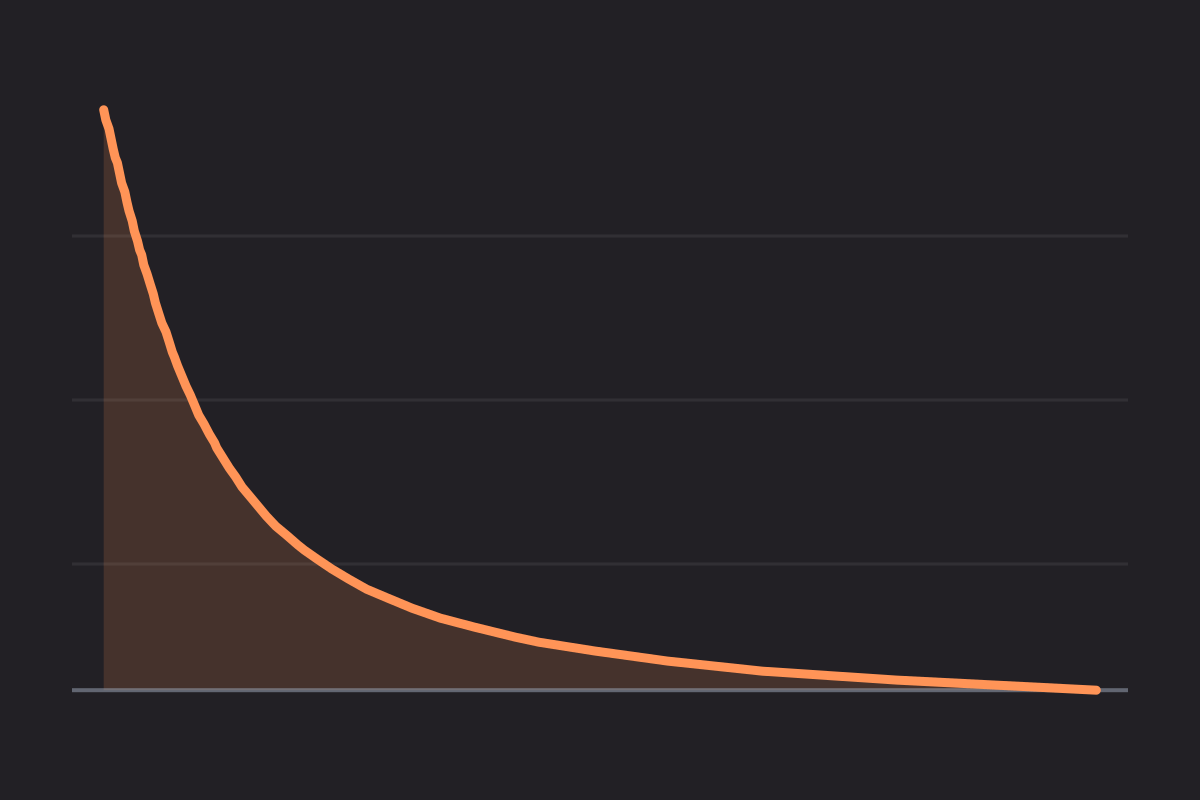
No integration error: nothing is integrated. Every path is the exact hyperbola of a Coulomb repulsion, placed in time by the exact orbit time law solved to rounding error, and every angle, distance and cross-section the readouts show is a closed form. The detector is a random sample: each alpha’s impact parameter is drawn at random across the beam, so a band expected to hold n alphas holds about n give or take √n, and the few bands at large angles scatter most about the formula. That scatter is what a real detector records too, and it shrinks as more alphas are fired.
Common questions
What is Rutherford scattering?
It is the deflection of alpha particles, or any charged particles, by the electric repulsion of an atomic nucleus. Rutherford showed in 1911 that a small, heavy, positive nucleus sends each alpha along a hyperbola, and Geiger and Marsden confirmed in 1913 that the number scattered through an angle θ falls as 1/sin⁴(θ/2). Only a nucleus can turn alphas back, which is how the experiment showed that atoms have one.
How do you calculate the distance of closest approach?
Set the alpha’s kinetic energy equal to the electric potential energy where it stops: for a head-on alpha, d = 2Ze²/(4πε₀K). With e²/(4πε₀) = 1.44 MeV fm, a 7.7 MeV alpha and a gold nucleus give d = 2 × 79 × 1.44/7.7 = 29.5 fm. An alpha aimed at impact parameter b gets no closer than d/2 + √((d/2)² + b²), which is 35.8 fm at b = 15 fm.
How is the scattering angle related to the impact parameter?
By tan(θ/2) = d/(2b), where d is the head-on distance of closest approach and b the impact parameter. An alpha aimed at b = d/2 is turned through exactly 90°, a head-on one comes straight back, and one aimed at b = 10d is deflected by only 5.7°. For a 7.7 MeV alpha on gold, 90° needs b = 14.8 fm.
Why do so few alpha particles bounce back?
Because an alpha has to be aimed within d/2 of a nucleus, 14.8 fm for 7.7 MeV alphas on gold, to be turned through more than 90°, and that target, π(d/2)² or 686 fm², is tiny beside the share of a foil each nucleus has to itself. A gold foil 2.1 × 10⁻⁷ m thick turns back about 1 alpha in 118,000. Most of the rest pass far from every nucleus and are deflected by a few degrees at most.
What is the Rutherford scattering formula?
It gives the share of alphas scattered in each direction: dσ/dΩ = (d/4)²/sin⁴(θ/2), with d = 2Ze²/(4πε₀K). So the count in a detector of fixed size at angle θ goes as 1/sin⁴(θ/2), as Z² and as 1/K². Geiger and Marsden’s counts from gold fell from 132,000 at 15° to 33.1 at 150°, while N sin⁴(θ/2) stayed between 27.5 and 39.6.