Coulomb’s Law Calculator
Apply Coulomb’s law to find the force between two point charges, with the field, each charge as a multiple of e and the force at twice the separation.
Calculator
Magnitude only. Sign decides attraction or repulsion, not strength.
Centre to centre, and it is squared, so halving it quadruples the force.
Working, with your numbers
- F = k q1 q2 / r^2
- = 8.988 × 10⁹ x 1 × 10⁻⁶ C x 1 × 10⁻⁶ C / (0.1 m)^2
- = 0.0089876 / 0.01
- = 0.89876 N
Values are converted into the units the equation is worked in before the arithmetic.
- Field from the first charge E = kq/r². Multiply by the second charge to recover the force.
- 898,800 N/C
- Charges as multiples of e A microcoulomb is about 6.24 × 10¹² elementary charges.
- 6.242 × 10¹² and 6.242 × 10¹²
- At twice the separation Inverse square: double the distance, quarter the force.
- 0.2247 N
Citing this tool
Last updated . Add the date you accessed it as well, which a citation of a page that can change asks for. If a specific result matters, cite the permalink from the tool’s share row instead of this page: it reproduces the exact parameters.
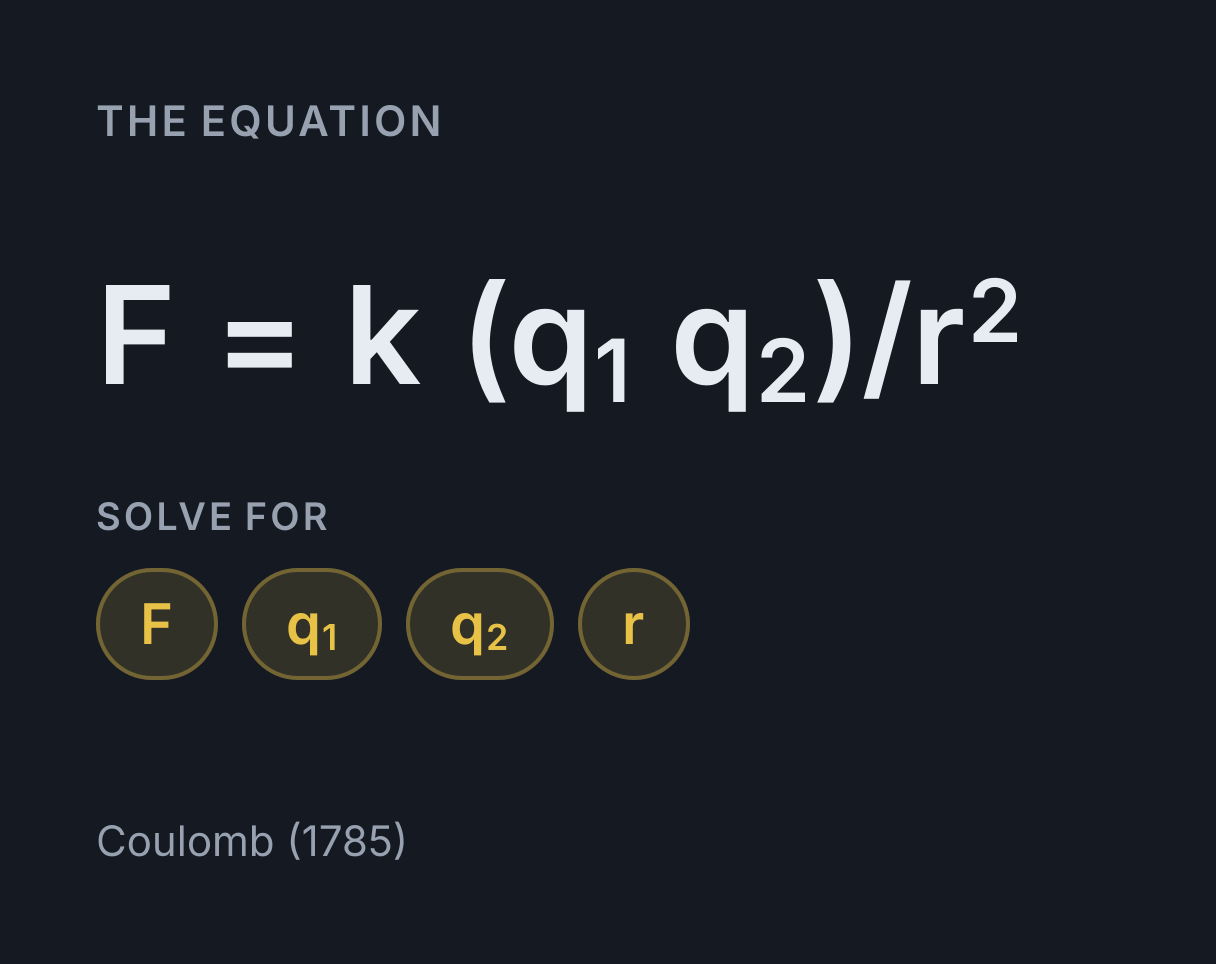
The equation
Coulomb (1785)
Magnitudes set the strength, signs set the direction
Coulomb’s law says the force between two point charges is proportional to the product of their magnitudes and inversely proportional to the square of their separation. The signs do not appear in the size of the force at all. They decide only whether the two are pushed apart or pulled together: like charges repel, opposite charges attract.
This is why the fields above ask for magnitudes. Feeding both signs into the formula and reading a negative answer as a weaker force is a standard exam trap. A negative result from the signed form means attraction, and its magnitude is exactly what the unsigned calculation gives.
The inverse square is the part worth internalising
Separation enters squared, so it dominates everything. Halving the distance quadruples the force, and doubling it cuts the force to a quarter. Move two charges from 1 cm apart to 10 cm apart and the force falls by a factor of a hundred, not ten.
That steepness is why charged objects appear to do nothing until they are close, and then act suddenly. It also means the separation is the input worth measuring carefully: a 10 percent error in distance produces roughly a 20 percent error in force, whereas a 10 percent error in either charge produces only 10 percent.
Worked example
Two charges of 1 µC each, 10 cm apart in vacuum:
-
F = k q₁ q₂ / r² = 8.988e9 × 1e-6 × 1e-6 / (0.1)² -
= 8.988e-3 / 0.01 = 0.899 N, a repulsion if both are the same sign. -
The field from one of them at that distance is
E = kq/r² = 8.988e9 × 1e-6 / 0.01 = 8.99e5 N/C.
Nearly a newton from two microcoulombs is worth pausing on. A microcoulomb is a tiny amount of charge, about 6.24 × 10¹² elementary charges, and yet the force is comparable to the weight of a 90 gram object. Electrostatics is strong; what keeps it invisible is that bulk matter is neutral.
Field is the more useful quantity beyond two charges
Force is a property of a pair. Field is a property of a location, and fields from several sources add as vectors, which is what makes them the right tool once a third charge appears. Work out the field at a point from every source, add them, then multiply by the charge you place there.
The readout above gives the field from the first charge for this reason. Multiply it by the second charge and you recover the force, which is a useful consistency check, and it makes clear that the field exists whether or not a second charge is present to feel it.
With three or more charges the electric field simulator does that sum at any point you choose, charge by charge, and draws the field lines and equipotentials it adds up to.
Common mistakes
- Forgetting to square the separation. The single most common error, and it produces an answer that is wrong by exactly the separation in metres, so it can look plausible.
- Leaving the distance in centimetres. With r in cm the answer is out by 10⁴, since the error is squared. The unit selector here handles it, but hand calculations need metres.
- Reading a negative signed result as a smaller force. The sign carries direction, not magnitude.
- Applying it to large nearby objects. The law is exact for point charges and for uniform spheres seen from outside. Two spheres close enough to polarise each other attract more strongly than the point-charge result.
- Ignoring the medium. The constant here, Coulomb’s constant, is for vacuum. Immerse the charges in a dielectric and the force drops by the relative permittivity of the material, which is about 80 for water.
Converting units first? Use the length, electric charge and force conversion tables.
Worked examples
Each one runs through the calculator above, so the arithmetic here is the arithmetic it does.
What is the electric force between the proton and electron in a hydrogen atom?
- F = k q1 q2 / r^2
- = 8.988 × 10⁹ x 1.6022 × 10⁻¹⁹ C x 1.6022 × 10⁻¹⁹ C / (5.29 × 10⁻¹¹ m)^2
- = 2.3071 × 10⁻²⁸ / (2.7984 × 10⁻²¹)
- = 8.2442 × 10⁻⁸ N
About 82 nN at the Bohr radius of 0.0529 nm, entered with the unit selector on e, so the calculator turns both charges into coulombs itself, as the working shows. Gravity between the same two particles is about 3.6 × 10⁻⁴⁷ N, over 10³⁹ times weaker, which is why gravity plays no part in holding an atom together.
How far apart must a 2 µC and a 3 µC charge be to feel a 1 N force?
- r = sqrt(k q1 q2 / F)
- = sqrt(8.988 × 10⁹ x 2 × 10⁻⁶ C x 3 × 10⁻⁶ C / 1 N)
- = sqrt(0.053925)
- = 0.2322 m = 23.222 cm
About 23 cm. Solving for the separation brings in a square root, so the distance responds more gently than the force: halving the force takes the charges apart by a factor of 1.41, to about 33 cm, not twice as far. Twice as far quarters the force instead.
Practise this with Electricity Practice Problems, questions generated from this calculator and 6 other calculators in Electricity.
Common questions
Does the sign of the charges change the size of the force?
No. The magnitudes set the strength and the signs only decide the direction: like charges repel, opposite charges attract. That is why this calculator asks for magnitudes. A common exam trick is to feed both signs into the formula and read the negative result as a smaller force, when it simply means attraction.
Why is electrostatic force so much stronger than gravity?
Because the constants differ by about 20 orders of magnitude. For two protons, the electrostatic repulsion is roughly 10³⁶ times their gravitational attraction. Gravity only dominates at astronomical scale because matter is electrically neutral in bulk, so the charges cancel while the masses keep adding up.
When does Coulomb’s law stop applying?
It is exact only for point charges or for uniformly charged spheres treated from outside, and it assumes both are at rest in vacuum. Bring two charged conducting spheres close together and each redistributes the other’s charge, so the real force departs from the point-charge prediction: opposite charges attract more strongly, while like charges repel less, and unequal like charges can even attract once the spheres nearly touch. A dielectric around them reduces the force by the relative permittivity of the material.