Gravitational Force Calculator
Calculate the gravitational attraction between two masses, with the field strength and how it compares to the weight of the smaller mass on Earth.
Calculator
Between centres of mass, not between surfaces. Squared, as with any inverse-square law.
Working, with your numbers
- F = G m1 m2 / r^2
- = 6.6743 × 10⁻¹¹ x 1000 kg x 1000 kg / (1 m)^2
- = 6.6743 × 10⁻⁵ / 1
- = 6.674 × 10⁻⁵ N = 0.066743 mN
Values are converted into the units the equation is worked in before the arithmetic.
- Field from the first mass g = Gm/r². This is 9.81 N/kg at the Earth’s surface.
- 6.674 × 10⁻⁸ N/kg
- Fraction of the smaller mass’s Earth weight Why mutual gravity between everyday objects goes unnoticed.
- 6.806 × 10⁻⁹
- At twice the separation Inverse square, exactly as with Coulomb’s law.
- 1.669 × 10⁻⁵ N
Citing this tool
Last updated . Add the date you accessed it as well, which a citation of a page that can change asks for. If a specific result matters, cite the permalink from the tool’s share row instead of this page: it reproduces the exact parameters.
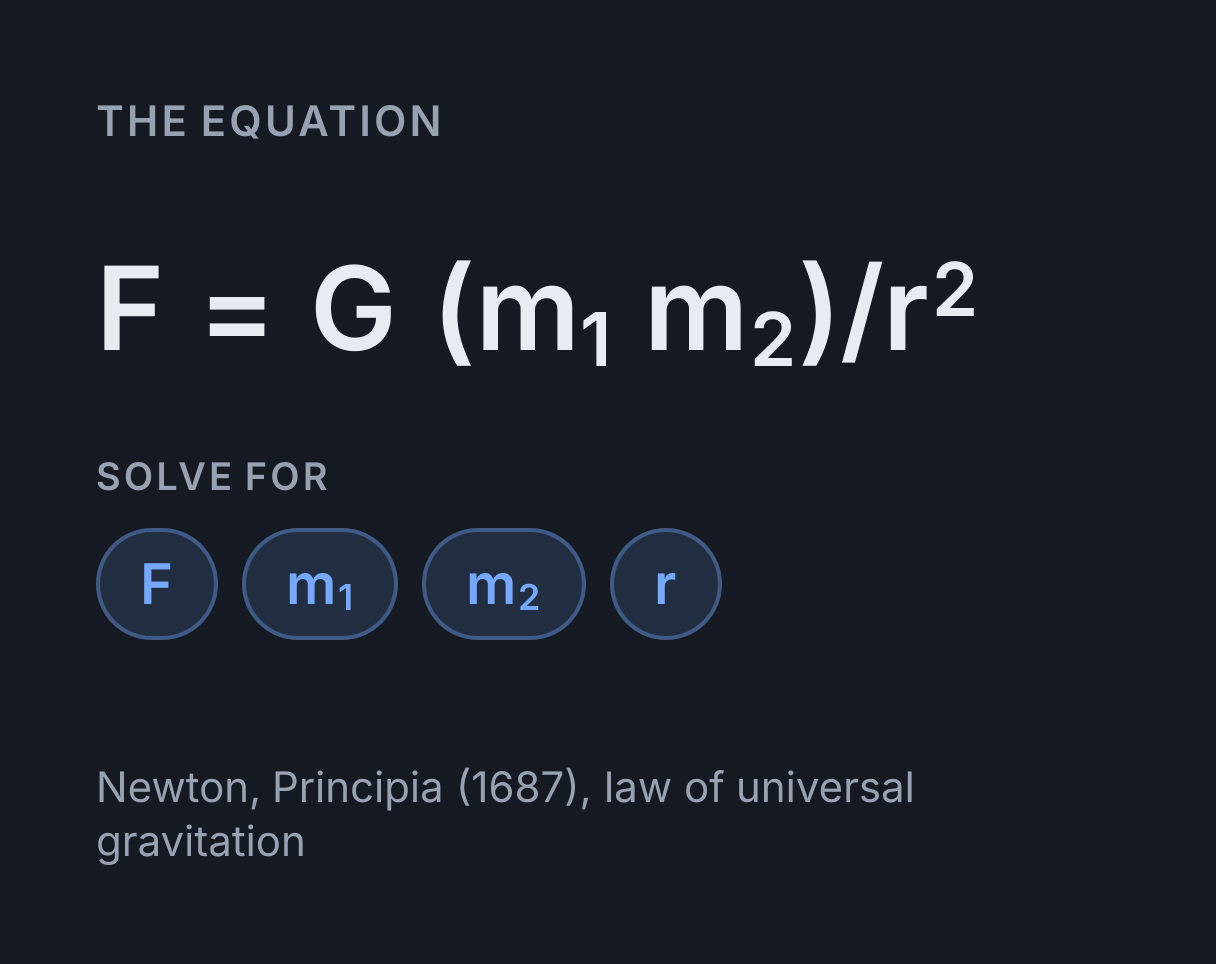
The equation
Newton, Principia (1687), law of universal gravitation
Every pair of masses attracts, and the constant is tiny
Newton’s law of gravitation has the same shape as Coulomb’s law: a product of two source strengths over the square of the separation. The difference is the size of the constant. G is about 6.674 × 10⁻¹¹, twenty orders of magnitude smaller than the electrostatic constant, which is why gravity between everyday objects is real and far too weak to notice without a sensitive instrument such as a torsion balance.
Two one-tonne cars parked a metre apart attract with roughly 67 micronewtons, about seven billionths of the force the Earth exerts on either one. Gravity only comes to dominate at astronomical scale because it never cancels. Charge comes in two signs and bulk matter is neutral, so electrostatic forces average away, while mass only ever adds.
Distances are between centres, not surfaces
For a uniform sphere, the gravitational field outside it is identical to that of all its mass concentrated at the centre. That result is why surface gravity calculations use the Earth’s radius rather than zero, and it is the assumption that makes the law usable for planets at all.
Measuring from the surfaces instead is the most common mistake here, and it fails badly when the objects are large compared with the gap between them. Two touching spheres are not at zero separation, and the formula would predict infinite force if they were.
Worked example
Two 1000 kg masses with their centres 1 metre apart:
-
F = G m₁ m₂ / r² = 6.6743e-11 × 1000 × 1000 / 1² = 6.674e-5 N, which is about 67 micronewtons. -
The field from one of them at that distance is
6.6743e-11 × 1000 / 1 = 6.67e-8 N/kg, against 9.81 N/kg at the Earth’s surface. -
As a fraction of the smaller mass’s weight on Earth,
6.674e-5 / (1000 × 9.80665) = 6.8e-9.
That last figure is the honest answer to why nobody notices. To feel gravity you need a mass on the order of a planet, which is exactly what makes measuring G itself so hard: the experiment has to detect the attraction of laboratory-sized objects, and it remains the least precisely known of the fundamental constants.
Where g comes from
Weight is this force with one of the masses being the Earth. Write
F = mg alongside F = GMm/r², cancel the object’s mass,
and g = GM/r². With M = 5.97 × 10²⁴ kg and r = 6371 km that gives
about 9.82 N/kg, a little above the standard 9.80665, because the standard value
also accounts for the Earth’s rotation and its equatorial bulge.
So g is not a constant of nature but a consequence of the Earth’s mass and radius, and it varies. It falls with altitude as the inverse square of distance from the centre, which puts the value at the International Space Station’s 400 km orbit at roughly 8.7 N/kg, about 11 percent below the surface value. Astronauts float because they are in free fall, not because gravity has stopped.
Common mistakes
- Measuring between surfaces. The separation is centre to centre. For two spheres, add both radii to the gap.
- Forgetting to square the separation. The same trap as every inverse-square law, and it leaves the answer wrong by a factor of r.
- Using grams. G carries kilograms in its units. A mass in grams makes the answer wrong by 10³ per mass, so 10⁶ for a pair. The unit selector handles it here; hand working does not.
- Confusing G with g. G is 6.674 × 10⁻¹¹ m³/(kg·s²) and universal. Lower case g is 9.81 N/kg and specific to the Earth’s surface.
- Quoting too many figures. G is known to about 1 part in 45,000, so an answer to more than five significant figures is claiming precision the constant does not have.
Converting units first? Use the mass, length and force conversion tables.
Worked examples
Each one runs through the calculator above, so the arithmetic here is the arithmetic it does.
What is the gravitational force between the Earth and the Moon?
- F = G m1 m2 / r^2
- = 6.6743 × 10⁻¹¹ x 5.972 × 10²⁴ kg x 7.346 × 10²² kg / (3.844 × 10⁸ m)^2
- = 2.928 × 10³⁷ / (1.4776 × 10¹⁷)
- = 1.982 × 10²⁰ N
About 2 × 10²⁰ N, and by Newton’s third law the Moon pulls on the Earth with exactly the same force. The effects differ because the masses do: the Moon has about 1.2 percent of the Earth’s mass, so the same force accelerates it about 81 times as much. The distance is centre to centre, 384,400 km.
How can you work out the mass of the Earth from the weight of 1 kg?
- m1 = F r^2 / (G m2)
- = 9.81 N x (6.371 × 10⁶ m)^2 / (6.6743 × 10⁻¹¹ x 1 kg)
- = 3.9818 × 10¹⁴ / (6.6743 × 10⁻¹¹)
- = 5.966 × 10²⁴ kg
About 5.97 × 10²⁴ kg, from the 9.81 N that a kilogram weighs and the Earth’s 6371 km radius. That is why Cavendish’s torsion balance experiment of 1798 is remembered as weighing the Earth: g and the radius were already known, and measuring the faint pull between lead spheres supplied the one missing quantity.
Practise this with Mechanics Practice Problems, questions generated from this calculator and 10 other calculators in Mechanics.
Common questions
Why can I not feel the gravity of objects around me?
Because G is about 6.67 × 10⁻¹¹, which makes everyday gravitational forces vanishingly small. Two one-tonne cars a metre apart attract with roughly 67 micronewtons, about seven billionths of what the Earth pulls on either of them. Only a mass on the scale of a planet produces a force you notice.
Do I measure the separation between surfaces or centres?
Between centres of mass. For a uniform sphere the external field is identical to that of a point mass at its centre, which is why the Earth’s radius appears in surface-gravity calculations. Using the gap between two surfaces instead of the centre distance is the most common error, and it overstates the force badly when the objects are large compared with the gap.
How does this relate to weight and to g?
Weight is this force with one mass being the Earth. Setting F = mg and cancelling the object’s mass gives g = GM/r², which comes to about 9.82 N/kg at the Earth’s surface with M = 5.97 × 10²⁴ kg and r = 6371 km. So g is not a fundamental constant, it is a consequence of the Earth’s mass and radius, and it falls off with altitude.