Centripetal Force Calculator
Calculate the centripetal force and acceleration for any turn from mass, speed and radius, with the acceleration expressed in multiples of g.
Calculator
Working, with your numbers
- F = m v^2 / r
- = 1000 kg x 10^2 / 200 m
- = 1000 x 100 / 200
- = 500 N
Values are converted into the units the equation is worked in before the arithmetic.
- Centripetal acceleration
- 0.5 m/s²
- In g Sustained values above about 5 g acting from head to foot, as for a pilot pulling out of a dive, cause most people to lose consciousness.
- 0.05099 × g
- Time for one lap
- 125.7 s
Citing this tool
Last updated . Add the date you accessed it as well, which a citation of a page that can change asks for. If a specific result matters, cite the permalink from the tool’s share row instead of this page: it reproduces the exact parameters.
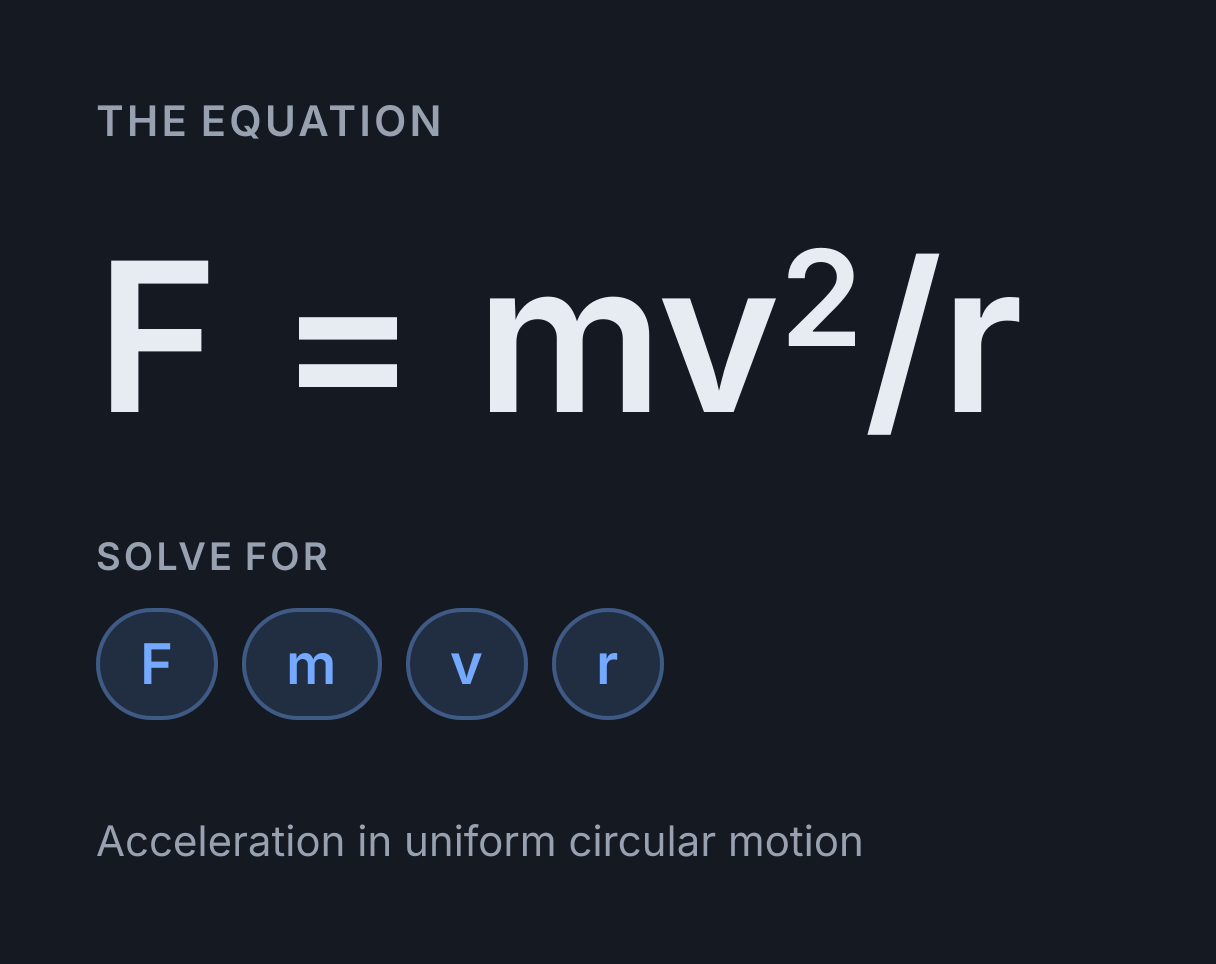
The equation
Acceleration in uniform circular motion
Turning is acceleration, so it needs a force
An object moving in a circle at constant speed is still accelerating, because
its velocity is a vector and its direction changes continuously. That
acceleration points at the centre of the circle, and by
F = ma something has to supply the force that produces it.
F = mv²/r is simply Newton’s second law with the circular value
of a, which is v²/r, substituted in.
The shape of the expression tells you where the sensitivity lies. Speed is squared, so taking the same corner at twice the speed demands four times the force. Radius sits in the denominator, so the relationship there is inverse: halve the radius and the force doubles. The squared term dominates in practice, which is why cornering accidents scale so sharply with speed while a slightly tighter line barely registers.
Worked example
A 1000 kg car rounds a bend of radius 200 m at 10 m/s, which is 36 km/h. Those are the loaded values, so the readouts on screen follow along.
a = v² / r = 100 / 200 = 0.5 m/s²F = m a = 1000 × 0.5 = 500 N- In multiples of g:
0.5 / 9.80665 = 0.05099 × g - One full lap:
2πr / v = 1256.6 / 10 = 125.7 s
Now raise the speed to 20 m/s. The force becomes
1000 × 400 / 200 = 2000 N, four times as much for a doubling of
speed. Tighten the radius to 100 m instead and it becomes 1000 N, exactly
double. The 500 N here is a gentle turn. Hard cornering in a road car runs
closer to 1 g, meaning something near 9800 N on the same mass.
Centrifugal force is not acting on the object
The outward push a passenger feels in a turn has no physical source pulling them towards the door. What is happening is that their inertia carries them straight on while the car curves beneath them, and the door then pushes them inwards to bring them round with it. The only real force is centripetal, and it must be supplied by something concrete: friction under the tyres, tension in a string, gravity for an orbiting satellite, or the normal force from a banked surface.
Identifying the supplier matters because each has a ceiling. Friction is the
obvious case. Tyres can only generate so much lateral grip, and once the
required mv²/r exceeds that limit the car simply continues in a
straight line and understeers off the intended path. No amount of steering
input helps, because the shortfall is in the force available rather than in
the direction it is pointed. Banking the surface is the standard remedy: the
road is tilted so that part of the normal force points towards the centre of
the turn and contributes to the requirement, which is why racetracks and
railway curves lean into their bends.
Common mistakes
- Forgetting to square the speed. Using
mv/rgives 50 N for the example above instead of 500 N. The squared term is the whole reason speed matters so much here. - Adding centrifugal force to a free body diagram. In the
ground frame there is no outward force on the object. Draw only the real
forces and set their inward resultant equal to
mv²/r. - Mixing diameter and radius. Track and centrifuge specifications often quote a diameter. Using it directly halves the calculated force, and the error passes unnoticed because the answer still looks plausible.
- Using angular speed in the linear formula. If you have
revolutions per minute rather than metres per second, convert first, or use
F = mω²rwith ω in radians per second.
Converting units first? Use the mass, length, speed and force conversion tables.
Worked examples
Each one runs through the calculator above, so the arithmetic here is the arithmetic it does.
How fast can a 1200 kg car take a 50 m bend with 8 kN of grip?
- v = sqrt(F r / m)
- = sqrt(8000 x 50 / 1200)
- = sqrt(333.33)
- = 18.257 m/s
About 18.3 m/s, or 66 km/h. The 8 kN is 0.68 g for this car, and tyre grip grows with the weight on the tyres, so a heavier car on the same road gets proportionally more of it: the top speed works out as √(μgr), with the mass cancelled. The friction coefficient and the radius set the limit, not the car’s weight.
What tension swings a 0.5 kg ball on a 1.2 m string at 6 m/s?
- F = m v^2 / r
- = 0.5 kg x 6^2 / 1.2 m
- = 0.5 x 36 / 1.2
- = 15 N
15 N for a horizontal circle, such as a ball whirled round on a smooth table. Swung in a vertical circle at the same speed, the string also has to hold up the ball’s 4.9 N weight at the bottom and gets help from it at the top, so the tension runs from about 19.9 N at the bottom to 10.1 N at the top.
Practise this with Mechanics Practice Problems, questions generated from this calculator and 10 other calculators in Mechanics.
Common questions
Is centrifugal force real?
Not as a force acting on the object. What exists is the centripetal force pulling it towards the centre, supplied by tension, friction or gravity. The outward push a passenger feels is their own inertia carrying them straight on while the car turns beneath them. Centrifugal force is a useful bookkeeping term in a rotating frame, not something with a physical source.
Why does halving the radius double the force?
Because the force is inversely proportional to radius. A tighter turn changes the direction of travel faster, which needs more acceleration towards the centre. Speed matters more still: it is squared, so taking the same corner twice as fast needs four times the force, which is why cornering accidents scale so sharply with speed.
What supplies the force when a car turns?
Friction between the tyres and the road, which has a limit. Once the required centripetal force exceeds what friction can supply, the car continues in a straight line and slides. Banking the road tilts the normal force inwards so some of it contributes, which is why racetracks and railway curves are banked.