Force Calculator (F = ma)
Solve Newton’s second law for force, mass or acceleration with unit conversion, and see the acceleration in multiples of g alongside weight.
Calculator
Working, with your numbers
- F = m x a
- = 4 x 5
- = 20 N
Values are converted into the units the equation is worked in before the arithmetic.
- In g Acceleration as a multiple of standard gravity, 9.80665 m/s².
- 0.5099 × g
- Weight on Earth Weight is a force; mass is not. This is what a scale measures.
- 39.23 N
- Speed gained in 1 s Change in speed over one second of this acceleration; the speed itself only if the object starts from rest.
- 5 m/s
Citing this tool
Last updated . Add the date you accessed it as well, which a citation of a page that can change asks for. If a specific result matters, cite the permalink from the tool’s share row instead of this page: it reproduces the exact parameters.
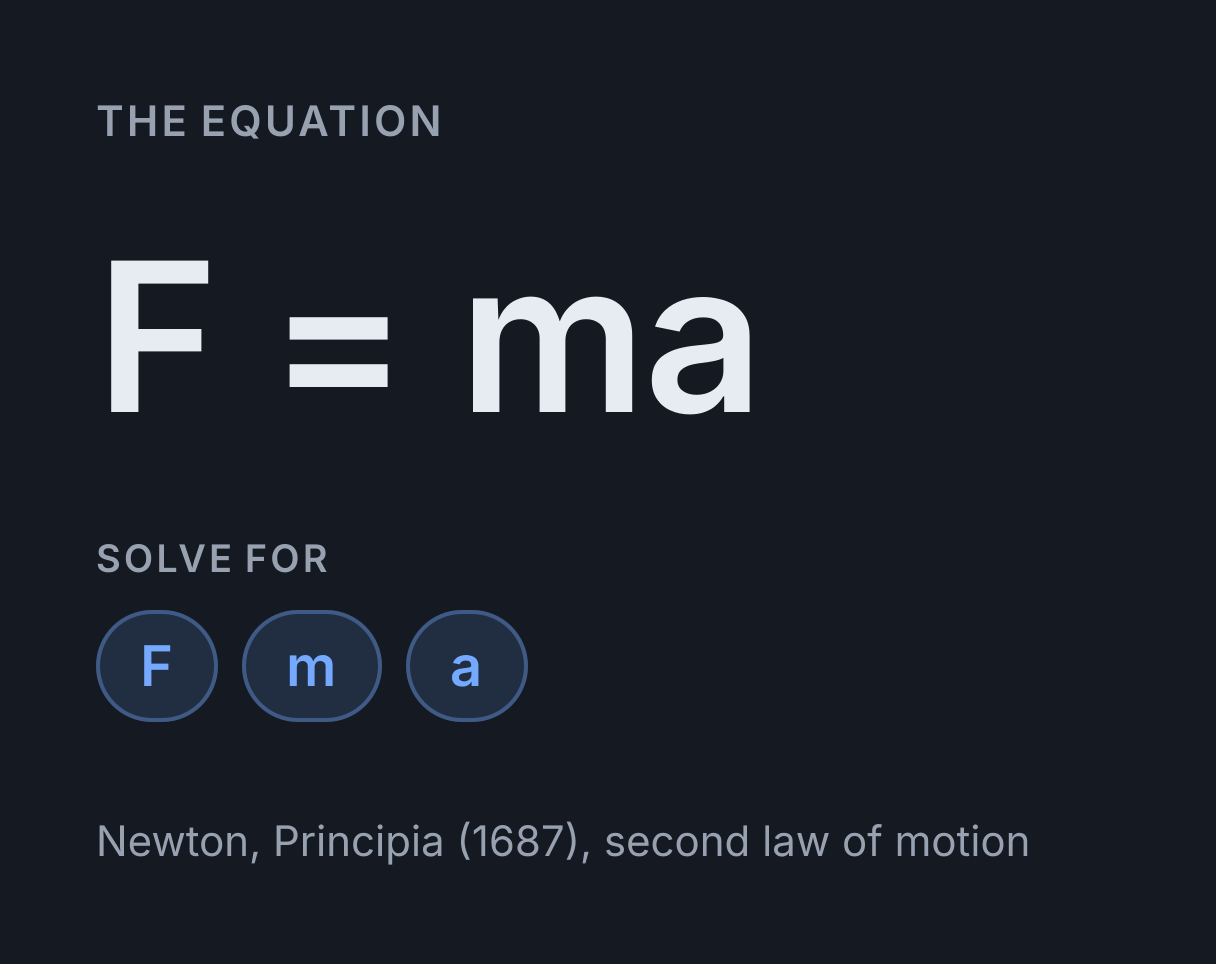
The equation
Newton, Principia (1687), second law of motion
What F = ma is saying
Newton’s second law states that the acceleration of a body is proportional
to the force applied to it and inversely proportional to its mass. Written
F = ma, with force in newtons, mass in kilograms and
acceleration in metres per second squared, it defines the newton: one
newton accelerates one kilogram at one metre per second squared, so a
newton is a kg·m/s².
The rearrangements carry the practical content. a = F / m gives
the acceleration a known push produces, which shows why the same force
moves a light object far more readily than a heavy one, and
m = F / a gives the inertial mass from a measured force and
acceleration. Mass in this law is a measure of resistance to being
accelerated, not a measure of how heavy something feels.
Worked example
A 4 kg object is accelerated at 5 m/s². Find the force required, and compare it with the object’s weight.
F = ma = 4 × 5 = 20 N-
Weight on Earth:
W = mg = 4 × 9.80665 = 39.23 N. -
Expressed in units of gravity:
5 / 9.80665 = 0.51 g. - So the 20 N push is about half the object’s own weight, and it produces roughly half the acceleration of free fall.
Mass, weight, and the general form of the law
Mass and weight are different quantities. Mass is measured in kilograms and does not depend on location: the 4 kg object above is 4 kg anywhere. Weight is a force in newtons, equal to mass times the local gravitational acceleration, and it varies with where the object is. The same 4 kg weighs about 39 N on Earth and about 6.5 N on the Moon, where the gravitational acceleration is roughly one sixth as large.
Two refinements matter beyond the textbook cases. First, the general
statement of the second law is that force equals the rate of change of
momentum, and F = ma is the special case where the mass is
constant. When the mass changes during the motion, as it does for a rocket
burning fuel, the momentum form has to be used instead. Second,
F is the net force, meaning the vector sum of
every force acting on the body. A crate pushed with 20 N against 8 N of
friction accelerates under a net 12 N, so the forces have to be added as
vectors before the law is applied.
Common mistakes
- Using weight where mass belongs. Substituting 39.23 N into the mass slot instead of 4 kg overstates the required force by roughly a factor of ten. Divide a weight by the gravitational acceleration first.
- Forgetting that F is the net force. Friction, the normal force and gravity all contribute. Leaving out an opposing force predicts an acceleration higher than the one observed.
- Working in grams. A newton is defined with kilograms, so a mass in grams must be divided by a thousand. Using grams directly inflates the force by that factor.
- Confusing acceleration with velocity. A body moving at constant velocity has zero acceleration and therefore zero net force, however fast it is travelling. Force relates to the change in velocity, not to velocity itself.
Converting units first? Use the mass, force and acceleration conversion tables.
Worked examples
Each one runs through the calculator above, so the arithmetic here is the arithmetic it does.
What force accelerates a 1200 kg car at 3 m/s squared?
- F = m x a
- = 1200 x 3
- = 3600 N
3600 N, and this is the NET force. The engine must supply that plus whatever drag and rolling resistance take, which at motorway speed is several hundred newtons more. F = ma answers what the acceleration requires, not what the engine has to produce.
What acceleration does a 20 N force give a 4 kg mass?
- a = F / m
- = 20 / 4
- = 5 m/s2
5 m/s squared, and note what the answer does not depend on: how fast the object is already moving. A constant net force gives a constant acceleration whether the object is at rest or already travelling, which is the part of this law that contradicts intuition.
What mass does a 500 N force accelerate at 2.5 m/s squared?
- m = F / a
- = 500 / 2.5
- = 200 kg
200 kg. Read this way the equation is a definition of inertia: mass is the ratio of force to the acceleration it produces, so a large mass is simply one that yields little for a given push. That is what makes mass measurable without a balance.
Practise this with Mechanics Practice Problems, questions generated from this calculator and 10 other calculators in Mechanics.
Common questions
What is the difference between mass and weight?
Mass is the amount of matter, measured in kilograms, and does not change with location. Weight is the gravitational force on that mass, measured in newtons, and does change. A 4 kg object weighs about 39 N on Earth and about 6.5 N on the Moon.
Is F = ma the whole of the second law?
It is the constant-mass form. The general statement is that force equals the rate of change of momentum, which matters when mass itself changes. A rocket burning fuel is the standard example. For everyday problems with fixed mass the two are equivalent.