Kinetic Energy Calculator
Solve KE = ½mv² for energy, mass or speed with unit conversion, and see momentum and the equivalent fall height alongside the result.
Calculator
Working, with your numbers
- KE = 0.5 x m x v^2
- = 0.5 x 2 x 15.811^2
- = 0.5 x 2 x 250
- = 250 J
Values are converted into the units the equation is worked in before the arithmetic.
- Momentum p = mv. Doubling speed doubles momentum but quadruples kinetic energy.
- 31.62 kg·m/s
- In kilojoules
- 0.25 kJ
- Equivalent drop Height this object would have to fall to gain this much energy.
- 12.75 m
Citing this tool
Last updated . Add the date you accessed it as well, which a citation of a page that can change asks for. If a specific result matters, cite the permalink from the tool’s share row instead of this page: it reproduces the exact parameters.
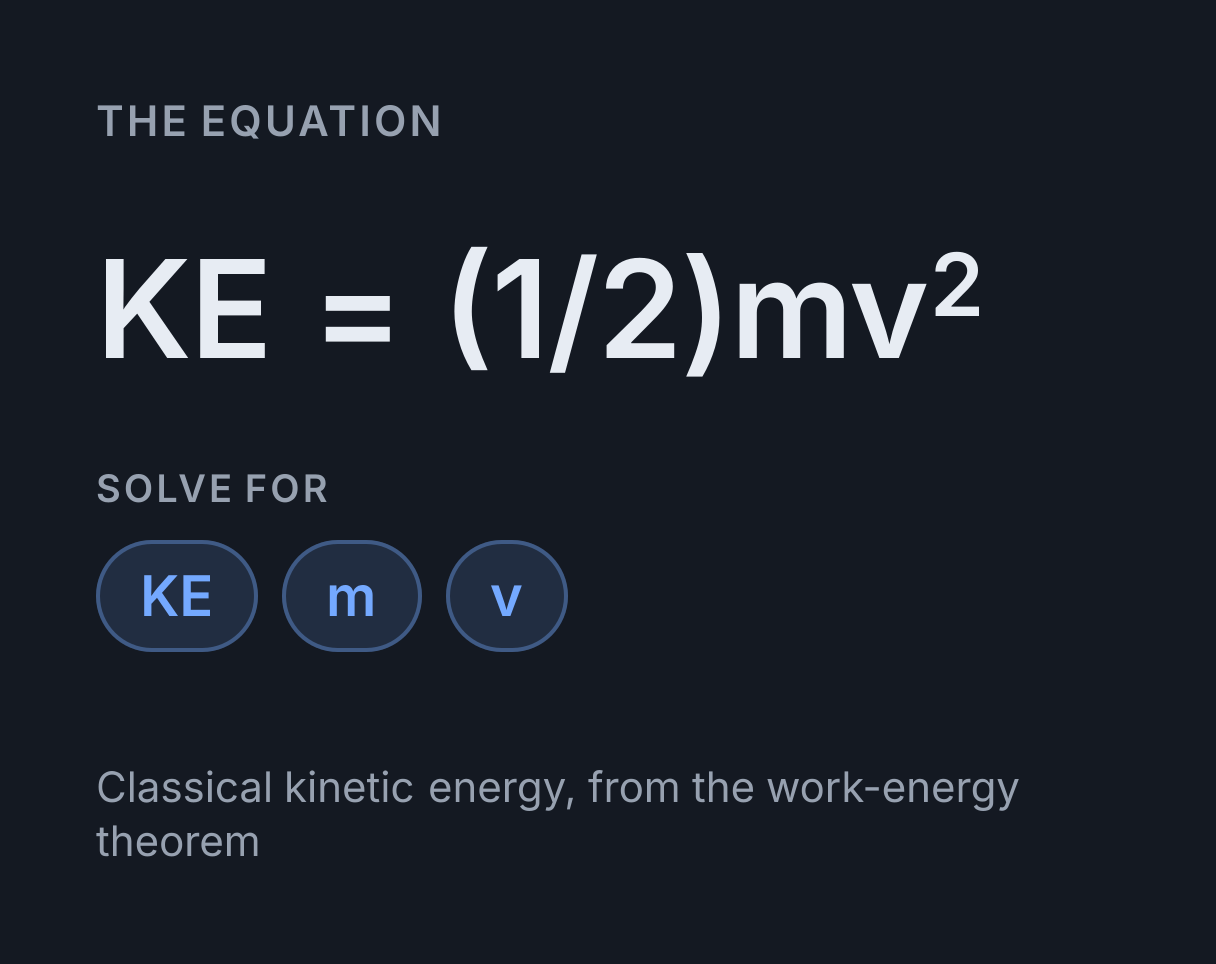
The equation
Classical kinetic energy, from the work-energy theorem
What KE = ½mv² is saying
Kinetic energy is the energy an object carries by virtue of its motion,
given by KE = ½mv² with mass in kilograms, speed in metres per
second and the result in joules. The expression follows from the work done
in accelerating a body from rest: force times distance, integrated over the
acceleration, produces the factor of one half and the square on the speed.
The square is the part that governs behaviour. Mass enters linearly, so
doubling the mass doubles the energy, but speed enters quadratically, so
doubling the speed quadruples it. Rearranged as
v = √(2KE / m), the same relation gives the speed a known
energy will produce, which is how a stopping distance or a drop height is
turned into an impact speed.
Worked example
Take a 1 kg mass moving at 10 m/s, then compare it with the same mass at 20 m/s.
KE = ½mv² = 0.5 × 1 × 10² = 0.5 × 1 × 100 = 50 Jp = mv = 1 × 10 = 10 kg·m/sfor the momentum.- At 20 m/s:
KE = 0.5 × 1 × 400 = 200 J. - Twice the speed gives four times the energy, while the momentum only doubles to 20 kg·m/s.
Why the square matters on the road
Braking removes kinetic energy through friction at the tyres, and the friction force is roughly constant. Constant force over a distance means the stopping distance is proportional to the energy, so it grows with the square of the speed rather than in step with it. Brakes on a vehicle travelling at twice the speed must dissipate four times the energy, which is why a modest increase in speed lengthens the stopping distance sharply. The same reasoning applies to collisions: a doubling of speed is far more damaging than a doubling of mass, because the first quadruples the energy that has to be absorbed and the second only doubles it.
Kinetic energy and momentum are distinct quantities and it is worth keeping
them apart. Kinetic energy is a scalar, equal to
½mv², and it is conserved only in elastic collisions; in any
other collision part of it becomes heat and deformation. Momentum is a
vector, equal to mv, and it is conserved in
every collision regardless of type. Two objects can share the same momentum
and carry very different energies, which is why both are needed to describe
an impact.
Common mistakes
- Dropping the factor of one half. Computing
mv²gives twice the correct answer. The half comes from the integration and is not optional. - Squaring only part of the expression. The square applies
to the speed alone, not to the mass or to the product. Compute
v²first, then multiply. - Mixing km/h with m/s. Divide a speed in km/h by 3.6 before substituting, so 72 km/h becomes 20 m/s. Skipping the conversion inflates the energy by a factor of about thirteen.
- Assuming equal momentum means equal energy. A heavy slow object and a light fast one can match in momentum while differing greatly in kinetic energy, since energy depends on the square of the speed.
Converting units first? Use the mass, energy and speed conversion tables.
Worked examples
Each one runs through the calculator above, so the arithmetic here is the arithmetic it does.
How much kinetic energy does a 1500 kg car have at 100 km/h?
- KE = 0.5 x m x v^2
- = 0.5 x 1500 x 27.778^2
- = 0.5 x 1500 x 771.6
- = 578,700 J
About 579 kJ, and the conversion is where this goes wrong: 100 km/h is 27.8 m/s, not 100. Divide by 3.6. Using 100 directly gives 7.5 megajoules, thirteen times too much, and nothing about the answer looks obviously absurd.
What is the kinetic energy of a 145 g baseball thrown at 40 m/s?
- KE = 0.5 x m x v^2
- = 0.5 x 0.145 x 40^2
- = 0.5 x 0.145 x 1600
- = 116 J
116 J, against 579,000 J for the car above. A baseball at 90 mph and a car at motorway speed differ by a factor of five thousand, which is the honest reason one is a sport and the other is a collision.
What speed does a 2 kg object need to carry 400 J of kinetic energy?
- v = sqrt(2 x KE / m)
- = sqrt(2 x 400 / 2)
- = sqrt(400)
- = 20 m/s
Rearranged for speed, which brings in a square root. Doubling the energy does not double the speed, it multiplies it by about 1.41. This is the same asymmetry that makes braking distance grow with the square of speed rather than in proportion to it.
Practise this with Mechanics Practice Problems, questions generated from this calculator and 10 other calculators in Mechanics.
Common questions
Why does doubling speed quadruple the energy?
Because speed is squared in the formula while mass is not. Doubling mass doubles the energy, but doubling speed multiplies it by four. This is why stopping distances grow so sharply with speed: the brakes must dissipate four times the energy from twice the speed.
How do kinetic energy and momentum differ?
Momentum is mv, a vector that has direction and is conserved in every collision, while kinetic energy is ½mv², a scalar that is only conserved in elastic collisions. Two objects can share the same momentum and very different energies.