Momentum Calculator
Calculate momentum from mass and speed, with the impulse needed to stop it, the force that implies over a chosen time, and the kinetic energy.
Calculator
Only used for the stopping force readout. It does not affect the momentum.
Working, with your numbers
- p = m v
- = 3 x 10
- = 30 kg m/s
Values are converted into the units the equation is worked in before the arithmetic.
- Stopping force Impulse equals change in momentum, so a longer stop needs less force.
- 60 N
- Kinetic energy Momentum is mv and energy is half mv squared, so they are not interchangeable.
- 150 J
- Impulse to stop Numerically equal to the momentum, since the two share dimensions.
- 30 N·s
Citing this tool
Last updated . Add the date you accessed it as well, which a citation of a page that can change asks for. If a specific result matters, cite the permalink from the tool’s share row instead of this page: it reproduces the exact parameters.
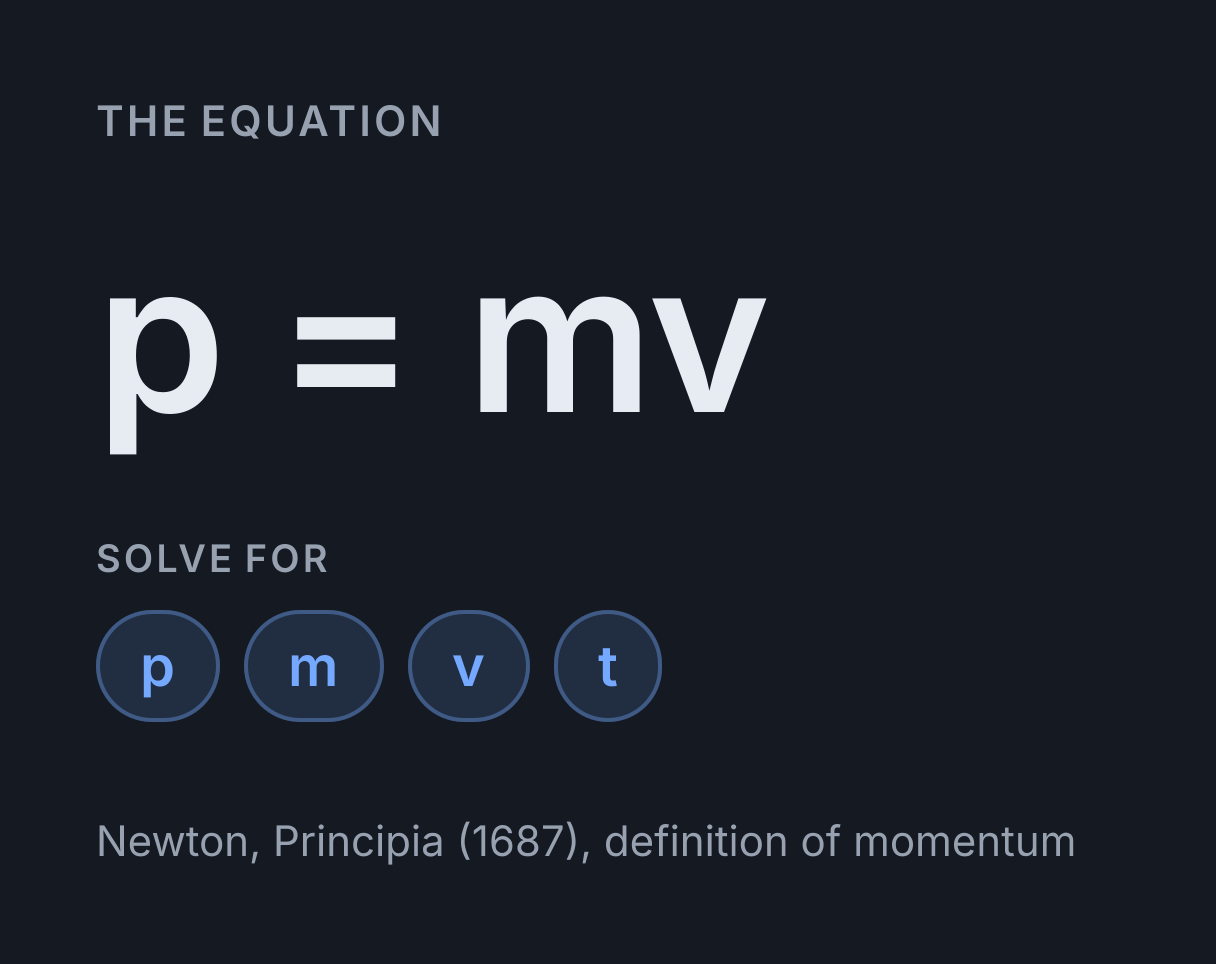
The equation
Newton, Principia (1687), definition of momentum
Momentum measures how hard something is to stop
p = mv combines the two properties that make a moving object
difficult to arrest: how much of it there is, and how fast it is travelling.
Both enter the product linearly, so a 6 kg mass at 5 m/s carries exactly the
same momentum as a 3 kg mass at 10 m/s. The heavy slow object and the light
fast one are equivalent as far as this quantity is concerned, and that
even-handedness is what makes momentum the thing that survives an impact.
Momentum is a vector. It points where the object is going, and in any collision the vector sum before the impact equals the vector sum after it, provided no net external force acts on the colliding objects. Kinetic energy behaves quite differently. It is a scalar, it grows with the square of speed rather than the first power, and it is only conserved when the collision is elastic. Anything that crumples, heats up or makes a noise has lost kinetic energy while keeping every last unit of its momentum.
Worked example
A 3 kg mass moves at 10 m/s and is brought to rest in 0.5 s. These are the values loaded on screen, so you can change one and watch every figure below move with it.
p = m v = 3 × 10 = 30 kg·m/s- Impulse needed to stop it:
30 N·s, the same number F = p / t = 30 / 0.5 = 60 NKE = ½ m v² = 0.5 × 3 × 100 = 150 J
Note what happens if you double the speed to 20 m/s. Momentum doubles to 60 kg·m/s, but kinetic energy quadruples to 600 J. The two quantities do not track each other, which is why a slow lorry and a fast bullet are hazardous in quite different ways.
Stopping force is really about time
Impulse equals the change in momentum, and impulse is force multiplied by the time it acts for. In a crash the momentum you have to shed is already fixed by your mass and your speed, so the only quantity left to negotiate is the duration of the stop. Every safety feature in a car works that lever. Airbags, crumple zones and seatbelt pretensioners do not reduce the momentum to be lost. They stretch the interval over which it is lost.
The scaling is direct. Extending a stop from 10 milliseconds against a rigid dashboard to 100 milliseconds against an inflating bag cuts the average force by a factor of ten. Set the stopping time in the calculator to 0.05 s and the 60 N above becomes 600 N. The same reasoning explains why a wicketkeeper draws their hands back as they catch, and why a fall onto concrete injures where an identical fall onto a crash mat does not.
Common mistakes
- Treating momentum as a scalar. Two trolleys of equal mass closing head on at equal speed have a total momentum of zero, not double. Assign a positive direction, keep the signs, and only then add.
- Substituting kinetic energy for momentum. Momentum is
mvand energy is½mv². Conserving the wrong one is the single most common error in collision problems, because kinetic energy is conserved only in the idealised elastic case. - Doubting that N·s equals kg·m/s. They are dimensionally identical and numerically interchangeable. Newton seconds are conventional for the impulse applied, kilogram metres per second for the momentum an object holds.
- Reading the stopping force as an instantaneous peak. The calculator returns the average force over the interval you supply. Real deceleration is far from uniform, and the peak force partway through a collision is comfortably higher than the average.
Converting units first? Use the mass, time, speed and momentum conversion tables.
Worked examples
Each one runs through the calculator above, so the arithmetic here is the arithmetic it does.
What is the momentum of a 1500 kg car travelling at 20 m/s?
- p = m v
- = 1500 x 20
- = 30,000 kg m/s
30,000 kg m/s. Momentum is a vector, so reversing the car reverses the sign while its kinetic energy stays positive. That difference is why a head-on collision is far worse than the energies alone suggest: the momenta cancel and the energy has to go somewhere.
What velocity gives a 60 kg runner 480 kg m/s of momentum?
- v = p / m
- = 480 / 60
- = 8 m/s
8 m/s, a fast run. Because momentum is linear in speed while kinetic energy goes as its square, this runner has about one sixtieth of the car’s momentum above but only about one hundred and fiftieth of its kinetic energy, 1,920 J against 300,000 J.
What mass carries 50 kg m/s of momentum at 25 m/s?
- m = p / v
- = 50 / 25
- = 2 kg
2 kg. The same 50 kg m/s could be a 2 kg object at 25 m/s or a 50 kg object at 1 m/s, and those two carry 625 J and 25 J respectively. Equal momentum does not mean equal energy, which is why both quantities are needed to describe a collision.
Practise this with Mechanics Practice Problems, questions generated from this calculator and 10 other calculators in Mechanics.
Common questions
How do momentum and kinetic energy differ?
Momentum is mv and kinetic energy is half mv squared. Momentum is a vector, so direction matters and it is conserved in every collision. Kinetic energy is a scalar and is only conserved in elastic collisions. Two objects can carry the same momentum and very different energies, which is why a slow lorry and a fast bullet are dangerous in different ways.
Why do airbags reduce injury?
Because impulse equals the change in momentum, and impulse is force times time. The momentum you have to lose in a crash is fixed by your mass and speed, so the only variable is how long the stop takes. Stretching a stop from 10 milliseconds to 100 milliseconds cuts the average force by a factor of ten.
Is a newton second the same as a kilogram metre per second?
Yes, exactly. Impulse and momentum have the same dimensions, so the two units are numerically identical and interchangeable. Newton seconds are usually used when talking about the impulse applied, and kilogram metres per second when talking about the momentum an object has.