Collision Theory and Activation Energy Simulator
Set temperature, activation energy and a catalyst to see collision theory at work: few molecules clear the barrier, yet ten degrees can double the rate.
Simulator
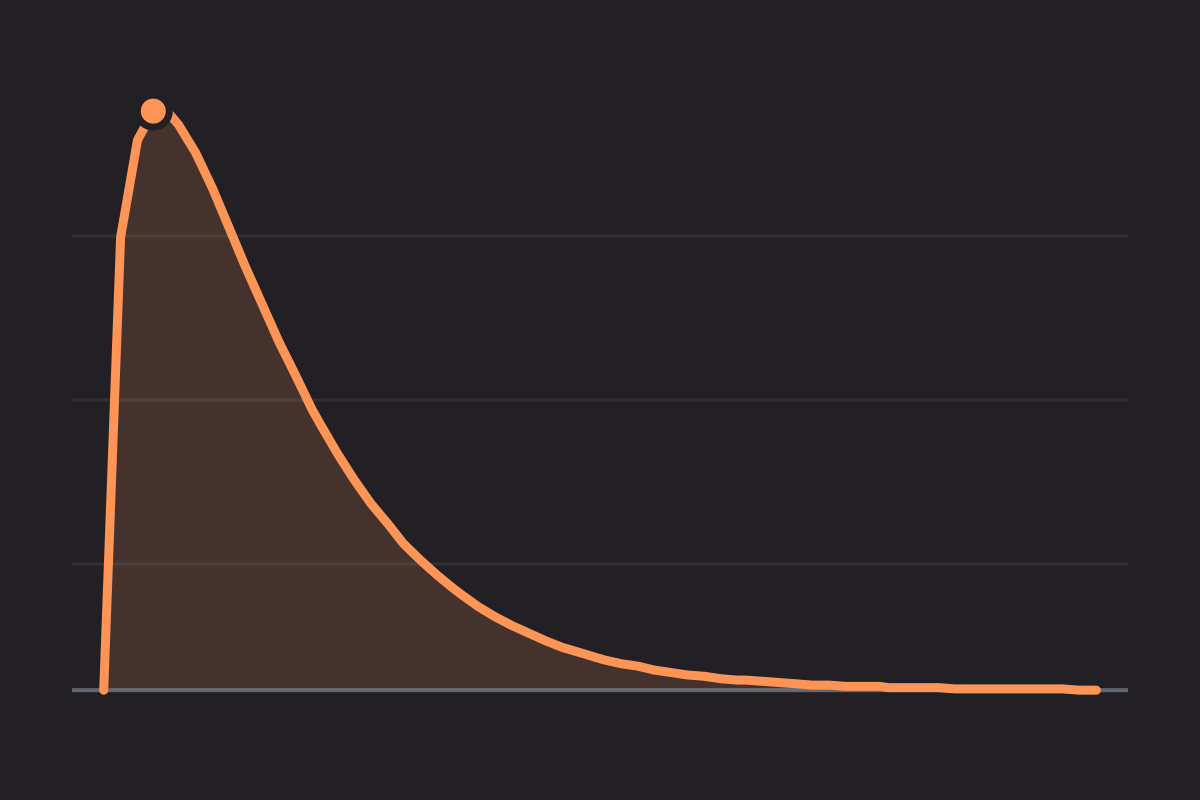
- Molecules above the barrier Integrating the distribution from the barrier upwards. This is the shaded area.
- 0.0456
- Boltzmann factor exp(-Ea/RT), the term in the Arrhenius equation. Not the same as the fraction.
- 0.0182
- Effective barrier
- 20 kJ/mol
- Mean molecular energy Three halves RT. Compare it with the barrier to see how far into the tail you are.
- 7.48 kJ/mol
- Ten degrees hotter The rule of thumb says double. That only holds for barriers around 50 kJ/mol near room temperature; compare the figure here.
- 1.07x
- Catalyst speedup At the same temperature, purely from lowering the barrier.
- 1x
- This reaction
Citing this tool
Last updated . Add the date you accessed it as well, which a citation of a page that can change asks for. If a specific result matters, cite the permalink from the tool’s share row instead of this page: it reproduces the exact parameters.
The equation
Arrhenius (1889), with collision theory of reaction rates
Temperature is a distribution, not a value
The single most useful correction to make here is that molecules in a sample at 300 K do not have "the energy of 300 K". They carry a spread of energies described by the Maxwell-Boltzmann distribution, and at any instant some are nearly stationary while a few carry many times the average. Collisions constantly reshuffle who is where, which is what the resampling in the scene is showing.
That matters because reacting is not an average behaviour. A collision only produces a reaction if it brings enough energy to clear the activation barrier, so the rate depends entirely on the population of the far right tail, and the tail behaves quite differently from the bulk.
Why ten degrees can double a rate
Set the temperature to 300 K and the activation energy to 50 kJ/mol, then move the temperature slider up by ten kelvin and watch two numbers. The mean molecular energy changes by around three percent. The fraction of molecules above the barrier, the ones that can actually react, changes by something closer to a factor of two. Same shift, wildly different consequences, because one is a linear response and the other is exponential.
This is the whole content of the Arrhenius equation:
k = A e^(-Ea/RT)
The exponential is where the sensitivity lives. The rule of thumb that ten degrees doubles a rate is not a law, it is what this expression happens to give for a barrier near 50 kJ/mol at around room temperature. Set the activation energy to 5 kJ/mol and ten degrees does almost nothing; set it to 150 and the same ten degrees is transformative. The readout reports the real ratio rather than the folklore.
Two numbers that are not the same number
Textbooks routinely call exp(-Ea/RT) "the fraction of
molecules with enough energy". It is not, and this tool shows both so the
difference is visible. Integrating the distribution above the barrier gives
F = erfc(√a) + (2/√π)·√a·e^(-a), with a = Ea/RT
which for a typical barrier is several times larger than
exp(-a) on its own. So why does the shorthand cause no harm?
Because the extra factor varies slowly with temperature while the
exponential varies enormously. The exponential therefore carries
essentially all of the temperature dependence, and everything left over is
absorbed into the pre-exponential factor A, which is fitted
experimentally anyway.
That is worth understanding rather than memorising, because it tells you
what A actually is: not a fudge factor, but the collision
frequency and the geometric requirement that molecules meet in a suitable
orientation, bundled with the slowly varying part of this integral.
What a catalyst does, and what it does not
A catalyst adds no energy. Set the reduction slider to 20 kJ/mol and watch what changes: the distribution does not move at all, and the mean energy readout does not budge. Only the barrier moves, down to where a much larger slice of the existing distribution already sits.
Because the relationship is exponential, that modest shift is dramatic. Removing 10 kJ/mol at room temperature multiplies the rate by roughly 55. Removing 20 multiplies it by about 3000, which is the square of the first figure, since exponentials turn addition into multiplication.
This also explains why catalysts do not shift an equilibrium. They lower the barrier for the forward and reverse reactions by the same amount, so both rates rise by the same factor and their ratio, which is the equilibrium constant, is untouched.
Common mistakes
- Thinking all molecules at a temperature share one energy. Temperature sets the shape of a distribution. The spread is not experimental error, it is the physics.
- Reading exp(-Ea/RT) as a literal fraction. It is the temperature-dependent term of a rate law. The true fraction is larger, and both are on screen here.
- Believing a catalyst provides energy. It lowers the barrier. The distribution is identical before and after, which the scene makes plain.
- Treating the ten-degree rule as general. It depends on the activation energy, and it fails badly at both extremes.
- Assuming every sufficiently energetic collision reacts. Energy is necessary, not sufficient: the molecules also have to be oriented correctly. That requirement lives in the pre-exponential factor, not in the exponential.
- Expecting a catalyst to change the yield. It changes how fast equilibrium is reached, not where equilibrium lies.
Model and assumptions
- Method
- Exact expression, no time stepping
- Repeatability
- Every reported number is exact and repeatable. Only the animated scatter is random.
What it assumes
- Molecular speeds follow the Maxwell-Boltzmann distribution at the stated temperature.
- A collision leads to reaction only if it carries at least the activation energy, which is the Arrhenius picture.
- The distribution is evaluated exactly rather than sampled, so the fraction in the reactive tail is a number, not an estimate.
Numerical accuracy
No method error to report: the result is a closed-form expression evaluated directly, with no time stepping to accumulate error. What remains is double-precision rounding, of order one part in 10^16 per operation.
Common questions
Why does a small temperature rise change the rate so much?
Because reacting depends on the tail of the energy distribution, not on its average. Heating shifts the whole distribution a little, which moves the average by a few percent, but the number of molecules out past the barrier is set by an exponential and can easily double. Watch the mean energy readout barely move while the shaded area changes several fold.
Is the Boltzmann factor the fraction of molecules with enough energy?
Not exactly, though it is often described that way. The true fraction, from integrating the distribution above the barrier, is several times larger than exp(-Ea/RT). Both are shown here. The shorthand survives because the exponential carries almost all of the temperature dependence and the slowly varying remainder gets absorbed into the Arrhenius pre-exponential factor A.
How does a catalyst speed up a reaction?
By lowering the barrier, not by adding energy. Nothing about the molecules changes: the same distribution, at the same temperature, simply has more of itself above a lower threshold. Because the relationship is exponential the effect is dramatic, and removing 10 kJ/mol at room temperature speeds the reaction up by roughly 55 times.
Does raising the temperature by ten degrees really double the rate?
Only for a barrier near 50 kJ/mol at around room temperature, which is where the rule of thumb came from. Set the activation energy to 5 kJ/mol and ten degrees changes almost nothing; set it to 150 and the same ten degrees changes it enormously. The readout shows the actual ratio for whatever you have set.
Why do the dots thin out towards the right?
Each dot is one molecule placed on the energy axis by its own energy, so their density is the curve drawn underneath them. Their thinning out is the distribution’s falling tail seen as individuals instead of as a smooth density, and the handful past the barrier is what the shaded probability looks like as countable molecules.
Do the molecules all have the same energy at a given temperature?
No, and this is the point people most often miss. Temperature fixes the shape of the distribution, not a single value. At any instant some molecules are nearly stationary and a few carry many times the average, and collisions constantly redistribute energy between them, which is why resampling the cloud gives a different set of molecules in the tail every time.