Arrhenius Equation Calculator
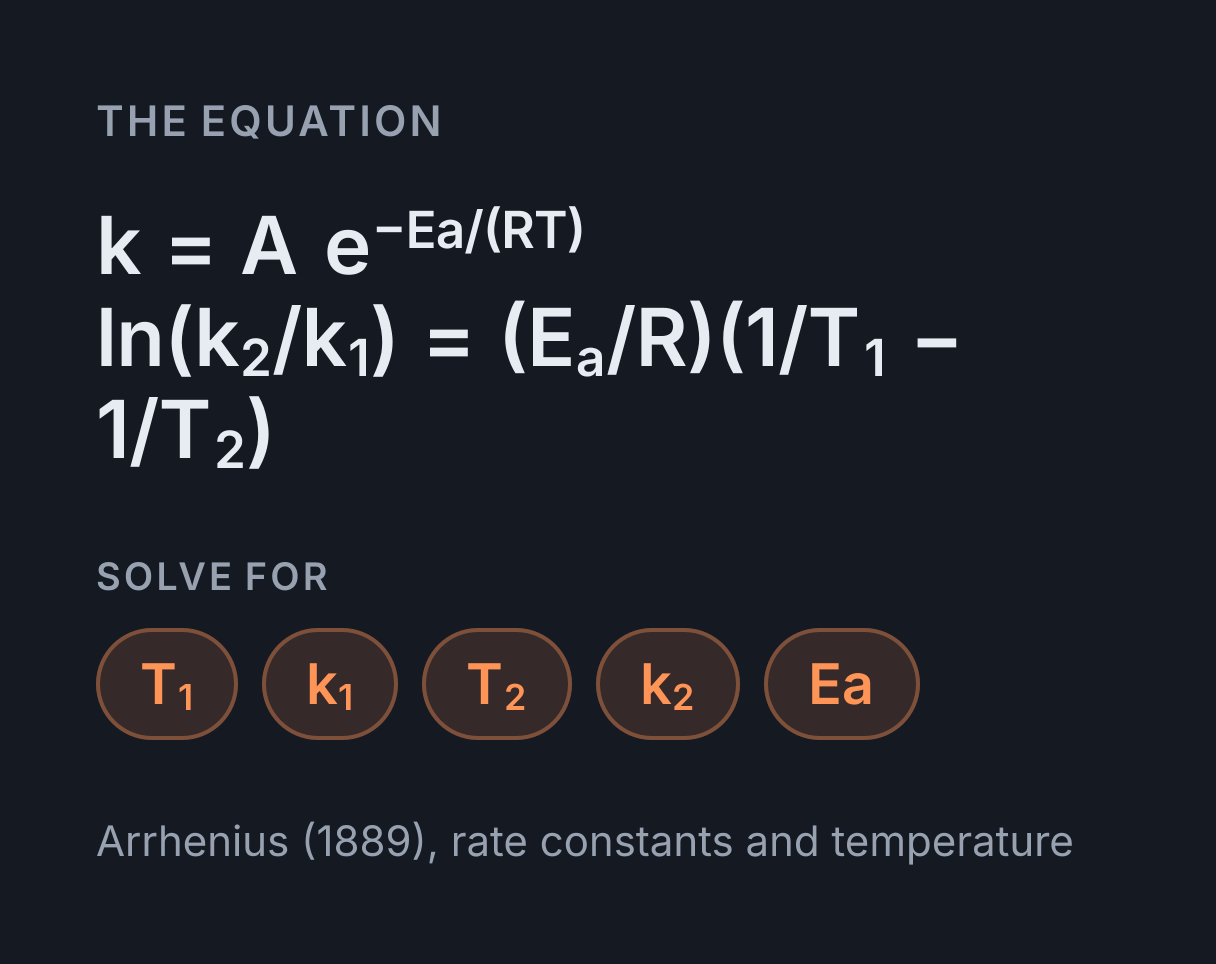
The Arrhenius equation, k = Ae^(−Ea/RT), links a rate constant to temperature. Find the activation energy from k at two temperatures, or k at a new one.
Calculator
Converted to kelvin before the arithmetic, because the equation needs absolute temperature.
Any unit, if k₂ uses the same one: s⁻¹ for a first-order reaction, M⁻¹ s⁻¹ for a second-order one.
In kJ/mol: divide a value in J/mol by 1000 first.
Working, with your numbers
- ln(k2/k1) = (Ea/R)(1/T1 - 1/T2)
- Ea = R ln(k2/k1) / (1/T1 - 1/T2)
- = 8.31446 x ln(0.035 / 0.01) / (1/300 - 1/320)
- = 8.31446 x 1.2528 / 0.00020833
- = 49,997 J/mol = 49.997 kJ/mol
Values are converted into the units the equation is worked in before the arithmetic.
- Pre-exponential factor A A = k₁ e^(Ea/RT₁), the value k tends to as the temperature rises without limit. It has the unit of k.
- 5.071 × 10⁶ same unit as k
- Rate constant ratio, k₂/k₁ How many times faster the reaction runs at T₂ than at T₁, from the same concentrations.
- 3.5 ×
- Factor for a 10 K rise from T₁ k at T₁ + 10 K divided by k at T₁. The rule that ten degrees doubles a rate holds only near Ea = 50 kJ/mol at room temperature.
- 1.91 ×
Citing this tool
Last updated . Add the date you accessed it as well, which a citation of a page that can change asks for. If a specific result matters, cite the permalink from the tool’s share row instead of this page: it reproduces the exact parameters.
The equation
Arrhenius (1889), rate constants and temperature
The Arrhenius equation: how temperature sets a rate constant
The Arrhenius equation, k = A e^(−Ea/RT), gives a
reaction’s rate constant k from its activation energy Ea, the absolute
temperature T and a pre-exponential factor A, with R = 8.314 J/(mol·K).
Measure k at two temperatures and the activation energy follows from
the two-point form, ln(k₂/k₁) = (Ea/R)(1/T₁ − 1/T₂). For
the values loaded above, a rate constant rising from 0.010 s⁻¹ at
300 K to 0.035 s⁻¹ at 320 K,
Ea = 8.314 × ln 3.5 ÷ (1/300 − 1/320) = 50.0 kJ/mol.
Enter any four of the five values and choose Solve for this on the fifth: the activation energy from two rate constants, the rate constant at a new temperature, or the temperature at which a reaction reaches a given rate constant. Temperatures can be typed in kelvin, °C or °F, and each is converted to kelvin before the arithmetic. The activation energy is in kJ/mol. The rate constants can be in any unit, s⁻¹ for a first-order reaction or M⁻¹ s⁻¹ for a second-order one, as long as both use the same one, and a solved k comes out in that unit.
Alongside the answer the calculator shows the pre-exponential factor A, how many times faster the reaction runs at T₂ than at T₁, and the factor a 10 K rise from T₁ would give. The working underneath puts your numbers into the natural-log form, step by step.
Worked example: activation energy and A from two rate constants
A reaction’s rate constant is 0.02 s⁻¹ at 500 K and 0.07 s⁻¹ at 700 K. What are its activation energy and its pre-exponential factor?
-
Ea = R ln(k₂/k₁) ÷ (1/T₁ − 1/T₂) = 8.314 × 1.2528 ÷ 0.00057143 = 18,228 J/mol, which is 18.23 kJ/mol. -
Ea/RT₁ = 18,228 ÷ (8.314 × 500) = 4.385, soA = k₁ e^(Ea/RT₁) = 0.02 × e^4.385 = 1.60 s⁻¹.
Worked with common logarithms instead, as NCERT and many other courses
do, the same equation reads
log(k₂/k₁) = Ea/(2.303R) × (T₂ − T₁)/(T₁T₂), so
Ea = 2.303 × 8.314 × log 3.5 × (500 × 700) ÷ (700 − 500) = 19.147 × 0.54407 × 1750 = 18,230 J/mol.
The two routes agree to four figures, 18.23 kJ/mol. They part in the
last digit mainly because 2.303 is ln 10 rounded up from 2.3026.
Why a few degrees change the rate so much
Temperature sits in an exponent, so a change of a few percent in T multiplies k rather than adding to it. The Factor for a 10 K rise readout shows by how much: for the values loaded above, 50 kJ/mol at 300 K, a rise of ten degrees multiplies k by 1.91. Near room temperature, at 298 K, a barrier of 52.9 kJ/mol doubles the rate for a rise of ten degrees, so that is the barrier the rule of thumb fits. It is not a law. At the same temperature a 100 kJ/mol barrier gives 3.7 times for ten degrees and a 5 kJ/mol barrier only 1.07 times, and at 500 K the 52.9 kJ/mol barrier itself gives only 1.28 times.
The collision theory simulator shows why: only molecules in the far tail of the energy distribution carry enough energy to react, and warming a gas grows that tail far faster than it moves the average. The kinetic theory gas simulator shows where the spread comes from, building the distribution of molecular speeds out of atoms colliding in a box.
The Arrhenius plot: ln k against 1/T
Taking logarithms turns the equation into a straight line,
ln k = ln A − (Ea/R)(1/T). Plot ln k against 1/T and the
slope is −Ea/R and the intercept ln A, which is how an activation
energy is found from more than two measurements. These rate constants
for the decomposition of hydrogen iodide, 2HI → H₂ + I₂, are the ones
OpenStax Chemistry 2e uses to show the method.
| T | k (L mol⁻¹ s⁻¹) | 1/T (10⁻³ K⁻¹) | ln k |
|---|---|---|---|
| 555 K | 3.52 × 10⁻⁷ | 1.8018 | −14.860 |
| 575 K | 1.22 × 10⁻⁶ | 1.7391 | −13.617 |
| 645 K | 8.59 × 10⁻⁵ | 1.5504 | −9.362 |
| 700 K | 1.16 × 10⁻³ | 1.4286 | −6.759 |
| 781 K | 3.95 × 10⁻² | 1.2804 | −3.231 |
The two end points give a slope of −22,302 K, so
Ea = 22,302 K × 8.314 J/(mol·K) = 185 kJ/mol, and put
into the calculator above they give 185.4 kJ/mol. A least-squares line
through all five points gives 185.3 kJ/mol, and OpenStax rounds its
own estimate to 180 kJ/mol. Neighbouring pairs of points give anything
from 165 to 198 kJ/mol, because an error in k counts for more when the
two temperatures are close together. That is why activation energies
are measured over as wide a range of temperature as the reaction
allows, and fitted through every point.
The linear regression calculator fits these five points, or your own 1/T and ln k, and gives the standard error of the slope as well. Ea is the slope times −R, so for this table Ea is 185.3 kJ/mol with a standard error of 2.2 kJ/mol.
Reading A and Ea from a table of rate data
Evaluated gas-phase data, such as IUPAC’s for atmospheric chemistry,
usually give the equation as k = A exp(−B/T), where B is
Ea/R in kelvin. For the reaction of oxygen atoms with ozone,
O + O₃ → 2O₂, IUPAC recommends
k = 8.0 × 10⁻¹² exp(−2060/T) cm³ molecule⁻¹ s⁻¹ between
200 and 400 K. So A is
8.0 × 10⁻¹² cm³ molecule⁻¹ s⁻¹ and
Ea = 2060 K × 8.314 J/(mol·K) = 17.1 kJ/mol. Cooled from
298 K to 220 K, both inside that range, the reaction slows by a factor
of 11.6.
Common mistakes
- Leaving temperatures in Celsius. The equation needs kelvin. Put 25 and 35 in place of 298.15 K and 308.15 K and a rate that doubles appears to have an activation energy of 0.5 kJ/mol instead of 52.9.
- Mixing joules and kilojoules. R is 8.314 J/(mol·K), so Ea goes into the equation in J/mol. Put a 50 kJ/mol barrier in as 50 rather than 50,000 and k changes by about a tenth of a percent between 300 K and 320 K instead of rising 3.5 times. This calculator takes kJ/mol and converts.
- Mixing log and ln. log(k₂/k₁) goes with 2.303R and ln(k₂/k₁) with R. Pair log with R and the activation energy comes out 2.303 times too small.
- Swapping a pair. k₁ belongs to T₁. Swap only the rate constants and the activation energy comes out negative, which few real reactions have.
- Giving the two rate constants different units. Only their ratio enters, so k₁ in s⁻¹ against k₂ in min⁻¹ puts a factor of 60 into it: for the values loaded above that turns 50 kJ/mol into 213 kJ/mol.
- Extrapolating far beyond the data. A and Ea are fitted over the temperatures that were measured. Well outside them a prediction can be out by more than a factor of two, as the next section shows.
What this calculator does not cover
It treats A and Ea as constants, which holds over the range they were
measured across but not indefinitely: the IUPAC Green Book defines the
activation energy from the slope of ln k against 1/T and notes that it
can itself depend on temperature. For hydroxyl radicals reacting with
hydrogen, HO + H₂ → H₂O + H, IUPAC’s evaluation recommends
k = 7.7 × 10⁻¹² exp(−2100/T) cm³ molecule⁻¹ s⁻¹ between
200 and 450 K, while measurements up to 992 K were fitted by
4.12 × 10⁻¹⁹ T^2.44 exp(−1281/T). Carried out to 992 K,
the first expression gives a rate constant 2.5 times smaller than the
second. Forms with a power of T, k = A Tⁿ e^(−Ea/RT),
are beyond this calculator.
Nor does it know the mechanism behind a rate constant. A negative
activation energy is allowed, with a warning, because a few reactions
have one: IUPAC gives 2NO + O₂ → 2NO₂ as
k = 3.3 × 10⁻³⁹ exp(530/T) cm⁶ molecule⁻² s⁻¹ from 270
to 600 K, and records measurements in which k falls to a minimum near
600 K and then rises again. Reactions catalysed by enzymes speed up
with temperature only until the enzyme starts to lose its shape. And
it does not take A as an input: to find k from A and Ea at one
temperature, work k = A e^(−Ea/RT) directly.
For a first-order reaction the half-life is t½ = ln 2 / k,
so whatever a change of temperature does to k it does in reverse to
the half-life, and the
half-life calculator takes
it from there. Radioactive decay is the exception: a nuclide’s
half-life is, for practical purposes, independent of the temperature
of the sample.
Converting units first? Use the temperature conversion table.
Worked examples
Each one runs through the calculator above, so the arithmetic here is the arithmetic it does.
What activation energy doubles a reaction rate between 25 and 35 degrees?
- ln(k2/k1) = (Ea/R)(1/T1 - 1/T2)
- Ea = R ln(k2/k1) / (1/T1 - 1/T2)
- = 8.31446 x ln(2 / 1) / (1/298.15 - 1/308.15)
- = 8.31446 x 0.69315 / 0.00010884
- = 52,949 J/mol = 52.949 kJ/mol
52.9 kJ/mol, the barrier for which the rule of thumb that ten degrees doubles a rate is exact. Only the ratio of the rate constants enters, so 1 and 2 stand for any pair. The same barrier gains only 28 percent for ten degrees at 500 K, and a 100 kJ/mol barrier speeds up 3.7 times near room temperature, so the rule describes typical cases rather than a law.
What is the rate constant at 700 K if k is 1.60 × 10⁻⁵ s⁻¹ at 600 K and Ea is 209 kJ/mol?
- ln(k2/k1) = (Ea/R)(1/T1 - 1/T2)
- k2 = k1 x exp[(Ea/R)(1/T1 - 1/T2)]
- = 1.6 × 10⁻⁵ x exp[(209,000 / 8.31446) x (1/600 - 1/700)]
- = 1.6 × 10⁻⁵ x exp(5.985)
- = 0.0063586
6.36 × 10⁻³ s⁻¹, about 400 times faster for a 100 K rise, because a high barrier makes k very sensitive to temperature: with Ea = 50 kJ/mol the same rise would multiply k by only 4.2. The numbers are those NCERT’s Class 12 chemistry textbook gives for the decomposition of ethyl iodide, C₂H₅I → C₂H₄ + HI, which it works with common logarithms.
What temperature takes k from 4.5 × 10³ s⁻¹ at 10 degrees to 1.5 × 10⁴ s⁻¹ if Ea is 60 kJ/mol?
- ln(k2/k1) = (Ea/R)(1/T1 - 1/T2)
- 1/T2 = 1/T1 - (R/Ea) ln(k2/k1)
- = 1/283.15 - (8.31446 / 60,000) x ln(15,000 / 4500)
- = 0.0035317 - 0.00016684 = 0.0033649 per K
- T2 = 297.19 K = 24.04 °C
297 K, which is 24 °C: a rise of just 14 degrees multiplies k by 3.3, because at 60 kJ/mol and these temperatures each ten degrees is worth a factor of about 2.4. The 10 °C must go in as 283.15 K. Put 10 in its place and the answer comes out at 10.02, a rise of less than a fiftieth of a degree instead of 14.
Practise this with Chemistry Practice Problems, questions generated from this calculator and 6 other calculators in Chemistry.
Common questions
What is the Arrhenius equation?
It is k = Ae^(−Ea/RT), the equation that gives a reaction’s rate constant k at an absolute temperature T from its activation energy Ea and a pre-exponential factor A, with R = 8.314 J/(mol·K). Because T sits inside an exponential, a small rise in temperature multiplies k: with Ea = 50 kJ/mol, warming from 300 K to 310 K almost doubles it. Svante Arrhenius gave the equation its interpretation in 1889.
How do you calculate activation energy from two rate constants?
Use the two-point form, Ea = R ln(k₂/k₁) ÷ (1/T₁ − 1/T₂), with both temperatures in kelvin. For a rate constant that rises from 0.010 s⁻¹ at 300 K to 0.035 s⁻¹ at 320 K, Ea = 8.314 × ln 3.5 ÷ (1/300 − 1/320), about 50,000 J/mol or 50.0 kJ/mol. Only the ratio of the rate constants enters, so they can be in any unit as long as both use the same one.
What is the pre-exponential factor A?
It is the factor in front of the exponential in k = Ae^(−Ea/RT), the value k would approach if the temperature rose without limit with A and Ea unchanged, so it has the same unit as k. Once Ea is known, one measurement gives it: A = k e^(Ea/RT). For the reaction above, 0.010 s⁻¹ at 300 K with Ea of about 50 kJ/mol, A is about 5.1 × 10⁶ s⁻¹. In collision theory it stands for how often the molecules collide and how often they meet in an orientation that can react.
Why do some textbooks write the Arrhenius equation with 2.303?
Because they use common logarithms: 2.303 is ln 10 rounded, and log(k₂/k₁) = Ea/(2.303R) × (T₂ − T₁)/(T₁T₂) is the same equation as the natural-log form. NCERT and many other courses write it that way. Both give the same activation energy to within 0.02 percent; the mistake to avoid is mixing them, log with R or ln with 2.303R, which puts the answer out by a factor of 2.303.
Can activation energy be negative?
Yes, for a few reactions whose rate constant falls as the temperature rises. IUPAC’s evaluated data give 2NO + O₂ → 2NO₂ a rate constant of 3.3 × 10⁻³⁹ exp(530/T) cm⁶ molecule⁻² s⁻¹ from 270 to 600 K, an activation energy of about −4.4 kJ/mol, so the reaction is about 2.4 times faster at 298 K than at 600 K. Such reactions do not cross a single barrier: this one has been explained by a mechanism of several steps involving NO₃ or the dimer (NO)₂. In a homework problem a negative answer usually means two values were swapped.