Half-Life Calculator
Calculate remaining amount, elapsed time or half-life for radioactive decay, with the decay constant and mean lifetime for the same isotope.
Calculator
Carbon-14 5700 y, tritium 12.32 y, iodine-131 8.02 d, uranium-238 4.468 Gy.
Working, with your numbers
- N = N0 x (1/2)^n, where n = t / t_half
- n = 2 half-lives elapsed
- = 100 x (1/2)^2
- = 25
Values are converted into the units the equation is worked in before the arithmetic.
- Half-lives elapsed
- 2
- Fraction left
- 25%
- Mean lifetime τ τ = t½ / ln2. The time constant in N = N₀e^(−t/τ).
- 8.223 thousand yr
- Decay constant λ
- 3.853 × 10⁻¹² s⁻¹
Citing this tool
Last updated . Add the date you accessed it as well, which a citation of a page that can change asks for. If a specific result matters, cite the permalink from the tool’s share row instead of this page: it reproduces the exact parameters.
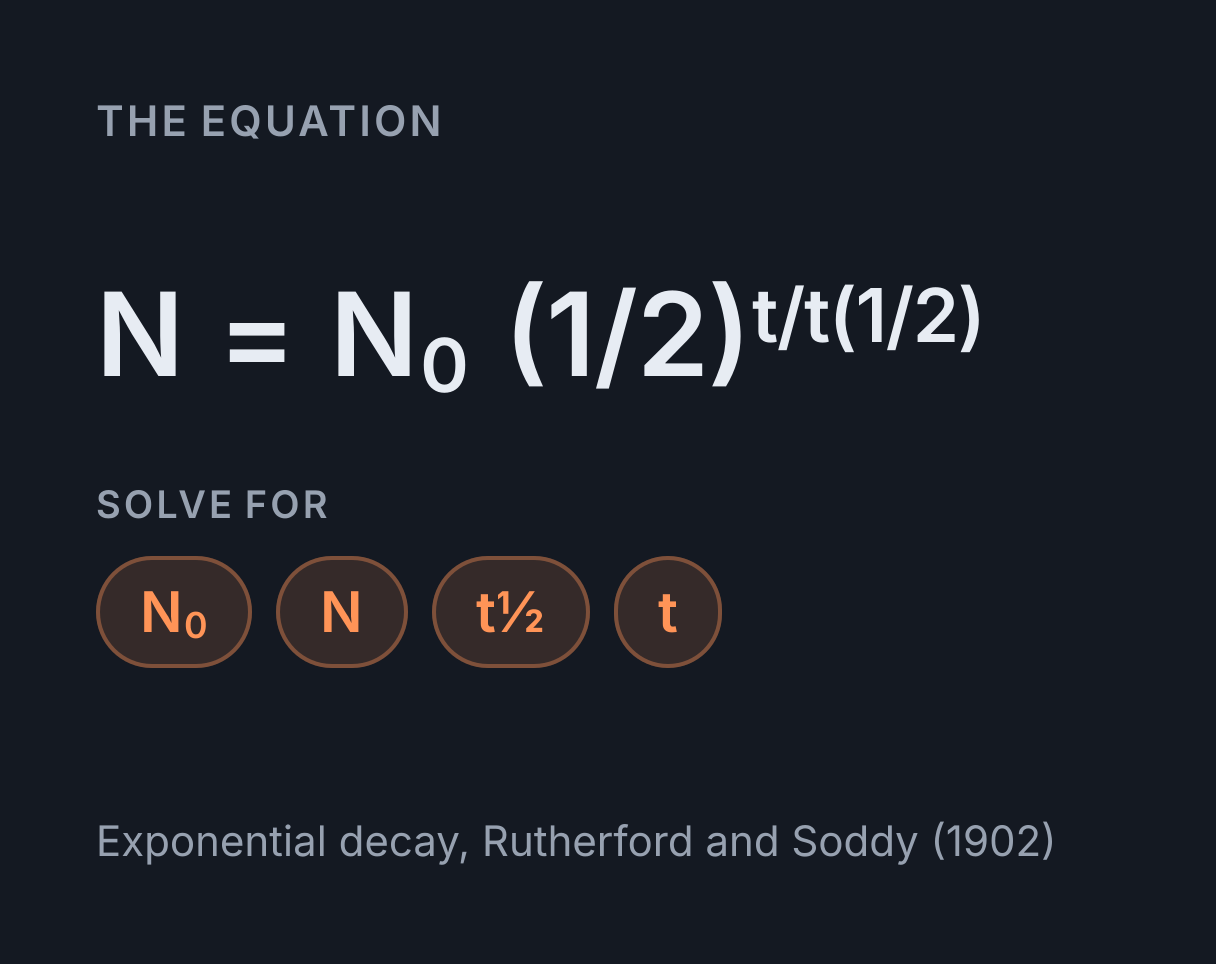
The equation
Exponential decay, Rutherford and Soddy (1902)
What the decay equation is saying
The half-life t½ is the time for half of a radioactive sample
to decay, so the amount left after a time t is
N = N₀(½)^(t/t½), where N₀ is the starting
amount. Radioactive decay is random for any single nucleus but predictable
for a large population. Each nucleus has the same chance of decaying in the
next interval regardless of how long it has already existed, and that
property makes the surviving fraction fall by a constant factor in equal
times.
The same behaviour is often written with a decay constant,
λ = ln2 / t½, giving N = N₀e^(-λt). The mean
lifetime is the reciprocal of that constant,
τ = t½ / ln2 ≈ 1.443 × t½, so the average nucleus outlives the
half-life. Measured half-lives span an enormous range:
iodine-131 at 8.02 days,
tritium at 12.32 years,
cobalt-60 at 5.27 years,
carbon-14 at 5700 years and
uranium-238 at 4.468 billion years.
Worked example
How much carbon-14 remains after 11,400 years, starting from 100 units?
- Carbon-14 has a half-life of 5700 years.
-
Count the half-lives:
t / t½ = 11400 / 5700 = 2. N = 100 × (1/2)² = 100 × 0.25N = 25 unitsremaining, so 75 units have decayed.
The exponent does not have to be a whole number. For 8000 years it is
8000 / 5700 = 1.404, and
N = 100 × (1/2)^1.404 = 37.8 units.
Why decay never finishes, and where dating runs out
Because the loss is a fixed fraction rather than a fixed amount, the curve approaches zero without reaching it. Ten half-lives leave about 0.1% of the original activity and twenty leave about one part in a million. Radiation protection practice takes the shorter figure as the working answer, so a sealed source or a batch of medical waste is treated as spent after roughly ten half-lives. For iodine-131 that is about 80 days, which is why it is stored rather than processed.
The same arithmetic sets the ceiling on radiocarbon dating. At 50,000 years a sample has passed nearly nine half-lives and holds about 0.2% of its original carbon-14. That is close to both the detection limit and the level at which a trace of modern carbon from handling or groundwater would dominate the measurement, so the result stops being trustworthy rather than stopping outright. Older material is dated with slower clocks instead, such as potassium-40 or uranium-238, whose half-lives are long enough to leave a measurable parent fraction over millions of years.
Common mistakes
- Subtracting a fixed amount each half-life. Each interval removes half of what is present, not half of the original. Two half-lives leave 25%, not zero.
- Using the mean lifetime as the half-life. They differ by the factor 1.443. Substituting one for the other biases every result in the same direction.
- Mismatching time units. The elapsed time and the half-life must share units before the ratio is taken. Days against years is a factor of 365 in the exponent.
- Expecting the amount to reach zero. The function is exponential and never terminates. A sample is called spent when its activity falls below a stated threshold, not when it is empty.
Converting units first? Use the time conversion table.
Worked examples
Each one runs through the calculator above, so the arithmetic here is the arithmetic it does.
How much of a 100 g sample is left after 3 half-lives?
- N = N0 x (1/2)^n, where n = t / t_half
- n = 3 half-lives elapsed
- = 100 x (1/2)^3
- = 12.5
12.5 g, not zero and not a third. Each half-life halves what is left rather than removing a fixed amount, so three of them leave an eighth. That is also why a sample never formally reaches zero.
A bone has a quarter of its original carbon-14. How old is it?
- t = t_half x log2(N0 / N)
- N0 / N = 4
- log2(4) = 2 half-lives
- t = 2 x 5.7 thousand yr = 11.4 thousand yr
A quarter remaining is exactly two half-lives, so 11,400 years. This is radiocarbon dating, and the reason it runs out beyond about 50,000 years is that after ten half-lives under a thousandth is left, which is too little to measure against the background.
What fraction of a radioactive sample remains after 10 half-lives?
- N = N0 x (1/2)^n, where n = t / t_half
- n = 10 half-lives elapsed
- = 100 x (1/2)^10
- = 0.097656
Under a tenth of a percent, which is the rule of thumb behind ten half-lives being treated as effectively gone. It is also why storage times for medical isotopes are quoted in half-lives rather than in days.
Practise this with Chemistry Practice Problems, questions generated from this calculator and 6 other calculators in Chemistry.
Common questions
Why does a half-life never reach zero?
Because each half-life removes half of whatever is left, not a fixed amount. Ten half-lives leave about 0.1 percent and twenty leave about one part in a million, but the curve only approaches zero. In practice a sample is treated as spent after roughly ten half-lives.
What is the difference between half-life and mean lifetime?
Mean lifetime τ is the average time an individual atom survives, and equals the half-life divided by ln 2, so it is about 1.44 times longer. Half-life appears in the base-2 form of the decay law, while τ appears in the exponential form N = N₀e^(−t/τ).
Why is carbon dating limited to about 50,000 years?
Carbon-14 has a half-life near 5,700 years, so after 50,000 years only about 0.2 percent of the original remains. That is close to the detection limit and to contamination levels, so older samples need a longer-lived isotope such as potassium-40 or uranium-238.