Cell Doubling Time Calculator
Calculate doubling time and specific growth rate from two cell counts and the time between them, or project a future count.
Calculator
Working, with your numbers
- Td = t x ln2 / ln(N / N0)
- = 48 x 0.6931 / ln(800,000 / 100,000)
- = 33.271 / ln(8)
- = 33.271 / 2.0794
- = 16 h
Values are converted into the units the equation is worked in before the arithmetic.
- Doublings
- 3
- Growth rate µ µ = ln2 / Td. The exponential growth constant.
- 0.04332 per hour
- Fold increase
- 8×
Citing this tool
Last updated . Add the date you accessed it as well, which a citation of a page that can change asks for. If a specific result matters, cite the permalink from the tool’s share row instead of this page: it reproduces the exact parameters.
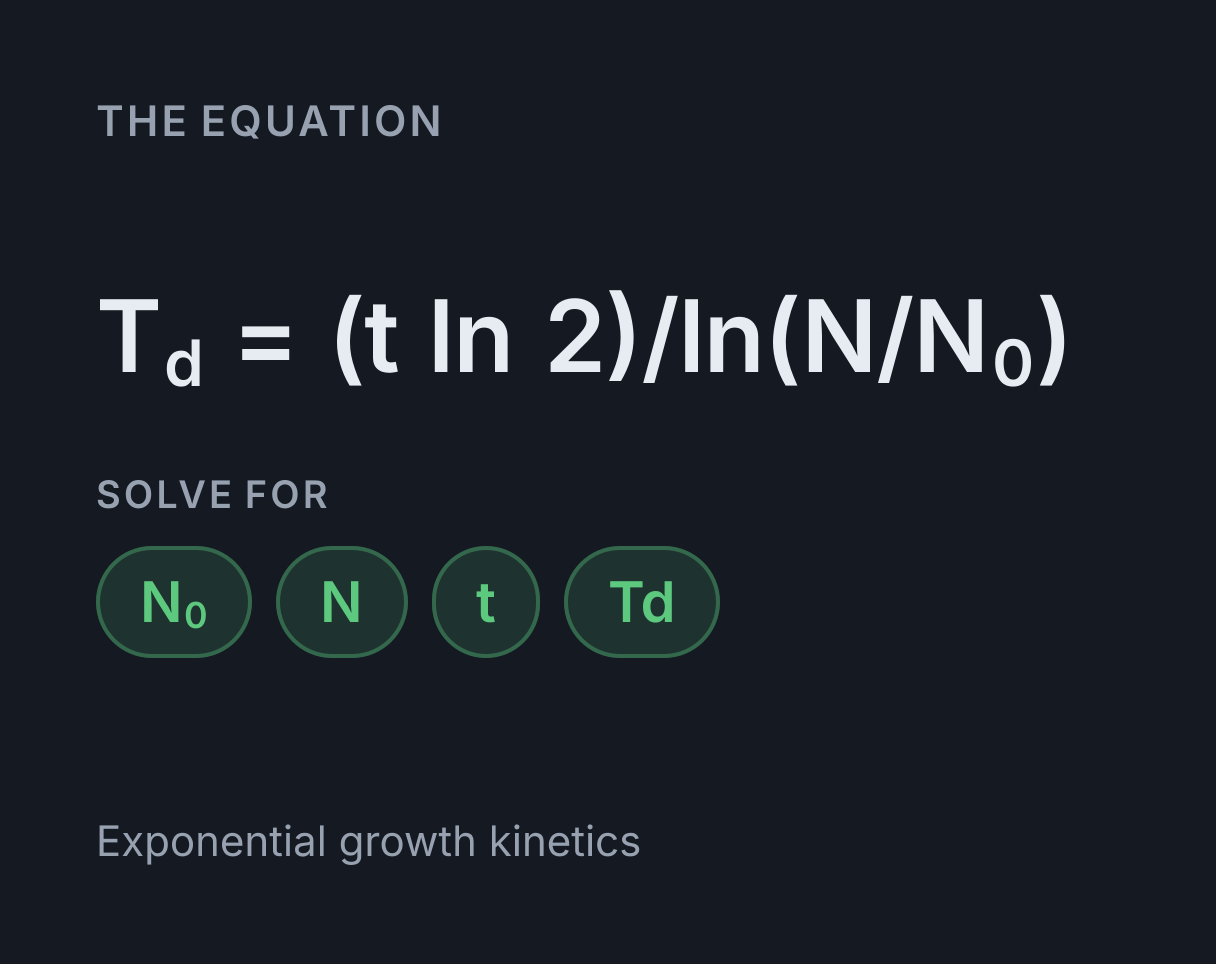
The equation
Exponential growth kinetics
What doubling time measures
Doubling time is the interval a population needs to double in number while
it is growing exponentially. Growth is multiplicative rather than
additive, so the figure does not depend on the starting count: a culture
with a doubling time of 16 hours takes as long to go from 1 × 10⁵ to
2 × 10⁵ cells as it does to go from 1 × 10⁶ to 2 × 10⁶. The relationship
is Td = t × ln2 / ln(N/N0), where t is elapsed
time, N0 the initial count and N the final
count.
The same information is often carried as the specific growth rate,
µ = ln2 / Td, in reciprocal hours. Doubling time is easier to
picture, while the growth rate is easier to substitute into
N = N0 × e^(µt). For orientation:
E. coli in rich medium doubles in roughly 20 minutes,
budding yeast in roughly 90 minutes, HeLa cells in about
24 hours, and primary human fibroblasts in 30 to 40 hours.
Worked example
A flask seeded with 1 × 10⁵ cells reaches 8 × 10⁵ cells after 48 hours.
N / N0 = 8 × 10⁵ / 1 × 10⁵ = 8-
Eight is two cubed, so the culture completed
log2(8) = 3doublings. Td = 48 h / 3 doublings = 16 h-
From the general formula:
Td = 48 × 0.6931 / 2.0794 = 16.0 h -
Specific growth rate:
µ = 0.6931 / 16 = 0.0433 per hour
The counting shortcut worked only because the ratio was an exact power of two. The formula handles any ratio, which is the usual case with real counts.
Valid only in exponential phase
The derivation assumes a constant fractional growth rate, which holds during log phase and nowhere else. A pair of counts that straddles the lag phase includes hours in which almost no division happened, and a pair that runs into the plateau includes hours in which division had already stalled. Both cases return a doubling time that is too long, and neither is flagged by the arithmetic.
A doubling time that drifts upward across passages is a signal worth following up. The common causes are confluence, exhausted medium, contamination, and a high passage number, which brings replicative senescence in primary lines. Comparing a fresh measurement against the historical value for the same line is more informative than the absolute number.
Common mistakes
- Measuring across the wrong phase. Counts taken through lag phase or after the culture has plateaued inflate the doubling time. Take both counts inside the exponential window.
- Mixing logarithm bases. The number of doublings needs
log2. Usinglog10orlnwithout the corresponding factor is out by 3.322 or 1.443 respectively. - Counting a shrinking culture. If
Nis belowN0the logarithm turns negative and doubling time is undefined. That result describes cell death, not slow growth. - Overstating precision. Trypsinisation losses and counting error typically put 10 to 20 percent uncertainty on each count, so a doubling time quoted to three decimal places carries no information.
Converting units first? Use the time conversion table.
Worked examples
Each one runs through the calculator above, so the arithmetic here is the arithmetic it does.
How many bacteria does one E. coli cell become in 8 hours at 20 minutes a doubling?
- N = N0 x 2^(t / Td)
- = 1 x 2^(8 / 0.33333)
- = 1 x 2^24
- = 1.6777 × 10⁷ cells
About 16.8 million, since 8 hours is 24 doublings and 2²⁴ is 16,777,216. Real cultures stop long before the arithmetic does, because nutrients run out and waste builds up: kept going for two days, the same rate would produce a mass of bacteria several thousand times that of the Earth.
How long do cells with a 24 hour doubling time take to grow from 10,000 to a million?
- t = Td x log2(N / N0)
- = 24 x log2(100)
- = 24 x 6.6439
- = 159.5 h
About 159 hours, a little over six and a half days. A hundredfold rise is log₂ 100 = 6.64 doublings, and every tenfold rise costs 3.32 doublings whatever the starting count. The figure assumes growth stays exponential throughout, which it will not once the flask nears confluence.
Practise this with Lab and Clinical Calculation Practice Problems, questions generated from this calculator and 9 other calculators in Biology.
Common questions
What is a normal doubling time?
E. coli in rich medium manages about 20 minutes, yeast 90 minutes, HeLa cells roughly 24 hours, and primary human fibroblasts 30 to 40 hours. A sudden increase in your own culture’s doubling time usually means confluence, medium exhaustion, contamination or too many passages.
Does this only work during exponential growth?
Yes. Doubling time is only defined while growth is exponential. If your two counts straddle the lag phase or the culture has reached a plateau, the number returned is an average over a period that was not exponential and will overstate the true doubling time.