Beer-Lambert Law Calculator
Apply the Beer-Lambert law, A = εlc, to turn absorbance into concentration or solve for any other term, with a flag for readings outside the linear range.
Calculator
Unitless. Most spectrophotometers are only linear below about 1.5.
Property of the substance at the measurement wavelength.
A standard cuvette is 1 cm.
Working, with your numbers
- c = A / (e x l)
- = 0.65 / (43,000 x 1)
- = 1.5116 × 10⁻⁵ mol/L
Values are converted into the units the equation is worked in before the arithmetic.
- Transmittance %T = 100 × 10⁻ᴬ. Absorbance 1 means 10% of the light gets through.
- 22.39 %
- Light absorbed
- 77.61 %
Citing this tool
Last updated . Add the date you accessed it as well, which a citation of a page that can change asks for. If a specific result matters, cite the permalink from the tool’s share row instead of this page: it reproduces the exact parameters.
The equation
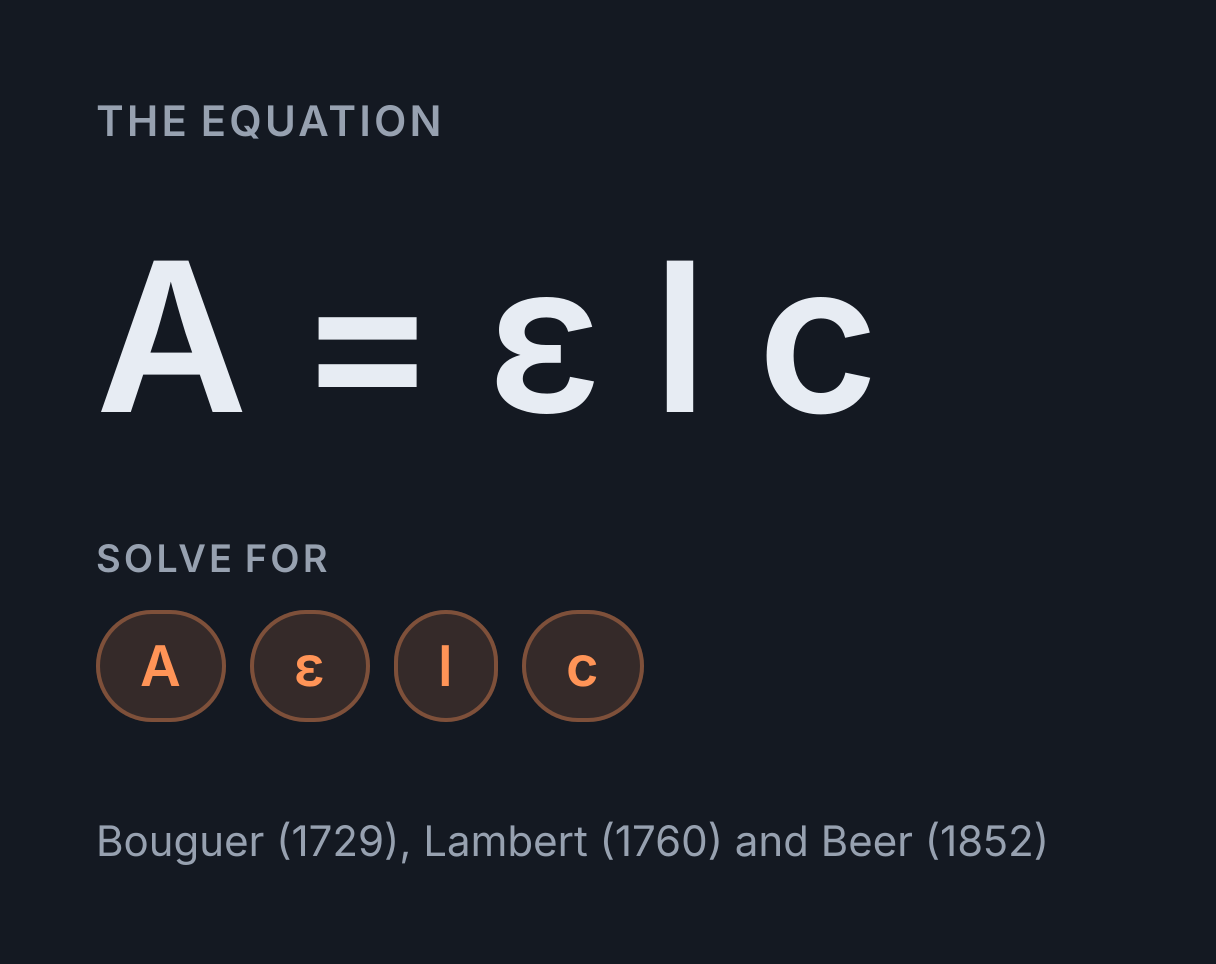
Bouguer (1729), Lambert (1760) and Beer (1852)
What A = εlc is saying
The Beer-Lambert law states that absorbance is proportional to how strongly
a species absorbs light, how far the light travels through the sample, and
how much of the species is present. In A = εlc the molar
extinction coefficient ε carries units of
M⁻¹cm⁻¹, the path length l is in centimetres,
and the concentration c is in mol/L. Those units cancel
exactly, so absorbance is unitless.
Because the relation is linear in concentration, a single measurement on a
known standard calibrates the instrument for that species. Rearranged for
the usual unknown, c = A / (εl).
Worked example
A protein with ε = 43000 M⁻¹cm⁻¹ is read at 15 µM in a standard 1 cm cuvette.
- Convert the concentration:
15 µM = 1.5e-5 M. A = ε l c = 43000 × 1 × 1.5e-5A = 0.645- Working backwards:
c = 0.645 / (43000 × 1) = 1.5e-5 M.
Absorbance relates to transmittance as A = −log10(T). So
A = 1 means 10% of the light passes through,
A = 2 means 1%, and A = 0.301 means 50%.
Staying inside the linear range
The law holds over a limited window of absorbance, roughly 0.05 to 1.5 on most bench spectrophotometers. Above about 1.5 only around 3% of the incident light reaches the detector, so stray light leaking through the optics and electronic noise become comparable to the real signal. Measured absorbance then falls below the true value and the response curves away from a straight line.
Below about 0.05 the opposite problem applies: the difference between sample and blank approaches the noise floor of the detector, and small baseline drifts translate into large relative errors in concentration. The fix at the high end is dilution by a known factor, then multiplying the result back. At the low end, use a longer path length or concentrate the sample.
Common mistakes
- Reading outside the linear range. An absorbance of 2.8 is not four times more informative than 0.7; it is unreliable. Dilute into the working window rather than trusting the number.
- Skipping the blank. The instrument must be zeroed against the solvent and buffer in the same cuvette, otherwise the solvent’s own absorbance and the cuvette walls are counted as signal.
- Using ε from the wrong wavelength. Extinction coefficients are wavelength-specific and often pH- or solvent-specific. An ε quoted at 280 nm does not apply to a reading taken at 260 nm.
- Assuming a 1 cm path length. That is true of standard cuvettes but not of microplates, where the path length is set by the fill volume and well geometry. Measure or calculate it before applying the formula.
Converting units first? Use the concentration and length conversion tables.
Worked examples
Each one runs through the calculator above, so the arithmetic here is the arithmetic it does.
What NADH concentration gives an absorbance of 0.311 at 340 nm in a 1 cm cuvette?
- c = A / (e x l)
- = 0.311 / (6220 x 1)
- = 5 × 10⁻⁵ mol/L
50 µM, using 6220 M⁻¹cm⁻¹, the molar absorptivity of NADH at 340 nm that dehydrogenase assays rely on. NAD⁺ barely absorbs at that wavelength, so the reading follows the reduced form alone. The same figure is often printed as 6.22 per millimolar, and mixing the two scales puts the answer out by a thousand.
What is the molar absorptivity if a 50 µM solution reads 0.6 in a 1 cm cuvette?
- e = A / (l x c)
- = 0.6 / (1 x 5 × 10⁻⁵)
- = 12,000 /M/cm
12,000 M⁻¹cm⁻¹, once the concentration is in moles per litre. Left as 50, it comes out as 0.012, a million times too small, with nothing about it that looks wrong. A single standard gives one point; reading several concentrations and taking the slope is more reliable, because a constant error in the blank drops out of a slope.
Practise this with Chemistry Practice Problems, questions generated from this calculator and 6 other calculators in Chemistry.
Common questions
Why should absorbance stay below about 1.5?
At A = 1.5 only about 3 percent of the light reaches the detector, so stray light and detector noise become a large share of the signal and the response stops being linear. Dilute the sample and multiply back up rather than trusting a high reading.
How do absorbance and transmittance relate?
A = −log₁₀(T), so absorbance 1 means 10 percent transmitted, absorbance 2 means 1 percent, and absorbance 0 means fully transparent. The relationship is logarithmic, which is why small absorbance changes at the high end represent very large changes in transmitted light.