Titration Calculator
Find an unknown concentration from a titration’s endpoint volume, with the mole ratio handled explicitly so diprotic acids come out right.
Calculator
1 for HCl with NaOH. 2 for H₂SO₄ titrated with NaOH, since each acid gives two protons, or 0.5 with the acid in the burette.
Working, with your numbers
- r x c1 x V1 = c2 x V2 at the endpoint, with r = 1
- c1 = c2 V2 / (r V1)
- = (100 mM x 25 mL) / (1 x 25 mL)
- = 100 mM = 0.1 mol/L
Values are converted into the units the equation is worked in before the arithmetic.
- Moles of analyte
- 2.5 mmol
- Moles of titrant
- 2.5 mmol
- Mole ratio used
- 1 : 1
Citing this tool
Last updated . Add the date you accessed it as well, which a citation of a page that can change asks for. If a specific result matters, cite the permalink from the tool’s share row instead of this page: it reproduces the exact parameters.
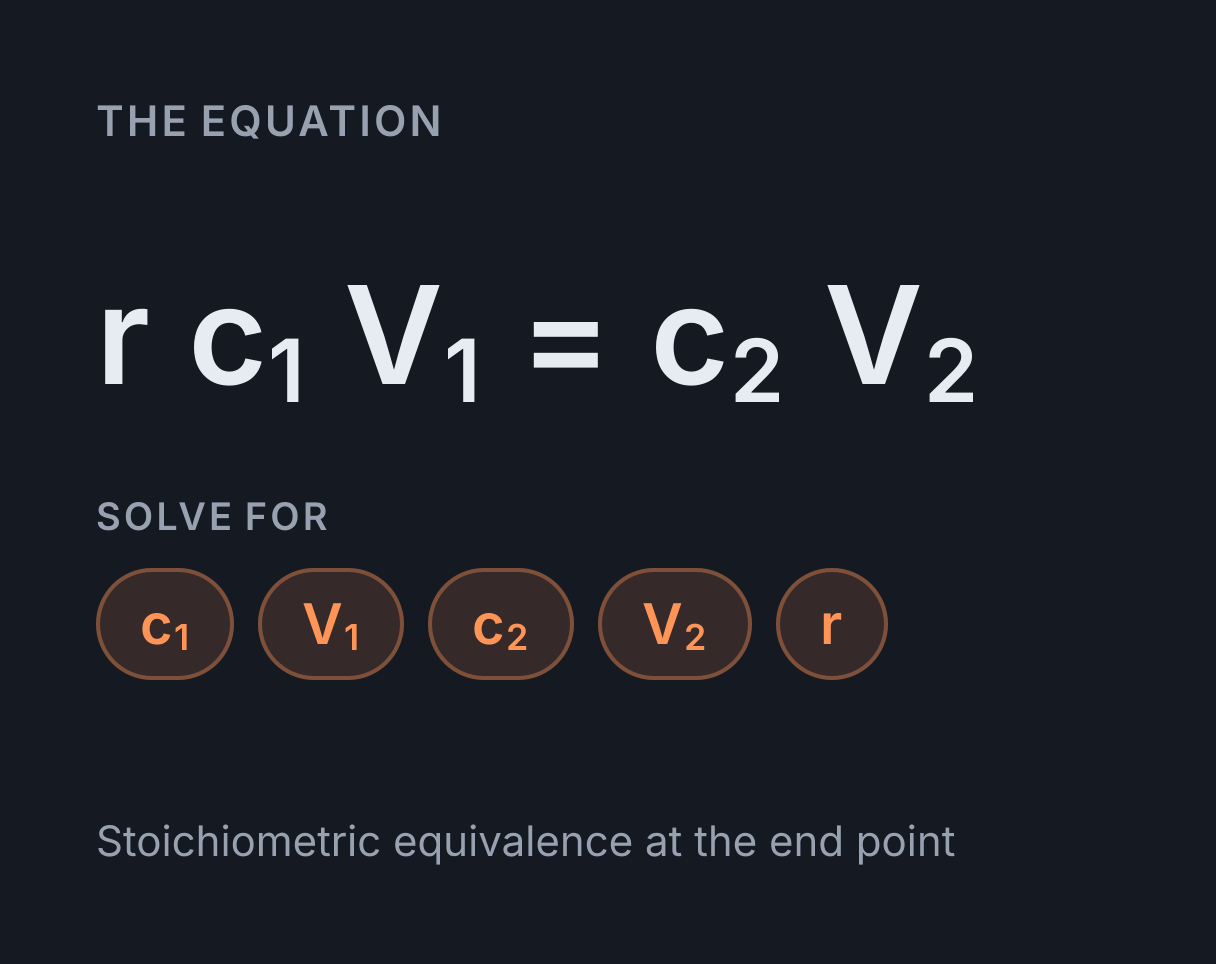
The equation
Stoichiometric equivalence at the end point
What a titration actually measures
A titration converts a volume you can read precisely into a concentration
you cannot measure directly. You add titrant of known strength until the
reaction with your analyte is exactly complete, note the volume, and work
backwards. The whole method rests on one idea: at the
equivalence point the moles
consumed are in the ratio the balanced equation demands, so
r · c₁V₁ = c₂V₂.
That r is the part people skip, and it is where the
arithmetic usually goes wrong. It is the moles of titrant needed per mole of
analyte. Hydrochloric acid against sodium hydroxide is 1:1, so r = 1 and the
relation collapses to the familiar c₁V₁ = c₂V₂. Sulfuric acid
supplies two protons per molecule, so it takes two hydroxides to neutralise
one acid molecule and r = 2. This calculator keeps r as an explicit field
rather than assuming 1, because an unnoticed 1:1 assumption is a silent
factor-of-two error.
Worked example
A 25.00 mL aliquot of sulfuric acid of unknown concentration is titrated with 0.100 M sodium hydroxide. The endpoint arrives at 28.40 mL.
- Balanced:
H₂SO₄ + 2 NaOH → Na₂SO₄ + 2 H₂O, sor = 2 - Moles of NaOH:
0.100 × 0.02840 = 2.840 mmol - Moles of H₂SO₄:
2.840 / 2 = 1.420 mmol c₁ = 1.420 mmol / 25.00 mL = 0.0568 M
Had you left r at 1, you would have reported 0.114 M. That is exactly twice the truth. A result that is out by a clean factor of two or three is almost always a mole ratio that was never checked against the equation.
Endpoint versus equivalence point
The equivalence point is a fact about stoichiometry. The endpoint is what you see when the indicator changes colour. A good indicator puts them within a drop of each other; a badly chosen one separates them enough to bias every result in the same direction.
Match the indicator to the pH at equivalence, not to the pH of either starting solution. A strong acid with a strong base reaches equivalence at pH 7, and the pH jumps so steeply there that almost any indicator works. A weak acid with a strong base reaches equivalence above 7 because the conjugate base hydrolyses, so phenolphthalein at pH 8.2 to 10 suits it and methyl orange at 3.1 to 4.4 would change far too early. Reverse the pairing to a weak base with strong acid and methyl orange becomes the right choice.
Common mistakes
- Ignoring the mole ratio. Diprotic acids such as H₂SO₄ and diacidic bases such as Ca(OH)₂ need r = 2. Read it off the balanced equation every time rather than assuming a 1:1 reaction.
- Using the total volume in the flask. V₁ is the aliquot of analyte you pipetted, not the aliquot plus the titrant you have added. Diluting the analyte with water beforehand does not change its moles, so it does not change the endpoint volume.
- Reading the burette from the wrong place. Take the bottom of the meniscus at eye level. Reading from above biases every volume low by a consistent few tenths of a millilitre, which on a 25 mL titration is about a one percent systematic error.
- Trusting a single run. The first titration finds the rough endpoint. Repeat until two runs agree within 0.05 mL and average those, discarding the trial run.
Converting units first? Use the concentration and volume conversion tables.
Worked examples
Each one runs through the calculator above, so the arithmetic here is the arithmetic it does.
What is the NaOH concentration if 25 mL needs 14.2 mL of 0.05 M sulfuric acid?
- r x c1 x V1 = c2 x V2 at the endpoint, with r = 0.5
- c1 = c2 V2 / (r V1)
- = (50 mM x 14.2 mL) / (0.5 x 25 mL)
- = 56.8 mM = 0.0568 mol/L
0.0568 M, with a mole ratio of 0.5, because here the sulfuric acid is the titrant: each molecule neutralises two hydroxides, so the reaction needs half a mole of acid per mole of NaOH. The ratio is always titrant per analyte, so with the acid in the flask instead the same reaction takes a ratio of 2.
What is the molarity of NaOH if 22.8 mL neutralises 25.0 mL of 0.100 M HCl?
- r x c1 x V1 = c2 x V2 at the endpoint, with r = 1
- c2 = r c1 V1 / V2
- = 1 x 100 mM x 25 mL / 22.8 mL
- = 109.65 mM = 0.10965 mol/L
0.1096 M. The endpoint came in under 25 mL, so for a 1:1 reaction the NaOH must be the stronger solution, a check worth making by eye before any arithmetic, since swapping the two volumes gives 0.0912 M. Sodium hydroxide absorbs carbon dioxide from the air, which is why its concentration is measured like this rather than trusted from the label.
Practise this with Chemistry Practice Problems, questions generated from this calculator and 6 other calculators in Chemistry.
Common questions
What mole ratio should I enter?
The moles of titrant consumed per mole of analyte, taken from the balanced equation. HCl with NaOH is 1, because one hydroxide neutralises one proton. H₂SO₄ in the flask titrated with NaOH is 2, since each sulfuric acid molecule supplies two protons, and with the sulfuric acid in the burette instead it is 0.5. Getting this wrong scales your answer by exactly that factor, which is why a result that is out by a clean factor of two is nearly always a ratio error.
What is the difference between the endpoint and the equivalence point?
The equivalence point is where the moles are stoichiometrically balanced, while the endpoint is where your indicator changes colour, which is what you actually observe. A well-chosen indicator puts the two within a fraction of a drop, but a poor one, such as phenolphthalein for a weak base titration, can separate them enough to matter.
Does it matter which solution goes in the burette?
For the arithmetic, no: the relation is symmetric once the ratio is right. In practice put the solution of known concentration in the burette and the unknown in the flask, so the volume you read precisely is the one paired with the concentration you trust.