Dilution Calculator
Work out stock and diluent volumes for any dilution using C1V1 = C2V2, including fold dilution and multi-step serial dilution planning.
Calculator
The amount of stock to transfer.
Total volume after dilution, including the stock.
- Stock to take
- 500 µL
- Diluent to add
- 4.5 mL
- Fold dilution
- 10×
Serial dilution
Set two or more steps to split this into a serial dilution. Useful once the fold dilution passes about 100×.
Citing this tool
Last updated . Add the date you accessed it as well, which a citation of a page that can change asks for. If a specific result matters, cite the permalink from the tool’s share row instead of this page: it reproduces the exact parameters.
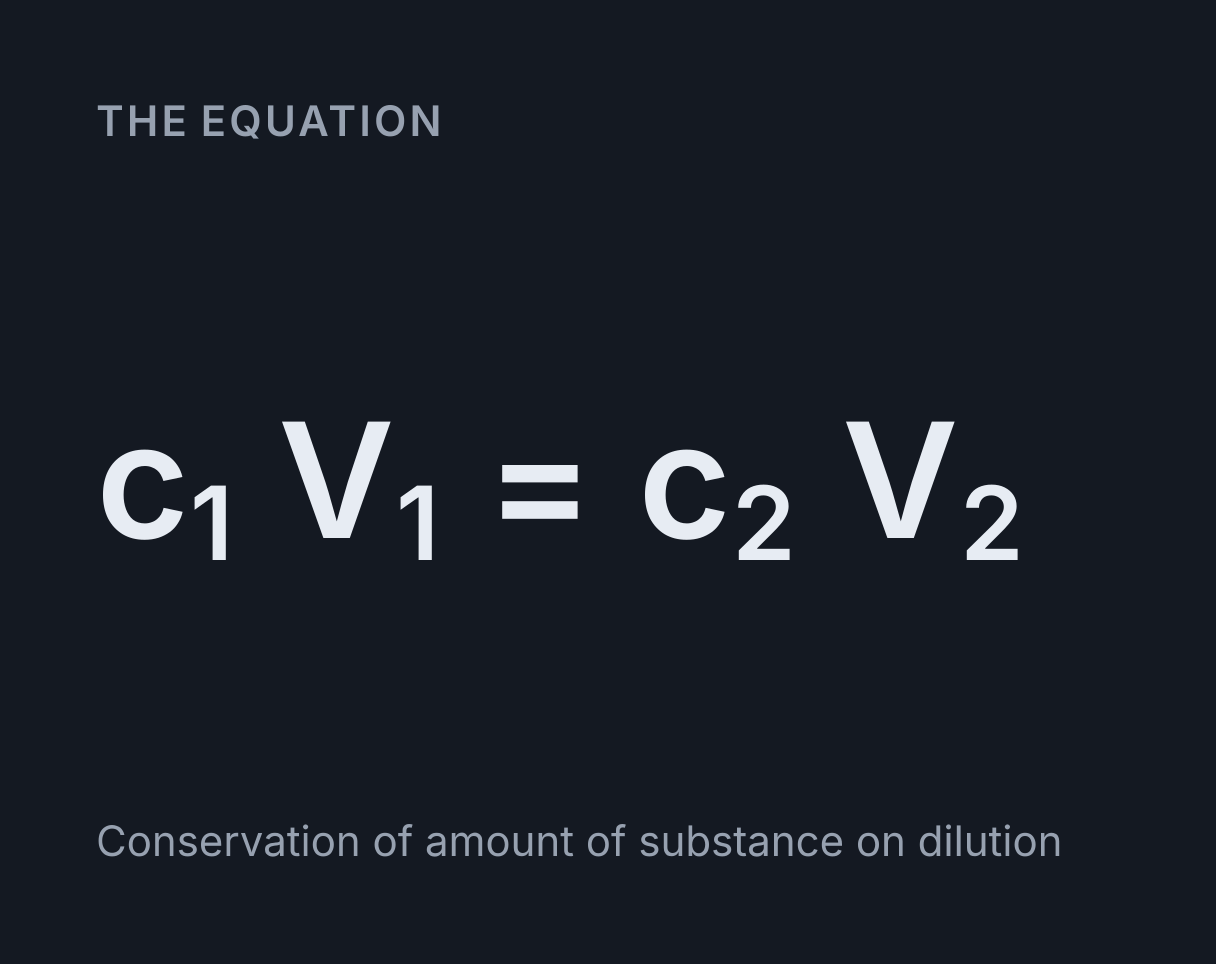
The equation
Conservation of amount of substance on dilution
Why c₁V₁ = c₂V₂ works
The dilution equation c₁V₁ = c₂V₂ says the stock
concentration c₁ times the stock volume V₁
equals the final concentration c₂ times the final volume
V₂, so any three of them fix the fourth. Diluting a solution
adds solvent but no solute. The number of moles you started with is the
number you end up with, and since moles equal
concentration times volume, c₁V₁ must equal
c₂V₂. That is the whole derivation. It is a conservation
statement, not an empirical rule, which is why it holds for any
concentration expressed per volume of solution, such as mol/L, mg/mL or
% w/v, as long as you use the same unit on both sides.
The quantity you almost always want is V₁ = c₂V₂ / c₁: how
much stock to transfer. The diluent to add is then simply
V₂ − V₁.
Worked example
You have a 1 M stock and need 5 mL of 100 mM:
V₁ = (0.1 mol/L × 0.005 L) / 1 mol/L = 0.0005 L- That is 500 µL of stock.
- Add 4.5 mL of diluent to reach 5 mL total.
Note that this is a 10-fold dilution, and the stock volume is a comfortable 500 µL. Compare that with a 10,000-fold dilution into the same 5 mL, which would need 0.5 µL. That is far below what any pipette delivers reliably.
When to go serial
Pipetting error grows sharply below about 2 µL, and most air-displacement pipettes are only specified down to 10% of their nominal volume. So a single dilution step much beyond 100-fold is a trap: it either demands an unpipettable transfer or a wastefully large final volume.
The fix is to split the job. Three successive 10-fold steps give the same 1000-fold result while keeping every transfer in the accurate range. The serial planner above divides your total dilution into equal-ratio steps and lists the transfer and diluent volumes for each one. The trade-off is that errors compound across steps, so use the fewest steps that keep each transfer sensible rather than the most.
Practical notes
- Acids go into water, never the reverse. Mixing concentrated acid with water is strongly exothermic, and adding water to acid can boil and spit.
- Mix between serial steps. An unmixed tube carries the wrong concentration into the next step and the error multiplies.
- Change tips between steps. Carryover on the outside of a tip is a real contribution at high dilution factors.
- Volumes are not always additive. For concentrated solutions, make up to a mark in a volumetric flask rather than adding V₂ − V₁ of diluent.
Converting units first? Use the concentration and volume conversion tables.
Common questions
How much diluent do I add?
The final volume minus the stock volume, V2 minus V1, which the calculator reports as Diluent to add. Add the stock to the diluent rather than the reverse when working with concentrated acids, since that keeps the heat of mixing under control.
Why use a serial dilution instead of one big step?
Single-step dilutions beyond roughly 100-fold need either an impractically small stock volume or a very large final volume, and pipetting under about 2 microlitres carries high relative error. Splitting into several moderate steps keeps every transfer inside the accurate range of your pipettes.