Full Skeleton Explorer
Free 3D human skeleton: click any of 203 bones to name, isolate or hide it, both sides, with the cartilage and membranes alongside. No sign-in.
Visualiser
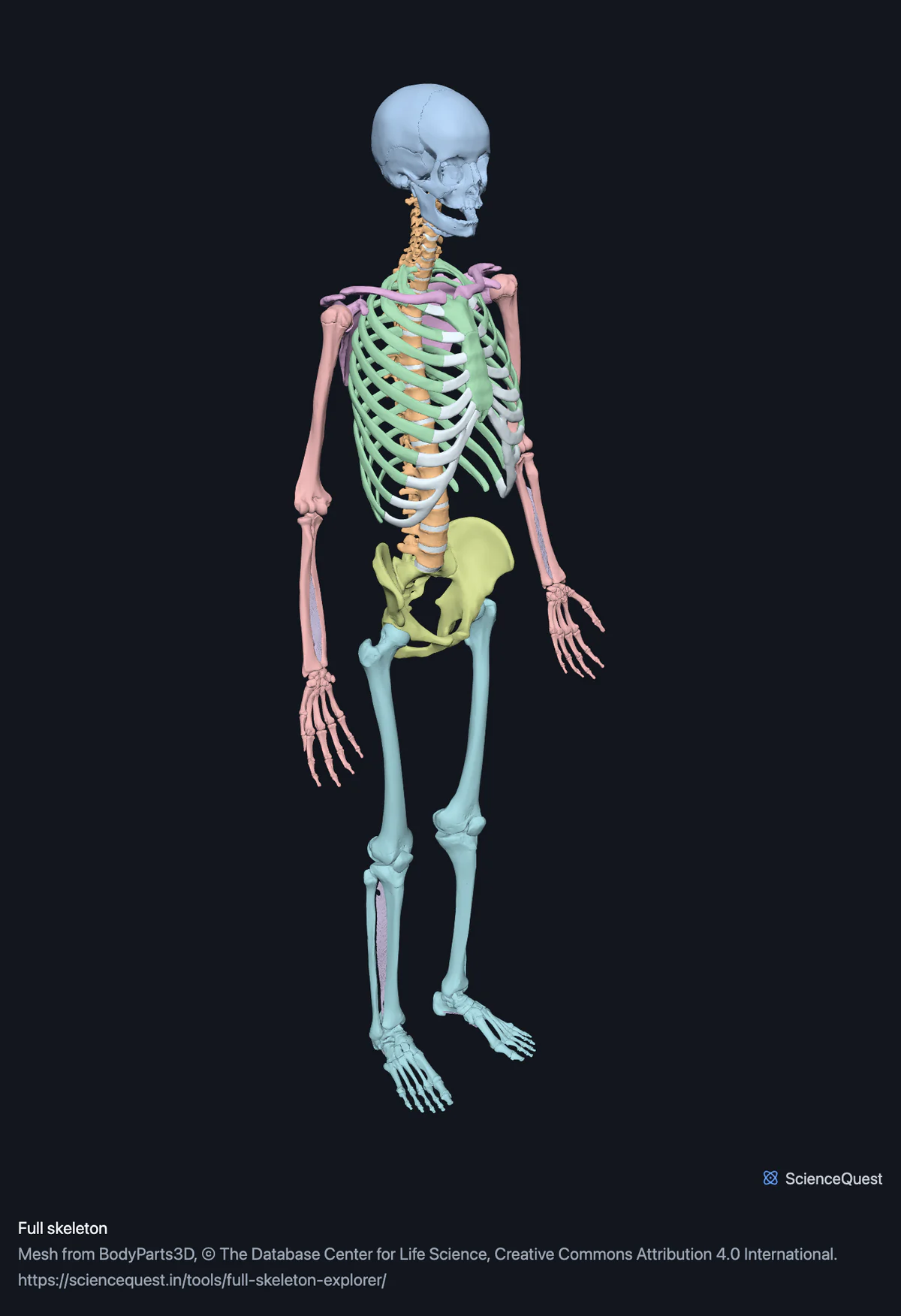
Full skeleton, 203 bones in 248 meshes
Checking this device for a stored copy.
Start here
- Collapse every band but one The structure list opens closed on a model this size. Open a single band to work through it rather than scrolling 248 rows.
- Hide Cartilage and Membranes and ligaments Leaves the 203 bones on their own. The other 45 structures are not bone.
- Turn on Fade the rest, then select one bone The only practical way to place a single bone in a whole body. Drag the fade slider to decide how much context you keep.
Bone, cartilage, membranes and ligaments. No coccyx and no auditory ossicles, because the dataset publishes neither, and no teeth. It does file an eyeball and two sets of gums under the skull, which are left out as not skeletal at all. Everything else soft is absent.
- 203 bones
- 2362k triangles
- 12000 KB, on request
- 0.0125 mm worst error per axis
- 23 skull and hyoid
- 24 vertebral column
- 27 thorax
- 4 shoulder girdle
- 60 upper limbs
- 3 pelvis
- 62 lower limbs
- 39 cartilage
- 6 membranes and ligaments
The model also carries 39 of cartilage and 6 of other tissue, so 248 parts load in total. They are listed and coloured like the rest, just not counted as bone.
203 bones, within 248 meshes, against the 206 a textbook gives, and the gap reconciles exactly. Seven of the 206 are not here, because BodyParts3D publishes no coccyx and none of the six auditory ossicles. Four bones are here that the 206 does not count: the two sesamoids under each big toe. So 206, minus seven, plus four, is 203. The bone meshes come to 203 as well, by a different route: the sternum is three meshes, the manubrium, the body and the xiphoid process, where the 206 counts it as one bone, and each foot’s two sesamoids share a single mesh. The other 45 meshes are 23 intervertebral discs, 16 costal cartilages, 4 interosseous membranes and 2 long plantar ligaments, none of which is bone.
Where this comes from
Segmented from imaging of one adult male body, not drawn by an artist, so the shapes are measurements. Two consequences worth knowing: it is one person’s anatomy rather than an average, and faint stepping on some surfaces is the resolution of the original scan rather than a rendering fault.
Meshes from BodyParts3D, © The Database Center for Life Science, under Creative Commons Attribution 4.0 International. Names and identifiers are the dataset’s own: Foundational Model of Anatomy identifiers and English labels, as its parts list gives them. Converted meshes are shared under the same licence.
Changes made: Meshes were converted from binary STL to an indexed mesh with 16-bit quantised vertex positions, and surface normals were recomputed from the geometry. No vertex was moved other than by that quantisation, whose worst-case error on any one coordinate is reported on the page.
Latin terms for 70 of the 248 structures come from English Wikipedia anatomy infoboxes, under Creative Commons Attribution-ShareAlike 4.0, joined by Wikidata property P1402, Foundational Model of Anatomy identifier. Only a term a source states for that structure is used, never one constructed from a family name, which is why the rest carry no Latin rather than a guess.
All 248 structures
Every structure the model contains, group by group and alphabetically within each. Of these, 203 are bones of this region. Each name opens the viewer with that structure selected, so a link can point at one structure rather than at the whole region.
Skull and hyoid 23
- ethmoid os ethmoidale
- frontal bone os frontale
- hyoid bone os hyoideum
- left inferior nasal concha concha nasi inferior, concha nasalis inferior
- left lacrimal bone os lacrimale
- left maxilla maxilla
- left nasal bone os nasale
- left palatine bone os palatinum
- left parietal bone os parietale
- left temporal bone os temporale
- left zygomatic bone os zygomaticum, zygoma
- mandible
- occipital bone os occipitale
- right inferior nasal concha concha nasi inferior, concha nasalis inferior
- right lacrimal bone os lacrimale
- right maxilla maxilla
- right nasal bone os nasale
- right palatine bone os palatinum
- right parietal bone os parietale
- right temporal bone os temporale
- right zygomatic bone os zygomaticum, zygoma
- sphenoid bone os sphenoidale
- vomer vomer
Vertebral column 24
- atlas atlas, vertebra cervicalis I
- axis axis, vertebra cervicalis II
- eighth thoracic vertebra
- eleventh thoracic vertebra
- fifth cervical vertebra
- fifth lumbar vertebra
- fifth thoracic vertebra
- first lumbar vertebra
- first thoracic vertebra
- fourth cervical vertebra
- fourth lumbar vertebra
- fourth thoracic vertebra
- ninth thoracic vertebra
- second lumbar vertebra
- second thoracic vertebra
- seventh cervical vertebra
- seventh thoracic vertebra
- sixth cervical vertebra
- sixth thoracic vertebra
- tenth thoracic vertebra
- third cervical vertebra
- third lumbar vertebra
- third thoracic vertebra
- twelfth thoracic vertebra
Thorax 27
- body of sternum
- left eighth rib
- left eleventh rib
- left fifth rib
- left first rib
- left fourth rib
- left ninth rib
- left second rib
- left seventh rib
- left sixth rib
- left tenth rib
- left third rib
- left twelfth rib
- manubrium
- right eighth rib
- right eleventh rib
- right fifth rib
- right first rib
- right fourth rib
- right ninth rib
- right second rib
- right seventh rib
- right sixth rib
- right tenth rib
- right third rib
- right twelfth rib
- xiphoid process processus xiphoideus
Shoulder girdle 4
- left clavicle clavicula
- left scapula scapula
- right clavicle clavicula
- right scapula scapula
Upper limbs 60
- distal phalanx of left index finger
- distal phalanx of left little finger
- distal phalanx of left middle finger
- distal phalanx of left ring finger
- distal phalanx of left thumb
- distal phalanx of right index finger
- distal phalanx of right little finger
- distal phalanx of right middle finger
- distal phalanx of right ring finger
- distal phalanx of right thumb
- left capitate
- left fifth metacarpal bone
- left first metacarpal bone
- left fourth metacarpal bone
- left hamate os hamatum
- left humerus humerus
- left lunate
- left pisiform os pisiforme
- left radius radius
- left scaphoid
- left second metacarpal bone
- left third metacarpal bone
- left trapezium os trapezium, os multangulum majus
- left trapezoid
- left triquetral os triquetrum, os pyramidale
- left ulna ulna
- middle phalanx of left index finger
- middle phalanx of left little finger
- middle phalanx of left middle finger
- middle phalanx of left ring finger
- middle phalanx of right index finger
- middle phalanx of right little finger
- middle phalanx of right middle finger
- middle phalanx of right ring finger
- proximal phalanx of left index finger
- proximal phalanx of left little finger
- proximal phalanx of left middle finger
- proximal phalanx of left ring finger
- proximal phalanx of left thumb
- proximal phalanx of right index finger
- proximal phalanx of right little finger
- proximal phalanx of right middle finger
- proximal phalanx of right ring finger
- proximal phalanx of right thumb
- right capitate
- right fifth metacarpal bone
- right first metacarpal bone
- right fourth metacarpal bone
- right hamate os hamatum
- right humerus humerus
- right lunate
- right pisiform os pisiforme
- right radius radius
- right scaphoid
- right second metacarpal bone
- right third metacarpal bone
- right trapezium os trapezium, os multangulum majus
- right trapezoid
- right triquetral os triquetrum, os pyramidale
- right ulna ulna
Pelvis 3
- left hip bone os coxae, os innominatum
- right hip bone os coxae, os innominatum
- sacrum os sacrum
Lower limbs 62
- distal phalanx of left big toe
- distal phalanx of left fourth toe
- distal phalanx of left little toe
- distal phalanx of left second toe
- distal phalanx of left third toe
- distal phalanx of right big toe
- distal phalanx of right fourth toe
- distal phalanx of right little toe
- distal phalanx of right second toe
- distal phalanx of right third toe
- left calcaneus calcaneus, calcaneum, os calcis
- left cuboid bone os cuboideum
- left femur femur, os femoris
- left fibula
- left fifth metatarsal bone os metatarsale V
- left first metatarsal bone os metatarsale I
- left fourth metatarsal bone os metatarsale IV
- left intermediate cuneiform bone
- left lateral cuneiform bone
- left medial cuneiform bone
- left patella patella
- left second metatarsal bone os metatarsale II
- left talus talus
- left third metatarsal bone
- left tibia
- middle phalanx of left fourth toe
- middle phalanx of left little toe
- middle phalanx of left second toe
- middle phalanx of left third toe
- middle phalanx of right fourth toe
- middle phalanx of right little toe
- middle phalanx of right second toe
- middle phalanx of right third toe
- navicular bone of left foot os naviculare
- navicular bone of right foot os naviculare
- proximal phalanx of left big toe
- proximal phalanx of left fourth toe
- proximal phalanx of left little toe
- proximal phalanx of left second toe
- proximal phalanx of left third toe
- proximal phalanx of right big toe
- proximal phalanx of right fourth toe
- proximal phalanx of right little toe
- proximal phalanx of right second toe
- proximal phalanx of right third toe
- right calcaneus calcaneus, calcaneum, os calcis
- right cuboid bone os cuboideum
- right femur femur, os femoris
- right fibula
- right fifth metatarsal bone os metatarsale V
- right first metatarsal bone os metatarsale I
- right fourth metatarsal bone os metatarsale IV
- right intermediate cuneiform bone
- right lateral cuneiform bone
- right medial cuneiform bone
- right patella patella
- right second metatarsal bone os metatarsale II
- right talus talus
- right third metatarsal bone
- right tibia
- sesamoid bone of left foot
- sesamoid bone of right foot
Cartilage 39
- intervertebral disk of axis cartilage
- intervertebral disk of eighth thoracic vertebra cartilage
- intervertebral disk of eleventh thoracic vertebra cartilage
- intervertebral disk of fifth cervical vertebra cartilage
- intervertebral disk of fifth lumbar vertebra cartilage
- intervertebral disk of fifth thoracic vertebra cartilage
- intervertebral disk of first lumbar vertebra cartilage
- intervertebral disk of first thoracic vertebra cartilage
- intervertebral disk of fourth cervical vertebra cartilage
- intervertebral disk of fourth lumbar vertebra cartilage
- intervertebral disk of fourth thoracic vertebra cartilage
- intervertebral disk of ninth thoracic vertebra cartilage
- intervertebral disk of second lumbar vertebra cartilage
- intervertebral disk of second thoracic vertebra cartilage
- intervertebral disk of seventh cervical vertebra cartilage
- intervertebral disk of seventh thoracic vertebra cartilage
- intervertebral disk of sixth cervical vertebra cartilage
- intervertebral disk of sixth thoracic vertebra cartilage
- intervertebral disk of tenth thoracic vertebra cartilage
- intervertebral disk of third cervical vertebra cartilage
- intervertebral disk of third lumbar vertebra cartilage
- intervertebral disk of third thoracic vertebra cartilage
- intervertebral disk of twelfth thoracic vertebra cartilage
- left costal cartilage cartilage
- left fifth costal cartilage cartilage
- left first costal cartilage cartilage
- left fourth costal cartilage cartilage
- left second costal cartilage cartilage
- left seventh costal cartilage cartilage
- left sixth costal cartilage cartilage
- left third costal cartilage cartilage
- right costal cartilage cartilage
- right fifth costal cartilage cartilage
- right first costal cartilage cartilage
- right fourth costal cartilage cartilage
- right second costal cartilage cartilage
- right seventh costal cartilage cartilage
- right sixth costal cartilage cartilage
- right third costal cartilage cartilage
Membranes and ligaments 6
- interosseous membrane of left forearm membrana interossea antebrachii other tissue
- interosseous membrane of left leg other tissue
- interosseous membrane of right forearm membrana interossea antebrachii other tissue
- interosseous membrane of right leg other tissue
- left long plantar ligament ligamentum plantare longum other tissue
- right long plantar ligament ligamentum plantare longum other tissue
Citing this tool
Last updated . Add the date you accessed it as well, which a citation of a page that can change asks for. If a specific view matters, cite the page address as it stands in your browser instead: it records what is selected and shown.
203 bones, and why not 206
This 3D model of a whole adult human skeleton, from the BodyParts3D dataset, names every bone it holds, 203 of them against the 206 a textbook counts. The familiar figure counts differently rather than counting something else, and the gap closes exactly:
- Plus four
- The two sesamoid bones under each big toe, which the 206 leaves out. The dataset publishes each foot’s pair as one mesh, two separate pieces side by side under the head of the first metatarsal.
- Minus one
- There is no coccyx. BodyParts3D publishes the coccygeus muscles and no coccyx bone.
- Minus six
- No auditory ossicles. The three in each middle ear are not in this dataset either.
206 plus four minus one minus six is 203. The bone meshes come to 203 as well, by a different route: the sternum is here as its three parts, the manubrium, the body and the xiphoid process, where the textbook figure treats it as one bone, and the four sesamoids are two meshes.
Forty-five of the 248 are not bones
The dataset’s skeletal system is not only bone, so they are banded separately rather than counted as bone: 23 intervertebral discs and 16 costal cartilages, which are cartilage, and 4 interosseous membranes and 2 long plantar ligaments, which are neither. Hide those two bands to see the 203 alone.
An earlier version of this page banded the discs with the vertebrae and the cartilages with the ribs, which made it claim 251 bones. It was wrong, and no arithmetic on the page could be made to work.
No published bone is missing, and that is checked
The part list is generated from the dataset’s part-of hierarchy, and a test asserts it matches the leaves under the skeletal system root exactly, in both directions, less three named exclusions. A bone cannot be dropped and one cannot be invented. That test caught two real errors: a first pass banded only 231 parts, because twenty bones are filed by shape rather than by region, and the subtree turned out to contain an eyeball and two sets of gums, because the hierarchy records what a body region contains rather than what it is made of.
Common questions
How many bones does this model have, and why is it not 206?
203 bones, and the gap from 206 reconciles exactly. Seven of the 206 are not here, because BodyParts3D publishes no coccyx and none of the six auditory ossicles. Four are here that the 206 leaves out: the two sesamoid bones under each big toe. So 206 minus seven plus four is 203. The bone meshes come to 203 as well, by a different route: the sternum is three meshes, the manubrium, the body and the xiphoid process, where the textbook figure treats it as one bone, and each foot’s two sesamoids share one mesh. The model carries 248 structures in total, because 45 of them are not bones: 23 intervertebral discs and 16 costal cartilages are cartilage, and 4 interosseous membranes and 2 long plantar ligaments are neither. Those sit in their own bands rather than being counted as bone.
Is anything missing?
Of the textbook 206, only the coccyx and the six auditory ossicles, which BodyParts3D does not publish; no bone the dataset does publish is missing, and that is checked rather than claimed. The part list is generated from the dataset’s own part-of hierarchy, and a test asserts it matches the leaves under the skeletal system root exactly, in both directions, less three named exclusions. A bone therefore cannot be dropped without failing a test, and one cannot be invented either. Two things that test caught: a first pass banded only 231 parts and looked perfectly healthy, because twenty bones are filed by shape rather than by region, and the subtree also contains an eyeball and two sets of gums, because the dataset records anatomical containment rather than tissue class. Those three are the exclusions.
Why is it so large to download?
Because it is 2,362,198 triangles, which is about 12 megabytes compressed. The ribs and the scapulae alone are about two fifths of it: long thin curved shells are the worst case for a triangle budget, since a surface enclosing almost no volume has nothing to amortise its own area against. Nothing downloads until you press the button and the figure is printed on it, so this costs nothing unless you want it, and once you have it the model is kept on your device and opens without asking next time. If you only need one area, the individual regions are a fraction of the size.
Will this run on a phone?
It may not, and as one of the heavier models here it is a real question. Two and a third million triangles needs roughly 45 megabytes of graphics memory before anything is drawn, which is comfortable on a laptop and near the limit on an older phone. If it fails the viewer falls back to the structure list rather than showing an error, so you still get every name, and the smaller regions are a better choice on a phone regardless: a single limb is under a megabyte and the skull only a little over one, and both turn smoothly.