Upper Limb Explorer
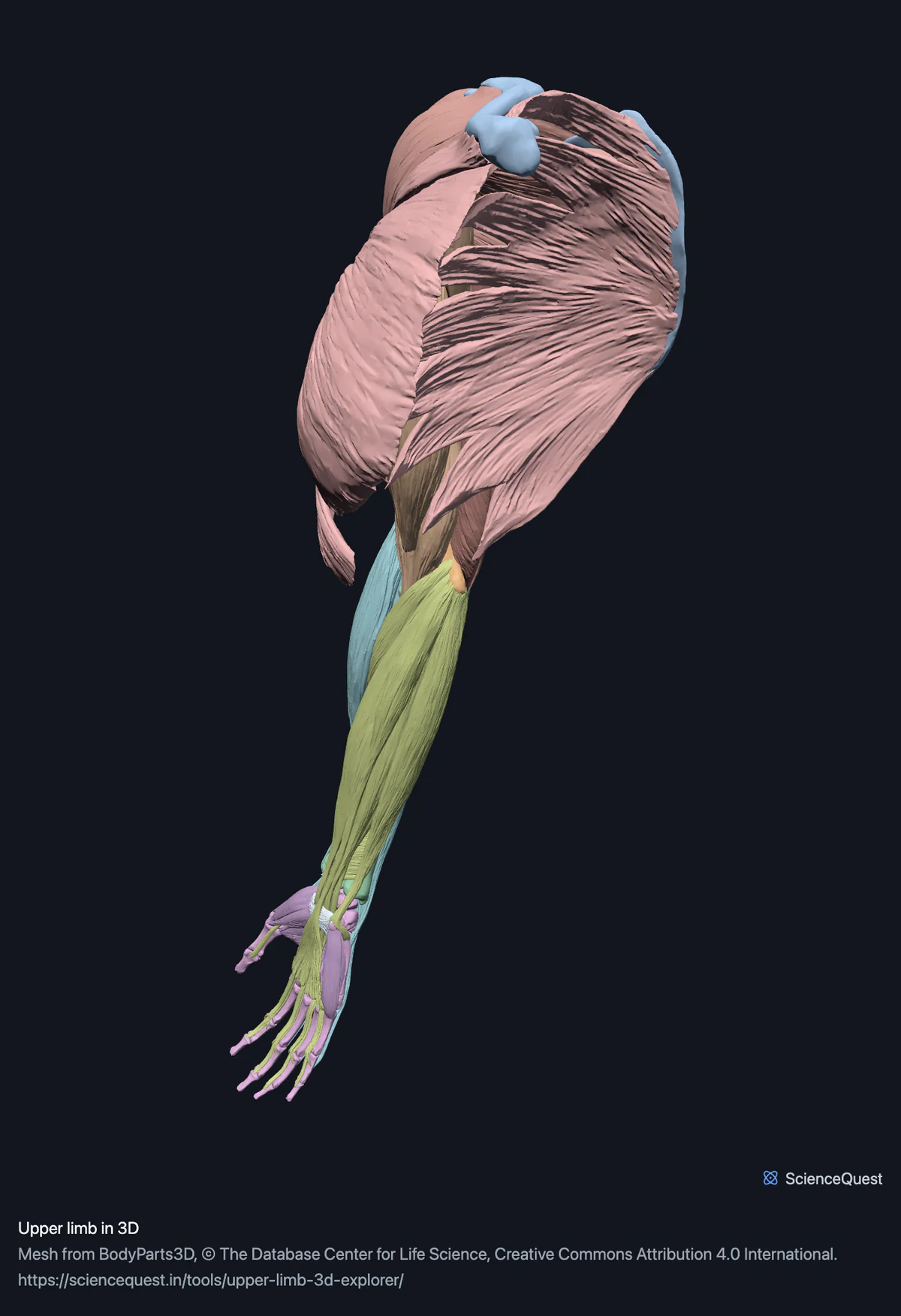
The right arm’s bones with the upper limb muscles over them, shoulder to fingertip: 148 structures loaded, glassed or hidden layer by layer.
Visualiser
Right upper limb, 32 bones
Checking this device for a stored copy.
Start here
- Press Show all Brings back the 58 left-arm structures, which start hidden because the skeleton here is the right limb only. Useful for comparing the two sides, odd to look at as anatomy.
- Glass the Anterior forearm band Bone visible through the anterior forearm muscles: the long flexors cross the wrist and the two pronators stop short of it, which is the relationship neither the skeleton model nor the muscle model shows on its own.
- Filter to Bone, then open Hand All 27 bones of the hand and wrist, carpals included, in the Hand band. They share one colour here; the hand and wrist skeleton explorer colours the carpals, metacarpals and phalanges apart.
Bone and muscle, right side. No nerves and no vessels in the limb. The brachial plexus is not segmented, and neither is any artery or vein beyond the subclavian, which is as far towards the arm as the vessel model reaches. The dataset’s only nerves anywhere are the optic nerves, with their chiasm and tracts, so there is nothing to switch on rather than something withheld.
Where this comes from
Segmented from imaging of one adult male body, not drawn by an artist, so the shapes are measurements. Two consequences worth knowing: it is one person’s anatomy rather than an average, and faint stepping on some surfaces is the resolution of the original scan rather than a rendering fault.
Meshes from BodyParts3D, © The Database Center for Life Science, under Creative Commons Attribution 4.0 International. Names and identifiers are the dataset’s own: Foundational Model of Anatomy identifiers and English labels, as its parts list gives them. Converted meshes are shared under the same licence.
Changes made: Meshes were converted from binary STL to an indexed mesh with 16-bit quantised vertex positions, and surface normals were recomputed from the geometry. No vertex was moved other than by that quantisation, whose worst-case error on any one coordinate is reported on the page. On this page it is at most 0.00537 mm, the largest among the 3 models the page can load.
Latin terms for 69 of the 148 structures in these models come from English Wikipedia anatomy infoboxes, under Creative Commons Attribution-ShareAlike 4.0, joined by Wikidata property P1402, Foundational Model of Anatomy identifier. Only a term a source states for that structure is used, never one constructed from a family name, which is why the rest carry no Latin rather than a guess.
Citing this tool
Last updated . Add the date you accessed it as well, which a citation of a page that can change asks for. If a specific view matters, cite the page address as it stands in your browser instead: it records what is selected and shown.
One arm of bone, two arms of muscle
The bone model used here covers the right upper limb only, while the muscle model covers both arms. This page keeps the right of each and hides the left 58, so what you see is one arm. Press Show all to get the other set back. Nothing is thrown away and nothing is re-encoded: the hidden structures are in the list, in the count and in any link you share.
The side is measured rather than read off the label. Each structure’s centroid comes from its geometry, and the sign of its across-body coordinate gives the side; testing the name for the word left or right is the same pattern matching that once dropped the navicular from a published bone count, so it is not used. The two were checked against each other before this was relied on: across every bone and muscle asset, 608 structures whose label names a side all agreed with their centroid, with no disagreement.
Common questions
Why does the page say it is showing 90 of 148 structures?
Because it has hidden the left arm’s muscles, and it would rather tell you than let you wonder. The bone model used here covers the right upper limb only, while the muscle model covers both arms, so loading them together naively puts a left arm made entirely of muscle in space beside a right arm of bone. The page declares which side it is about, the viewer hides the far one, and the 58 hidden structures stay in the list, in the count and in any link you share. Show all brings them back in one press.
How does it know which side a muscle is on?
By measuring, not by reading the label. Each structure’s centroid is computed from its geometry and the sign of its across-body coordinate gives the side. The obvious alternative, testing the name for left or right, is the same pattern matching that once silently lost the navicular from a bone count, so it is not used. The measurement was checked against the labels first: across every bone and muscle asset, 608 structures whose label names a side all agreed with their centroid, with no disagreement.
What can I see here that the separate arm pages cannot show?
How the two fit together, which is the one thing neither shows alone. Glass a muscle band and the bone stays visible through it, so you can see that the long flexors of the anterior forearm cross the wrist while the two pronators stop short of it. Filter to bone and the muscles vanish without unloading, so you can check what a muscle was sitting on and put it straight back. The skeleton page has no muscle and the muscle page has no bone, so in both cases the relationship has to be imagined.
Are the nerves and arteries of the arm included?
No, and there is nothing to include. The brachial plexus is not segmented, and neither is any artery or vein beyond the subclavian, which is as far towards the arm as the vessel model reaches. The dataset’s only nerves anywhere are the optic nerves, with their chiasm and tracts. So a page claiming to show the innervation of the arm would have to invent it, and this one says instead that the source does not contain it.