IV Drip Rate Practice Problems
Practice IV drip rate questions: gtt/min from volume, time and drop factor, mL/h, time to infuse and mcg/kg/min to mL/h, each marked with the working.
Practice
- Volume to infuse
- V = 720 mL
- Infusion time
- t = 7 h
- Drop factor
- DF = 20 gtt/mL
Within 1.5% counts as right. Type 12,500, 0.25, -45.3 or 1.6e-19.
Working
The working opens here after you check, or press Show working.
Cite this tool
Citing this tool
Last updated . Add the date you accessed it as well, which a citation of a page that can change asks for. If a specific result matters, cite the permalink from the tool’s share row instead of this page: it reproduces the exact parameters.
Worked answers
The first ten questions from the set above, each with its answer and the working that gets there. The working is carried out in the units each equation takes, so its last line can show the answer before it is converted.
-
- Volume to infuse
- V = 720 mL
- Infusion time
- t = 7 h
- Drop factor
- DF = 20 gtt/mL
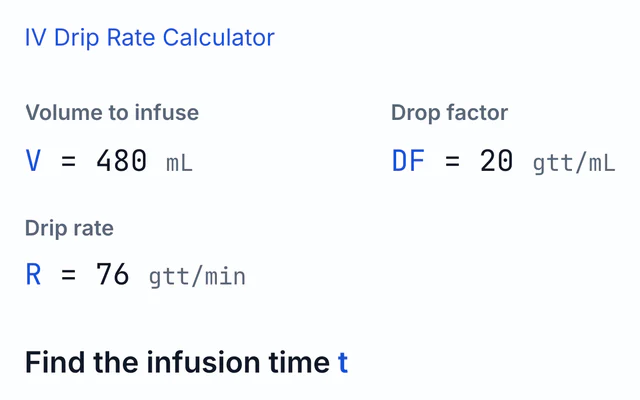
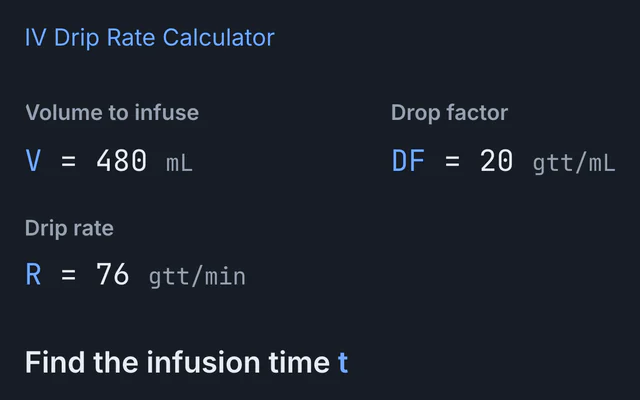
Find the drip rate (R).
Show the answer and working
Answer R = 34.29 gtt/min
Rearranged R = V × DF ÷ t
- R = V × DF ÷ t
- t = 7 h × 60 = 420 min
- R = 720 mL × 20 gtt/mL ÷ 420 min
- = 14,400 gtt ÷ 420 min
- = 34.29 gtt/min
- ≈ 34 gtt/min, rounded to a whole drop
Check it with the IV Drip Rate Calculator.
-
- Volume to infuse
- V = 540 mL
- Infusion rate
- R = 300 mL/h
Find the infusion time (t).
Show the answer and working
Answer t = 1.8 h
Rearranged t = V ÷ R
- t = V ÷ R
- = 540 mL ÷ 300 mL/h
- = 1.8 h, which is 1 h 48 min
Check it with the IV Infusion Rate Calculator.
-
- Dose rate
- D = 14 mcg/kg/min
- Weight
- W = 66 kg
- Concentration
- C = 4900 mcg/mL
Find the infusion rate (R).
Show the answer and working
Answer R = 11.31 mL/h
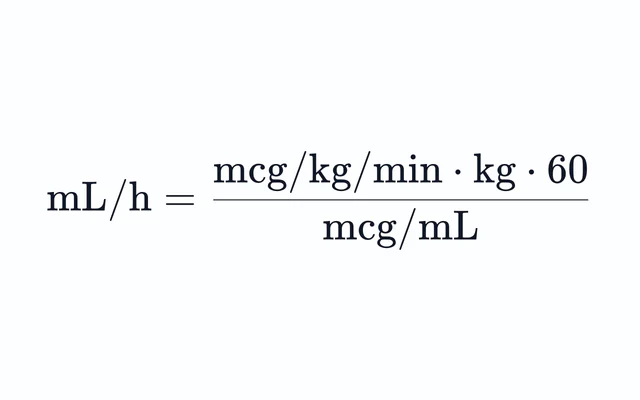
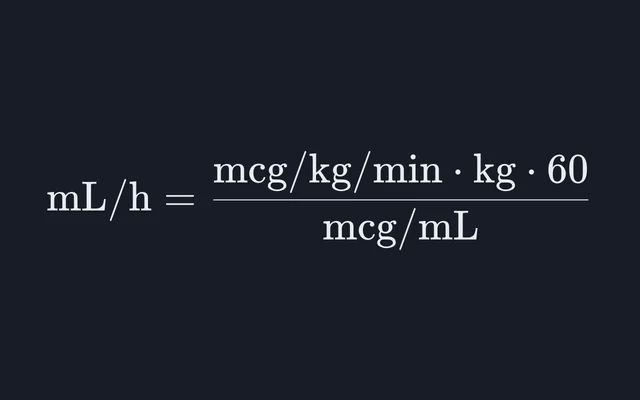
Rearranged R = D × W × 60 ÷ C
- R = D × W × 60 ÷ C
- = 14 mcg/kg/min × 66 kg × 60 min/h ÷ 4900 mcg/mL
- = 55,440 mcg/h ÷ 4900 mcg/mL
- = 11.31 mL/h
Check it with the mcg/kg/min to mL/hr Calculator.
-
- Volume to infuse
- V = 280 mL
- Infusion rate
- R = 96 mL/h
Find the infusion time (t).
Show the answer and working
Answer t = 2.917 h
Rearranged t = V ÷ R
- t = V ÷ R
- = 280 mL ÷ 96 mL/h
- = 2.917 h, which is 2 h 55 min
Check it with the IV Infusion Rate Calculator.
-
- Volume to infuse
- V = 890 mL
- Infusion time
- t = 8.3 h
- Drop factor
- DF = 20 gtt/mL
Find the drip rate (R).
Show the answer and working
Answer R = 35.74 gtt/min
Rearranged R = V × DF ÷ t
- R = V × DF ÷ t
- t = 8.3 h × 60 = 498 min
- R = 890 mL × 20 gtt/mL ÷ 498 min
- = 17,800 gtt ÷ 498 min
- = 35.74 gtt/min
- ≈ 36 gtt/min, rounded to a whole drop
Check it with the IV Drip Rate Calculator.
-
- Volume to infuse
- V = 610 mL
- Infusion time
- t = 17 h
Find the infusion rate (R).
Show the answer and working
Answer R = 35.88 mL/h
Rearranged R = V ÷ t
- R = V ÷ t
- t = 1020 min ÷ 60 = 17 h
- R = 610 mL ÷ 17 h
- = 35.88 mL/h
Check it with the IV Infusion Rate Calculator.
-
- Weight
- W = 120 kg
- Concentration
- C = 3700 mcg/mL
- Infusion rate
- R = 25 mL/h
Find the dose rate (D).
Show the answer and working
Answer D = 12.85 mcg/kg/min
Rearranged D = R × C ÷ (W × 60)
- D = R × C ÷ (W × 60)
- = 25 mL/h × 3700 mcg/mL ÷ (120 kg × 60 min/h)
- = 1542 mcg/min ÷ 120 kg
- = 12.85 mcg/kg/min
Check it with the mcg/kg/min to mL/hr Calculator.
-
- Volume to infuse
- V = 670 mL
- Drop factor
- DF = 20 gtt/mL
- Drip rate
- R = 47 gtt/min
Find the infusion time (t).
Show the answer and working
Answer t = 4.752 h
Rearranged t = V × DF ÷ R
- t = V × DF ÷ R
- = 670 mL × 20 gtt/mL ÷ 47 gtt/min
- = 13,400 gtt ÷ 47 gtt/min
- = 285.1 min
- = 4.752 h, which is 4 h 45 min
Check it with the IV Drip Rate Calculator.
-
- Volume to infuse
- V = 810 mL
- Infusion rate
- R = 320 mL/h
Find the infusion time (t).
Show the answer and working
Answer t = 2.531 h
Rearranged t = V ÷ R
- t = V ÷ R
- = 810 mL ÷ 320 mL/h
- = 2.531 h, which is 2 h 32 min
Check it with the IV Infusion Rate Calculator.
-
- Dose rate
- D = 4.4 mcg/kg/min
- Concentration
- C = 1900 mcg/mL
- Infusion rate
- R = 16 mL/h
Find the weight (W).
Show the answer and working
Answer W = 115.2 kg
Rearranged W = R × C ÷ (D × 60)
- W = R × C ÷ (D × 60)
- = 16 mL/h × 1900 mcg/mL ÷ (4.4 mcg/kg/min × 60 min/h)
- = 506.7 mcg/min ÷ 4.4 mcg/kg/min
- = 115.2 kg
Check it with the mcg/kg/min to mL/hr Calculator.
How do you solve IV drip rate problems?
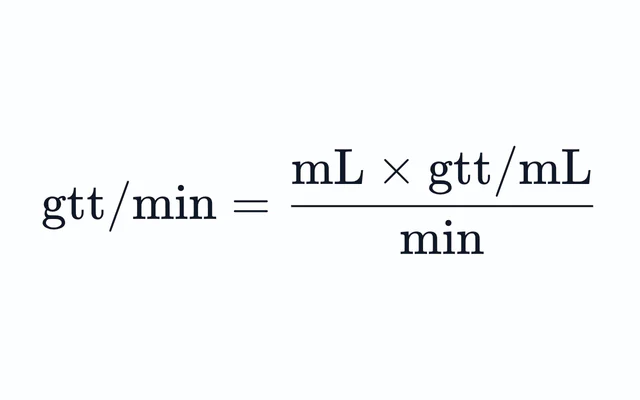
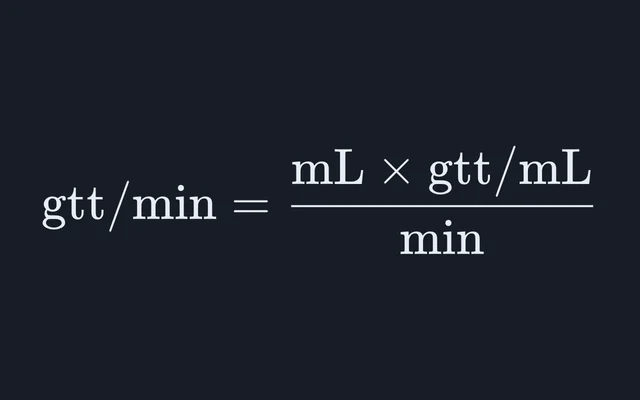
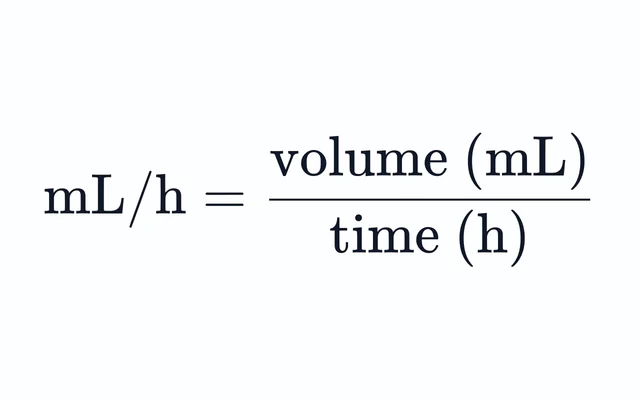
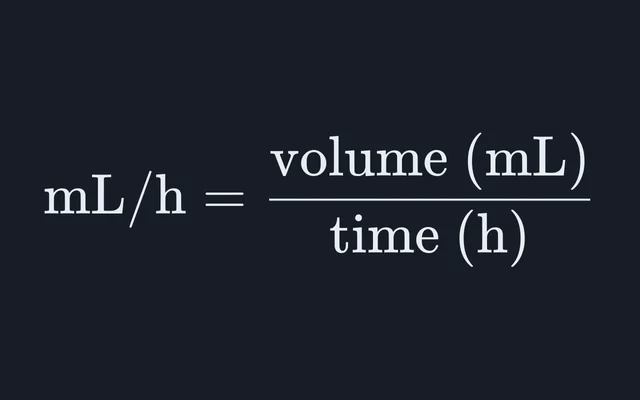
Multiply the volume in mL by the drop factor of the tubing, then divide by the time in minutes: gtt/min = mL × gtt/mL ÷ min, rounded to a whole drop. A pump rate leaves the drop factor out and divides by hours, mL/h = mL ÷ h. Turned around, either relation gives the time a bag takes.
Open RN works the three in sections 5.14 (gravity), 5.15 (pump) and 5.16 (completion time), and rounds drops to the nearest whole number in 5.5.
The calculators behind the questions
Every question is generated from one of these 3 calculators, and links back to the one it came from: IV Drip Rate Calculator, IV Infusion Rate Calculator and mcg/kg/min to mL/hr Calculator.
- Drip rate. Drops per minute from a volume, a time and a drop factor, or the time a volume takes at a counted rate.
- Pump rate. mL/h from a volume and a time, the time a bag lasts at a set rate, or the volume a rate delivers in a given time.
- Weight-based infusion. mL/h from a dose in mcg/kg/min, a weight and a concentration, and the same relation solved for the dose, the weight or the concentration.
The same order on other drop factors
Every drip question here uses a 20 gtt/mL set. The drop factor multiplies the answer directly, so one order counts differently on each set. 900 mL over 7 hours (420 minutes), which is 128.6 mL/h, comes to:
| gtt/mL | Working | gtt/min | Set as |
|---|---|---|---|
| 10 | 900 × 10 ÷ 420 | 21.43 | 21 |
| 15 | 900 × 15 ÷ 420 | 32.14 | 32 |
| 20 | 900 × 20 ÷ 420 | 42.86 | 43 |
| 60 | 900 × 60 ÷ 420 | 128.6 | 129 |
Starting from a rate in mL/h, the drip rate is a sixth of it on a 10 gtt/mL set, a quarter on 15 and a third on 20. OpenStax’s worked example is the quarter: 75 mL/h on 15 gtt tubing is (75 × 15) ÷ 60 = 18.75, which it gives as 19 gtt/min. On a 60 gtt/mL microdrip set the 60 drops in a mL cancel the 60 minutes in an hour, so the drops per minute are the mL/h, 128.6 in both, as in Open RN’s section 5.14 example, where 500 mL over 4 hours (125 mL/h) on a 60 gtt/mL set runs at 125 gtt/min. The IV drip rate chart works 17 common orders on all four sets.
Open RN’s Nursing Skills lists macrodrip sets at 10, 15 or 20 gtt/mL in its IV therapy chapter and at 10, 12, 15 or 20 gtt/mL in its math chapter, with microdrip sets at 60 gtt/mL in both, so the factor to use is the one on the package of the set that is hanging. To check a running drip, OpenStax has you count the drops in the drip chamber for one full minute, or count for 15 seconds and expect a quarter of the rate.
Times in hours and minutes
Each time question asks for hours, entered as a decimal. The digits after the point are a fraction of an hour, which Open RN (section 5.16) converts by multiplying by 60 for the minutes: 2.75 h is 2 hours 45 minutes, and 2 hours 20 minutes is 2.333 h. Entered as 2.2, that last one is out by almost 6 percent and is marked wrong, while 2.33 is inside the margin. Open RN’s example, 500 mL at 75 mL/h, takes 6.6667 hours, which is 6 hours 40 minutes, so a bag hung at 0800 finishes at 1440.
Weight-based infusions in mcg/kg/min
Open RN (section 5.17) multiplies the dose by the weight in kg, which gives mcg/min for the whole patient, then chains the bag’s mL per mg, 1000 mcg to 1 mg and 60 minutes to an hour to reach mL/h. Taken one step at a time, times 60 gives mcg/h and dividing by the concentration in mcg/mL leaves mL/h, so a bag labeled in mg is converted first: 50 mg in 250 mL is 0.2 mg/mL, which is 200 mcg/mL. Open RN’s multi-step example runs 0.5 mcg/kg/min for a 180 lb patient from that bag at 12.27 mL/h, dividing the pounds by 2.2, and the exact pound, 0.45359237 kg, gives 12.25 mL/h. The questions here state the weight in kg and the concentration in mcg/mL, so each one tests the arithmetic alone.
What the questions leave out
No drug or fluid is named, and the values are drawn to exercise each formula rather than to match a real order. Open RN notes that in the United States IV medications are most commonly given by infusion pump, typically programmed in mL/h, and teaches the gravity count for when no pump is available. OpenStax cites the Infusion Nurses Society (2024) in recommending a pump in every setting. A real infusion follows the prescriber’s order and the drug label, which Open RN has the nurse check before giving a medication (section 15.2), and Open RN leaves how far a pump rate is rounded to agency policy and the pump’s settings (section 5.17).
Sources
Kimberly Ernstmeyer and Elizabeth Christman, editors, Nursing Skills, 2nd edition (Open RN, WisTech Open, 2023): section 5.5 on rounding, sections 5.13, 5.14, 5.15, 5.16 and 5.17 on IV infusion by gravity and by pump, completion times and multi-step calculations, section 15.2 on administering medications, and section 23.2 on blood collection and IV therapy basics, for the drop factors, the rounding rules, the order and the label, and the worked examples quoted here. Christy Bowen, Clinical Nursing Skills (OpenStax, 2024), section 13.3 on intravenous infusion, for its worked gravity rate from mL/h, the drop count and the pump recommendation it cites to the Infusion Nurses Society, Infusion Therapy Standards of Practice, 9th edition (Journal of Infusion Nursing, 2024). NIST Special Publication 811, Guide for the Use of the International System of Units (2008), appendix B.8, footnote 22, for the exact pound of 0.45359237 kg.
For the caution above: Open RN section 15.2 for the order and for the second nurse’s check that some high-alert medications need, 5.5 for rounding by agency policy and 23.2 for agencies that require a pump; 21 CFR 201.57, paragraphs (c)(3) and (c)(4), for the dose limit and the strength that prescription drug labeling states; and Open RN sections 5.14 and 5.17 and NIST footnote 22 for the factors of 60, 1000 and 2.2. The exact pound makes a kilogram 2.2046 lb.
Compare the formulas: IV drip rate chart.
Common questions
Why is every drip question on a 20 gtt/mL set?
The drop factor belongs to the tubing, so the questions keep it at one real set instead of drawing a factor such as 27 gtt/mL, which is not among the drop factors sets are sold in (10, 15 or 20 gtt/mL macrodrip, 60 gtt/mL microdrip; Open RN 5.14 also lists 12). 20 gtt/mL is the factor the IV drip rate calculator starts on. Another set changes only the multiplier, and the section on other drop factors works one order through the 10, 15, 20 and 60 gtt/mL sets.
Should I round a drip rate before I enter it?
You can. Open RN’s Nursing Skills (section 5.5) rounds drops to the nearest whole number, and every drip rate asked for here is at least 34 gtt/min, so the rounded count stays inside the 1.5 percent each answer is marked to: 34.4 entered as 34 is out by 1.2 percent. The same section rounds only the final answer, so round pump rates, doses and times once, at the end. In this set, three or four significant figures are marked right. On a real pump, Open RN (section 5.17) leaves how far to round to agency policy and the pump’s settings.
How is this set different from the dosage calculation practice problems?
The dosage set draws on these three calculators and a fourth, the weight-based dose in mg/kg and the volume to draw up. This set leaves that one out, so every question is a drip rate, a pump rate, a time to infuse, a volume infused or a weight-based infusion in mcg/kg/min. It is generated from a different seed, so the numbers differ too.