IV Infusion Rate Calculator
Find an IV pump rate in mL/hr from the volume and the infusion time, or how long a bag will last, with the gravity drip rate at each standard drop factor.
Calculator
The volume ordered, which is not always the size of the bag. 1 L is 1000 mL.
Hours or minutes. The working converts to hours, because a pump runs in mL per hour.
Often written mL/hr on American orders. It is the same unit.
Working, with your numbers
- R = V ÷ t
- t = 480 min ÷ 60 = 8 h
- R = 1000 mL ÷ 8 h
- = 125 mL/h
Values are converted into the units the equation is worked in before the arithmetic.
- Over 24 hours The rate kept up for a whole day, for checking against an order written per day.
- 3000 mL
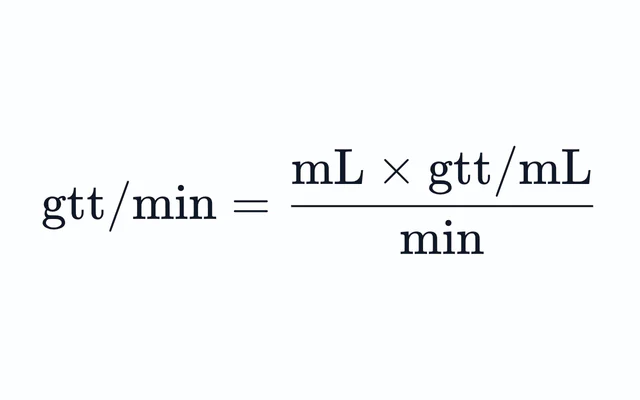
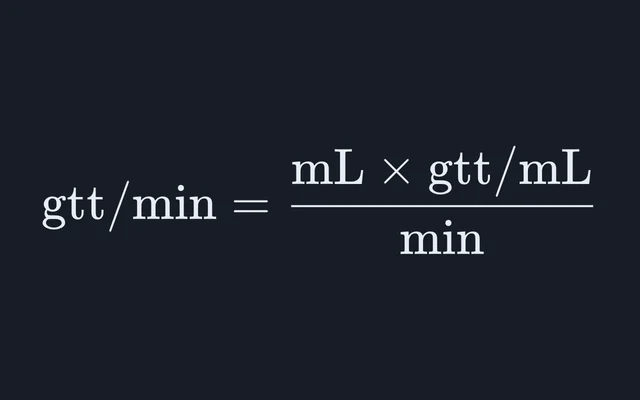
- Gravity drip at 10 gtt/mL The same rate on a gravity set, rounded to a whole drop: mL/h × drop factor ÷ 60.
- 21 gtt/min
- Gravity drip at 15 gtt/mL
- 31 gtt/min
- Gravity drip at 20 gtt/mL
- 42 gtt/min
- Microdrip at 60 gtt/mL Equal to the rate in mL/h, rounded, because the 60 drops in a mL cancel the 60 minutes in an hour.
- 125 gtt/min
Citing this tool
Last updated . Add the date you accessed it as well, which a citation of a page that can change asks for. If a specific result matters, cite the permalink from the tool’s share row instead of this page: it reproduces the exact parameters.
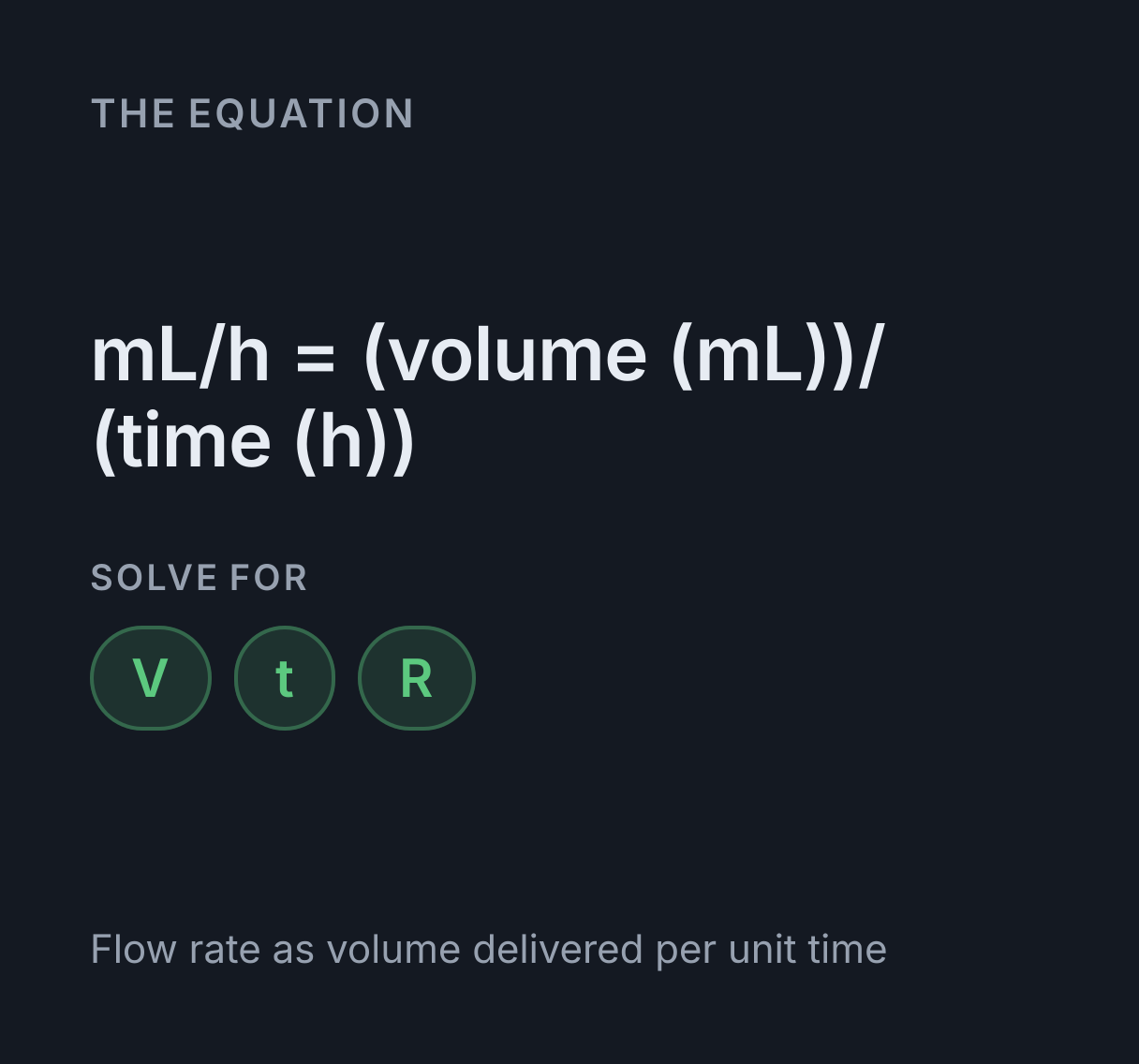
The equation
Flow rate as volume delivered per unit time
How do you calculate IV infusion rate in mL/hr?
Divide the volume to infuse in mL by the infusion time in hours: mL/h = mL ÷ h. A 1000 mL bag ordered over 8 hours runs at 125 mL/h. When the time is given in minutes, divide it by 60 to turn it into hours first, so 50 mL over 20 minutes is 150 mL/h, not 2.5.
Pump rate and drip rate
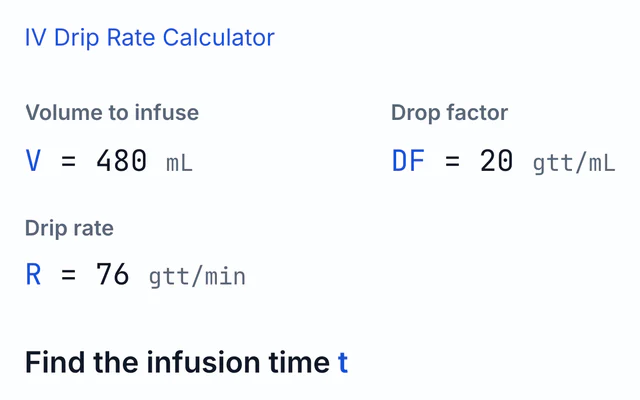
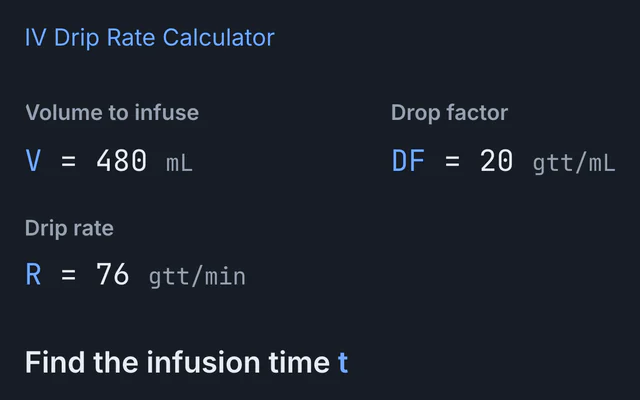
An infusion pump is programmed in mL/h, written mL/hr on many American orders, and needs nothing more than the volume and the time. A gravity set is adjusted by counting drops instead, so the same infusion has to be turned into gtt/min with the drop factor printed on the tubing. The readouts above give that figure at each standard drop factor, rounded to a whole drop, so one calculation covers both ways of running the bag. The IV drip rate calculator starts from the volume and the time and prints the drop count in full.
Volume infused and time left
The same relation answers the two questions asked most during a shift. Solved for the volume, it gives the amount infused so far, the figure that goes on the intake record. Solved for the time, it gives how long the fluid left in the bag will last, which is when the next bag is due.
Both use the volume of the order, which is not always the volume of the bag. A 1000 mL bag hung for an order of 500 mL over 4 hours runs at the rate for 500 mL, and the pump’s volume to be infused is set to 500 so that it stops there.
When the order is a dose, not a volume
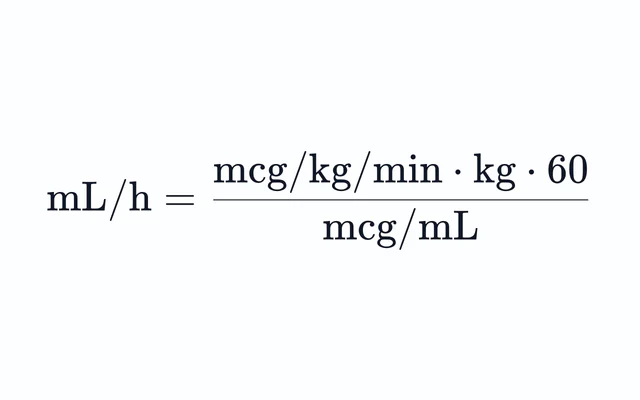
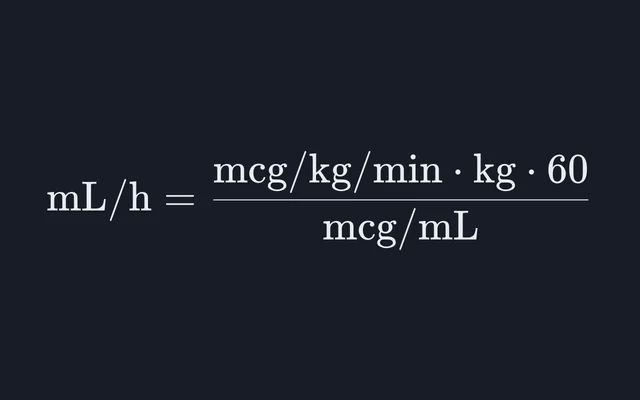
An order for a drug by dose rate, such as mcg/kg/min, sets the rate through the patient’s weight and the concentration in the bag rather than through a volume and a time. That conversion is on the mcg/kg/min to mL/hr calculator. An order in units/h works the same way without the weight: divide it by the concentration in units/mL to get mL/h.
Common mistakes
- Dividing by minutes. A time left in minutes gives a rate per minute, 60 times smaller than the number the pump needs.
- Reading a decimal hour as minutes. 0.5 h is 30 minutes and 0.25 h is 15. The working writes a solved time in hours and minutes for this reason.
- Working from the bag instead of the order. The volume in the formula is the volume ordered.
- Forgetting what has already run. After a rate change the time left comes from the volume left in the bag, not from the volume first hung.
Worked examples
Each one runs through the calculator above, so the arithmetic here is the arithmetic it does.
What is the pump rate for 50 mL over 20 minutes?
- R = V ÷ t
- t = 20 min ÷ 60 = 0.3333 h
- R = 50 mL ÷ 0.3333 h
- = 150 mL/h
A time in minutes becomes hours before it divides, because the pump runs per hour. Dividing 50 by 20 gives 2.5, which is a rate per minute: a pump set to 2.5 mL/h would deliver a sixtieth of the order.
How long does a 250 mL bag last at 75 mL/h?
- t = V ÷ R
- = 250 mL ÷ 75 mL/h
- = 3.333 h, which is 3 h 20 min
3.333 hours is 3 hours 20 minutes, not 3 hours 33. A decimal hour read as minutes is an easy slip when the next bag is being timed, which is why the working writes the answer both ways.
How much has infused after 4.5 hours at 125 mL/h?
- V = R × t
- t = 270 min ÷ 60 = 4.5 h
- V = 125 mL/h × 4.5 h
- = 562.5 mL
Solved for the volume, the same relation gives the intake to record at the end of a shift or when a bag is changed. It holds only while the rate stayed the same: after a rate change, work out the volume run at each rate and add them.
Practise this with Dosage Calculation Practice Problems, questions generated from this calculator and 3 other calculators in Biology.
Common questions
How do I work out mL/hr from a dose in mcg/kg/min?
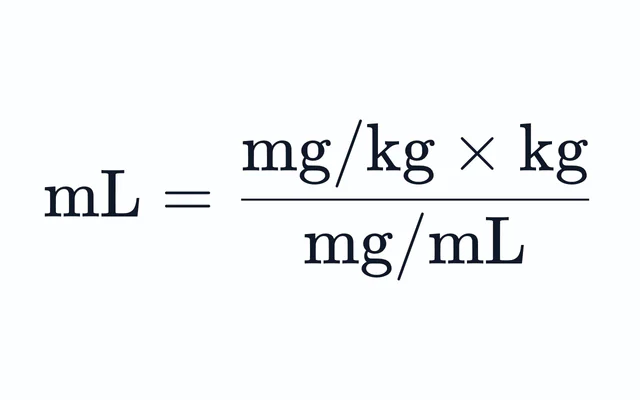
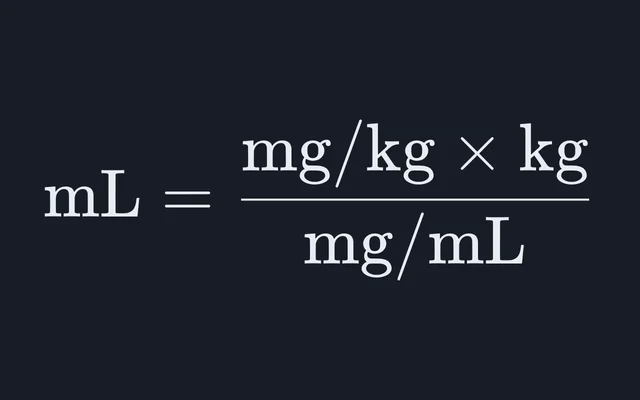
Through the weight and the concentration instead of a volume and a time: mL/h = mcg/kg/min × kg × 60 ÷ mcg/mL. The 60 turns the dose per minute into a dose per hour, the unit the pump runs in. The mcg/kg/min to mL/hr calculator carries each unit through, including a weight in pounds and a strength in mg/mL.
How long will an IV bag last?
Divide the volume left in the bag by the rate. 500 mL at 80 mL/h lasts 6.25 hours, which is 6 hours 15 minutes, because 0.25 of an hour is a quarter of an hour and not 25 minutes. Solve for the time in the calculator and the working writes the answer in hours and minutes for that reason.
Is mL/hr the same as mL/h?
Yes. Both are millilitres per hour. American orders and pumps often write mL/hr, while h is the symbol the SI Brochure gives the hour, which is why this site writes mL/h. The number is the same either way, so a rate worked out here goes into a pump labelled mL/hr unchanged.