IV Drip Rate Calculator
Work out an IV drip rate in drops per minute from the volume, the infusion time and the drop factor of a 10, 15, 20 or 60 gtt/mL set, with the working.
Calculator
The volume ordered, which is not always the size of the bag. 1 L is 1000 mL.
Hours or minutes. The working converts to minutes, because the drip rate is per minute.
Printed on the tubing package. Macrodrip sets are 10, 15 or 20 gtt/mL, microdrip sets 60 gtt/mL.
Working, with your numbers
- R = V × DF ÷ t
- t = 8 h × 60 = 480 min
- R = 1000 mL × 20 gtt/mL ÷ 480 min
- = 20,000 gtt ÷ 480 min
- = 41.67 gtt/min
- ≈ 42 gtt/min, rounded to a whole drop
Values are converted into the units the equation is worked in before the arithmetic.
- Rounded to whole drops Drops are counted whole, so a gravity infusion is set to the nearest whole drop per minute. Round once, at the end.
- 42 gtt/min
- Flow rate The same infusion in the unit a pump is programmed in. On a 60 gtt/mL microdrip set this equals the drip rate, because 60 drops make a mL and 60 minutes make an hour.
- 125 mL/h
- Drops in 15 seconds For checking against a watch. A drop miscounted over 15 seconds is four drops a minute out, so a full minute’s count is the closer check.
- 10.42 gtt
- Set type Macrodrip sets deliver 10, 15 or 20 gtt/mL depending on the manufacturer, microdrip sets 60. Use the factor printed on the package.
- Macrodrip
Citing this tool
Last updated . Add the date you accessed it as well, which a citation of a page that can change asks for. If a specific result matters, cite the permalink from the tool’s share row instead of this page: it reproduces the exact parameters.
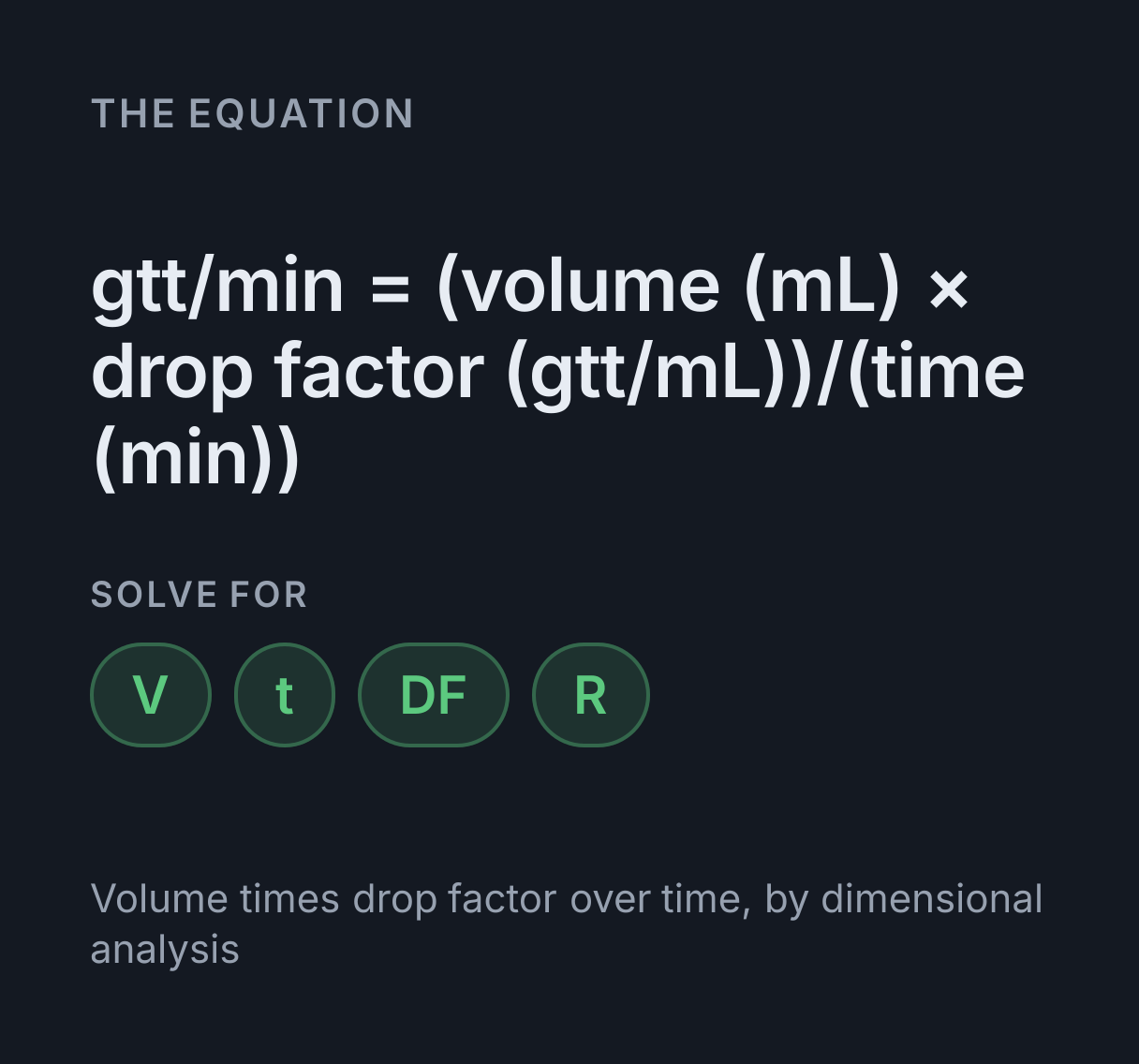
The equation
Volume times drop factor over time, by dimensional analysis
How do you calculate IV drip rate in gtt/min?
Multiply the volume to infuse in mL by the drop factor of the tubing in gtt/mL, then divide by the infusion time in minutes: gtt/min = (mL × gtt/mL) ÷ min. For 1000 mL over 8 hours on a 20 gtt/mL set, that is 1000 × 20 ÷ 480 = 41.7, which rounds to 42 gtt/min.
Macrodrip and microdrip sets
The drop factor is the number of drops the tubing forms from one mL, and it is fixed by the drip chamber the set is made with. Macrodrip sets deliver 10, 15 or 20 gtt/mL depending on the manufacturer. Microdrip sets deliver 60, drops small enough to set slow rates and the small volumes of pediatric infusions accurately. The factor is printed on the tubing package, and nothing in the order or the fluid says which set is hanging.
On a microdrip set the drip rate in gtt/min and the flow rate in mL/h are the same number. Sixty drops make a mL and sixty minutes make an hour, so the two factors cancel. It is a quick check on any answer, and it holds for that set only: on a macrodrip set the drip rate is a sixth, a quarter or a third of the mL/h figure, for 10, 15 and 20 gtt/mL.
Why the time has to be in minutes
The drop factor counts drops per mL and the answer counts drops per minute, so the only time unit that cancels is the minute. An order written over hours is multiplied by 60 before it goes in, which is the line of working printed straight after the formula. Dividing by the hours instead gives an answer 60 times too high, with the rest of the arithmetic correct, so nothing else in the working looks wrong.
Setting and checking the rate
A gravity infusion is set with the roller clamp while the drops falling in the drip chamber are counted against a watch. The Drops in 15 seconds readout is there for that count, but one drop miscounted over 15 seconds becomes four drops a minute once it is multiplied up, so a full minute’s count is the closer check. Drops are counted whole, so only the final answer is rounded, to the nearest drop.
A gravity rate also drifts after it is set. The flow is driven by the height of the bag above the cannula, so raising or lowering the bed, a bent arm or a kinked line changes it, and the count is worth repeating whenever the patient moves. A pump holds its rate in mL/h whatever the height, which is why local policy names the fluids and drugs that must run on one.
Common mistakes
- Dividing by hours. 8 hours is 480 minutes. Dividing by 8 gives a drip rate 60 times too high.
- Assuming the drop factor. A rate worked out for 15 gtt/mL on a set that is really 10 or 20 gtt/mL is out by at least a quarter. Read the package.
- Reading mL/h as gtt/min. They match only on a 60 gtt/mL set. On a 20 gtt/mL set, 125 mL/h is about 42 gtt/min, not 125.
- Rounding on the way through. Rounding the minutes or the volume first adds an error of its own before the last step adds another. Round the drip rate once, at the end.
Worked examples
Each one runs through the calculator above, so the arithmetic here is the arithmetic it does.
What is the drip rate for 250 mL over 5 hours on a 60 gtt/mL microdrip set?
- R = V × DF ÷ t
- t = 5 h × 60 = 300 min
- R = 250 mL × 60 gtt/mL ÷ 300 min
- = 15,000 gtt ÷ 300 min
- = 50 gtt/min
- ≈ 50 gtt/min, rounded to a whole drop
On a microdrip set the drip rate is the same number as the rate in mL/h, because the 60 drops in a mL cancel the 60 minutes in an hour. That makes a microdrip answer checkable at a glance, and only a microdrip one.
How long will 1 L take at 25 gtt/min on a 15 gtt/mL set?
- t = V × DF ÷ R
- = 1000 mL × 15 gtt/mL ÷ 25 gtt/min
- = 15,000 gtt ÷ 25 gtt/min
- = 600 min
- = 10 h
The litre goes in as 1000 mL, and the answer comes out in minutes because the drip rate is per minute. Turning the minutes into hours is the last step, and the one that is easy to leave out.
How much fluid runs in 3 hours at 28 gtt/min on a 20 gtt/mL set?
- V = R × t ÷ DF
- t = 3 h × 60 = 180 min
- V = 28 gtt/min × 180 min ÷ 20 gtt/mL
- = 5040 gtt ÷ 20 gtt/mL
- = 252 mL
A drip rate counted at the bedside, turned into the volume for the intake record. The drops are counted per minute, so the 3 hours become 180 minutes before the drop factor turns drops back into mL.
Practise this with Dosage Calculation Practice Problems, questions generated from this calculator and 3 other calculators in Biology.
Common questions
Which drop factor should I use?
The one printed on the tubing package. The drop factor belongs to the administration set, not to the fluid or the order: macrodrip sets are made at 10, 15 or 20 gtt/mL depending on the manufacturer, and microdrip sets at 60 gtt/mL. An exam question states the factor, and at the bedside it is read off the package of the set that is actually hanging.
How do I convert mL/hr to gtt/min?
Multiply the rate in mL/h by the drop factor and divide by 60, the minutes in an hour. 100 mL/h on a 15 gtt/mL set is 100 × 15 ÷ 60 = 25 gtt/min. The IV infusion rate calculator prints this figure at all four standard drop factors beside the pump rate.
Should a drip rate be rounded up or down?
To the nearest whole drop, once, at the end. Drops are counted whole, so 31.25 gtt/min is set as 31 and 41.67 as 42. Rounding the time or the volume on the way through adds an error of its own before the last step adds another. Where a course or local policy states a different rounding rule, follow that one.