Dosage Calculation Practice Problems
Work through nursing dosage calculation questions on drip rates, mL/hr, mcg/kg/min infusions and mg/kg doses, each marked instantly with the working shown.
Practice
Question 1 of 40
Weight-Based Dosage Calculator
- Dose per kilogram
- D = 23 mg/kg
- Concentration
- C = 99 mg/mL
- Volume to give
- V = 7 mL
Citing this tool
Last updated . Add the date you accessed it as well, which a citation of a page that can change asks for. If a specific result matters, cite the permalink from the tool’s share row instead of this page: it reproduces the exact parameters.
Worked answers
The first ten questions from the set above, each with its answer and the working that gets there. The working is carried out in the units each equation takes, so its last line can show the answer before it is converted.
-
- Dose per kilogram
- D = 23 mg/kg
- Concentration
- C = 99 mg/mL
- Volume to give
- V = 7 mL
Find the weight (W).
Show the answer and working
Answer W = 30.13 kg
Rearranged
W = V × C ÷ D- W = V × C ÷ D
- dose = 7 mL × 99 mg/mL = 693 mg
- W = 693 mg ÷ 23 mg/kg
- = 30.13 kg
Check it with the Weight-Based Dosage Calculator.
-
- Volume to infuse
- V = 310 mL
- Drop factor
- DF = 20 gtt/mL
- Drip rate
- R = 62 gtt/min
Find the infusion time (t).
Show the answer and working
Answer t = 1.667 h
Rearranged
t = V × DF ÷ R- t = V × DF ÷ R
- = 310 mL × 20 gtt/mL ÷ 62 gtt/min
- = 6200 gtt ÷ 62 gtt/min
- = 100 min
- = 1.667 h, which is 1 h 40 min
Check it with the IV Drip Rate Calculator.
-
- Volume to infuse
- V = 270 mL
- Infusion time
- t = 21 h
Find the infusion rate (R).
Show the answer and working
Answer R = 12.86 mL/h
Rearranged
R = V ÷ t- R = V ÷ t
- t = 1260 min ÷ 60 = 21 h
- R = 270 mL ÷ 21 h
- = 12.86 mL/h
Check it with the IV Infusion Rate Calculator.
-
- Dose per kilogram
- D = 21 mg/kg
- Weight
- W = 70 kg
- Concentration
- C = 84 mg/mL
Find the volume to give (V).
Show the answer and working
Answer V = 17.5 mL
Rearranged
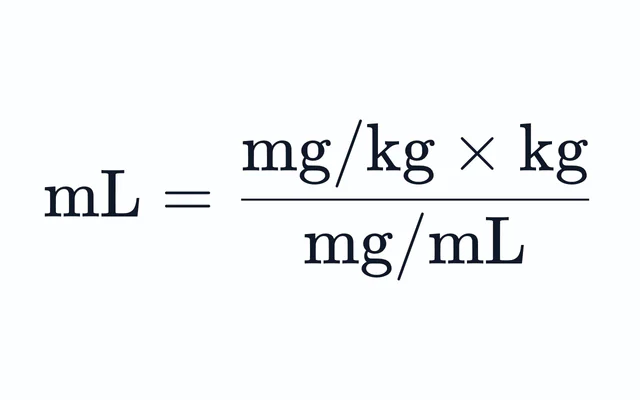
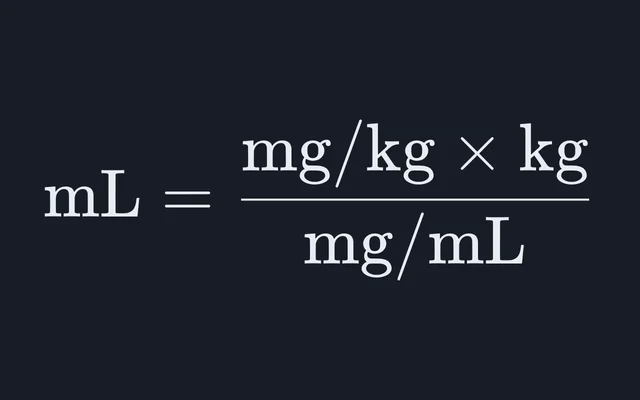
V = D × W ÷ C- V = D × W ÷ C
- dose = 21 mg/kg × 70 kg = 1470 mg
- V = 1470 mg ÷ 84 mg/mL
- = 17.5 mL
Check it with the Weight-Based Dosage Calculator.
-
- Volume to infuse
- V = 330 mL
- Infusion time
- t = 12 h
Find the infusion rate (R).
Show the answer and working
Answer R = 27.5 mL/h
Rearranged
R = V ÷ t- R = V ÷ t
- t = 720 min ÷ 60 = 12 h
- R = 330 mL ÷ 12 h
- = 27.5 mL/h
Check it with the IV Infusion Rate Calculator.
-
- Dose rate
- D = 18 mcg/kg/min
- Weight
- W = 60 kg
- Concentration
- C = 1900 mcg/mL
Find the infusion rate (R).
Show the answer and working
Answer R = 34.11 mL/h
Rearranged
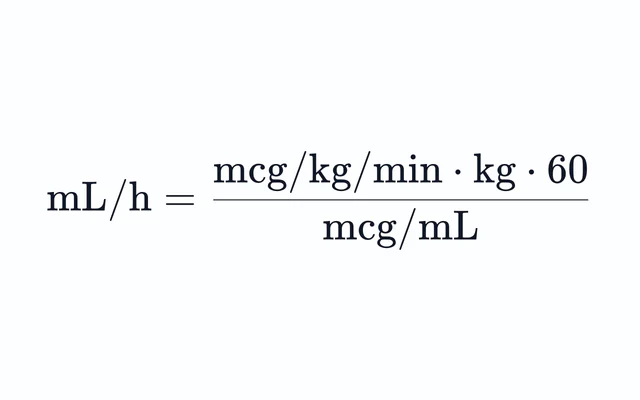
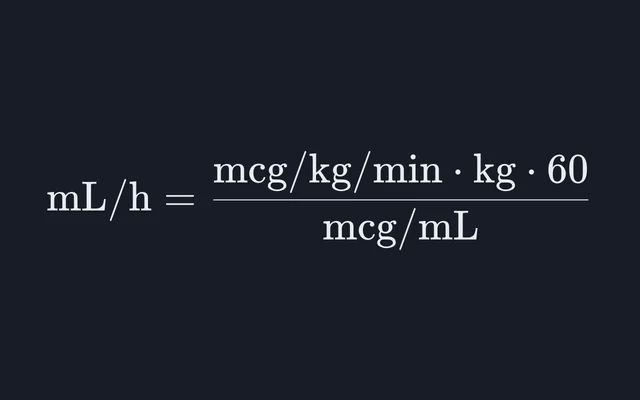
R = D × W × 60 ÷ C- R = D × W × 60 ÷ C
- = 18 mcg/kg/min × 60 kg × 60 min/h ÷ 1900 mcg/mL
- = 64,800 mcg/h ÷ 1900 mcg/mL
- = 34.11 mL/h
Check it with the mcg/kg/min to mL/hr Calculator.
-
- Dose per kilogram
- D = 22 mg/kg
- Weight
- W = 16 kg
- Concentration
- C = 20 mg/mL
Find the volume to give (V).
Show the answer and working
Answer V = 17.6 mL
Rearranged
V = D × W ÷ C- V = D × W ÷ C
- dose = 22 mg/kg × 16 kg = 352 mg
- V = 352 mg ÷ 20 mg/mL
- = 17.6 mL
Check it with the Weight-Based Dosage Calculator.
-
- Volume to infuse
- V = 530 mL
- Drop factor
- DF = 20 gtt/mL
- Drip rate
- R = 81 gtt/min
Find the infusion time (t).
Show the answer and working
Answer t = 2.181 h
Rearranged
t = V × DF ÷ R- t = V × DF ÷ R
- = 530 mL × 20 gtt/mL ÷ 81 gtt/min
- = 10,600 gtt ÷ 81 gtt/min
- = 130.9 min
- = 2.181 h, which is 2 h 11 min
Check it with the IV Drip Rate Calculator.
-
- Infusion time
- t = 8.3 h
- Infusion rate
- R = 38 mL/h
Find the volume to infuse (V).
Show the answer and working
Answer V = 315.4 mL
Rearranged
V = R × t- V = R × t
- t = 498 min ÷ 60 = 8.3 h
- V = 38 mL/h × 8.3 h
- = 315.4 mL
Check it with the IV Infusion Rate Calculator.
-
- Dose rate
- D = 15 mcg/kg/min
- Concentration
- C = 3200 mcg/mL
- Infusion rate
- R = 33 mL/h
Find the weight (W).
Show the answer and working
Answer W = 117.3 kg
Rearranged
W = R × C ÷ (D × 60)- W = R × C ÷ (D × 60)
- = 33 mL/h × 3200 mcg/mL ÷ (15 mcg/kg/min × 60 min/h)
- = 1760 mcg/min ÷ 15 mcg/kg/min
- = 117.3 kg
Check it with the mcg/kg/min to mL/hr Calculator.
How do you solve dosage calculation problems?
Write down what is ordered, what is on hand and the patient’s weight, each with its unit. Convert until the units agree (pounds to kilograms, hours to minutes or mg to mcg), then arrange the numbers so that every unit cancels except the one asked for. Each question here is one of those set-ups, with its working shown.
The calculators behind the questions
Every question is generated from one of these 4 calculators, and links back to the one it came from: IV Drip Rate Calculator, IV Infusion Rate Calculator, mcg/kg/min to mL/hr Calculator and Weight-Based Dosage Calculator.
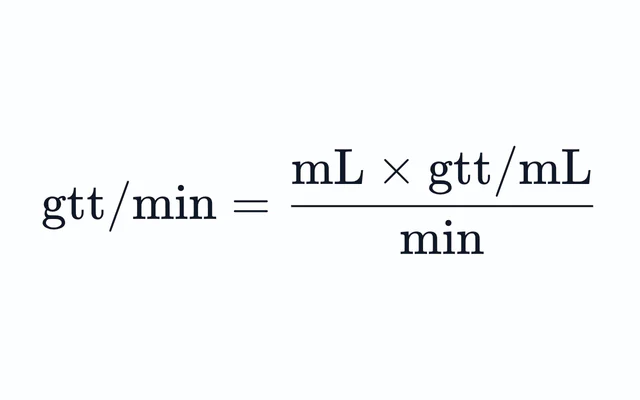
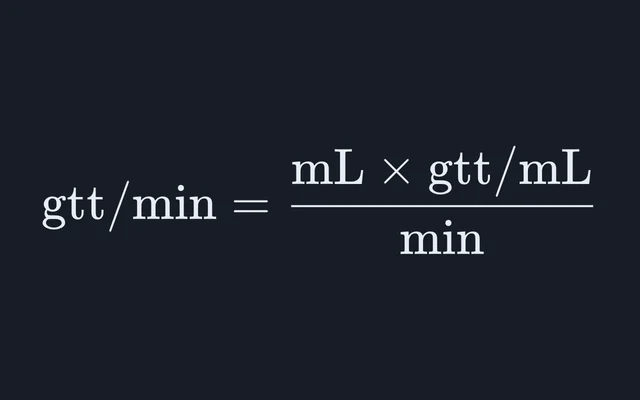
- Drip rate. A volume, a time and a drop factor give drops per minute, or the time a bag lasts at a counted rate.
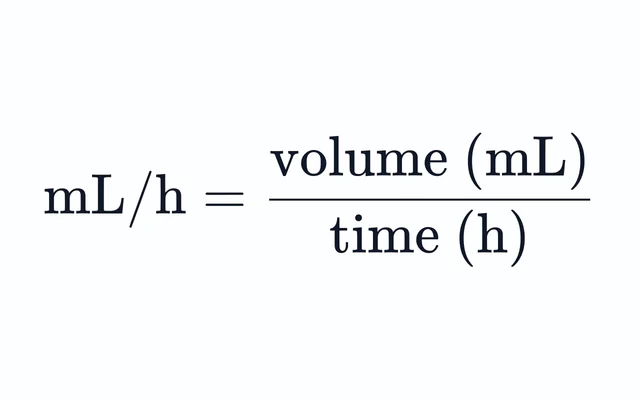
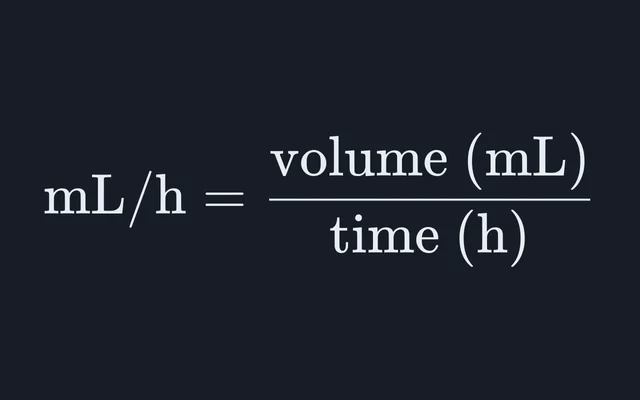
- Pump rate. A volume and a time give mL/h, or the volume infused by a given time.
- Weight-based infusion. A dose in mcg/kg/min, a weight and a concentration give mL/h, or the dose a running rate delivers.
- Weight-based dose. A dose in mg/kg, a weight and the strength of a liquid give the volume to give, or the mg/kg an ordered volume comes to.
Checking an answer by its size
Most dosage errors are a missed conversion, and a missed conversion leaves a signature in the size of the answer. Out by exactly 60 is a minutes and hours slip. Out by 1000 is mg against mcg, or mL against L. Out by about 2.2 is a weight in pounds used as kilograms. So estimate before trusting a result: 1000 mL over 8 hours is a little over 100 mL/h, and an answer of 2 or of 7500 is a conversion gone wrong rather than a slip in the arithmetic.
Desired over have, and dimensional analysis
Courses teach two methods for the same arithmetic. Desired over have, D ÷ H × Q, divides the ordered dose by the strength on hand and multiplies by the volume that strength comes in. Dimensional analysis chains conversion factors until the units leave only the one asked for. The worked answers here carry the units through every line, which is the habit dimensional analysis is built on, and which makes a missing conversion visible where it happens.
What the questions leave out
No drug is named, because the arithmetic is the same whatever is in the bag, and the values are drawn to exercise each formula rather than to match a real product. A real dose follows the prescriber’s order, the drug label and local policy, which also decide the maximum dose, how far to round for the pump or syringe in use, and which infusions a second nurse has to check.
Common questions
Where do these dosage questions come from?
Every question is generated from the specification behind one of the four dosage calculators on this site, and the answer is computed by the same solver that calculator uses, so the two cannot disagree. The values are drawn at random inside ranges set for practice, and no drug is named, so each question is about the arithmetic and never a dose for a real patient.
How should I round my answers?
Give a drip rate to the nearest whole drop, as it would be set at the bedside. Every drip rate asked for here is at least 34 gtt/min, high enough that the rounded figure is still inside the 1.5 percent each answer is marked to. Give other answers to three or four significant figures, and round only at the end.