eGFR equations: CKD-EPI 2021 vs MDRD vs Cockcroft-Gault
For an 85-year-old woman of 60 kg and 160 cm with creatinine 0.8 mg/dL, CKD-EPI 2021 gives 72 mL/min/1.73 m² and MDRD 68. Cockcroft-Gault gives 49 mL/min, 29% below CKD-EPI de-indexed to her 1.63 m² (68 mL/min). At 30 the same woman gets 102, 84 and 97: Cockcroft-Gault falls furthest with age.
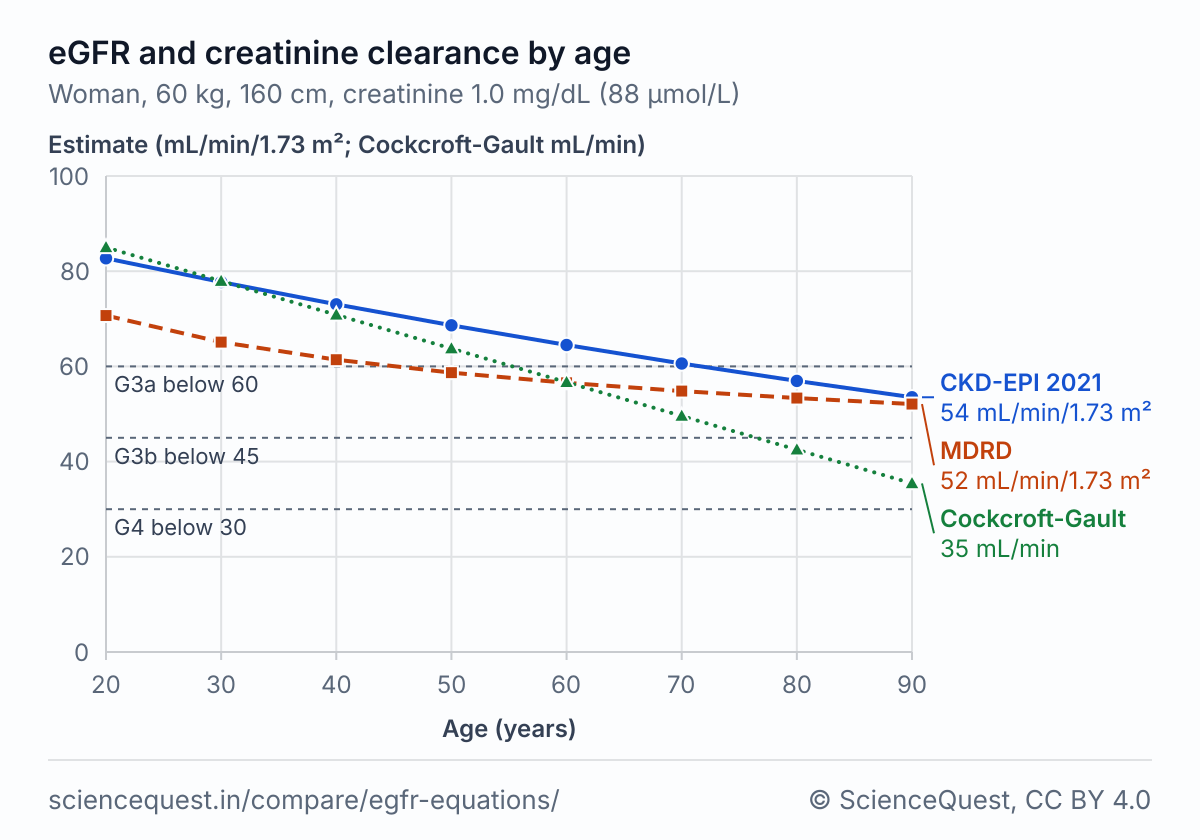
By age, at creatinine 1.0 mg/dL
| Age (years) | Estimate | KDIGO GFR category | ||||
|---|---|---|---|---|---|---|
| CKD-EPI 2021 mL/min/1.73 m² | MDRD mL/min/1.73 m² | Cockcroft-Gault mL/min | CKD-EPI | MDRD | C-G* | |
| 20 | 83 | 71† | 85 | G2 | G2 | G2 |
| 30 | 78 | 65† | 78 | G2 | G2 | G2 |
| 40 | 73 | 61† | 71 | G2 | G2 | G2 |
| 50 | 69 | 59 | 64 | G2 | G3a | G2 |
| 60 | 64 | 57 | 57 | G2 | G3a | G3a |
| 70 | 61 | 55 | 50 | G2 | G3a | G3a |
| 80 | 57 | 53 | 43 | G3a | G3a | G3b |
| 90 | 54 | 52 | 35 | G3a | G3a | G3b |
† 60 or above, where NKDEP advised laboratories to report no MDRD number. * Cockcroft-Gault is a clearance in mL/min, not a GFR per 1.73 m², so KDIGO did not write its categories for it; the column shows the band you get by reading it as one.
Women, 60 kg and 160 cm
| Creatinine, mg/dL (µmol/L) | Age 30 | Age 50 | Age 70 | Age 85 | ||||||||
|---|---|---|---|---|---|---|---|---|---|---|---|---|
| CKD-EPI | MDRD | C-G | CKD-EPI | MDRD | C-G | CKD-EPI | MDRD | C-G | CKD-EPI | MDRD | C-G | |
| 0.5 (44) | 129 | 145† | 156 | 114 | 131† | 128 | 101 | 122† | 99 | 92 | 117† | 78 |
| 0.6 (53) | 124 | 117† | 130 | 109 | 106† | 106 | 97 | 99† | 83 | 88 | 95† | 65 |
| 0.7 (62) | 119 | 98† | 111 | 105 | 89† | 91 | 93 | 83† | 71 | 85 | 80† | 56 |
| 0.8 (71) | 102 | 84† | 97 | 90 | 76† | 80 | 79 | 71† | 62 | 72 | 68† | 49 |
| 0.9 (80) | 88 | 74† | 87 | 78 | 66† | 71 | 69 | 62† | 55 | 63 | 60† | 43 |
| 1.0 (88) | 78 | 65† | 78 | 69 | 59 | 64 | 61 | 55 | 50 | 55 | 53 | 39 |
| 1.2 (106) | 62 | 53 | 65 | 55 | 48 | 53 | 49 | 44 | 41 | 44 | 43 | 32 |
| 1.5 (133) | 48 | 41 | 52 | 42 | 37 | 43 | 37 | 34 | 33 | 34 | 33 | 26 |
| 2.0 (177) | 34 | 29 | 39 | 30 | 26 | 32 | 26 | 25 | 25 | 24 | 24 | 19 |
| 3.0 (265) | 21 | 18 | 26 | 18 | 17 | 21 | 16 | 15 | 17 | 15 | 15 | 13 |
† 60 or above, where NKDEP advised laboratories to report no MDRD number. µmol/L is mg/dL × 88.4, rounded to the whole number.
Men, 80 kg and 178 cm
| Creatinine, mg/dL (µmol/L) | Age 30 | Age 50 | Age 70 | Age 85 | ||||||||
|---|---|---|---|---|---|---|---|---|---|---|---|---|
| CKD-EPI | MDRD | C-G | CKD-EPI | MDRD | C-G | CKD-EPI | MDRD | C-G | CKD-EPI | MDRD | C-G | |
| 0.5 (44) | 141 | 195† | 244 | 124 | 176† | 200 | 110 | 164† | 156 | 100 | 158† | 122 |
| 0.6 (53) | 133 | 158† | 204 | 118 | 143† | 167 | 104 | 133† | 130 | 95 | 128† | 102 |
| 0.7 (62) | 127 | 132† | 175 | 112 | 119† | 143 | 99 | 111† | 111 | 90 | 107† | 87 |
| 0.8 (71) | 122 | 114† | 153 | 108 | 102† | 125 | 95 | 96† | 97 | 87 | 92† | 76 |
| 0.9 (80) | 118 | 99† | 136 | 104 | 89† | 111 | 92 | 83† | 86 | 84 | 80† | 68 |
| 1.0 (88) | 104 | 88† | 122 | 92 | 79† | 100 | 81 | 74† | 78 | 74 | 71† | 61 |
| 1.2 (106) | 83 | 71† | 102 | 74 | 64† | 83 | 65 | 60† | 65 | 59 | 58 | 51 |
| 1.5 (133) | 64 | 55 | 81 | 56 | 50 | 67 | 50 | 46 | 52 | 45 | 44 | 41 |
| 2.0 (177) | 45 | 39 | 61 | 40 | 36 | 50 | 35 | 33 | 39 | 32 | 32 | 31 |
| 3.0 (265) | 28 | 25 | 41 | 25 | 22 | 33 | 22 | 21 | 26 | 20 | 20 | 20 |
† 60 or above, where NKDEP advised laboratories to report no MDRD number. µmol/L is mg/dL × 88.4, rounded to the whole number.
By body weight, at 70 and creatinine 1.0 mg/dL
| Weight (kg) | Woman, 160 cm | Man, 178 cm | ||||||
|---|---|---|---|---|---|---|---|---|
| BSA m² | CKD-EPI 2021 mL/min/1.73 m² | CKD-EPI de-indexed mL/min | Cockcroft-Gault mL/min | BSA m² | CKD-EPI 2021 mL/min/1.73 m² | CKD-EPI de-indexed mL/min | Cockcroft-Gault mL/min | |
| 50 | 1.49 | 61 | 52 | 41 | 1.57 | 81 | 74 | 49 |
| 70 | 1.76 | 61 | 62 | 58 | 1.86 | 81 | 87 | 68 |
| 90 | 2.00 | 61 | 70 | 74 | 2.11 | 81 | 99 | 88 |
| 120 | 2.31 | 61 | 81 | 99 | 2.44 | 81 | 114 | 117 |
De-indexed: CKD-EPI × BSA ÷ 1.73, with BSA by Mosteller. That is the figure to set beside Cockcroft-Gault.
Why the formulas disagree
CKD-EPI 2021 and MDRD estimate glomerular filtration rate per 1.73 m² of body surface, the average of 25-year-old Americans in 1927, so neither takes weight. Cockcroft-Gault estimates creatinine clearance in mL/min from actual body weight. At age 70 and creatinine 1.0 mg/dL, the 160 cm woman’s CKD-EPI stays at 61 mL/min/1.73 m² from 50 to 120 kg, while her Cockcroft-Gault climbs from 41 to 99 mL/min. To set the two side by side, multiply CKD-EPI by her body surface area over 1.73: 81 mL/min at 120 kg.
Cockcroft-Gault subtracts age from 140, so the chart’s woman loses 58% of her clearance between 20 and 90. CKD-EPI multiplies by 0.9938 for each year and loses 35%; MDRD takes age to the power −0.203 and loses 26%. Her Cockcroft-Gault falls below CKD-EPI de-indexed to her 1.63 m² at 47. On the chart her Cockcroft-Gault and CKD-EPI lines cross at 31, because the chart sets mL/min against mL/min/1.73 m².
MDRD gives creatinine one exponent, and it reads low at higher GFR: the MDRD Study developed and validated it in 1,628 people with chronic kidney disease whose measured GFR averaged 39.8 mL/min/1.73 m². CKD-EPI bends at 0.7 mg/dL for women and 0.9 for men. For the 50-year-old woman at 0.7 mg/dL, CKD-EPI gives 105 mL/min/1.73 m² and MDRD 89; at 3.0 mg/dL they give 18 and 17. Cockcroft-Gault predates standardised creatinine assays, and KDIGO notes that nobody can re-express it for them.
The formulas
- CKD-EPI 2021 [1]
-
- MDRD, re-expressed for IDMS creatinine [2]
-
- Cockcroft-Gault [4]
-
- De-indexing, with BSA by Mosteller [5]
-
SCr is serum creatinine in mg/dL, age in years, weight in kg, height in cm. CKD-EPI and MDRD give mL/min/1.73 m², Cockcroft-Gault mL/min.
Where each formula holds
| Formula | Fitted in | Holds for | Not for |
|---|---|---|---|
| CKD-EPI 2021 | 8,254 adults in 10 studies, 31.5% of them Black, refitted without race; validated in 4,050 adults in 12 other studies | Adults 18 and over with a stable creatinine on an IDMS-traceable assay; NKF and ASN advised every US laboratory to adopt it | Acute kidney injury and the other limits KDIGO 2012 Table 11 sets for any creatinine estimate: extremes of muscle mass or body size, high-protein diets and creatine supplements, drugs such as trimethoprim and cimetidine. Least certain over 70: the 2009 data it refits had relatively few participants that old (Levey 2009) |
| MDRD (175, IDMS) | Developed and validated in 1,628 people with chronic kidney disease in the MDRD Study, measured GFR averaging 39.8 mL/min/1.73 m² | Adults with chronic kidney disease; its 2006 paper found it reasonably accurate where measured GFR was below 90 | Acute kidney injury and the other KDIGO Table 11 limits, as for CKD-EPI; a figure of 60 or above, which NKDEP advised laboratories not to report as a number; higher GFR, where it reads low |
| Cockcroft-Gault | Creatinine excretion in 249 patients aged 18 to 92, for adult men, with 15% less for women; checked against measured clearance in 236 | Adults, as a creatinine clearance in mL/min for the person’s own weight, not adjusted to 1.73 m² | Acute kidney injury and the other KDIGO Table 11 limits, extremes of body size among them; standardised (IDMS) creatinine, which it predates; anything read as a GFR per 1.73 m² |
Calculators and simulators
Sources
- Inker LA, Eneanya ND, Coresh J, et al. New creatinine- and cystatin C-based equations to estimate GFR without race. N Engl J Med. 2021;385(19):1737-1749. doi:10.1056/NEJMoa2102953
- Levey AS, Coresh J, Greene T, et al. Using standardized serum creatinine values in the Modification of Diet in Renal Disease Study equation for estimating glomerular filtration rate. Ann Intern Med. 2006;145(4):247-254. doi:10.7326/0003-4819-145-4-200608150-00004
- Levey AS, Stevens LA, Schmid CH, et al. A new equation to estimate glomerular filtration rate. Ann Intern Med. 2009;150(9):604-612. The 2009 CKD-EPI equation, which the 2021 equation refits without race. doi:10.7326/0003-4819-150-9-200905050-00006
- Cockcroft DW, Gault MH. Prediction of creatinine clearance from serum creatinine. Nephron. 1976;16(1):31-41. doi:10.1159/000180580
- Mosteller RD. Simplified calculation of body-surface area. N Engl J Med. 1987;317(17):1098. The letter was not accessible to us; the next source prints its formula. doi:10.1056/NEJM198710223171717
- Mohamed AAA, van Londen M, Stevens J, Heerspink HJL, Gansevoort RT. Indexing for body surface area when assessing kidney function. Nephrol Dial Transplant. 2026;41(9):1595-1605. Table 1 gives Mosteller’s formula as (weight^0.5 × height^0.5)/60, the square root above. doi:10.1093/ndt/gfag063
- KDIGO CKD Work Group. KDIGO 2012 clinical practice guideline for the evaluation and management of chronic kidney disease. Kidney Int Suppl. 2013;3(1):1-150. The G1 to G5 categories, the rounding and reporting advice, and the limits of creatinine estimates. https://kdigo.org/wp-content/uploads/2017/02/KDIGO_2012_CKD_GL.pdf
- Delgado C, Baweja M, Crews DC, et al. A unifying approach for GFR estimation: recommendations of the NKF-ASN Task Force on reassessing the inclusion of race in diagnosing kidney disease. Am J Kidney Dis. 2022;79(2):268-288. doi:10.1053/j.ajkd.2021.08.003
The values are facts and free to use; this table’s selection and presentation are © 2026 ScienceQuest.