Body Surface Area Calculator
Body surface area by Mosteller, Du Bois, Haycock and Gehan-George at once, with the spread between them shown because dosing rests on the choice.
Calculator
In centimetres. One foot is 30.48 cm, so 5 foot 7 is 170 cm.
Actual body weight. Some protocols cap or adjust it in obesity, and that is a protocol decision rather than an arithmetic one.
Working, with your numbers
- BSA = sqrt(height x weight / 3600)
- = sqrt(170 x 70 / 3600)
- = sqrt(11,900 / 3600)
- = sqrt(3.3056)
- = 1.818 m2
Values are converted into the units the equation is worked in before the arithmetic.
- Du Bois The 1916 original, derived by coating nine subjects in plaster. Still the reference many protocols name.
- 1.81 m²
- Haycock Derived to work in infants and children as well as adults, which Du Bois does poorly.
- 1.826 m²
- Gehan and George Fitted to a much larger sample of 401 subjects than the nine Du Bois used.
- 1.831 m²
- Spread across the four How much the choice of formula moves the dose. Small in the middle of the range and larger at the extremes, which is where it matters most.
- 0.0216 m²
- Body mass index Shown because it uses the same two measurements and is constantly confused with surface area. BMI scales as height squared, surface area roughly as height to the power 1.5.
- 24.22 kg/m²
Citing this tool
Last updated . Add the date you accessed it as well, which a citation of a page that can change asks for. If a specific result matters, cite the permalink from the tool’s share row instead of this page: it reproduces the exact parameters.
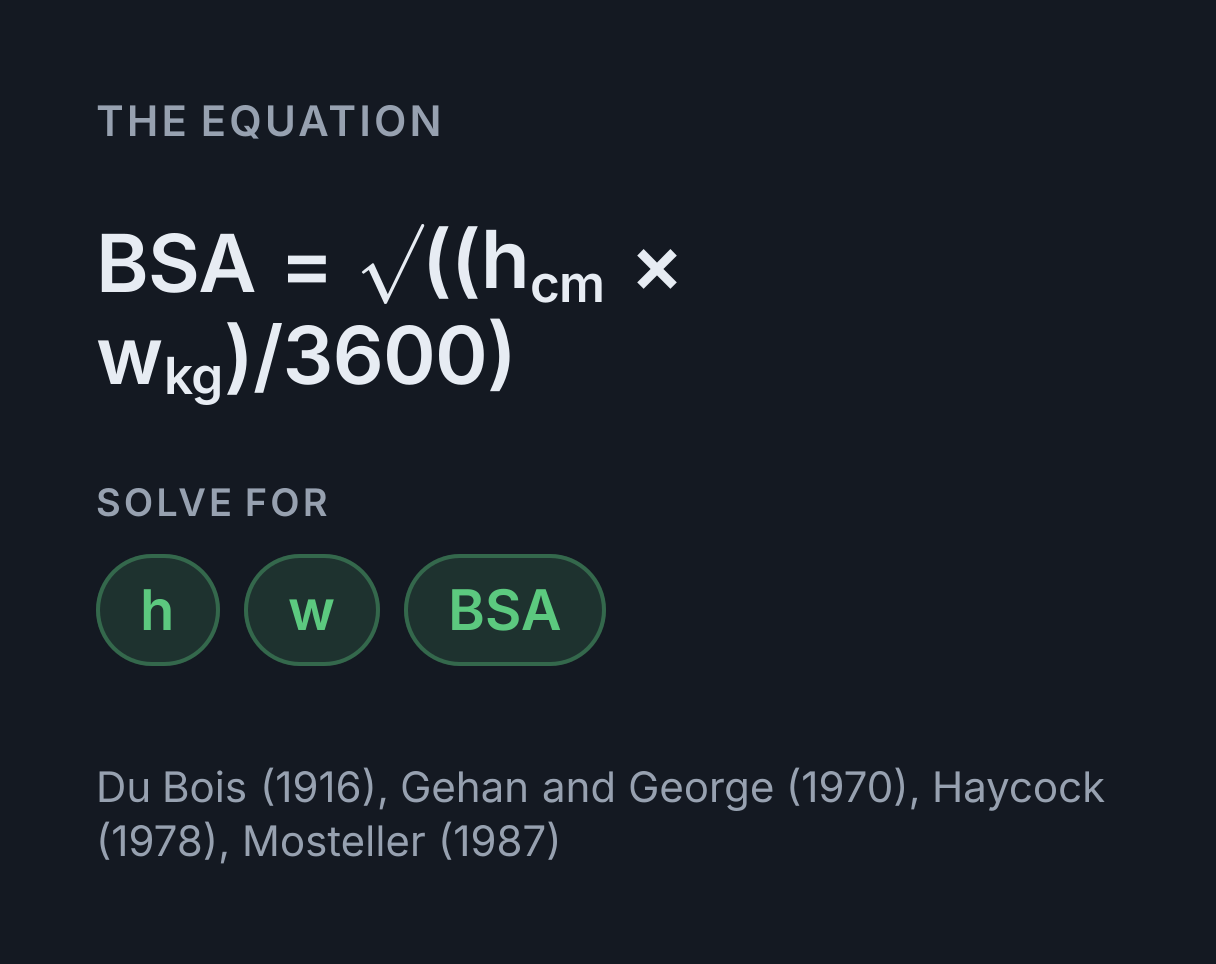
The equation
Du Bois (1916), Gehan and George (1970), Haycock (1978), Mosteller (1987)
Why surface area rather than weight
Body surface area, BSA, is the area of the body’s outer surface in square metres, estimated
here by the Mosteller formula, BSA = √(height × weight / 3600), with height in
centimetres and weight in kilograms. Several physiological quantities scale with surface
area rather than with mass. Basal metabolic rate, cardiac output and glomerular filtration
all track it more closely than they track weight, which is a consequence of heat exchange
and of how transport surfaces scale with body size. For drugs where the gap between an
effective dose and a toxic one is narrow, most visibly cytotoxic chemotherapy, surface area
predicts clearance better than weight does.
It is worth knowing that this is contested. Surface area explains only part of the variation in drug clearance between individuals, and for many agents flat or weight based dosing performs just as well in trials. The practice persists largely where the original dose finding studies were conducted that way, so the convention is now embedded in the protocols rather than in the pharmacology.
The four formulas
All take height in centimetres and weight in kilograms and return square metres.
- Mosteller, 1987.
BSA = √(height × weight / 3600) - Du Bois and Du Bois, 1916.
BSA = 0.007184 × height^0.725 × weight^0.425 - Haycock, 1978.
BSA = 0.024265 × height^0.3964 × weight^0.5378 - Gehan and George, 1970.
BSA = 0.0235 × height^0.42246 × weight^0.51456
Mosteller is the usual choice because it can be done on any calculator without a power function. The 3600 in it is not arbitrary: it was chosen so that the result agrees closely with Gehan and George, the formula it simplifies, across the ordinary adult range, which is why a simple square root can stand in for a two exponent fit.
At 170 cm and 70 kg the four give 1.818, 1.810, 1.826 and 1.831 square metres. That is a spread of 0.022, about 1.2 percent, and it will not change a dose. The readout above shows this spread for whatever height and weight you enter, because the agreement is not uniform: it is closest in the middle of the adult range, and it degrades at the extremes. Du Bois in particular was derived from nine subjects, one of them a child, by wrapping them in plaster moulds, and it is known to underestimate in obesity.
Worked reasoning
For a patient of 170 cm and 70 kg by Mosteller:
170 × 70 = 11,90011,900 / 3600 = 3.3056√3.3056 = 1.818 m²
A property of Mosteller that makes it easy to sanity check: because it is a square root, quadrupling the weight exactly doubles the surface area. If a mental estimate does not have that behaviour, something has gone wrong.
Where 1.73 square metres comes from
Glomerular filtration rate is reported as mL/min per 1.73 m², and that figure was the average adult surface area in the studies which established normal filtration. Indexing to it is what makes an eGFR comparable between a small adult and a large one, since a bigger person has bigger kidneys and a higher absolute filtration rate without being any healthier.
The indexing matters when dosing a renally cleared drug in someone far from average size. An indexed eGFR has to be multiplied back by their actual surface area divided by 1.73 to recover their true clearance in mL/min:
-
absolute clearance = indexed eGFR × (actual BSA / 1.73)
Skipping that step underdoses large patients and overdoses small ones. For a 45 kg adult with a surface area of about 1.4 m², an indexed eGFR of 60 corresponds to an absolute clearance of roughly 49 mL/min, which can cross a dose adjustment threshold that the indexed number sits above.
Actual, ideal or adjusted weight
Actual body weight is what all four formulas were derived with and what this calculator uses. Substituting something else is a protocol decision rather than an arithmetic one, and the formula cannot tell you whether to.
Historically many chemotherapy protocols capped surface area at 2.0 or 2.2 m² in obesity, or used an adjusted body weight, on the argument that adipose tissue adds surface area without adding proportionally to drug clearance. Current oncology guidance has largely moved against capping, on the evidence that it underdoses obese patients and worsens outcomes without reducing toxicity. Follow the protocol in front of you rather than the formula, and note which weight it specifies.
Common mistakes
- Entering height in metres. Every formula here wants centimetres. Using 1.7 instead of 170 gives 0.18 m², a tenth of the right answer, and in Mosteller the error is a clean factor of √100.
- Confusing surface area with body mass index. They use the same two measurements and mean different things. BMI is weight over height squared and is a measure of relative weight; surface area scales roughly as height to the power 1.5 and is a measure of absolute size. BMI is shown in the readouts only because the confusion is so common.
- Using an adult formula in a neonate. Du Bois is unreliable in infants, which is precisely what Haycock was developed to fix. Below about 10 kg the choice of formula genuinely changes the answer.
- Carrying too many figures into a dose. Height and weight are measured to about three significant figures at best, and often to two in a busy clinic. A surface area quoted to four decimal places implies a precision the inputs do not support.
Worked examples
Each one runs through the calculator above, so the arithmetic here is the arithmetic it does.
What is the body surface area of someone 170 cm tall weighing 70 kg?
- BSA = sqrt(height x weight / 3600)
- = sqrt(170 x 70 / 3600)
- = sqrt(11,900 / 3600)
- = sqrt(3.3056)
- = 1.818 m2
The standard adult figure, and close to the 1.73 square metres that kidney function is indexed to. Du Bois gives 1.810 and Gehan and George 1.831 for the same person, which is no accident: Mosteller is Gehan and George simplified to a plain square root, with the 3600 chosen to keep the two close.
What is the body surface area of a toddler 85 cm tall weighing 12 kg?
- BSA = sqrt(height x weight / 3600)
- = sqrt(85 x 12 / 3600)
- = sqrt(1020 / 3600)
- = sqrt(0.28333)
- = 0.5323 m2
Under a third of the adult value while the weight is a sixth of it, because surface area falls more slowly than mass does. That ratio is why children need proportionally larger doses per kilogram, and why the formula choice matters far more at this size than in an adult.
What weight gives a body surface area of 1.73 m2 at a height of 166 cm?
- weight = BSA^2 x 3600 / height
- = 1.73^2 x 3600 / 166
- = 10,774 / 166
- = 64.91 kg
About 65 kg, which reconstructs roughly the average adult the 1.73 standard was drawn from. Useful for seeing how far a given patient sits from that reference, since an indexed eGFR has to be scaled by their own surface area over 1.73 to recover a real clearance.
Practise this with Lab and Clinical Calculation Practice Problems, questions generated from this calculator and 9 other calculators in Biology.
Common questions
Why dose by surface area rather than by weight?
Because several physiological quantities scale with surface area rather than with mass. Basal metabolic rate, cardiac output and glomerular filtration all track surface area more closely than they track weight, so for drugs with a narrow margin between effect and toxicity, notably cytotoxic chemotherapy, surface area predicts clearance better. The practice is not without critics: surface area explains only part of the variation in clearance, and for many drugs weight based or flat dosing performs just as well. It persists where the original trials established the dose that way.
Which formula should I use, and does it matter?
Mosteller is the usual choice because it is a plain square root that can be done on any calculator, and the 3600 in it was picked so that it agrees closely with Gehan and George, the formula it simplifies. At 170 cm and 70 kg the four formulas here give 1.818, 1.810, 1.826 and 1.831 square metres, a spread of about 1.2 percent, which will not change a dose. The agreement is worse at the extremes of size, particularly in infants and in obesity, and Du Bois in particular was fitted to only nine subjects in 1916, one of them a child. This calculator shows the spread so you can see when the choice begins to matter.
Where does 1.73 square metres come from?
It was the average adult body surface area in the studies that established normal glomerular filtration rate, so filtration is reported indexed to it as mL/min per 1.73 square metres. That indexing is what makes an eGFR comparable between a small adult and a large one. It matters when dosing a drug cleared by the kidney in someone whose size is far from average: an indexed eGFR has to be multiplied back by their actual surface area over 1.73 to recover their true clearance in mL/min, and skipping that step underdoses large patients and overdoses small ones.
Should I use actual, ideal or adjusted body weight?
Actual body weight is what all four formulas were derived with, and it is what this calculator uses. Whether to substitute something else is a protocol decision rather than an arithmetic one. Many chemotherapy protocols cap surface area at 2.0 or 2.2 square metres in obesity, and some use adjusted body weight, both on the grounds that fat adds to surface area without adding proportionally to drug clearance. Current oncology guidance mostly recommends full weight based dosing rather than capping, so follow the protocol rather than the formula.