BMI Calculator
Work out adult BMI from ft and in or cm, and lb or kg, with the CDC and WHO category, BMI prime, the healthy weight range for your height and the working.
Calculator
Converted to kg at exactly 0.45359237 kg per lb.
- BMI Weight in kg over height in meters squared, to one decimal place. A BMI just under a cut-off is rounded down, so 24.98 shows as 24.9: the category is read from the unrounded value.
- 23.0 kg/m²
- Adult category (CDC) BMI 18.5 to below 25. The WHO calls this band “normal range”. For adults aged 20 and over. For ages 2 through 19 the CDC reads BMI on age and sex growth charts instead.
- Healthy weight
- BMI prime BMI divided by 25, the top of the healthy range. Below 0.74 is underweight, and 1.00 or more is overweight.
- 0.92
- Healthy weight for this height BMI 18.5 up to, but not including, 25 at this height. Rounded inward, so every weight in the range gives a BMI inside it.
- 129 to 174 lb
Working, with your numbers
- Height: 5 ft 10 in = 70 in x 0.0254 = 1.778 m
- Weight: 160 lb x 0.4536 = 72.57 kg
- BMI = 72.57 / 1.778^2 = 72.57 / 3.161 = 22.96 kg/m2
- CDC form: 703 x 160 / 70^2 = 22.96, with 703.07 rounded to 703
- BMI prime = 22.96 / 25 = 0.9183
- Healthy weight: 18.5 x 3.161 = 58.48 kg, up to but not including 25 x 3.161 = 79.03 kg, or 128.9 to 174.2 lb
Heights are converted to meters and pounds to kg before dividing, so the answer is the same whichever units were entered.
Citing this tool
Last updated . Add the date you accessed it as well, which a citation of a page that can change asks for. If a specific result matters, cite the permalink from the tool’s share row instead of this page: it reproduces the exact parameters.
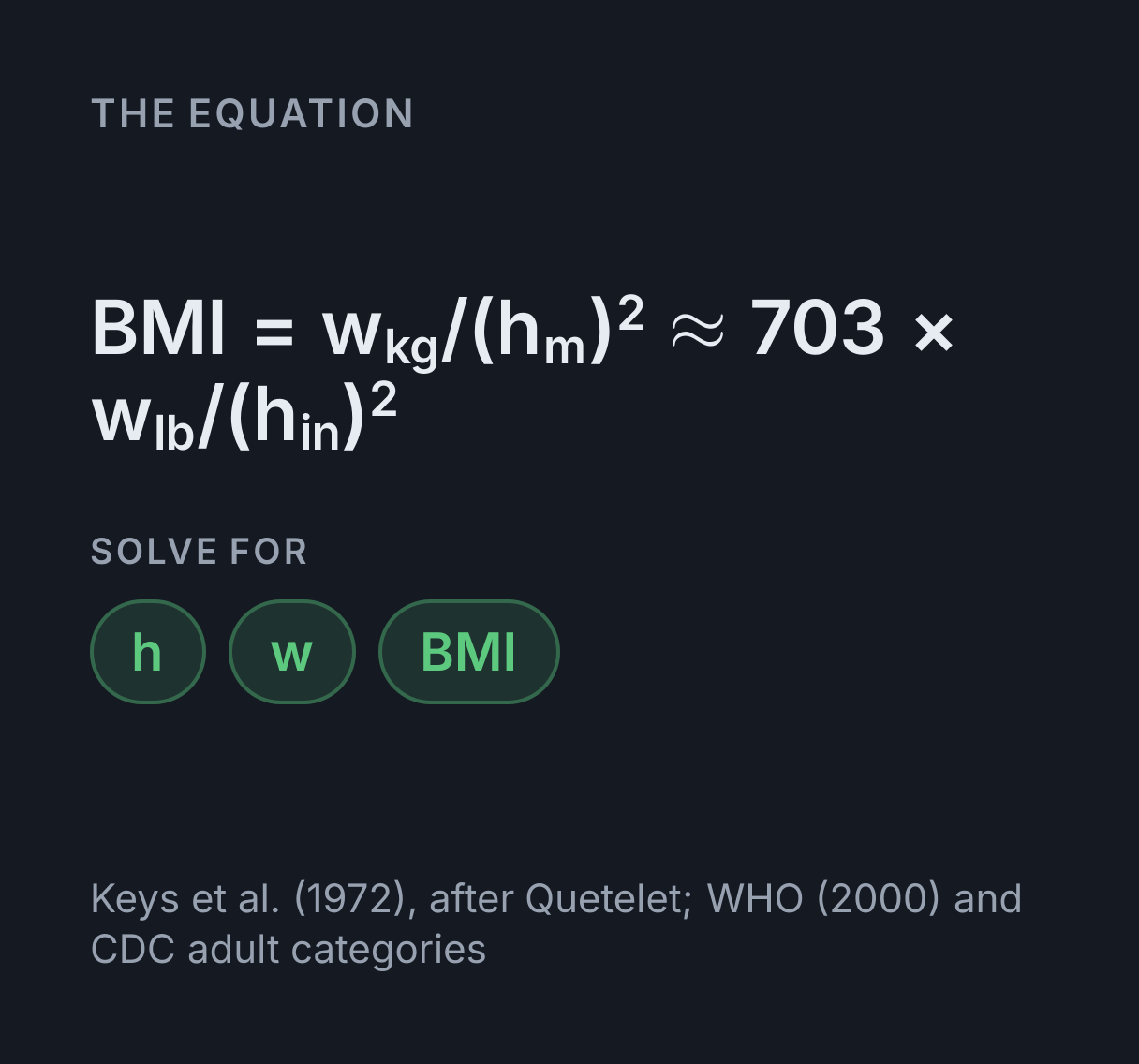
The equation
Keys et al. (1972), after Quetelet; WHO (2000) and CDC adult categories
How do you calculate BMI?
Divide weight in kilograms by height in meters squared: BMI = kg ÷ m². With pounds and inches, use BMI = 703 × lb ÷ in². For adults, the CDC calls a BMI under 18.5 underweight, 18.5 to under 25 healthy weight, 25 to under 30 overweight, and 30 or more obesity, on WHO cut-offs.
Adult BMI categories
The CDC and the WHO draw the adult lines at the same numbers and name the bands differently. Both split obesity into three classes, and the CDC calls class 3 severe obesity and applies the categories from age 20.
| BMI (kg/m²) | CDC | WHO |
|---|---|---|
| Below 18.5 | Underweight | Underweight |
| 18.5 to below 25 | Healthy weight | Normal range |
| 25 to below 30 | Overweight | Pre-obese |
| 30 to below 35 | Obesity, class 1 | Obese class I |
| 35 to below 40 | Obesity, class 2 | Obese class II |
| 40 or more | Obesity, class 3 | Obese class III |
Below 18.5 the WHO also grades thinness: mild from 17 to below 18.5, moderate from 16 to below 17, and severe below 16. The calculator adds the grade to any underweight result.
The category is read from the unrounded BMI. 68 kg at 165 cm gives 24.98, inside the healthy range, but at one decimal place it rounds to 25.0, which would sit beside the wrong category. So a BMI just under a cut-off is shown rounded down, here as 24.9, and the working prints as many figures as it needs to stay on the right side of the line.
Where the 703 comes from
A pound is exactly 0.45359237 kg and an inch exactly 0.0254 m, so one pound per square inch is 0.45359237 ÷ 0.0254², or 703.07 kg/m². Multiplying pounds per square inch by that factor converts them to the metric BMI, and the CDC rounds it to 703, which leaves its form 0.01 percent low. For 180 lb at 5 ft 10 in that is 25.83 by kilograms and meters against 25.82 by the CDC form, and 25.8 either way at one decimal place.
The calculator always converts to kilograms and meters before it divides, so the answer does not depend on the units entered. When the height and weight are both in US units, its working also prints the CDC form, so the figure can be checked against a hand calculation done the American way.
BMI prime
BMI prime is BMI divided by 25, the top of the healthy range, proposed by Gadzik in 2006. At 1.00 a person is on the overweight cut-off, and the distance from 1.00 reads as a percentage: 1.10 is 10 percent above the cut-off and 0.90 is 10 percent below it. The underweight cut-off is 0.74, and obesity begins at 1.20, 20 percent above the top of the healthy range. As a ratio of two BMIs it has no units.
Healthy weight range for your height
The range is every weight that gives a BMI from 18.5 up to, but not including, 25: 18.5 × height² to 25 × height², in kilograms and meters. The calculator rounds both ends inward, to a tenth of a kilogram or a whole pound, so every weight it lists gives a BMI inside the range. The chart below is worked the same way.
| Height | cm | Weight (lb) | Weight (kg) |
|---|---|---|---|
| 4 ft 10 in | 147.3 | 89 to 119 | 40.2 to 54.2 |
| 5 ft 0 in | 152.4 | 95 to 128 | 43.0 to 58.0 |
| 5 ft 2 in | 157.5 | 102 to 136 | 45.9 to 61.9 |
| 5 ft 4 in | 162.6 | 108 to 145 | 48.9 to 66.0 |
| 5 ft 6 in | 167.6 | 115 to 154 | 52.0 to 70.2 |
| 5 ft 8 in | 172.7 | 122 to 164 | 55.2 to 74.5 |
| 5 ft 10 in | 177.8 | 129 to 174 | 58.5 to 79.0 |
| 6 ft 0 in | 182.9 | 137 to 184 | 61.9 to 83.6 |
| 6 ft 2 in | 188.0 | 145 to 194 | 65.4 to 88.3 |
| 6 ft 4 in | 193.0 | 152 to 205 | 69.0 to 93.1 |
A range this wide is a population screening band, not a target for any one person, and it says nothing about where in it a particular adult is best placed.
What BMI does not measure
BMI is weight for height. It does not measure body fat, and the CDC describes it as a screening measure, not a diagnostic one: a high BMI is a reason to look further, not a diagnosis.
- A scale cannot tell muscle from fat. A muscular athlete can have a BMI in the overweight range with little body fat, and an older adult who has lost muscle can carry excess fat at a BMI in the healthy range. At the same BMI, women on average carry more body fat than men.
- Where fat sits matters. Fat around the waist carries more cardiometabolic risk than fat elsewhere, which is why the NHLBI’s 1998 adult obesity guidelines pair BMI with waist circumference and flag more than 40 in (102 cm) in men and more than 35 in (88 cm) in women.
- Pregnancy. A BMI measured during pregnancy is not read against these categories, and weight gain guidance is set from the BMI before pregnancy.
Different cut-offs for Asian populations
A WHO expert consultation, published in The Lancet in 2004, found that a substantial share of Asian people are at high risk of type 2 diabetes and cardiovascular disease at BMIs below 25. The BMI at which risk rose ranged from 22 to 25 across the populations studied, and from 26 to 31 for high risk, so the consultation set no single Asian cut-off. It kept the international categories and added public health action points at 23, 27.5, 32.5 and 37.5, leaving each country to decide how to use them.
In the United States, the American Diabetes Association’s Standards of Care lower the BMI at which diabetes testing is considered for Asian American adults with other risk factors from 25 to 23. This calculator reports the international categories for everyone.
Children and teens
For ages 2 through 19 the CDC does not use the adult categories. It plots BMI on sex-specific BMI-for-age growth charts and reads it as a percentile: below the 5th percentile is underweight, the 5th to below the 85th healthy weight, the 85th to below the 95th overweight, and the 95th or above obesity. A child’s BMI normally changes as they grow, so the same number can mean different things a year apart. This calculator takes no age or sex and does not compute percentiles, so its result should not be read for anyone under 20.
BMI beside other body measures
Several clinical numbers are built from height and weight, and each answers a different question. The ideal body weight calculator gives the Devine and ARDSNet weights that drug doses and ventilator settings are worked from, and the body surface area calculator gives the surface area used for chemotherapy doses and for indexing cardiac output. The BMR and TDEE Calculator estimates the energy the body uses at rest. None of them measures body fat either.
Common mistakes
- Typing pounds as kilograms. The calculator’s opening adult, 160 lb at 5 ft 10 in, has a BMI of 22.96. Entered as 160 kg, the same number gives 50.6, deep in obesity class 3. Check the unit beside the box.
- Squaring the height in centimeters. The same adult worked as 72.57 ÷ 177.8² gives 0.002296, ten thousand times too small. Divide centimeters by 100 first.
- Rounding before classifying. A BMI of 24.98 is healthy weight, and rounded to 25.0 first it would be called overweight.
- Using the adult categories for a child. Under 20, BMI is read as a percentile for age and sex, as above.
Worked examples
Each one runs through the calculator above, so the arithmetic here is the arithmetic it does.
What is the BMI of someone 5 ft 10 in tall who weighs 180 lb?
- BMI = weight in kg / (height in m)^2
- height = 177.8 cm (70 in) = 1.778 m
- weight = 81.65 kg (180 lb)
- BMI = 81.65 / 1.778^2
- = 81.65 / 3.161
- = 25.83 kg/m2
25.8, overweight on the CDC’s 25 to under 30. The pounds and inches become kilograms and meters first. The CDC’s shortcut, 703 × 180 ÷ 70², gives 25.82 rather than 25.83 because 703 rounds the exact factor of 703.07 down, and both are 25.8 at one decimal place.
What is the BMI of someone 165 cm tall who weighs 68 kg?
- BMI = weight in kg / (height in m)^2
- height = 165 cm (64.96 in) = 1.65 m
- weight = 68 kg (149.9 lb)
- BMI = 68 / 1.65^2
- = 68 / 2.722
- = 24.98 kg/m2
24.98 is below the overweight cut-off of 25, so this is healthy weight. Rounded to one decimal place first it becomes 25.0 and reads as overweight, which is why the category is taken from the unrounded number and the calculator above shows this BMI as 24.9.
What weight gives a BMI of 25 at 5 ft 6 in tall?
- weight in kg = BMI x (height in m)^2
- height = 167.6 cm (66 in) = 1.676 m
- weight = 25 x 1.676^2
- = 25 x 2.81
- = 70.26 kg (154.9 lb)
This is the first overweight weight, so the healthy range at 5 ft 6 in stops just below 154.9 lb. The calculator lists that range as 115 to 154 lb, both ends rounded inward to whole pounds, from 114.6 lb at a BMI of 18.5.
Practise this with Lab and Clinical Calculation Practice Problems, questions generated from this calculator and 20 other calculators in Biology.
Common questions
Why does the BMI formula in pounds multiply by 703?
Because 703 turns pounds per square inch into kilograms per square meter, the unit BMI is defined in. A pound is exactly 0.45359237 kg and an inch exactly 0.0254 m, so 1 lb/in² is 0.45359237 ÷ 0.0254², or 703.07 kg/m². The CDC rounds that to 703, which leaves its pound and inch form about 0.01 percent low: 25.82 against 25.83 for 180 lb at 5 ft 10 in, and 25.8 either way at one decimal place.
What is BMI prime?
BMI divided by 25, the top of the healthy weight range, proposed by Gadzik in 2006. A BMI prime of 1.00 sits on the overweight cut-off, 0.74 on the underweight cut-off of 18.5, and 1.20 on the obesity cut-off of 30, so its distance from 1 reads as a percentage above or below the top of the healthy range. As a ratio of two BMIs it has no units.
Can I use this BMI calculator for a child or teenager?
No. For ages 2 through 19 the CDC reads BMI as a percentile on sex-specific BMI-for-age growth charts, because a healthy BMI changes as a child grows: below the 5th percentile is underweight, the 5th to below the 85th healthy weight, the 85th to below the 95th overweight, and the 95th or above obesity. This calculator uses the adult cut-offs, which the CDC applies from age 20, and takes no age or sex.
Is BMI accurate for muscular people and older adults?
It can mislead for both, because BMI is weight for height and does not measure body fat. A muscular athlete can have a BMI in the overweight range with little fat, and an older adult who has lost muscle can carry excess fat at a BMI in the healthy range. The CDC treats BMI as a screening measure rather than a diagnosis, and the NHLBI’s 1998 adult guidelines pair it with waist circumference, flagging more than 40 in (102 cm) in men and more than 35 in (88 cm) in women.
Are BMI cut-offs different for Asian people?
The international categories are the same, but a 2004 WHO expert consultation found that a substantial share of Asian people are at high risk of type 2 diabetes and cardiovascular disease at BMIs below 25, with risk rising from somewhere between 22 and 25 depending on the population. It kept the WHO categories and added public health action points at 23, 27.5, 32.5 and 37.5 for countries to use. In the US, the American Diabetes Association considers diabetes testing in Asian American adults with other risk factors from a BMI of 23 rather than 25.