Ideal Body Weight Calculator
Ideal body weight by Devine, adjusted body weight and ARDSNet predicted body weight with 6 and 8 mL/kg tidal volumes, from ft and in or cm, lb or kg.
Calculator
Changes only the weight at 5 ft, 50 kg for men and 45.5 kg for women. The 2.3 kg per inch above it is the same for both.
Used only for adjusted body weight. IBW and PBW come from height and sex alone.
- Ideal body weight (Devine) 161 lb. 50 kg at 5 ft plus 2.3 kg for each inch above it. A dosing weight, not a weight to aim for.
- 73.0 kg
- Adjusted body weight 185 lb. IBW plus 0.4 of the weight above it, the dosing weight used for aminoglycosides in obesity. Which drugs use it, and from what weight, is set by the protocol.
- 83.7 kg
- Actual weight Protocols that switch to adjusted body weight state their threshold as a percentage of IBW, so it is shown rather than chosen for you.
- 137 % of IBW
- Predicted body weight (ARDSNet) The same base weight plus 0.91 kg per cm above 152.4 cm, as the ARDS Network wrote it in 2000. Its 0.91 is slightly more than 2.3 / 2.54, so it sits just above IBW: 0.14 kg above at 6 ft.
- 73.1 kg
- Tidal volume, 6 mL/kg PBW The ARDSNet target, and the low tidal volume arm of the 2000 trial.
- 439 mL
- Tidal volume, 8 mL/kg PBW Where the ARDSNet protocol starts, then steps down 1 mL/kg at a time to 6.
- 585 mL
Working, with your numbers
- Height: 5 ft 10 in = 70 in = 177.8 cm
- Actual weight: 220 lb x 0.4536 = 99.79 kg
- IBW (men) = 50 + 2.3 x (70 - 60) = 73 kg
- AdjBW = 73 + 0.4 x (99.79 - 73) = 83.72 kg
- PBW (men) = 50 + 0.91 x (177.8 - 152.4) = 73.11 kg
- Vt at 6 mL/kg = 6 x 73.11 = 438.7 mL
- Vt at 8 mL/kg = 8 x 73.11 = 584.9 mL
Heights are converted to inches for Devine and to cm for ARDSNet, and pounds to kg, before the arithmetic.
Citing this tool
Last updated . Add the date you accessed it as well, which a citation of a page that can change asks for. If a specific result matters, cite the permalink from the tool’s share row instead of this page: it reproduces the exact parameters.
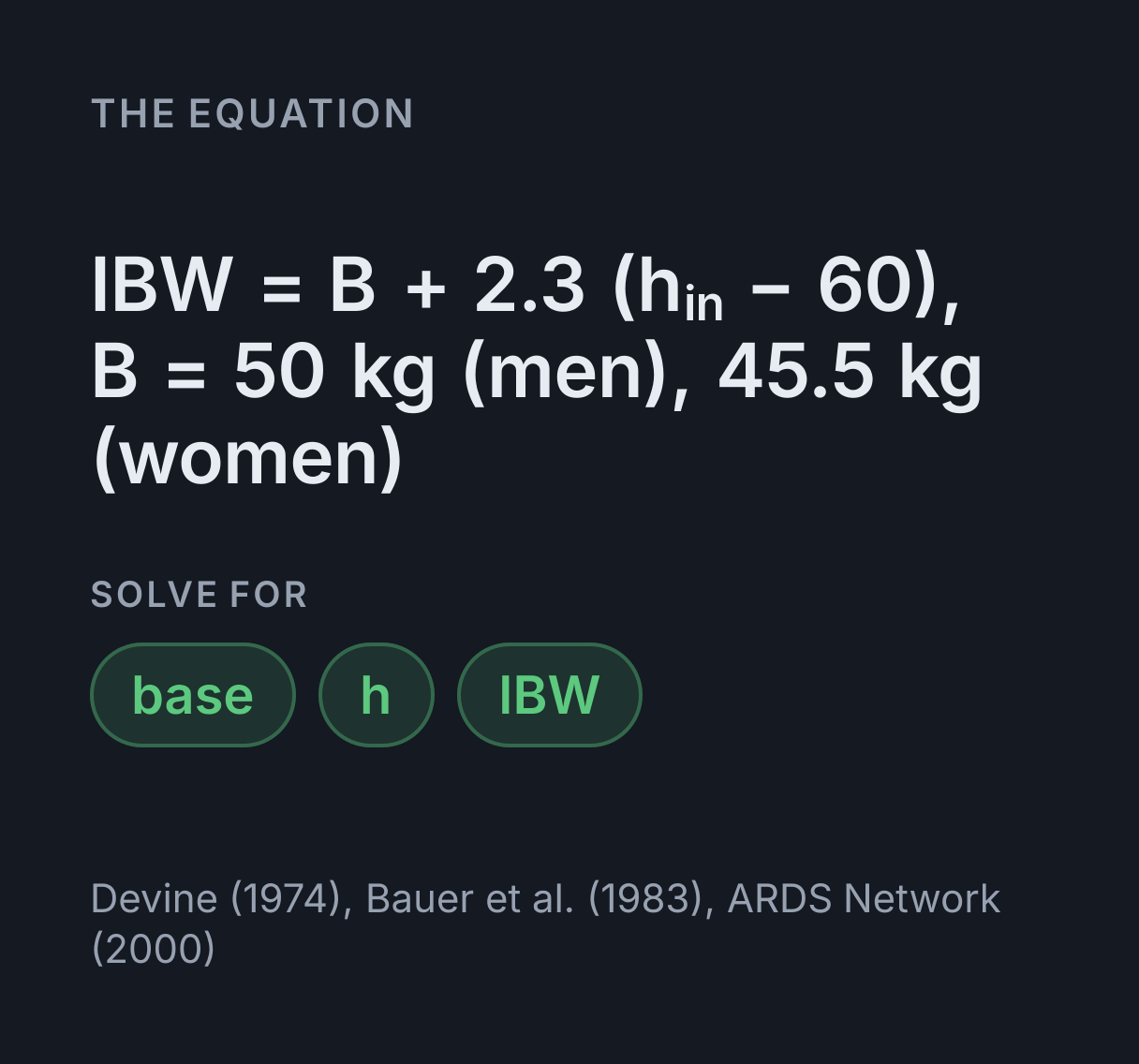
The equation
Devine (1974), Bauer et al. (1983), ARDS Network (2000)
How do you calculate ideal body weight?
Use the Devine formula: IBW = 50 kg + 2.3 kg per inch over 5 feet for men, or 45.5 kg + 2.3 kg per inch for women. A man 5 ft 10 in tall has an IBW of 73 kg, and a woman 5 ft 4 in tall, 54.7 kg. Below 5 feet the formula is not defined.
Three weights for three jobs
The calculator gives three numbers because dosing guides and ventilator protocols ask for different ones, and reaching for the wrong one is the usual error.
- Ideal body weight (IBW) is predicted from height and sex alone and ignores what the person actually weighs. Drug references name it for medicines that distribute poorly into fat, and it is the starting point for the other two.
- Adjusted body weight (AdjBW) counts 40 percent of the weight above IBW, for drugs that reach part of the extra tissue. It is best known from aminoglycoside dosing in obesity.
- Predicted body weight (PBW) is the ARDS Network’s name for the same height and sex line, used to set the tidal volume on a ventilator, because lung size follows height and sex rather than body weight.
Where the Devine formula comes from
Devine published the equation in 1974, in a paper on gentamicin therapy, as a way to estimate a weight to dose by. It was not a measure of healthy weight, and the word ideal is easy to misread: this is a dosing convention, not a weight anyone is advised to reach. Weight status is judged by body mass index instead.
It is one of several straight lines of this kind. Hamwi (1964), Robinson (1983) and Miller (1983) published others with different starting weights and slopes, and they give different numbers for the same person. Devine’s is the one most often meant by IBW, and the one the ARDS Network carried over into ventilation, so it is the one used here.
Adjusted body weight and the 0.4
The formula is AdjBW = IBW + 0.4 × (actual weight − IBW). The 0.4 comes from
aminoglycoside pharmacokinetics in obesity, studied by Bauer and colleagues in 1983, and it
belongs to that setting. Other drugs are dosed on actual weight, on IBW or with a different
correction, so the drug’s own guidance decides which weight applies.
Two things the formula leaves to the protocol. The first is when to switch: protocols move to adjusted weight once actual weight passes a set percentage of IBW, and they do not agree on the percentage, so the calculator shows actual weight as a percentage of IBW and leaves the cut-off to you. The second is a patient at or below IBW. There is no excess weight for the 0.4 to act on, and the formula would only pull the number toward the actual weight, so no adjusted weight is shown.
Tidal volume from predicted body weight
In the ARDS Network trial published in 2000, ventilating adults with acute lung injury at 6 mL/kg of predicted body weight instead of 12 mL/kg lowered mortality from 39.8 to 31.0 percent. The network’s protocol starts at 8 mL/kg and steps down 1 mL/kg at a time to 6, and goes as low as 4 if the plateau pressure stays above 30 cm H2O. The 2017 ATS, ESICM and SCCM guideline recommends 4 to 8 mL/kg of predicted body weight, with a plateau pressure below 30 cm H2O, for adults with ARDS.
Lungs do not grow with body fat, so a tidal volume set from actual weight hands the heaviest patients the largest breaths. A 120 kg man 5 ft 10 in tall would receive 720 mL at 6 mL/kg of his actual weight, against 439 mL from his predicted weight.
The trial wrote predicted body weight in cm, 50 or 45.5 + 0.91 × (height − 152.4),
and the protocol card in inches, with Devine’s 2.3. Because 0.91 is slightly more than 2.3
divided by 2.54, the two forms differ by 0.14 kg at 6 ft and 0.27 kg at 7 ft.
This calculator uses the trial’s form, which is why its PBW sits just above its IBW for the same
patient.
Shorter than 5 feet
Devine’s and the ARDS Network’s equations both start at 5 feet and count upward, so a shorter adult has no inch above 5 feet to count. The calculator gives no number there rather than an extrapolated one.
There is no agreed rule for this. Some clinicians extend the line downward, subtracting 2.3 kg for each inch under 5 feet; some use actual body weight when it is the lower figure; others follow a hospital dosing policy or ask a pharmacist. None of these is part of the published formulas, so check which one your institution uses. The formulas were not written for children either, whose doses are worked out by other methods.
Common mistakes
- Setting tidal volume from actual weight. The example above gives 720 mL where 439 mL was meant. Predicted body weight comes from height and sex, so measure the height rather than estimating it.
- Putting cm into the inch formula. A height of 177.8 cm read as inches gives an IBW of about 321 kg. One inch is exactly 2.54 cm, so convert first or choose cm above.
- Entering pounds as kilograms. A man of 5 ft 10 in weighing 220 lb, entered as 220 kg, gets an adjusted body weight about 48 kg too high. One pound is exactly 0.45359237 kg.
Worked examples
Each one runs through the calculator above, so the arithmetic here is the arithmetic it does.
What is the ideal body weight for a man who is 5 ft 10 in tall?
- IBW (men) = 50 + 2.3 x (height in inches - 60)
- = 50 + 2.3 x (70 - 60)
- = 50 + 2.3 x 10
- = 50 + 23
- = 73 kg
Ten inches above 5 ft, at 2.3 kg each, add 23 kg to the 50 kg base. His actual weight never enters, so 73 kg, about 161 lb, is his IBW whether he weighs 60 kg or 160 kg: a dosing weight set by height and sex, not a weight to aim for.
What is the ideal body weight for a woman who is 5 ft 4 in tall?
- IBW (women) = 45.5 + 2.3 x (height in inches - 60)
- = 45.5 + 2.3 x (64 - 60)
- = 45.5 + 2.3 x 4
- = 45.5 + 9.2
- = 54.7 kg
A man of the same 5 ft 4 in has an IBW of 59.2 kg. The sexes differ only in the weight at 5 ft, 45.5 kg against 50 kg, so a woman’s IBW is 4.5 kg below a man’s at every height.
What height gives a man an ideal body weight of 80 kg?
- height (men) = 60 + (IBW - 50) / 2.3
- = 60 + (80 - 50) / 2.3
- = 60 + 30 / 2.3
- = 60 + 13.04
- = 73.04 in
Solved backward: 30 kg above the 50 kg base is 13.04 inches above 5 ft at 2.3 kg per inch, just over 6 ft 1 in. The same rearrangement shows why an IBW below the base weight has no answer: it would need a height under 5 ft, where the formula is not defined.
Practise this with Lab and Clinical Calculation Practice Problems, questions generated from this calculator and 20 other calculators in Biology.
Common questions
Should I dose by ideal, adjusted or actual body weight?
The drug decides, through its own dosing guidance. Ideal body weight is named for drugs that distribute poorly into fat, adjusted body weight for drugs that reach part of the extra tissue, with aminoglycosides in obesity the standard example, and actual body weight for many others. Protocols that switch to adjusted body weight do so above a stated percentage of IBW, and they do not all use the same percentage, so this calculator shows actual weight as a percentage of IBW and leaves the cut-off to the protocol.
Why is tidal volume set from predicted body weight, not actual weight?
Because lung size follows height and sex, not body fat. At 6 mL/kg, a 120 kg man 5 ft 10 in tall would get 720 mL from his actual weight but 439 mL from his predicted body weight of 73.1 kg. The ARDS Network trial of 2000 set tidal volumes from predicted body weight, and the 2017 ATS, ESICM and SCCM guideline recommends 4 to 8 mL/kg of predicted body weight for adults with ARDS.
What is the ideal body weight for someone under 5 feet?
The Devine and ARDSNet equations do not give one: each counts inches above 5 feet, and there is no agreed rule to replace them below it. Some clinicians extend the line downward, subtracting 2.3 kg for each inch under 5 feet; some use actual body weight when it is lower; others follow a hospital policy or ask a pharmacist. This calculator gives no number below 5 feet rather than choose one of these for you.
Why does predicted body weight come out slightly above ideal body weight?
Because the ARDS Network trial wrote predicted body weight in cm, as 50 or 45.5 + 0.91 × (height in cm − 152.4), and 0.91 is slightly more than Devine’s 2.3 kg per inch divided by 2.54 cm per inch, which is 0.9055. The gap grows with height, to 0.14 kg at 6 ft and 0.27 kg at 7 ft, which at 6 mL/kg is under 2 mL of tidal volume. The ARDSNet protocol card writes the same formula in inches with 2.3, and that form matches IBW exactly.
Is ideal body weight a healthy weight to aim for?
No. Devine published the formula in 1974, in a paper on gentamicin therapy, as a weight to calculate doses from. It uses only height and sex, so it says nothing about frame, muscle or body fat, and weight status is judged by body mass index instead. Hamwi, Robinson and Miller published other lines of the same kind that give different numbers for the same person, which is a reminder that none of them is a measured ideal.