eGFR and Creatinine Clearance Calculator
Estimate eGFR from creatinine in mg/dL or µmol/L by CKD-EPI 2021 (race-free) and MDRD, beside Cockcroft-Gault clearance, and see why the three disagree.
Calculator
American and Indian reports use this unit
Adults only. Children need the Schwartz formula.
Enters all three equations differently: a flat 0.85 in Cockcroft-Gault, 0.742 in MDRD, and in CKD-EPI mostly through a different creatinine threshold rather than a multiplier.
Cockcroft-Gault only. The two GFR equations ignore it.
For body surface area, 1.84 m². Used only to de-index.
- CKD-EPI 2021 The current standard, race free since the 2021 revision. Two slopes either side of a sex specific creatinine, which is what keeps it accurate at both normal and reduced function.
- 71.4 mL/min/1.73m²
- KDIGO category Range 60 to 89 mL/min/1.73m². A category is not a diagnosis: KDIGO needs the abnormality present for three months, and one blood test cannot show that.
- G2, mildly reduced
- MDRD Above 60, where MDRD is unreliable: it was fitted in people who already had kidney disease and its single power law has nothing to flatten it at low creatinine.
- 62.9 mL/min/1.73m²
- Cockcroft-Gault A creatinine CLEARANCE, not indexed to body surface area, so it scales with weight. Still used because many drug dosing tables were validated against it.
- 70.8 mL/min
- CKD-EPI, de-indexed The same CKD-EPI figure scaled to this person’s own body surface area. This is the one comparable with Cockcroft-Gault; comparing the indexed value against a clearance compares two different quantities.
- 76.1 mL/min
- Creatinine Shown in both units so you can check which one your report uses. The factor is 88.4. A creatinine entered in the wrong unit is out by that much, which Cockcroft-Gault passes straight through and MDRD and CKD-EPI amplify to about 200.
- 1.2 mg/dL = 106 µmol/L
- CKD-EPI eGFR
- 60, the G2 to G3a boundary
Citing this tool
Last updated . Add the date you accessed it as well, which a citation of a page that can change asks for. If a specific result matters, cite the permalink from the tool’s share row instead of this page: it reproduces the exact parameters.
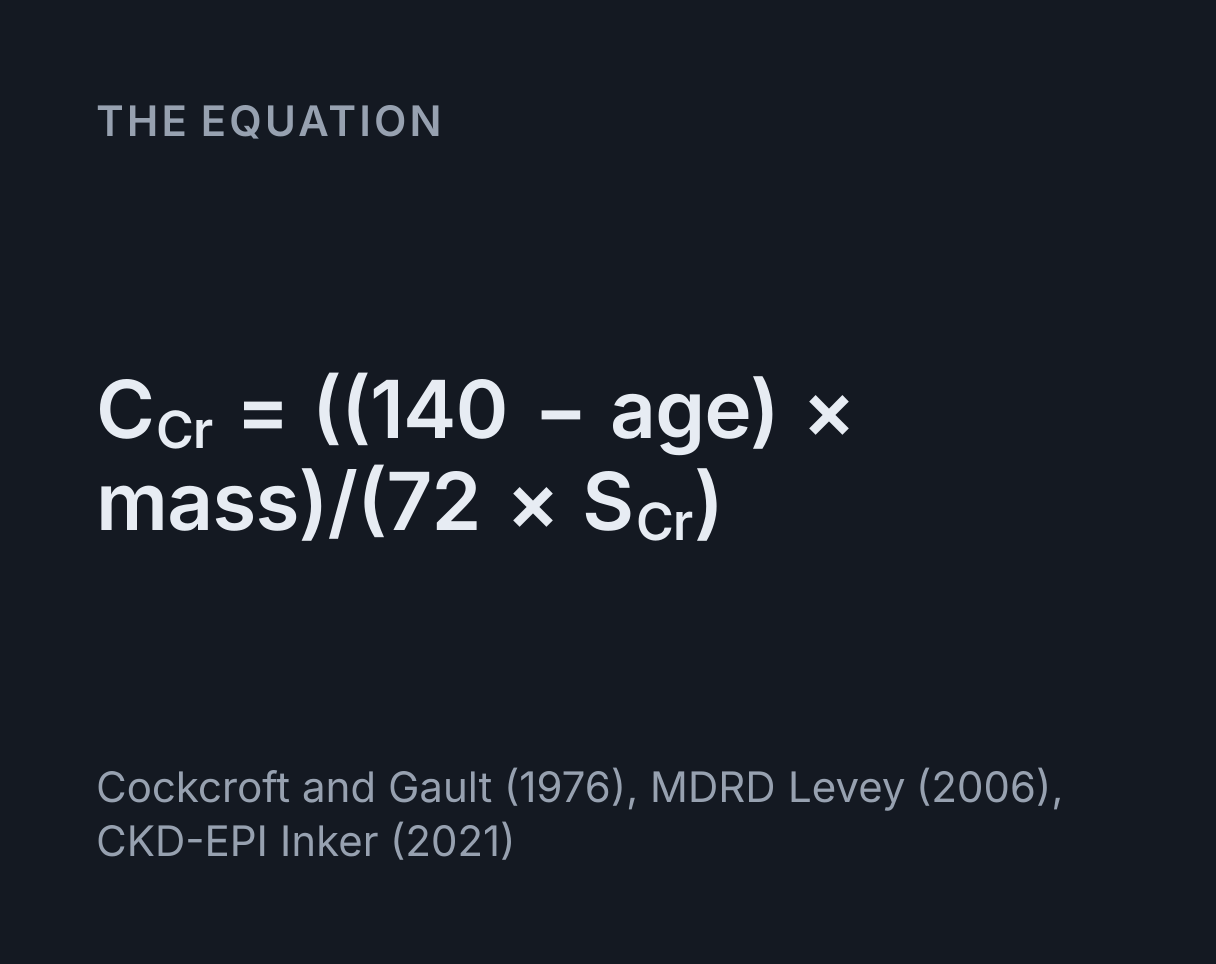
The equation
Cockcroft and Gault (1976), MDRD Levey (2006), CKD-EPI Inker (2021)
Three equations, three different quantities
eGFR is the glomerular filtration rate, the volume of plasma the kidneys filter each minute, estimated from serum creatinine, age and sex; this calculator gives it by CKD-EPI and MDRD alongside the Cockcroft-Gault creatinine clearance. They are not three attempts at the same number, and treating them as interchangeable is the most common error on this page.
- Cockcroft-Gault estimates creatinine clearance in
mL/min. It uses body weight and is not indexed to body surface area, so it scales with the person in front of you. - MDRD and CKD-EPI estimate glomerular filtration rate indexed to
1.73 m²of body surface area. Neither takes weight at all. An indexed result is a rate per standard body size, which is what makes it comparable between people and wrong for weight-based dosing.
So comparing a clearance in mL/min against a GFR in
mL/min/1.73 m² compares two different things. The tool shows CKD-EPI de-indexed to
the patient’s own surface area for exactly this reason: that figure is the one you may put
alongside Cockcroft-Gault. For someone of average size the two forms are close, which is
precisely what makes the distinction easy to forget.
Why creatinine is a late and blunt marker
Look at the curve. It is a hyperbola, not a line, and the consequence is stark: at 55 years old,
a creatinine moving from 0.6 to 1.2 mg/dL, which stays inside most
reference intervals the whole way, corresponds to an estimate falling by more than a third.
The reason is that the remaining nephrons compensate. As filtration falls the surviving glomeruli each filter more, so creatinine barely rises until a substantial fraction of function is gone. Only then does it climb steeply, which is the flat part of the curve on the right.
It also lags. After an acute injury creatinine takes a day or more to accumulate, so an early value can look reassuring in a kidney that has already stopped working. That is why acute kidney injury is defined by a change in creatinine and by urine output, not by a single absolute value.
Why the three disagree, and in which direction
MDRD is a single power law. One exponent means one slope everywhere, and it was
fitted in people who already had chronic kidney disease. So it underestimates at near normal
function, by roughly 14 percent at a creatinine of 0.9 in the tool’s default
patient, and it converges on CKD-EPI as function falls, which is the range it was derived in.
Below about 0.7 mg/dL it has nothing to flatten it and diverges upward instead.
Reporting MDRD above 60 is discouraged for both reasons, and the tool marks it when it happens.
CKD-EPI has two slopes, joined at a sex-specific creatinine of
0.7 for women and 0.9 for men. Shallow below, steep above. That is the
whole fix for MDRD’s problem: one equation can then stay accurate across both normal and
severely reduced function.
Cockcroft-Gault separates from both for an unusual body size, because it is the only one that takes weight. Change the mass slider and watch it move while the other two do not budge. For a 140 kg patient it nearly doubles, and that is not a better estimate of filtration: it is a different quantity that happens to be useful for dosing.
The race coefficient is gone, and why
The original MDRD and the 2009 CKD-EPI both carried a coefficient that raised the estimate for Black patients. It was removed in the 2021 revision of CKD-EPI, and this tool implements the race-free version with no race input to give.
The reasoning was twofold. Race is a social category rather than a biological determinant of creatinine production, so the coefficient had no mechanistic basis. And its effect was to report higher function for Black patients at the same creatinine, which delayed referral to nephrology and delayed transplant listing. Removing it was a decision about harm, not only about accuracy.
When an estimate from creatinine should not be used at all
Every equation here assumes creatinine is in a steady state and that its production tracks a typical relationship with age and sex. Where either assumption fails, the estimate is unreliable in a direction you can usually predict.
- Acute kidney injury. Creatinine is still rising, so any estimate overstates function.
- Unusual muscle mass. A bodybuilder produces more creatinine and a cachectic or amputee patient produces less, so function is under- and overestimated respectively.
- Pregnancy, where filtration rises substantially and none of these equations was fitted.
- High protein or creatine intake, and drugs such as trimethoprim and cimetidine that block tubular secretion of creatinine without changing filtration at all.
- Children. All three are adult equations. Paediatric practice uses the Schwartz formula, which is why the tool’s age input starts at 18.
In those situations a measured clearance, or an estimate based on cystatin C, is the better tool.
Reading the category, and what it does not mean
The KDIGO categories run from G1 above 90 down to G5 below 15. The line at 60 matters most, because below it a reduced eGFR is a stage of chronic kidney disease on its own, and above it other evidence of damage such as albuminuria is needed for the diagnosis.
A category is not a diagnosis. KDIGO requires the abnormality to have been present for at least three months, and a single blood test cannot establish that. Staging also has an albuminuria axis that nothing on this page touches, and it carries at least as much prognostic weight as the filtration category.
Converting the units, which is where the real danger is
Multiply mg/dL by 88.4 to get µmol/L, and divide to go
back. The factor comes from creatinine’s molar mass of 113.12 g/mol together with the
change from decilitres to litres.
British, Canadian and Australian laboratories usually report µmol/L; American
and Indian ones report mg/dL. Every equation here expects mg/dL.
Entering 90 where the formula wants 1.02 makes Cockcroft-Gault wrong by about ninetyfold, and
CKD-EPI and MDRD wrong by roughly two hundredfold, because both divide by creatinine raised to
a power above 1. That is the single most dangerous mistake available on this page, and it is
why the unit is a visible choice in the tool rather than an assumption.
Common mistakes
- Comparing an indexed GFR with a clearance. One is per
1.73 m², the other is not. De-index first, which the tool does for you. - Using an indexed eGFR for weight-based drug dosing. It describes a standard body, not this one. That is why Cockcroft-Gault survives.
- Getting the units wrong. Ninetyfold to two hundredfold depending on the equation, and the arithmetic looks fine.
- Trusting an eGFR in acute kidney injury. Creatinine has not caught up yet.
- Reading a normal creatinine as normal function, particularly in an elderly or low muscle mass patient. The curve is steepest inside the reference interval.
- Quoting MDRD above 60. It is unreliable there by construction and the tool flags it.
- Calling a category a diagnosis. Three months, plus the albuminuria axis, plus a clinical picture.
Common questions
Why do the three formulas give different answers?
Because they estimate different quantities from different populations. Cockcroft-Gault estimates creatinine clearance, includes body weight, and was derived in 1973 in a small and largely male group. MDRD and CKD-EPI estimate glomerular filtration rate indexed to body surface area, so they do not use weight at all, and CKD-EPI was fitted across a wider range of kidney function. CKD-EPI is the most accurate near normal function, where MDRD systematically underestimates, while Cockcroft-Gault persists because many drug dosing recommendations were validated against it.
Why is creatinine a delayed and blunt marker?
Because the relationship between creatinine and filtration rate is a hyperbola, not a line. Filtration can fall by nearly half from normal while creatinine stays inside the reference range, since the remaining nephrons compensate by filtering more. Only once function is substantially reduced does creatinine climb steeply. It also lags: after an acute injury it takes a day or more to accumulate, so an early creatinine can look reassuring in a kidney that has already stopped working.
When should I not use an eGFR at all?
Whenever creatinine is not in a steady state or is not tracking muscle mass. That includes acute kidney injury, where the value is still rising, and pregnancy. It also includes anyone whose creatinine production is unusual: very muscular or very cachectic people, amputees, and those on a high protein or creatine intake. In those situations an estimate from creatinine is unreliable in a direction you can often predict, and a measured clearance or a cystatin C based estimate is the better tool.
Does the race coefficient still apply?
No. The older MDRD and CKD-EPI equations included a coefficient that raised the estimate for Black patients, and it was removed in the 2021 revision of CKD-EPI. The reasoning was that race is a social category rather than a biological determinant of creatinine production, and that the coefficient systematically overestimated function in Black patients, delaying referral and transplant listing. Current practice uses the race-free equation, and this calculator follows it.
How do I convert creatinine between mg/dL and µmol/L?
Multiply mg/dL by 88.4 to get µmol/L, and divide by 88.4 to go the other way. The factor is creatinine’s molar mass of 113.12 g/mol combined with the change from decilitres to litres. This matters because British, Canadian and Australian laboratories usually report µmol/L while American and Indian ones report mg/dL, and every formula on this page expects one specific unit. Entering 90 where the equation wants 1.02 is the single most common error with these calculations, and it is not a small one: Cockcroft-Gault comes out about 88 times too low, and MDRD and CKD-EPI about 200 times too low, because both divide by creatinine raised to a power above one.