Body Fat Calculator
Estimate body fat percentage with the US Navy tape method from neck, waist, hip and height in inches or cm, with the ACE category and the working shown.
Calculator
Each sex has its own equation. Men are measured at the neck and the navel, women at the neck, the narrowest part of the waist and the hips.
One unit for every measurement. A switch converts the numbers already entered.
Without shoes. 5 ft 10 in is 70 in.
Just below the larynx, the tape sloping slightly down to the front.
Level with the navel, at the end of a normal breath out.
- Body fat (Navy, 1984) Hodgdon and Beckett’s equation, through Siri’s 495 / density − 450. In the 602 Navy men it was fitted to, its standard error against underwater weighing was 3.52 percentage points.
- 17.4 %
- ACE category American Council on Exercise norms for men: essential fat 2 to 5%, athletes 6 to 13%, fitness 14 to 17%, acceptable 18 to 24%, obesity over 25%. Read at the nearest whole percent, here 17%. A fitness reference, not a diagnosis.
- Fitness
- DoD 2002 inch form The equation DoD Instruction 1308.3 (2002) prints for the military tape test, in inches. It is derived from the 1984 equations and lands close to them, not on them. The DoD rounds its result to a whole percent in the service member’s favor.
- 17.5 %
- Body density What the 1984 equation predicts. Underwater weighing, the method it was fitted against, measures density too.
- 1.05897 g/mL
Working, with your numbers
- Inches x 2.54: waist 34 in = 86.36 cm, neck 15 in = 38.1 cm, height 70 in = 177.8 cm
- Circumference value = waist - neck = 86.36 - 38.1 = 48.26 cm
- Density = 1.0324 - 0.19077 x log10(48.26) + 0.15456 x log10(177.8)
- = 1.0324 - 0.19077 x 1.68359 + 0.15456 x 2.24993
- = 1.05897 g/mL
- Body fat = 495 / 1.05897 - 450 = 17.43%
The 1984 equations are written in cm, so inches are converted first. Logarithms are base 10.
Citing this tool
Last updated . Add the date you accessed it as well, which a citation of a page that can change asks for. If a specific result matters, cite the permalink from the tool’s share row instead of this page: it reproduces the exact parameters.
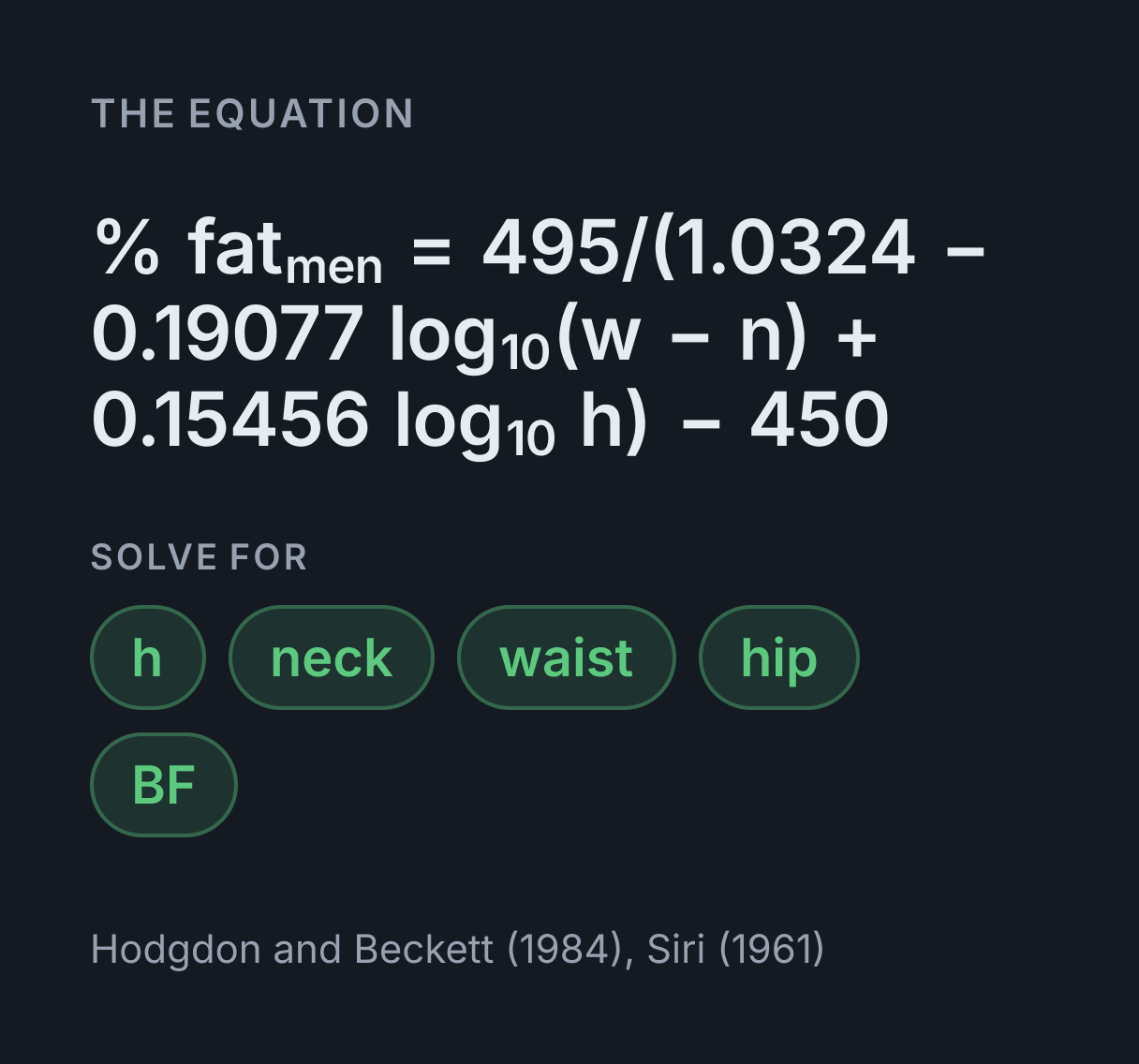
The equation
Hodgdon and Beckett (1984), Siri (1961)
How do you calculate body fat with the Navy method?
Measure height, neck and waist, plus hips for women. A man’s circumference value is waist minus neck; a woman’s is waist plus hip minus neck. Hodgdon and Beckett’s 1984 equation turns that value and height, in cm, into body density, and Siri’s equation, 495 ÷ density − 450, turns density into percent body fat.
The equations for men and women
Men: density = 1.0324 − 0.19077 × log10(waist − neck) + 0.15456 × log10(height)Women: density = 1.29579 − 0.35004 × log10(waist + hip − neck) + 0.22100 × log10(height)Body fat (%) = 495 ÷ density − 450
Lengths are in cm and the logarithms are base 10. James Hodgdon and Marcie Beckett fitted the two equations at the Naval Health Research Center in San Diego, against underwater weighing, in 602 Navy men aged 18 to 56 and 214 Navy women aged 18 to 44. They predict density rather than fat because density is what underwater weighing measures, and Siri’s 1961 equation is the step both reports use to convert it.
A stepwise regression picked the sites from about a dozen circumferences measured on each person. For men it kept the abdomen at the navel and the neck; for women, the narrowest part of the waist, the hips and the neck. So the waist is measured in a different place for each sex, and for a man only the difference between waist and neck counts: on the calculator’s default man, a neck read 1 in large and a waist read 1 in small both move the answer from 17.4 to 15.5 percent.
How to take the measurements
- Neck: just below the larynx, with the tape sloping slightly down toward the front.
- Waist, men: level with the navel, at the end of a normal breath out.
- Waist, women: at the narrowest part of the abdomen, about halfway between the navel and the bottom of the breastbone, at the end of a normal breath out.
- Hips, women: around the greatest protrusion of the buttocks, seen from the side.
- Height: standing, without shoes.
In the 1984 studies the tape followed the skin surface without pressing into it, and each site was measured twice, with a third reading when the two differed by more than 1 cm. DoD Instruction 1308.3 asks for a fiberglass tape that does not stretch, held level, and three rounds of readings to the nearest half inch. Either way, take the mean of repeated readings rather than the first one.
Reading the result on the ACE chart
The category beside the result comes from the American Council on Exercise chart of percent body fat norms:
| ACE category | Women | Men |
|---|---|---|
| Essential fat | 10 to 13% | 2 to 5% |
| Athletes | 14 to 20% | 6 to 13% |
| Fitness | 21 to 24% | 14 to 17% |
| Acceptable | 25 to 31% | 18 to 24% |
| Obesity | over 32% | over 25% |
The chart gives whole percentages, so the calculator rounds to the nearest whole percent before placing a result. Read literally, the chart leaves one value out: obesity is written as over 32 percent for women and over 25 percent for men, while acceptable stops at 31 and 24. A result that rounds to 32 or 25 is reported as between the two bands rather than assigned to either. The chart is a fitness reference, not a diagnostic standard, and it does not vary with age.
How accurate is the Navy method compared with DEXA?
Expect a single estimate to sit several percentage points from a DEXA scan, in a direction that depends on sex and on how lean you are. In the derivation samples the standard error against underwater weighing was 3.52 points for men and 3.72 for women. On new samples it was 2.70 points in 100 Navy men, and 4.36 and 4.04 points in 66 Canadian Forces women and 80 Navy women.
Two military studies have since compared the tape with DEXA, the reference both treat as the truth, and both tested the DoD inch form of the equations:
- Potter and colleagues, 2022, in 430 men and 179 women in the US Marine Corps. On average the tape read men about 2.5 points lower than DEXA and women 1.3 to 2.3 points higher, with a standard deviation of 3.7 to 4.8 points around those averages. Lean people were overestimated and fatter people underestimated.
- Foulis and colleagues, 2023, in 926 men and 481 women starting Army basic training. The tape read both sexes 6.0 points below DEXA. Over the 8 weeks DEXA showed women losing 4.0 points of body fat and men 3.3; the tape showed no change for the women and a 2.2 point fall for the men.
So treat the result as a range of several points, not a figure to a decimal place, and do not read a change of a point or two between measurements as a real change in body fat. Experienced measurers reproduce each other’s estimate to within about 1 percentage point, which is how repeatable the tape is, not how close it comes to a scan.
The 1984 equation and the DoD 2002 form
DoD Instruction 1308.3, issued in 2002 for the military tape test, prints the equations in a different form: percent fat directly, from measurements in inches.
Men: % fat = 86.010 × log10(abdomen − neck) − 70.041 × log10(height) + 36.76Women: % fat = 163.205 × log10(waist + hip − neck) − 97.684 × log10(height) − 78.387
The instruction says its tables derive from Hodgdon and Beckett’s equations, but the two forms do not give identical numbers. For the calculator’s default man the 1984 equation gives 17.4 percent and the DoD form 17.5; for a woman of 5 ft 4 in with a 13 in neck, 28 in waist and 38 in hips, 26.4 and 26.6. The calculator shows both and reads the ACE category from the 1984 result. The DoD rounds its result to a whole percent in the service member’s favor, and under Army Directive 2023-11 the Army replaced this tape test with an equation from the abdominal circumference and body weight, so an official military result may differ from either number.
A woman measured in cm
A woman 165 cm tall with a 32 cm neck, a 71 cm waist and 99 cm hips. With the calculator set to cm the numbers go straight into the equation, because cm is the unit it was written in:
- Circumference value = waist + hip - neck = 71 + 99 - 32 = 138 cm
- Density = 1.29579 - 0.35004 x log10(138) + 0.22100 x log10(165)
- = 1.29579 - 0.35004 x 2.13988 + 0.22100 x 2.21748
- = 1.03681 g/mL
- Body fat = 495 / 1.03681 - 450 = 27.43%
27.4 percent rounds to 27, which is acceptable on the ACE chart for women.
Using it with the other body calculators
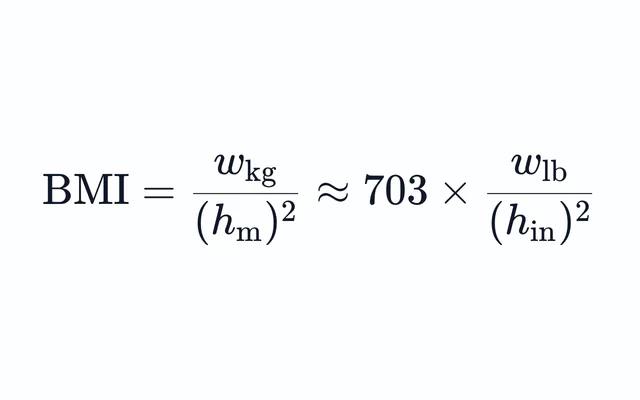
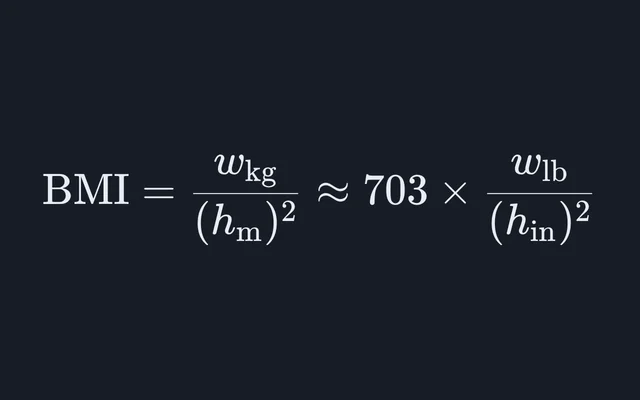
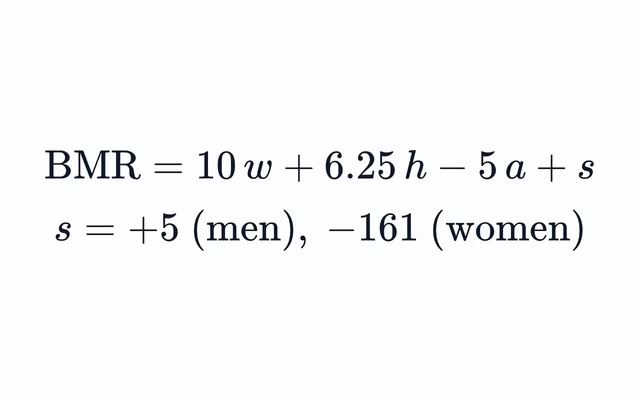
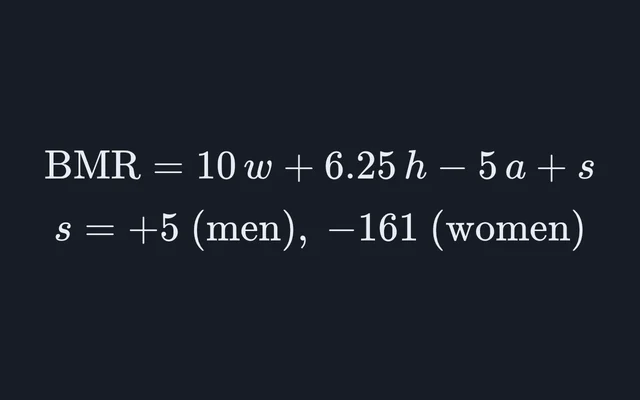
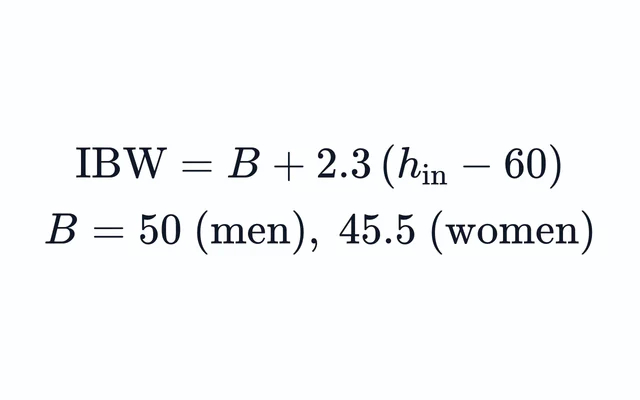
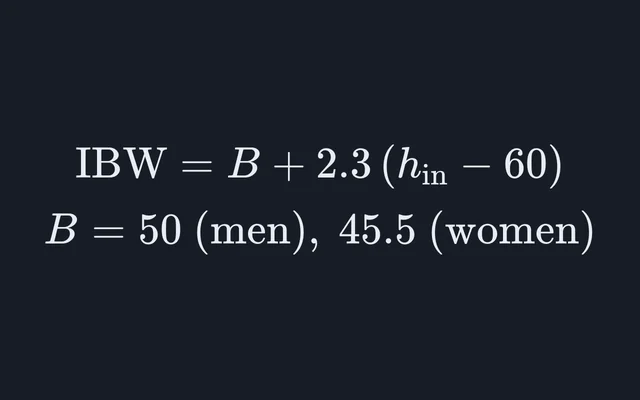
The BMI Calculator uses only height and weight, so it says nothing about how much of the weight is fat; this estimate tries to, within the error described above. The BMR and TDEE Calculator estimates resting energy use, and the Katch-McArdle equation for it works from lean body mass, which needs a body fat percentage like this one. The Ideal Body Weight Calculator gives the dosing weights set from height and sex alone, which ignore body composition entirely.
Common mistakes
- Measuring a woman’s waist at the navel. The women’s equation was fitted to the narrowest part of the waist. The navel is the men’s site, and a girth anywhere other than the narrowest point can only be larger, so it can only raise the estimate.
- Pulling the stomach in or the tape tight. On the default man, a waist read 1 in small takes the answer from 17.4 to 15.5 percent. Measure at the end of a normal breath out, with the tape on the skin but not pressing in.
- Typing cm with inches selected. A 38 cm neck and an 86 cm waist entered as inches, at 70 in tall, give 54.0 percent, a number that looks possible but describes a very different body. Pick the unit before typing.
- Using the result on a teenager. The equations were fitted in Navy adults, the youngest of them 18, and the 1984 reports tested them on nobody younger.
Worked examples
Each one runs through the calculator above, so the arithmetic here is the arithmetic it does.
What is the body fat percentage of a man 6 ft tall with a 16 in neck and a 38 in waist?
- Circumference value = waist - neck = 96.52 - 40.64 = 55.88 cm
- Density = 1.0324 - 0.19077 x log10(55.88) + 0.15456 x log10(182.9)
- = 1.0324 - 0.19077 x 1.74726 + 0.15456 x 2.26217
- = 1.04872 g/mL
- Body fat = 495 / 1.04872 - 450 = 22.01%
The equation sees only the 22 in between waist and neck, 55.88 cm once converted, so a 40 in waist over an 18 in neck gives the same 22.0 percent. That rounds to 22, inside acceptable on the ACE chart for men, which runs from 18 to 24 percent.
What waist size gives 20 percent body fat for a man 5 ft 9 in tall with a 15.5 in neck?
- Density = 495 / (BF + 450) = 495 / (20 + 450) = 1.05319 g/mL
- log10(waist - neck) = (1.0324 + 0.15456 x log10(175.3) - 1.05319) / 0.19077
- = (1.0324 + 0.15456 x 2.24368 - 1.05319) / 0.19077
- = 1.70882, so waist - neck = 51.15 cm
- Waist = 51.15 + neck 39.37 = 90.52 cm
Solved backward through density: 20 percent is a density of 1.05319 g/mL, which needs a waist 51.15 cm larger than the neck, so a waist of 90.52 cm, or 35.6 in. Around that size each extra inch of waist adds about 1.8 points.
Practise this with Lab and Clinical Calculation Practice Problems, questions generated from this calculator and 20 other calculators in Biology.
Common questions
How accurate is the Navy body fat method?
Typically to within several percentage points, and not always in the same direction. In 1984 Hodgdon and Beckett reported a standard error of 3.52 points for men and 3.72 for women against underwater weighing. Against DEXA, a 2022 study of US Marines found the tape read men about 2.5 points low and women 1.3 to 2.3 points high on average, overestimating lean people and underestimating fatter ones, and a 2023 study of Army recruits found it 6.0 points below DEXA in both sexes.
Why are men and women measured in different places?
Because each equation was fitted separately, and a stepwise regression kept the sites that best predicted body density in that sex. From about a dozen circumferences it kept the abdomen at the navel and the neck for men, and the narrowest part of the waist, the hips and the neck for women. The sites belong to the equations, so measuring a woman at the navel, or a man at the narrowest point, puts the wrong number into the right formula.
Why does this differ from the military tape test?
DoD Instruction 1308.3 of 2002 printed the tape test in an inch form that is derived from the 1984 equations but does not reproduce them exactly, and it rounds the result to a whole percent in the service member’s favor. This calculator shows that form beside the 1984 result. Under Army Directive 2023-11 the Army replaced the tape test with an equation from abdominal circumference and body weight, so a current Army result comes from a different equation altogether.
What is a healthy body fat percentage?
This calculator reads results against the American Council on Exercise chart, which lists essential fat at 10 to 13 percent for women and 2 to 5 for men, athletes at 14 to 20 and 6 to 13, fitness at 21 to 24 and 14 to 17, acceptable at 25 to 31 and 18 to 24, and obesity at over 32 and over 25. It is a fitness reference rather than a diagnostic standard, and with a tape estimate several points either way, a result near a boundary could belong to the band on either side.
Should I enter inches or centimeters?
Either, as long as every measurement uses the same one. Hodgdon and Beckett wrote the equations in cm, so inches are multiplied by exactly 2.54 first, and the working shows the conversion. Switching the unit converts the numbers already entered rather than relabeling them, so a 34 in waist becomes 86.4 cm, not 34 cm.