BMR and TDEE Calculator
Basal metabolic rate by Mifflin-St Jeor, revised Harris-Benedict or Katch-McArdle, and TDEE from FAO activity levels, in lb and ft or kg and cm.
Calculator
Adults only. Below 18 there is no answer, because these equations leave out the energy cost of growth.
For stones, 1 st is 14 lb: 11 st 6 lb is 160 lb.
Mifflin-St Jeor and Harris-Benedict take sex, age, height and weight. Katch-McArdle takes lean mass from a body fat percentage instead, and asks for it when chosen.
- BMR, Mifflin-St Jeor 7,459 kJ/day. Kilocalories, the Calories on a US food label. In a 2005 systematic review, Mifflin-St Jeor came within 10 percent of measured resting metabolic rate in more people than any other equation tested. Any one person can still fall outside that.
- 1,783 kcal/day
- BMR in kilojoules 1 kcal = 4.184 kJ. Food labels in Australia and New Zealand give energy in kJ, and UK labels give both.
- 7,459 kJ/day
- Total daily energy expenditure BMR × PAL 1.53, which is 11,412 kJ/day. PAL is total energy expenditure over 24 hours divided by BMR, as FAO/WHO/UNU (2004) define it.
- 2,728 kcal/day
- TDEE across the band The whole sedentary or light activity band, PAL 1.40 to 1.69. 1.53 is the report’s example lifestyle inside it, not its midpoint, and where in the band a real week falls is something no equation knows.
- 2,496 to 3,013 kcal/day
- Revised Harris-Benedict 82 kcal/day above the chosen estimate for the same person. Roza and Shizgal put the Harris-Benedict equations’ precision at 14 percent either way in normally nourished adults, and found them unreliable in malnutrition.
- 1,865 kcal/day
Working, with your numbers
- Height: 5 ft 10 in = 70 in = 177.8 cm
- Weight: 180 lb x 0.4536 = 81.65 kg
- BMR (Mifflin-St Jeor, men) = 10 x 81.65 + 6.25 x 177.8 - 5 x 30 + 5 = 1783 kcal/day
- BMR in kJ = 1783 x 4.184 = 7459 kJ/day
- TDEE = BMR x PAL = 1783 x 1.53 = 2728 kcal/day
- TDEE in kJ = 2728 x 4.184 = 11,410 kJ/day
Heights are converted to cm and pounds to kg before the arithmetic. The working is exact; the estimate is a population average with individual error.
Citing this tool
Last updated . Add the date you accessed it as well, which a citation of a page that can change asks for. If a specific result matters, cite the permalink from the tool’s share row instead of this page: it reproduces the exact parameters.
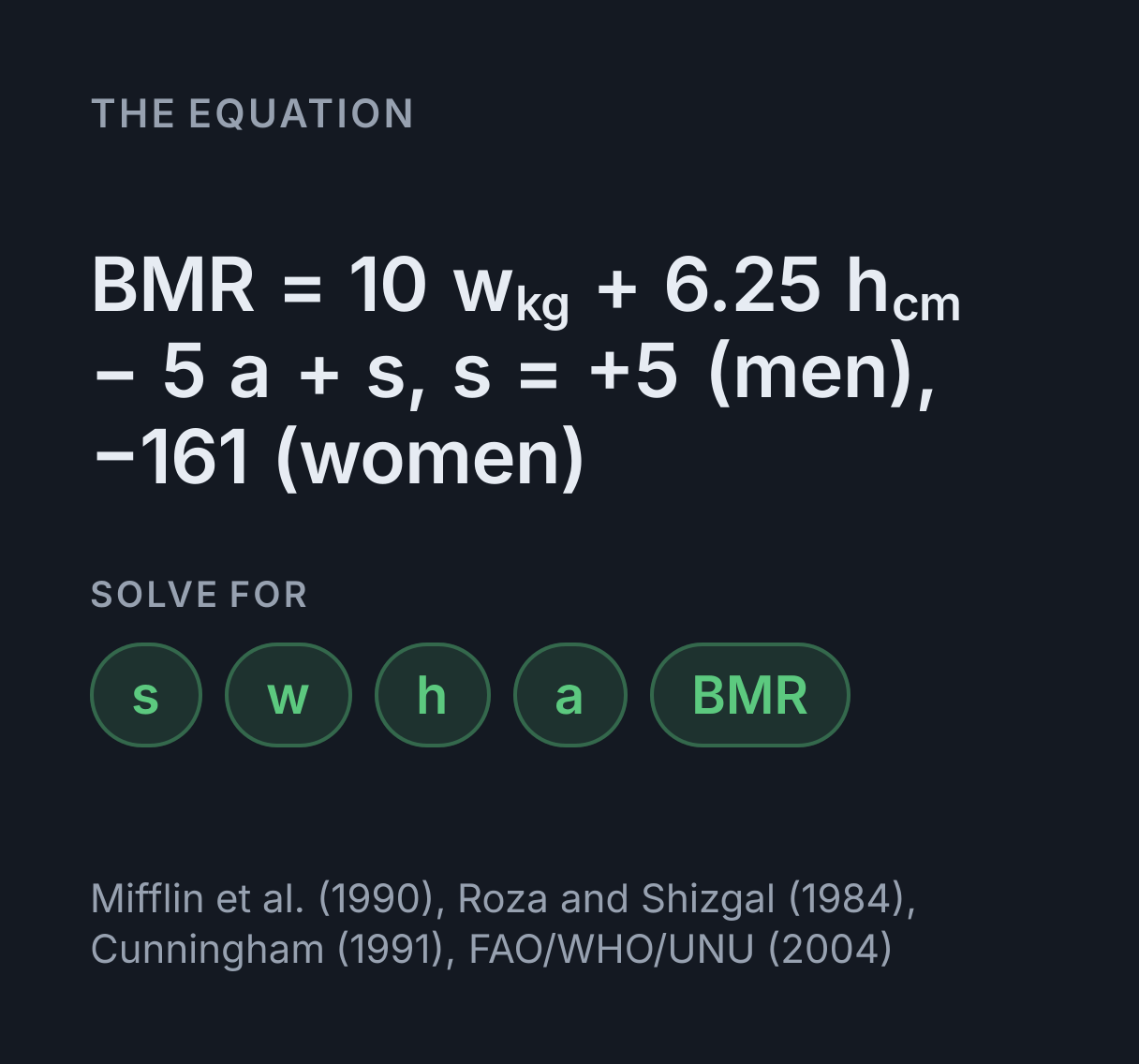
The equation
Mifflin et al. (1990), Roza and Shizgal (1984), Cunningham (1991), FAO/WHO/UNU (2004)
How do you calculate BMR?
Use the Mifflin-St Jeor equation: BMR = 10 × weight (kg) + 6.25 × height (cm) − 5 × age (years) + 5 for men, or − 161 in place of + 5 for women. The result is kilocalories per day. Multiply it by a physical activity level of 1.4 to 2.4 to estimate total daily energy expenditure (TDEE).
Three equations for the same number
For a man of 30, 5 ft 10 in and 180 lb, Mifflin-St Jeor gives 1,783 kcal/day and the revised Harris-Benedict equation 1,865, 82 more. They are regressions fitted to different groups of people, and the calculator shows both so the gap between them is visible rather than hidden behind one confident figure.
- Mifflin-St Jeor, 1990. Fitted to 498 healthy adults aged 19 to 78, 264 of normal weight and 234 obese, with resting energy expenditure measured by indirect calorimetry. Sex enters only as the constant, so a woman’s estimate is 166 kcal/day below a man’s of the same size and age, at every size and age.
- Revised Harris-Benedict, 1984. Harris and Benedict published their equations
in 1919. Roza and Shizgal refitted them to the original 239 subjects and 98 more that Benedict
published later, which gave the coefficients used here:
88.362 + 13.397 × weight + 4.799 × height − 5.677 × agefor men and447.593 + 9.247 × weight + 3.098 × height − 4.330 × agefor women. - Katch-McArdle.
370 + 21.6 × lean body mass, the general equation Cunningham proposed in a 1991 review of studies relating resting energy expenditure to fat-free mass. It needs a body fat percentage and ignores sex and age. At 20 percent body fat the same man gets 1,781 kcal/day.
From BMR to TDEE: the activity level
The FAO/WHO/UNU report on human energy requirements (2004) defines the physical activity level, PAL, as total energy expenditure over 24 hours divided by BMR, so TDEE is BMR × PAL. The report sorts adult lifestyles into three bands and works an example lifestyle inside each, and the calculator offers those examples:
- Sedentary or light activity: PAL 1.40 to 1.69, example 1.53. The report’s examples include urban office workers who only occasionally do anything physically demanding.
- Active or moderately active: PAL 1.70 to 1.99, example 1.76.
- Vigorous or vigorously active: PAL 2.00 to 2.40, example 2.25. Values above 2.40, the report notes, are difficult to maintain over a long period.
The band matters as much as the equation. For the man above, the sedentary or light activity band alone runs from 2,496 to 3,013 kcal/day, which is why the calculator prints the whole band beside the example. The same report puts BMR at about 45 to 70 percent of an adult’s total expenditure.
If another calculator gave a lower TDEE, check its multiplier. A sedentary factor of 1.2, which some calculators use, sits below the bottom of the FAO/WHO/UNU sedentary band at 1.40, and for this man it gives 588 kcal/day less than the report’s example of 1.53.
How accurate is a BMR estimate?
Each equation predicts the average for people like the one described, and a real person can sit well away from that average. The figures the sources themselves give:
- A 2005 systematic review in the Journal of the American Dietetic Association found that Mifflin-St Jeor predicted resting metabolic rate within 10 percent of the measured value in more nonobese and obese adults than any other equation in common use, with the narrowest error range. Ten percent of the man above is 178 kcal/day either way.
- Roza and Shizgal put the precision of the Harris-Benedict equations at 14 percent either way in normally nourished people, and found them unreliable in malnourished patients, whose measured oxygen consumption they underestimated.
- Mifflin and colleagues found that the original 1919 Harris-Benedict equations overestimated measured resting energy expenditure in their subjects by 5 percent.
- Cunningham’s lean mass equation explained 65 to 90 percent of the variation in resting energy expenditure across the studies it pooled. A body fat figure that is off by one percentage point moves it by about 18 kcal/day for the man above.
The same review found older adults and ethnic minorities living in the US underrepresented in the studies behind the equations. The only way to know one person’s rate is to measure it, by indirect calorimetry, which reads the oxygen used and the carbon dioxide produced at rest.
BMR, RMR and resting energy expenditure
Basal metabolic rate is a measurement taken under fixed conditions: awake and lying down, 10 to 12 hours after a meal, after 8 hours of physical rest with no strenuous exercise the day before, mentally relaxed, at a temperature that causes neither shivering nor sweating. Resting metabolic rate and resting energy expenditure relax those conditions. All three equations here were fitted to resting measurements, and the activity levels are defined against BMR, so TDEE from this calculator multiplies a resting estimate by a factor written for a basal one. That is the convention the calculator follows, stated here so the result is not mistaken for a measurement.
Calories, kilocalories and kilojoules
The Calorie on a US or Canadian food label is the kilocalorie, so a BMR of 1,800 kcal/day is 1,800 Calories. The FAO/WHO/UNU report converts at 1 kcal = 4.184 kJ, the thermochemical calorie. Food labels in Australia and New Zealand give energy in kilojoules, and UK and EU labels give both, which is why the calculator prints every result in kcal and in kJ.
When these equations do not apply
- Children and teenagers. A child’s energy needs include the cost of growth, and the FAO/WHO/UNU report sets them separately. Mifflin’s youngest subject was 19, so the calculator refuses ages under 18 and warns between 18 and 19 and above 78.
- Pregnancy and breastfeeding. The report defines BMR × PAL as the daily requirement only for adult men and for women who are neither pregnant nor lactating, and treats pregnancy and lactation in chapters of their own.
- Illness and malnutrition. Mifflin-St Jeor was fitted to healthy adults, and Roza and Shizgal found Harris-Benedict unreliable in malnutrition. Where an estimate matters clinically, the 2005 review’s expert panel points to measuring expenditure by indirect calorimetry instead.
- Unusual body composition. Mifflin-St Jeor and Harris-Benedict see only total weight, so a muscular person and a person with more body fat at the same height, weight and age get the same estimate. Katch-McArdle reads lean mass instead, which helps only if the body fat figure is measured.
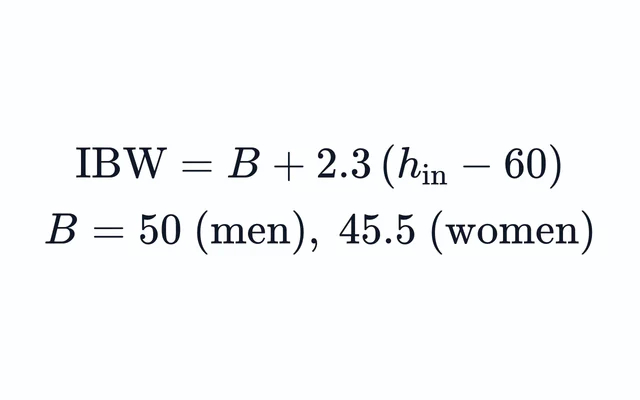
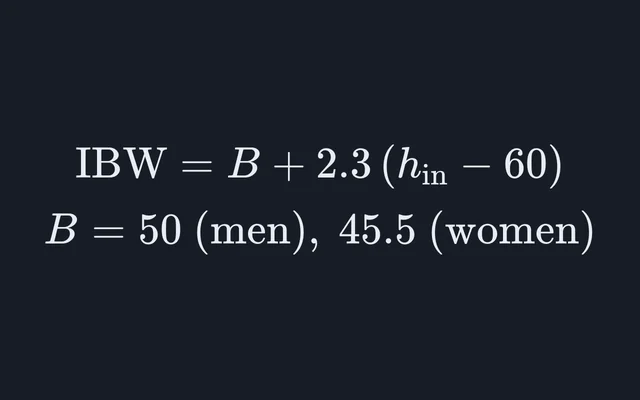
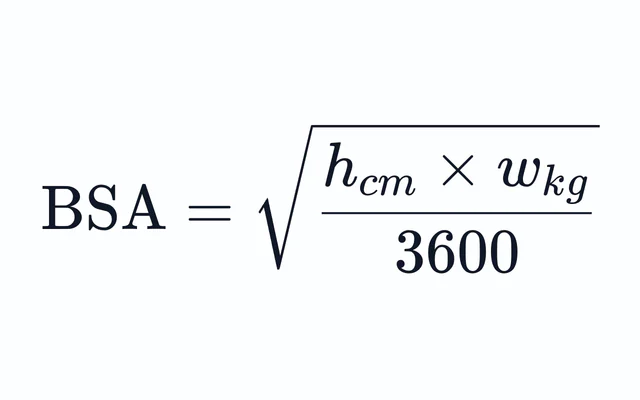
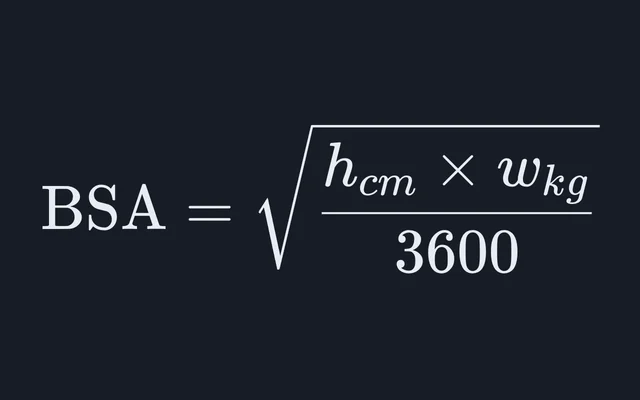
Two related tools answer different questions. The ideal body weight calculator gives a dosing weight from height and sex alone, and it is not an input here: every equation on this page was fitted to measured weight. The body surface area calculator carries the Du Bois formula of 1916, which was published in a series on clinical calorimetry, from the era when metabolic rate was reported per square metre of body surface.
Common mistakes
- Entering pounds as kilograms. The man above, at 180 lb typed as 180 kg, gets a BMR 984 kcal/day too high. Choose lb beside the box rather than converting by hand.
- Entering inches as centimetres. His 70 in typed as 70 cm takes 674 kcal/day off the estimate.
- Treating TDEE as exact. It carries the equation’s error and the activity level’s on top, so read it as a range, the one the calculator prints beside it, rather than a figure to the calorie.
- Counting exercise twice. A PAL is the whole day’s activity expressed as a multiple of BMR, so adding a watch’s workout calories on top of an active PAL counts the same activity twice.
Worked examples
Each one runs through the calculator above, so the arithmetic here is the arithmetic it does.
What is the BMR of a 30-year-old woman who is 5 ft 5 in and weighs 150 lb?
- BMR (women) = 10 x weight + 6.25 x height - 5 x age - 161
- = 10 x 68.04 + 6.25 x 165.1 - 5 x 30 - 161
- = 680.4 + 1032 - 150 - 161
- = 1401 kcal/day
Pounds and inches go in as 68.04 kg and 165.1 cm, which is where the working starts. About 1,401 kcal/day is a resting figure: at the sedentary or light activity PAL of 1.53 her estimated total is about 2,144 kcal/day, and any exercise she does belongs inside the PAL chosen, not added on top of it.
What is the BMR of a 45-year-old man who is 180 cm tall and weighs 85 kg?
- BMR (men) = 10 x weight + 6.25 x height - 5 x age + 5
- = 10 x 85 + 6.25 x 180 - 5 x 45 + 5
- = 850 + 1125 - 225 + 5
- = 1755 kcal/day
Food labels in Australia and New Zealand count energy in kilojoules, and at 4.184 kJ per kcal this is 7,343 kJ/day. The revised Harris-Benedict equation gives the same man 1,835 kcal/day, 80 kcal or 4.6 percent more, which in Mifflin-St Jeor is the effect of 8 kg of body weight: the choice of equation moves the answer that much.
What weight gives a 40-year-old woman who is 5 ft 6 in a BMR of 1,500 kcal/day?
- weight (women) = (BMR - 6.25 x height + 5 x age + 161) / 10
- = (1500 - 6.25 x 167.6 + 5 x 40 + 161) / 10
- = (1500 - 1048 + 200 + 161) / 10
- = 813.3 / 10
- = 81.33 kg
Solved backward: 81.33 kg, about 179 lb. Every kilogram moves Mifflin-St Jeor by exactly 10 kcal/day, about 4.5 per pound, so losing 10 kg lowers the estimate by 100 kcal/day, and a calorie target worked out at the starting weight overstates needs as the weight comes off.
Practise this with Lab and Clinical Calculation Practice Problems, questions generated from this calculator and 20 other calculators in Biology.
Common questions
Which BMR equation is the most accurate?
For healthy adults, Mifflin-St Jeor, on the best evidence available. A 2005 systematic review in the Journal of the American Dietetic Association compared the equations in common clinical use and found that Mifflin-St Jeor predicted resting metabolic rate within 10 percent of the measured value in more nonobese and obese people than any other, with the narrowest error range. The same review found older adults and US-residing ethnic minorities underrepresented in the studies. Only indirect calorimetry, which measures the oxygen a person uses and the carbon dioxide they produce, gives one person’s actual rate.
What activity factor should I use to work out TDEE?
A physical activity level, or PAL, from the FAO/WHO/UNU report on human energy requirements (2004). It defines PAL as total energy expenditure over 24 hours divided by BMR, and sorts adult lifestyles into three bands: sedentary or light activity, 1.40 to 1.69; active or moderately active, 1.70 to 1.99; and vigorous, 2.00 to 2.40, noting that higher values are difficult to maintain over a long period. The calculator uses the report’s example lifestyle in each band, 1.53, 1.76 and 2.25, and also shows TDEE across the whole band, because a BMR of 1,700 kcal/day spans 2,380 to 2,873 kcal/day inside the sedentary band alone.
Is BMR the same as RMR or resting energy expenditure?
Not quite, although many calculators use the names interchangeably. BMR is measured under strict basal conditions, lying awake after an overnight fast and a night of physical rest, while resting metabolic rate and resting energy expenditure allow looser ones. Mifflin-St Jeor, the revised Harris-Benedict and the Cunningham equation behind Katch-McArdle were all fitted to resting measurements, so what this calculator reports as BMR is, strictly, a resting estimate.
How do I use my TDEE to lose weight?
TDEE estimates the energy an adult spends in a day, which is the intake that would hold weight steady, so eating less than it is a deficit. How large a deficit is a choice for the person, and for a clinician or registered dietitian where health is involved. Two things in the arithmetic matter. The estimate can miss one person’s real expenditure by 10 percent or more, so the weight trend over several weeks says more than the number does. And by Mifflin-St Jeor each kilogram lost lowers BMR by 10 kcal/day, so a target worked out at the starting weight overstates needs later on.
Why does Katch-McArdle not ask for sex or age?
Because in the data it came from, they added little once lean mass was known. Cunningham reanalysed Harris and Benedict’s subjects in 1980 and found lean body mass the single best predictor of basal metabolic rate, and his 1991 review of later studies proposed the equation calculators now call Katch-McArdle: 370 + 21.6 × lean body mass in kg. Its weakness is the input. Lean mass comes from a body fat percentage, and at 80 kg each percentage point of error moves the estimate by about 17 kcal/day, so the figure should come from a measurement rather than a guess.