Calorimetry Calculator
Solve the calorimetry equation q = mcΔT for heat, mass, specific heat capacity or temperature change, with results in joules, calories and per gram.
Calculator
Water 4.184, ethanol 2.44, aluminium 0.897, copper 0.385, glass 0.84.
A change, not an absolute temperature: 10 °C rise = 10 K rise.
Working, with your numbers
- q = m x c x dT
- = 500 x 4.184 x 10
- = 20,920 J = 20.92 kJ
Values are converted into the units the equation is worked in before the arithmetic.
- In kilojoules
- 20.92 kJ
- In kilocalories Thermochemical calorie, exactly 4.184 J.
- 5 kcal
- Per gram
- 41.84 J/g
Citing this tool
Last updated . Add the date you accessed it as well, which a citation of a page that can change asks for. If a specific result matters, cite the permalink from the tool’s share row instead of this page: it reproduces the exact parameters.
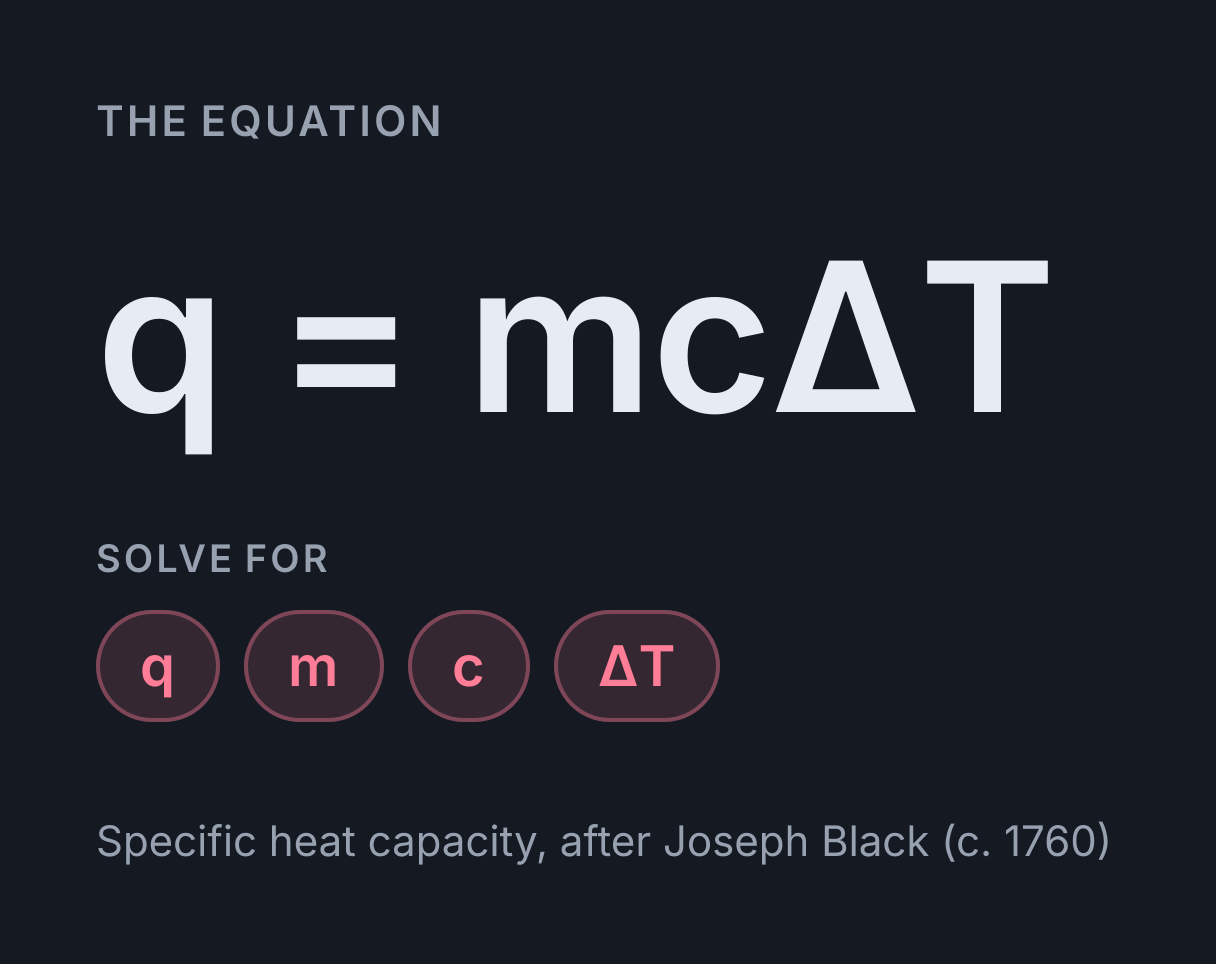
The equation
Specific heat capacity, after Joseph Black (c. 1760)
What q = mcΔT is saying
The relation q = mcΔT gives the heat transferred when a
substance changes temperature without changing state. The mass
m sets how much material is being heated, the specific heat
capacity c sets how much energy each gram demands per degree,
and ΔT is the temperature change. Heat scales linearly with
all three, so doubling the mass or doubling the temperature rise doubles
the energy required.
Specific heat capacities are measured per gram per kelvin. Water sits at 4.184 J/(g·K), ethanol at 2.44, glass at 0.84, aluminium at 0.897 and copper at 0.385. Water’s value is unusually high because hydrogen bonding between molecules absorbs energy that would otherwise appear as faster molecular motion, which is why water is an effective coolant and why lakes moderate local temperature.
Worked example
How much heat raises 500 g of water by 10 °C?
- Identify the terms:
m = 500 g,c = 4.184 J/(g·K),ΔT = 10 K. q = m c ΔT = 500 × 4.184 × 10q = 20920 J = 20.92 kJ- In thermochemical calories:
20920 / 4184 = 5.00 kcal.
Switching the solve-for selector to specific heat capacity or mass rearranges the same relation, so a measured temperature rise can be used to identify an unknown metal.
Why ΔT is a difference, not a temperature
A kelvin and a degree Celsius are the same size; the two scales differ
only by an offset of 273.15. Because ΔT is a subtraction,
that offset cancels: a rise of 10 °C is a rise of 10 K, and either value
may be substituted without conversion.
Substituting an absolute temperature into the ΔT slot is a
different matter and produces a large error. Heating water from 20 °C to
30 °C gives ΔT = 10 K, not 303.15 K, so using the absolute
figure overstates the heat by a factor of roughly thirty. The check is
whether the number came from one thermometer reading or from the
difference between two.
Common mistakes
- Using an absolute temperature instead of ΔT. The formula needs the change. Take the final reading minus the initial reading before anything else.
- Mixing joules and kilojoules. Specific heats are quoted in J/(g·K), so the raw answer is in joules. Divide by 1000 only at the end, and state the unit alongside the number.
- Ignoring the calorimeter. The vessel, stirrer and
thermometer also absorb heat. In accurate work their combined heat
capacity is measured separately and added to the
mcterm. - Applying it across a phase change. During melting or
boiling the temperature stays constant while energy continues to flow,
so
ΔTis zero and the formula returns nothing useful. Those segments need the latent heat of fusion or vaporisation instead.
Converting units first? Use the mass, temperature difference and energy conversion tables.
Worked examples
Each one runs through the calculator above, so the arithmetic here is the arithmetic it does.
How much energy does it take to heat 500 g of water from 20 to 100 degrees?
- q = m x c x dT
- = 500 x 4.184 x 80
- = 167,360 J = 167.4 kJ
Note that the temperature CHANGE goes in, not the final temperature. This is the single most common error with q = mcΔT: putting 100 in rather than 80 gives an answer 25 percent too high, and it looks perfectly reasonable.
Why does it take so much more energy to heat water than to heat the same mass of copper?
- q = m x c x dT
- = 500 x 0.385 x 80
- = 15,400 J = 15.4 kJ
Same mass, same temperature rise, about a tenth of the energy. Water’s specific heat capacity of 4.184 J/(g·K) is unusually high, roughly eleven times copper’s, which is why it is used as a coolant and why the sea moderates coastal climates.
A 250 g aluminium block absorbs 9 kJ. How much does it warm up?
- dT = q / (m x c)
- = 9000 / (250 x 0.9)
- = 40 K
Rearranged for the temperature change rather than the energy. The answer is in kelvin, and a change of 40 K is a change of 40 °C: temperature differences are identical in the two scales even though temperatures are not.
Practise this with Thermodynamics Practice Problems, questions generated from this calculator and 8 other calculators in Thermodynamics.
Common questions
Should ΔT be in Celsius or kelvin?
Either, because they are the same size of degree. A 10 °C rise is a 10 K rise. What matters is that ΔT is a difference, not an absolute temperature. Substituting 25 °C as 298 K into a ΔT slot is a common and large error, so this calculator keeps temperature differences on their own separate unit list.
Why does water need so much energy to heat?
Its specific heat capacity, 4.184 J/(g·K), is unusually high because energy goes into breaking hydrogen bonds as well as raising molecular motion. Aluminium is 0.897 and copper 0.385, so the same energy warms copper roughly eleven times as much per gram.