Born-Haber Cycle Calculator
Born-Haber cycle calculator: find the lattice enthalpy or enthalpy of formation of NaCl, MgO or any salt, with the cycle drawn to scale and full working.
Calculator
Drawn to scale. Arrows pointing up take in energy and arrows pointing down give it out; the heavier arrow is the value being calculated. Sodium chloride: NIST data, rounded to 0.1 kJ/mol.
- Lattice formation enthalpy ΔlattH = ΔfH − (steps to the gaseous ions): the enthalpy change when one mole of NaCl(s) forms from its gaseous ions, so it is negative.
- −787.1 kJ/mol
- Lattice dissociation enthalpy The same quantity with the definition turned round: the same size and the opposite sign. Check which one your course uses.
- +787.1 kJ/mol
- Elements to gaseous ions The sum of the atomisation, ionisation and electron affinity steps, which is how far the gaseous ions sit above the elements.
- +376.0 kJ/mol
- Enthalpy of formation ΔfH of NaCl(s) from its elements in their standard states, as entered.
- −411.1 kJ/mol
Working
- Round the cycle: ΔfH = ΔatH(Na) + ΔatH(Cl) + IE1(Na) + EA1(Cl) + ΔlattH
- to gaseous ions = 107.5 + 121.3 + 495.8 + (−348.6) = +376.0 kJ/mol
- ΔlattH = ΔfH − (to gaseous ions)
- ΔlattH = −411.1 − (+376.0) = −787.1 kJ/mol
- As a lattice dissociation enthalpy, solid to gaseous ions: +787.1 kJ/mol
Every value is per mole of the salt, in kJ/mol. A step taken by two atoms or ions counts twice.
Citing this tool
Last updated . Add the date you accessed it as well, which a citation of a page that can change asks for. If a specific result matters, cite the permalink from the tool’s share row instead of this page: it reproduces the exact parameters.
The equation
Born and Haber (1919); data from NIST, with oxygen’s second electron affinity from Huheey’s Inorganic Chemistry
What is a Born-Haber cycle?
A Born-Haber cycle is Hess’s law applied to an ionic solid. The solid can be made from its
elements in one step, whose enthalpy change is the enthalpy of formation, or in stages: turn each
element into gaseous atoms, turn the atoms into gaseous ions, then let the ions come together as a
lattice. Both routes start and finish in the same place, so their enthalpy changes are equal:
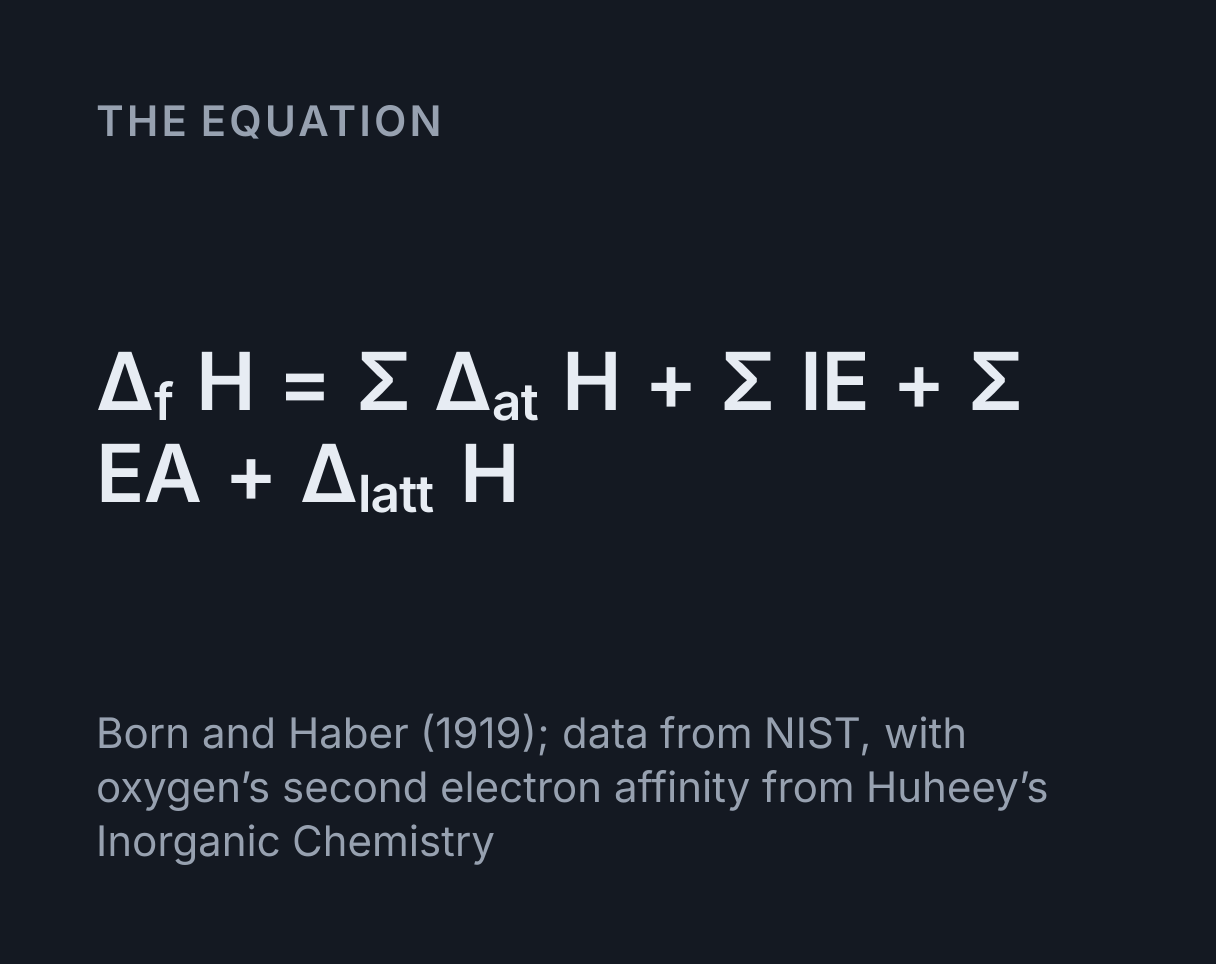
ΔfH = ΔatH(metal) + ΔatH(non-metal) + ΣIE + ΣEA + ΔlattH.
Max Born and Fritz Haber set it out in 1919, and Kasimir Fajans did so independently the same
year.
Every term except the lattice enthalpy can be measured, so the cycle is how lattice enthalpies
are found: ΔlattH = ΔfH − (ΔatH + ΣIE + ΣEA). Run
the other way, with a lattice enthalpy supplied, it gives the enthalpy of formation, which is how
the cycle shows why a compound such as NaCl₂ is never made.
Using the Born-Haber cycle calculator
Choose a salt and the calculator loads its data, finds the lattice enthalpy and draws the cycle. The drawing is to scale, so every arrow’s length is its enthalpy change: arrows pointing up take in energy, arrows pointing down give it out, and the heavier arrow is the value being calculated. The working under the drawing adds the steps one at a time, so each number can be checked against your own.
Every value can be edited, for instance to match the data an exam question gives. “Your own values” also sets the metal and non-metal symbols and the charges on the ions, for any salt, including ones that do not exist. The Find menu swaps the unknown: give it a lattice enthalpy and it returns the enthalpy of formation. On a narrow screen the levels are numbered, and the list under the drawing names them.
Lattice enthalpy: formation or dissociation?
Lattice enthalpy is defined two opposite ways, and its sign depends on which. The
lattice formation enthalpy is the enthalpy change when one mole of the solid
forms from its gaseous ions, so it is always negative. The
lattice dissociation enthalpy is the change when one mole of the solid breaks up
into gaseous ions: the same size, and always positive. For sodium chloride they are
−787.1 kJ/mol and +787.1 kJ/mol.
OCR, Edexcel and Cambridge International use the formation definition, AQA accepts either, and the IB uses dissociation, which is why its data booklet lists positive values. The calculator’s convention menu switches between the two: the lattice arrow turns round, the working is rewritten and the size stays the same.
Worked example: sodium chloride
The calculator opens on sodium chloride with NIST data. Making the gaseous ions takes four steps, and the lattice enthalpy is what is left:
- Atomise sodium,
Na(s) → Na(g):+107.5 kJ/mol. -
Atomise chlorine,
½Cl₂(g) → Cl(g):+121.3 kJ/mol, half the bond enthalpy of Cl₂. -
Ionise sodium,
Na(g) → Na⁺(g) + e⁻:+495.8 kJ/mol, which is NIST’s 5.13908 eV converted at 96.485 kJ/mol per eV. - Give chlorine the electron,
Cl(g) + e⁻ → Cl⁻(g):−348.6 kJ/mol. - Elements to gaseous ions:
107.5 + 121.3 + 495.8 − 348.6 = +376.0 kJ/mol. -
Hess’s law, with
ΔfH = −411.1 kJ/mol:ΔlattH = −411.1 − 376.0 = −787.1 kJ/mol.
So the ions give out 787.1 kJ/mol as they form the solid, more than twice the 376.0 kJ/mol it cost to make them, and the difference is the enthalpy of formation. That surplus is what makes the salt stable. It also explains why sodium stops at Na⁺. Its second electron would have to come from a full inner shell, as the electron configuration calculator shows, so sodium’s second ionisation energy is 4562.4 kJ/mol, more than nine times the first, and no lattice repays that.
Where the data come from
The salts share one table built from NIST reference data and rounded to 0.1 kJ/mol. Enthalpies of formation, of the salts and of the gaseous atoms, are those of the NIST Chemistry WebBook: the CODATA value where it lists one and the NIST-JANAF value otherwise. Ionisation energies come from the NIST Atomic Spectra Database and electron affinities from laser photodetachment measurements, both converted from electronvolts. Enthalpies of formation are themselves measured by calorimetry, the kind of experiment the calorimetry calculator works through.
The exception is oxygen’s second electron affinity, which MgO, CaO and Na₂O need. A free O²⁻ ion
is not stable, so the step cannot be measured and is itself worked out from cycles like this one,
and books disagree: the table uses +744 kJ/mol from Huheey’s Inorganic Chemistry,
while Chemguide gives +844 kJ/mol. The lattice enthalpy moves one for one, so with
Chemguide’s value magnesium oxide comes out at −3889.3 kJ/mol instead of
−3789.3 kJ/mol.
What this model leaves out
- Temperature corrections. Ionisation energies and electron affinities are
energies at absolute zero, while the other terms are enthalpies at 298 K. Strictly, each
electron removed adds about
5/2 RT, or 6.2 kJ/mol, and each electron added takes the same away, so in a neutral salt they cancel and the simple sum stands. - Lattice energy against lattice enthalpy. The cycle gives an enthalpy. The
lattice energy, an internal energy, is smaller in size by
nRTfor n moles of gaseous ions, which is 5.0 kJ/mol for sodium chloride at 298 K. - Covalent character. The cycle measures the real solid, whatever its bonding. A purely ionic model, built from the charges, the ion sizes and the crystal structure, agrees with it closely for the alkali metal halides and falls short for salts such as silver chloride, whose bonding is partly covalent.
- Entropy and equilibrium. Enthalpy alone does not decide whether a salt forms.
That takes
ΔG = ΔH − TΔS, which the Gibbs free energy calculator works out, and how far a reversible reaction goes is a matter for its equilibrium constant, which the ICE table calculator turns into concentrations. - Dissolving. Whether a salt dissolves depends on the hydration enthalpies of its ions as well as its lattice enthalpy, and those belong to a different cycle.
Common mistakes
- Using the whole bond enthalpy. NaCl needs one chlorine atom, half a Cl₂
molecule, so atomising chlorine is +121.3 kJ/mol, not the full bond enthalpy of
2 × 121.3 = 242.6 kJ/mol. - Forgetting to double. MgCl₂ holds two chloride ions, so chlorine’s atomisation
and electron affinity both count twice:
2 × (−348.6) = −697.2 kJ/mol. In Na₂O it is sodium’s steps that double. - Leaving out an ionisation energy. Making Mg²⁺ takes the first and the second:
737.7 + 1450.7 = 2188.4 kJ/mol. - Giving the second electron affinity a minus sign. Adding an electron to O⁻ takes in energy, because the ion repels it, so the value is positive.
- Treating bromine as a gas. Bromine is a liquid at 298 K, so its atomisation enthalpy, +111.9 kJ/mol, includes evaporating the liquid as well as breaking the bond.
- Mixing the conventions. A lattice dissociation enthalpy from one book, put into a cycle written for the formation definition, flips the sign of the answer.
Common questions
How do you calculate lattice enthalpy from a Born-Haber cycle?
Add up every step that turns the elements into gaseous ions, the atomisation of each element, the ionisation energies and the electron affinities, then subtract the total from the enthalpy of formation. For sodium chloride the steps come to 107.5 + 121.3 + 495.8 − 348.6 = +376.0 kJ/mol, so the lattice formation enthalpy is −411.1 − 376.0 = −787.1 kJ/mol.
Is lattice enthalpy positive or negative?
Either, depending on the definition. The lattice formation enthalpy, for gaseous ions coming together as a solid, is always negative; the lattice dissociation enthalpy, for the solid breaking up into gaseous ions, is the same size and always positive. Sodium chloride’s is −787.1 kJ/mol one way and +787.1 kJ/mol the other, so check which definition your course and your data book use before comparing numbers.
How do you do a Born-Haber cycle for CaCl₂?
Count every step per formula unit. One calcium atom is atomised and loses two electrons, so its first and second ionisation energies are both needed, and two chlorine atoms are atomised and each gains one, so chlorine’s steps count twice: 177.8 + 2 × 121.3 + 589.8 + 1145.4 + 2 × (−348.6) = +1458.4 kJ/mol. With an enthalpy of formation of −795.8 kJ/mol, the lattice formation enthalpy is −795.8 − 1458.4 = −2254.2 kJ/mol.
Why is the second electron affinity of oxygen positive?
Because the second electron is added to O⁻, which is already negative and repels it, so energy has to be put in. A free O²⁻ ion is not stable, so the value cannot be measured and is worked out from cycles like this one: Huheey’s Inorganic Chemistry gives +744 kJ/mol and Chemguide +844 kJ/mol. Oxide ions still exist in solids because the lattice more than repays the cost: magnesium oxide’s lattice formation enthalpy is −3789.3 kJ/mol.
Why is the lattice enthalpy of MgO so much larger than that of NaCl?
Its ions carry twice the charge, 2+ and 2− against 1+ and 1−, and they are smaller, so they attract each other far more strongly. The cycle gives −3789.3 kJ/mol for magnesium oxide against −787.1 kJ/mol for sodium chloride, nearly five times as much.
What is the difference between lattice energy and lattice enthalpy?
Lattice energy is strictly an internal energy change and lattice enthalpy an enthalpy change, and they differ by the work the gaseous ions do: for a solid breaking into n moles of gaseous ions, ΔH = ΔU + nRT. Sodium chloride gives two moles of ions, so the difference is 2RT, about 5.0 kJ/mol at 298 K, under 1 percent of its lattice enthalpy. That is why many books use the two names for the same thing.