Electron Configuration Calculator
Find the electron configuration of any element or ion, such as Fe3+ or O2−, in full and noble gas notation, with an orbital diagram and unpaired electrons.
Calculator
A symbol, name or atomic number, then any charge: Fe3+, Fe+3, Fe(III), iron 3+ and a pasted Fe³⁺ all work. Charges run from 4− to 8+.
Electron configuration of Fe³⁺, from iron (Z = 26), with 23 electrons
In full: 1s2 2s2 2p6 3s2 3p6 3d5
- Unpaired electrons
- 5
- Electrons
- 23
- Magnetism
- Paramagnetic
- Spin-only moment √(n(n + 2)) Bohr magnetons for n unpaired electrons. Close to measured moments for 3d ions; 4f ions add an orbital part it leaves out.
- 5.92 μB
- d-electron count The count used to describe this ion in its complexes, with its outer s and p subshells empty.
- d⁵
Orbital diagram
Each box is one orbital holding up to two electrons of opposite spin. Hund’s rule puts one electron in every orbital of a subshell before any pair up. Dashed boxes are subshells the ion has emptied.
Working, step by step
- Iron (Fe) has Z = 26, so the neutral atom has 26 electrons: [Ar] 3d6 4s2.
- electrons in Fe³⁺ = 26 − 3 = 23
- Electrons leave the outermost subshells first, the s and p of the highest shell, then the d below them, then the f: 2 from 4s and 1 from 3d.
- Fe³⁺: [Ar] 3d5, or in full 1s2 2s2 2p6 3s2 3p6 3d5
- Hund’s rule puts one electron in each orbital of a subshell before any orbital takes a second, so 3d5 has 5 unpaired.
- unpaired electrons = 5
- spin-only moment = √(5 × (5 + 2)) = 5.9161 μB
Citing this tool
Last updated . Add the date you accessed it as well, which a citation of a page that can change asks for. If a specific result matters, cite the permalink from the tool’s share row instead of this page: it reproduces the exact parameters.
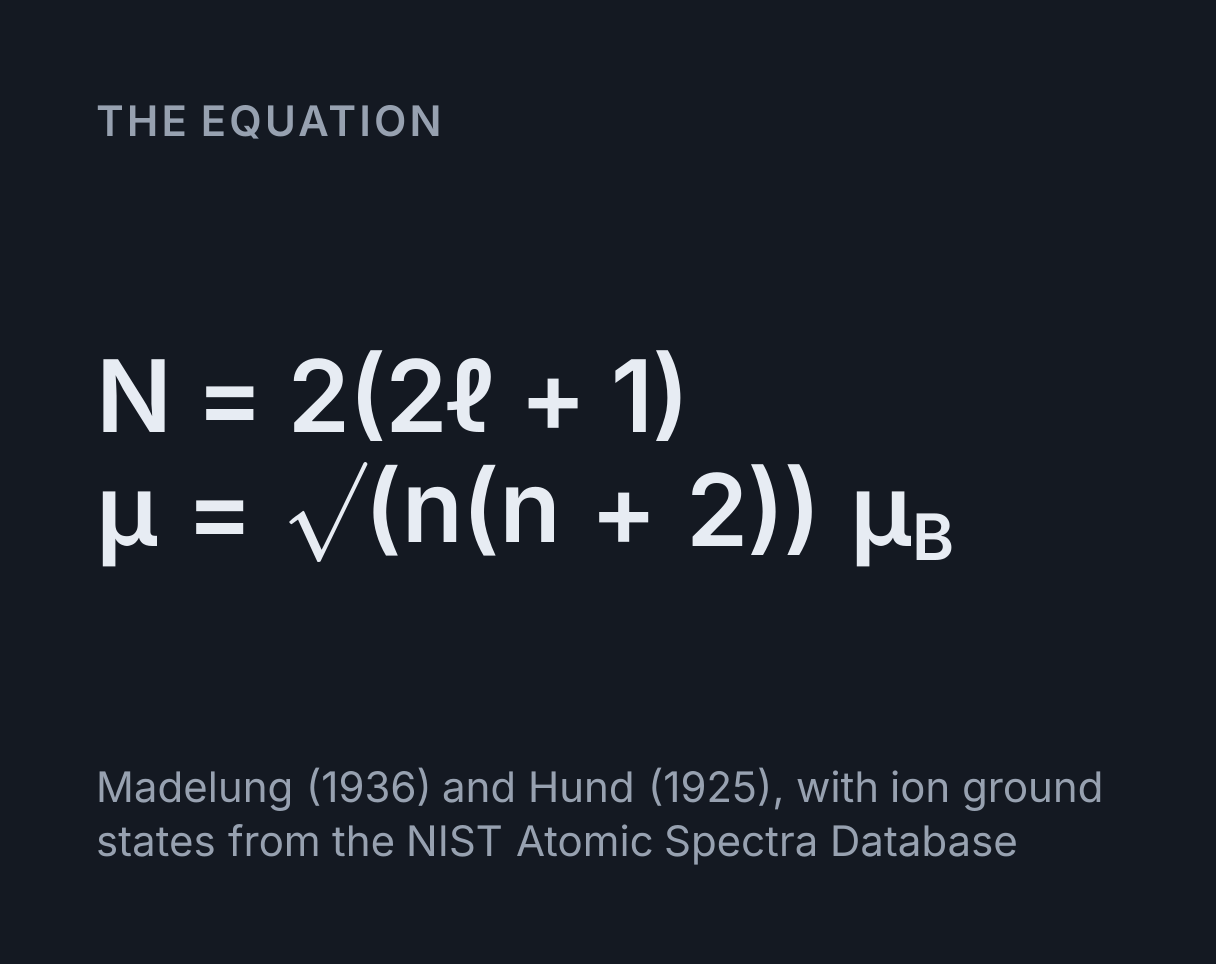
The equation
Madelung (1936) and Hund (1925), with ion ground states from the NIST Atomic Spectra Database
How to find an electron configuration
An electron configuration lists how many electrons occupy each subshell of an atom or ion.
Fill the subshells in order of increasing n + ℓ, the Madelung rule,
1s 2s 2p 3s 3p 4s 3d 4p 5s 4d 5p 6s 4f 5d 6p 7s 5f 6d 7p, putting at most
N = 2(2ℓ + 1) electrons in each: 2 in an s subshell, 6 in a p, 10 in a d and 14
in an f. For an ion, start from the neutral atom and take electrons away for a positive
charge or add them for a negative one. Iron is [Ar] 3d6 4s2, and Fe³⁺ is
[Ar] 3d5.
Type an element or an ion above, as a symbol, a name or an atomic number with any charge:
Fe3+, Cu+, O2-, Fe(III) or just
Cr. The calculator gives the configuration in noble gas notation and in full,
an orbital box diagram, the number of unpaired electrons, whether the species is
paramagnetic or diamagnetic, and the spin-only magnetic moment,
μ = √(n(n + 2)) μB for n unpaired electrons. The working underneath says
which electrons were removed or added, and from where.
Noble gas notation replaces the inner electrons with the symbol of the noble gas before
the element, in square brackets: [Ar] stands for
1s2 2s2 2p6 3s2 3p6, the 18 electrons of argon. Subshells are written in
order of shell, so iron is [Ar] 3d6 4s2 even though 4s fills first. Some
books write [Ar] 4s2 3d6, in filling order; the electrons are the same.
Positive ions: which electrons leave first
A positive ion loses its outermost electrons first, which are not always the last ones
in. For the transition metals the 4s electrons go before any 3d electron, so Fe²⁺ is
[Ar] 3d6, not [Ar] 3d4 4s2, and Cu²⁺ is [Ar] 3d9.
Once the 3d orbitals are occupied they lie below 4s in energy, and the 4s electrons,
which spend more of their time farther from the nucleus, are the first to be pulled away.
The filling order describes building up the atoms of the periodic table one element at a
time; it is not the order electrons leave any one atom.
The general form of the rule, and the one the calculator uses, is to remove electrons
from the s and p of the outermost shell first, p before s, then from the d subshell of
the shell below, then from the f below that. For tin that gives Sn²⁺ as
[Kr] 4d10 5s2, the 5p electrons gone and the 5s pair kept, and Sn⁴⁺ as
[Kr] 4d10. For gadolinium it takes the two 6s electrons, then the 5d
electron, leaving Gd³⁺ as [Xe] 4f7. Removing the electrons with the highest
n first, the way the rule is often worded for the d-block, fails for praseodymium,
[Xe] 4f3 6s2: it would take the third electron from 5p rather than 4f, when
Pr³⁺ is [Xe] 4f2, and most of the other lanthanides go the same way.
Negative ions: electrons added in filling order
A negative ion gains electrons into the next free places in the filling order, which for
the non-metals means the outer p subshell. Oxygen, 1s2 2s2 2p4, becomes
O²⁻, 1s2 2s2 2p6; chlorine becomes Cl⁻, [Ne] 3s2 3p6; nitrogen
becomes N³⁻, 1s2 2s2 2p6. Each has the configuration of the next noble gas,
so it is isoelectronic with it, and the calculator names that gas. It stops at the charge
that fills the p subshell, because one more electron would start a new shell.
An isolated O²⁻ or N³⁻ ion is not stable on its own: adding the second electron to O⁻
takes in energy rather than releasing it. These ions exist in ionic solids and in
solution, where the surrounding ions hold them together, and their configuration there is
the one given here. The calculator does not predict negative ions of the d- and
f-block metals or of group 2, where the extra electron does not follow the filling order:
Ca⁻, for one, is [Ar] 4s2 4p1, not [Ar] 3d1 4s2.
Worked example: the electron configuration of Fe³⁺
Iron has atomic number 26, so the neutral atom has 26 electrons:
1s2 2s2 2p6 3s2 3p6 3d6 4s2, or [Ar] 3d6 4s2. The 3+ charge
means three electrons fewer, 26 − 3 = 23. The two 4s electrons leave first,
then one 3d electron, which leaves [Ar] 3d5, or
1s2 2s2 2p6 3s2 3p6 3d5 in full.
The five 3d electrons go one into each of the five 3d orbitals, all with the same spin,
so Fe³⁺ has 5 unpaired electrons and is paramagnetic. Its spin-only moment is
μ = √(5 × 7) = √35 = 5.92 μB. Fe²⁺, with one electron more, is
[Ar] 3d6: the sixth electron pairs up in one orbital, leaving 4 unpaired.
Worked example: the oxide ion, O²⁻
Oxygen has atomic number 8, so O²⁻ has 8 + 2 = 10 electrons. The two extra
electrons complete the 2p subshell, giving 1s2 2s2 2p6, the configuration of
neon. Every orbital holds a pair, so the oxide ion has no unpaired electrons and is
diamagnetic. Na⁺, Mg²⁺, Al³⁺, F⁻ and N³⁻ share the same configuration, which is what
isoelectronic means.
The exceptions: chromium, copper and the ions the rule gets wrong
20 elements break the filling order in their ground state, all measured
except lawrencium’s, which comes from relativistic calculation.
Chromium is [Ar] 3d5 4s1 rather than [Ar] 3d4 4s2, and copper
is [Ar] 3d10 4s1 rather than [Ar] 3d9 4s2: moving one electron
from 4s into 3d leaves the d subshell half full or completely full, and that arrangement
is the lower in energy. Palladium, [Kr] 4d10, has no 5s electron at all.
The calculator uses the ground-state configuration and says what the filling order would
have given. The chromium and
copper pages explain each one.
Ions have exceptions of their own. Checked against every ion from 1+ to 8+ of elements 1
to 103 in the NIST Atomic Spectra Database, the removal rule gives the listed ground
state for all but 87. The ones a student might meet are the 1+ ions of
vanadium, cobalt and nickel, which keep all their electrons in 3d: V⁺ is
[Ar] 3d4, Co⁺ is [Ar] 3d8 and Ni⁺ is [Ar] 3d9,
not the 3d3 4s1, 3d7 4s1 and 3d8 4s1 the rule gives. For those the calculator shows the
measured ion and prints the rule’s answer beside it, since a question that asks you to
apply the rule is asking for the rule’s answer.
Orbital diagrams, Hund’s rule and unpaired electrons
An orbital diagram draws each orbital as a box holding up to two electrons of opposite
spin: one box for s, three for p, five for d and seven for f. Hund’s rule fills them
the way electrons actually settle: one electron into every box of a subshell, all with
the same spin, before any box takes a second. So a subshell with e electrons in m
orbitals has e unpaired electrons while it is at most half full and 2m − e
after that: 3d6 has 4 unpaired and 3d8 has 2.
Any unpaired electron makes an atom or ion paramagnetic, drawn into a magnetic field; with every electron paired it is diamagnetic. The spin-only formula turns the count into a magnetic moment, 1.73 μB for one unpaired electron, 2.83 for two, 3.87 for three, 4.90 for four and 5.92 for five. It is close to the measured moments of most 3d ions. For the lanthanide ions it is not, because their 4f electrons carry orbital motion that the formula leaves out.
Valence electrons
For the s- and p-block the valence electrons are the electrons in the outer shell: oxygen has 6, sodium has 1 and bromine has 7, which is also the count the VSEPR geometry of a molecule starts from. For the transition metals there is no single agreed number, because the 3d electrons take part in bonding as well as the 4s, so the calculator does not print one. For a d- or f-block cation it gives the dⁿ or fⁿ count instead, the number used to describe the ion in its compounds: d5 for Fe³⁺, d10 for Zn²⁺, f7 for Gd³⁺.
What this does not cover
- Ions in complexes. Ligands split the d orbitals, and a strong-field ligand can pair electrons up: Fe³⁺ has 5 unpaired electrons as a free ion but only 1 in [Fe(CN)₆]³⁻. The configurations here are those of the free ion.
- Excited states, term symbols and the fine structure of levels within a configuration.
- Elements above 103, whose configurations are predicted by the filling order rather than measured.
- Negative ions of the d- and f-block metals and of group 2, which the filling order does not predict, and group 13 anions beyond 1−, which would stop part way to the next noble gas.
Common mistakes
- Taking electrons from 3d before 4s, and writing Fe²⁺ as
[Ar] 3d4 4s2. - Counting the charge the wrong way: Fe³⁺ has 23 electrons, not 29.
- Forgetting the exceptions and writing chromium as
[Ar] 3d4 4s2. - Pairing electrons in one orbital while another orbital of the same subshell is empty.
-
Using a noble gas as its own core: argon is
[Ne] 3s2 3p6, not[Ar].
Sources
Neutral atoms follow the configurations on this site’s element pages, which carry the measured exceptions; the periodic table shows where each block begins. Ion ground states are checked against the NIST Atomic Spectra Database, version 5.12 (Kramida, Ralchenko, Reader and the NIST ASD Team, 2024). To see how the outer electrons set the chemistry, follow them into ionisation energy across the table, or into the ions of the polyatomic ions list.
Common questions
What is the electron configuration of Fe3+?
Fe³⁺ is [Ar] 3d5, or 1s2 2s2 2p6 3s2 3p6 3d5 in full. Iron is [Ar] 3d6 4s2 with 26 electrons, and Fe³⁺ has 23: both 4s electrons leave first, then one 3d electron. The five 3d electrons sit one in each 3d orbital, so Fe³⁺ has 5 unpaired electrons and a spin-only magnetic moment of √35 = 5.92 Bohr magnetons.
Why are 4s electrons removed before 3d electrons?
Because the 4s electrons are the outermost. Once the 3d orbitals of a transition metal are occupied they lie below 4s in energy, and the 4s electrons, which spend more of their time farther from the nucleus, are the first to go. So Fe²⁺ is [Ar] 3d6, not [Ar] 3d4 4s2. The filling order, in which 4s comes before 3d, describes building up the elements one after another, not the order electrons leave an atom.
How do you find the number of unpaired electrons?
Fill each subshell by Hund’s rule and count the single electrons. Every orbital of a subshell takes one electron before any takes a second, so a subshell with e electrons in m orbitals has e unpaired while it is at most half full and 2m − e after that. 3d5 has 5 unpaired, 3d6 has 4, 3d8 has 2 and 2p6 has none. Any unpaired electron makes the atom or ion paramagnetic.
What is noble gas notation?
It is an electron configuration with the inner electrons written as the previous noble gas in square brackets. Iron, 1s2 2s2 2p6 3s2 3p6 3d6 4s2 in full, is [Ar] 3d6 4s2, because [Ar] stands for argon’s 18 electrons. The core is always the noble gas before the element, so argon itself is written [Ne] 3s2 3p6.
Why is chromium [Ar] 3d5 4s1 and not [Ar] 3d4 4s2?
Because that is its measured ground state: moving one electron from 4s into 3d leaves the 3d subshell half full, and that arrangement is the lower in energy. Copper does the same to fill 3d completely, [Ar] 3d10 4s1. They are two of about twenty elements whose configuration breaks the filling order, and the calculator gives the ground state of each rather than the filling order’s prediction.
Why does the calculator give Co+ as [Ar] 3d8?
Because that is the ground state of the free Co⁺ ion in the NIST Atomic Spectra Database. The usual removal rule gives [Ar] 3d7 4s1, and the two configurations lie close in energy. The calculator shows the measured one and prints the rule’s answer beside it, so a question that asks you to apply the rule can still be answered with the rule.