Crystal Field Splitting Visualiser
Draw a crystal field splitting diagram for octahedral, tetrahedral or square planar complexes, see high or low spin, and read CFSE and unpaired electrons.
Visualiser
The left and right arrow keys change the d count, up and down change Δo by 500 cm⁻¹, and Page Up and Page Down by 5000 cm⁻¹.
[Fe(H₂O)₆]²⁺. Octahedral crystal field splitting diagram for d6: the t2g level at −0.4Δo holds four electrons and the eg level at +0.6Δo holds two electrons. High spin, with four unpaired electrons. Δo = 10,400 cm⁻¹ is less than P = 17,600 cm⁻¹, so an electron costs less in eg than paired in t2g: high spin.
- Spin state Δo = 10,400 cm⁻¹ is less than P = 17,600 cm⁻¹, so an electron costs less in eg than paired in t2g: high spin.
- High spin
- Configuration Electrons in each level from the bottom up: four in t2g (dxy, dxz and dyz) and two in eg (dz² and dx²−y²).
- t2g⁴ eg²
- Unpaired electrons Four unpaired electrons make the complex paramagnetic.
- 4
- Spin-only moment μ = √(n(n + 2)) μB with n = 4: √24 = 4.899 μB. Measured moments run higher where orbital motion adds to the spin.
- 4.899 μB
- CFSE 4 × (−0.4) + 2 × (+0.6) = −0.4Δo, counting each electron at its level’s energy.
- −0.4 Δo
- CFSE with pairing P counts once for each pair beyond the free ion’s: this arrangement has one pair and the free ion one pair, so no P term.
- −0.4Δo
- In wavenumbers −0.4 × 10,400 = −4160 cm⁻¹, measured from the free ion, so a negative value is a stabilisation.
- −4160 cm⁻¹
- Per mole 1 cm⁻¹ is 11.96 J/mol, the product h × c × N_A, so −4160 cm⁻¹ is −49.76 kJ/mol.
- −49.76 kJ/mol
- Splitting Δo Measured from the absorption spectrum of [Fe(H₂O)₆]²⁺, as tabulated by Shriver, Atkins and Langford, Inorganic Chemistry, 2nd edition (1994).
- 10,400 cm⁻¹
- Other spin state Low spin, t2g⁶ eg⁰, would come to −2.4Δo + 2P = +10,240 cm⁻¹, 14,400 cm⁻¹ above the arrangement shown.
- +14,400 cm⁻¹
[Fe(H₂O)₆]²⁺: Δo 10,400 cm⁻¹ from its absorption spectrum, as tabulated by Shriver, Atkins and Langford, Inorganic Chemistry, 2nd edition (1994). P 17,600 cm⁻¹ is for the free Fe²⁺ ion, from Miessler, Fischer and Tarr, Inorganic Chemistry, 5th edition (2014).
- High spin, 4 unpaired
- Low spin, 0 unpaired
- Drawn above
Citing this tool
Last updated . Add the date you accessed it as well, which a citation of a page that can change asks for. If a specific result matters, cite the permalink from the tool’s share row instead of this page: it reproduces the exact parameters.
The equation
Bethe (1929) and Van Vleck (1932), crystal field theory
What is a crystal field splitting diagram?
A crystal field splitting diagram shows how the five d orbitals of a transition metal ion, which share
one energy in the free ion, separate into sets of different energy when ligands surround it. In an
octahedral complex the three orbitals that point between the ligands, dxy, dxz and
dyz, fall to −0.4Δo and are called t2g. The two that point straight
at the ligands, dz² and dx²−y², rise to +0.6Δo and are called
eg. The gap between the two sets is the octahedral splitting, Δo, and their
average, the barycentre, stays where it was: 3 × (−0.4) + 2 × (+0.6) = 0.
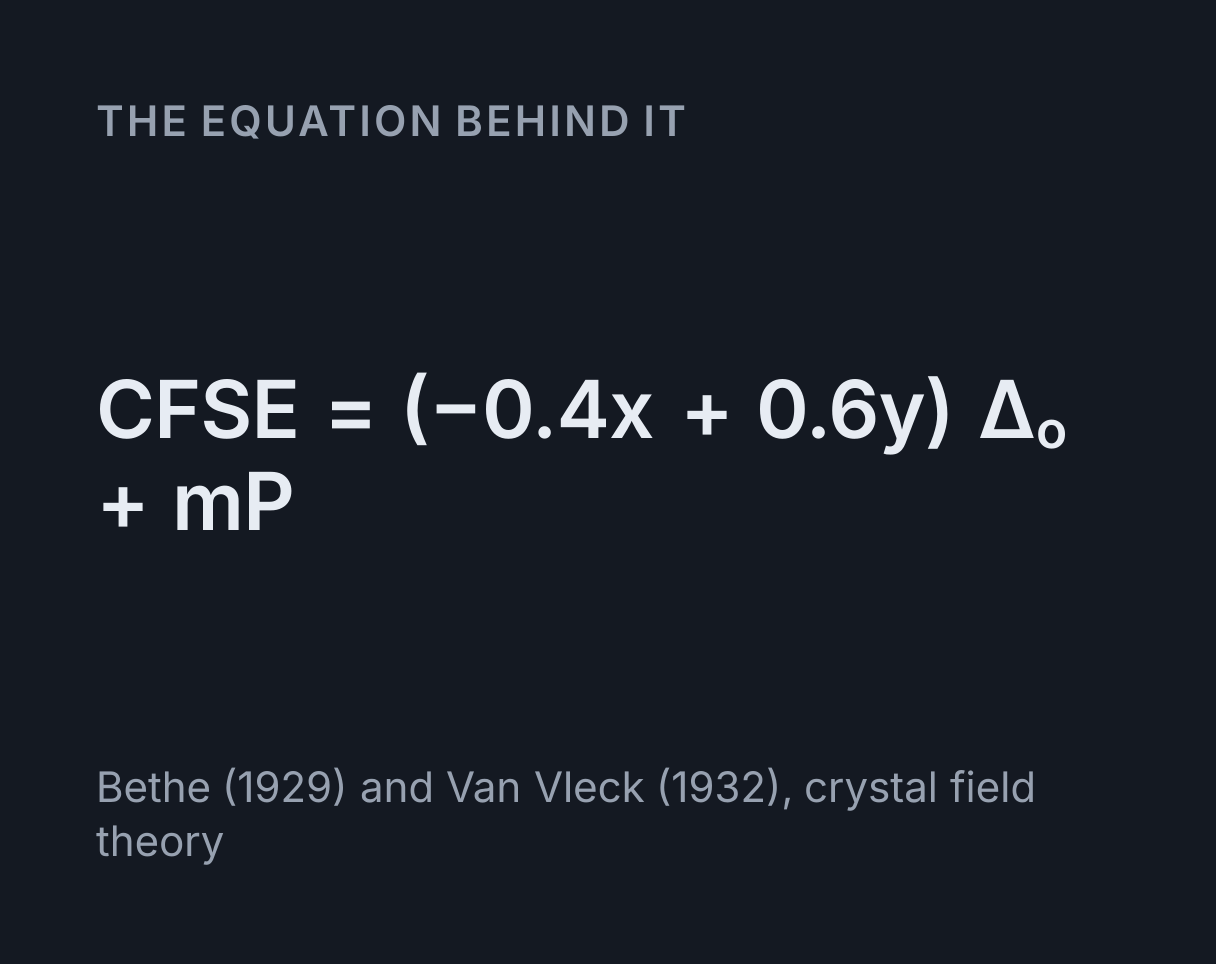
The d electrons then fill the levels, and the crystal field stabilisation energy, CFSE, is the energy they gain against the free ion:
CFSE = (−0.4x + 0.6y)Δo + mP
Here x is the number of electrons in t2g, y the number in eg, P the pairing energy and m the number of electron pairs beyond those the free ion already has. A negative CFSE is a stabilisation. The visualiser above draws the split levels to scale for octahedral, tetrahedral and square planar complexes, fills them with electrons, decides between high and low spin, and reads out the CFSE, the unpaired electrons and the spin-only magnetic moment. The theory goes back to Hans Bethe’s 1929 paper on ions in crystals and to John Van Vleck’s work on their magnetism in 1932.
Octahedral, tetrahedral and square planar splitting
Which orbitals rise depends on where the ligands sit, since an electron in an orbital pointing at a ligand is pushed up by it:
- Octahedral, six ligands on the x, y and z axes: t2g at −0.4Δo and eg at +0.6Δo.
- Tetrahedral, four ligands at alternate corners of a cube: the pattern turns over,
with e (dz², dx²−y²) at −0.6Δt and t2 (dxy,
dxz, dyz) at +0.4Δt. For the same metal, ligands and distance,
Δt = (4/9)Δo: there are four ligands instead of six, and none points straight at any orbital. The labels lose their g because a tetrahedron has no centre of symmetry. - Square planar, four ligands on the x and y axes: dx²−y² points at all four and rises far above the rest. In the point-charge model of Krishnamurthy and Schaap (1969), dxz and dyz sit at −0.514Δo, dz² at −0.428Δo, dxy at +0.228Δo and dx²−y² at +1.228Δo. The gap from dxy up to dx²−y², which the visualiser calls Δ1, is exactly Δo, and the whole spread is 1.742Δo.
The shapes are the ones the VSEPR Molecular Geometry tool builds in three dimensions, and the Atomic Orbitals Visualiser shows which d orbital lobes point at the ligands and which point between them.
High spin or low spin: the splitting against the pairing energy
For d¹ to d³ in an octahedron the electrons go into t2g one to an orbital. The fourth has a
choice. It can go up into eg at a cost of Δo, or pair with an electron already
in t2g at a cost of the pairing energy P, the extra repulsion of two electrons sharing one
orbital together with the exchange energy they lose. If Δo < P it goes up and the
complex is high spin; if Δo > P it pairs and the complex is low spin. The same
comparison settles d⁵, d⁶ and d⁷, so in an octahedron the choice exists for d⁴ to d⁷ only. From d⁸
on, t2g is full and the rest must go into eg whatever Δo is.
The pairing term counts only the pairs beyond those the free ion has under Hund’s rule. High-spin
d⁶, t2g⁴eg², has one pair, like the free ion, so its CFSE is simply
−0.4Δo. Low-spin d⁶, t2g⁶, has three pairs, so it is −2.4Δo + 2P.
The two differ by 2(Δo − P), which changes sign exactly where Δo equals P, and
low-spin d⁶, with t2g full, has the largest CFSE of any octahedral arrangement. In a tetrahedron the choice
exists for d³ to d⁶ and turns on Δt against P.
Using the visualiser
Choose a complex from the list, or set your own geometry, d electron count, Δo and P. A complex sets all four from measured data: Δo from its absorption spectrum, as tabulated by Shriver, Atkins and Langford (1994), and, where its d count leaves a choice of spin, the pairing energy of the free metal ion, from Miessler, Fischer and Tarr (2014). The Weaker ligand and Stronger ligand buttons step the same metal ion along the spectrochemical series, and moving any slider takes you back to your own values.
The d electron count of an ion is its group number less its charge: iron is in group 8, so Fe²⁺ is d⁶. The Periodic Table gives the group of every metal. The Electron arrangement menu can force either limit, so you can read the CFSE of an arrangement that is not the lowest, and the readouts then say how far above the lowest it sits. With the diagram focused, the left and right arrow keys change the d count, the up and down keys move Δo by 500 cm⁻¹, and Page Up and Page Down move it by 5000 cm⁻¹.
Reading the diagram and the readouts
Each orbital is a short bar at its energy, and each electron a half arrow, up or down for its spin. On a wide screen the free ion appears on the left, five bars at the barycentre filled by Hund’s rule. The coloured bracket is the splitting, and in the tetrahedral view a dashed one shows the Δo the same ligands would give in an octahedron. Under the diagram, bars set the splitting against P.
- Spin state is high spin, low spin, intermediate spin, or one arrangement where the d count leaves no choice.
- CFSE is in units of the geometry’s own splitting, Δt for a tetrahedron, and CFSE with pairing adds the P term. In wavenumbers and Per mole put numbers to it, at 11.96 J/mol for each cm⁻¹.
- Spin-only moment is
μ = √(n(n + 2)) μBfor n unpaired electrons. - Other spin state is how far the alternative lies above the arrangement drawn.
The plot under the diagram draws the energy of each possible arrangement against Δo as a straight line. Low spin starts higher, by its extra pairing energy, and falls faster, so the lines cross where the spin changes, and the dot marks the arrangement drawn.
Worked example: [Fe(H₂O)₆]²⁺ and [Fe(CN)₆]⁴⁻
The visualiser opens on hexaaquairon(II), with Δo = 10,400 cm⁻¹ and the free Fe²⁺ pairing energy P = 17,600 cm⁻¹:
- Iron is in group 8, so Fe²⁺ has
8 − 2 = 6d electrons. - Δo is less than P, so the fifth and sixth electrons go up into eg rather than pair: t2g⁴eg², with four unpaired electrons.
-
CFSE = 4 × (−0.4) + 2 × (+0.6) = −0.4Δo, with no P term, since high-spin d⁶ has one pair, as the free ion does. - In numbers,
−0.4 × 10,400 = −4160 cm⁻¹, which is −49.76 kJ/mol. -
Low spin would come to
−2.4 × 10,400 + 2 × 17,600 = +10,240 cm⁻¹, which is 14,400 cm⁻¹ higher,2 × (17,600 − 10,400). -
The spin-only moment is
√(4 × 6) = 4.899 μB. High-spin octahedral iron(II) measures 5.1 to 5.7 μB, a little more, because orbital motion adds to the spin.
Now press Stronger ligand. Cyanide gives Δo = 32,800 cm⁻¹, well above P, and all six electrons pair in t2g:
-
CFSE = −2.4Δo + 2P = −2.4 × 32,800 + 2 × 17,600 = −43,520 cm⁻¹, or −520.6 kJ/mol. - High spin would sit 30,400 cm⁻¹ higher, and with no unpaired electrons [Fe(CN)₆]⁴⁻ is diamagnetic.
The spectrochemical series
Ligands can be put in order of the splitting they give. Ryutaro Tsuchida set the series out in 1938 from the absorption spectra of cobalt(III) complexes, and a common short form of it is:
I⁻ < Br⁻ < Cl⁻ < F⁻ < OH⁻ < H₂O < NH₃ < en < bipy < phen < NO₂⁻ < CN⁻ < CO
The weak end is the halides and other π donors, whose filled p orbitals push t2g up and close the gap. The strong end is π acceptors such as CN⁻ and CO, which draw t2g down and widen it. The point-charge picture cannot explain that order, since in it neutral CO could never outrank an anion. The measured values in the list follow it: for chromium(III), Δo rises from 13,000 cm⁻¹ with Cl⁻ to 17,400 with H₂O, 21,500 with NH₃ and 26,600 with CN⁻.
The metal matters as well. Δo grows with the charge on the ion, from 10,400 to 14,300 cm⁻¹ for hexaaqua iron going from Fe²⁺ to Fe³⁺ and from 8500 to 21,000 cm⁻¹ for manganese. It grows down a group too: 22,900 cm⁻¹ for [Co(NH₃)₆]³⁺, 34,000 for [Rh(NH₃)₆]³⁺ and 41,000 for [Ir(NH₃)₆]³⁺. Together with their smaller pairing energies, that is why 4d and 5d complexes are nearly always low spin. Cobalt(III) shows the series deciding the spin: [CoF₆]³⁻, at 13,000 cm⁻¹, is high spin against P = 21,000 cm⁻¹, while [Co(NH₃)₆]³⁺, only 1900 cm⁻¹ above P, is low spin and diamagnetic.
Why tetrahedral complexes are high spin
With Δt = (4/9)Δo, a tetrahedral splitting rarely exceeds the pairing energy, so
tetrahedral complexes are almost always high spin. The cobalt(II) halides in the
list show it: Δt is 2700 cm⁻¹ for [CoI₄]²⁻, 2900 for [CoBr₄]²⁻ and 3300 for [CoCl₄]²⁻, in
spectrochemical order, against 22,500 cm⁻¹ for the pairing energy of free Co²⁺. For [CoCl₄]²⁻ the
visualiser sets the Δo slider to 7425 cm⁻¹, the 9/4 × 3300 that the 4/9 rule implies.
Cobalt(II) is d⁷, e⁴t2³ in a tetrahedron, with three unpaired electrons and a CFSE of
4 × (−0.6) + 3 × (+0.4) = −1.2Δt. That is −3960 cm⁻¹ for the chloride, or
−0.5333Δo. Its spin-only moment is 3.873 μB, and tetrahedral cobalt(II) complexes measure
4.2 to 4.8 μB.
Square planar d⁸ complexes
In a square planar field dx²−y² points straight at all four ligands and sits Δ1
above dxy, which the point-charge model makes equal to Δo. Eight d electrons
fill the four lower orbitals exactly, so once Δ1 passes P the last two pair in
dxy and dx²−y² stays empty. The CFSE is then
4 × (−0.514) + 2 × (−0.428) + 2 × (+0.228) = −2.456Δo, plus P for the one pair beyond the
free ion’s three. Every electron is paired, which is why [Ni(CN)₄]²⁻, [PdCl₄]²⁻, [PtCl₄]²⁻ and
[AuCl₄]⁻ are diamagnetic. Nearly all 4d and 5d d⁸ complexes with four ligands are square planar,
while nickel(II) with chloride is tetrahedral instead: [NiCl₄]²⁻ has two unpaired electrons.
With d⁴, d⁵ or d⁶ in the square planar field, the unevenly spread levels give an intermediate spin over a range of Δo. For d⁵ at P = 17,600 cm⁻¹, five unpaired electrons give way to three at Δo = 10,100 cm⁻¹, and three give way to one at 23,720 cm⁻¹.
Magnetic moments: spin-only and measured
Unpaired electrons make a complex paramagnetic, and counting them by a magnetic measurement is how high
and low spin are told apart in the laboratory. The spin-only moment μ = √(n(n + 2)) μB
gives 1.732, 2.828, 3.873, 4.899 and 5.916 μB for one to five unpaired electrons. Measured moments are
often higher, because the electrons’ orbital motion adds to their spin: octahedral high-spin cobalt(II)
complexes such as [Co(H₂O)₆]²⁺ measure 4.3 to 5.2 μB against a spin-only 3.873. A moment near zero
means every electron is paired, as in [Co(NH₃)₆]³⁺ and [Fe(CN)₆]⁴⁻.
What this model leaves out
- Covalent bonding. Crystal field theory treats the ligands as point charges, which cannot explain why neutral CO splits the d orbitals more than F⁻ does. Ligand field and molecular orbital theory can, by letting the ligand orbitals mix with the metal’s, and the Molecular Orbital Diagram Visualiser builds that kind of diagram for small molecules. The measured Δo values already contain those effects.
- A smaller pairing energy in the complex. The pairing energies are free-ion values. In a complex the d electrons spread onto the ligands, the nephelauxetic effect, and P falls, so a complex close to its crossover can be low spin where the free-ion P predicts high spin.
- Jahn-Teller distortion. High-spin d⁴, low-spin d⁷ and d⁹ ions have an odd number of electrons in eg, and their complexes distort, usually by lengthening two opposite bonds, which splits eg further. [Mn(H₂O)₆]³⁺ and copper(II) complexes do this.
- Absorption energies. For a single d electron the absorption band sits at Δo itself, so [Ti(H₂O)₆]³⁺, at 20,300 cm⁻¹, absorbs near 493 nm and looks violet. With more electrons, repulsion between them shifts and splits the bands, and Tanabe-Sugano diagrams are needed to read Δo from a spectrum.
- The order of the lower square planar levels. It is a result of the model. Point charges put dxy above dz², while other models and real ligands can swap them or move dz² lower still, as Börgel, Campbell and Ritter (2016) review. For d⁸ the order makes no difference, because the four lower orbitals are full.
- The choice of geometry. The visualiser draws the geometry you pick, while a real complex settles its own through CFSE, the size of its ligands and more.
Common mistakes
- Counting d electrons from the neutral atom. Iron is 3d⁶4s², but Fe²⁺ is 3d⁶ and Fe³⁺ is 3d⁵, because an ion loses its 4s electrons first. The Electron Configuration Calculator writes out the ion’s configuration.
- Using the octahedral pattern for a tetrahedron. The levels turn over, with e below t2, and the splitting is Δt, about 4/9 of Δo.
- Charging P for every pair. Only pairs beyond the free ion’s count, so low-spin d⁶ is −2.4Δo + 2P, not + 3P. Some books add every pair instead; the comparison between spin states comes out the same either way, since the free ion’s pairs appear on both sides.
- Looking for a spin choice in d³ or d⁸. In an octahedron only d⁴ to d⁷ have one, and in a tetrahedron only d³ to d⁶.
- Dropping the sign. A CFSE of −0.4Δo means 0.4Δo below the free ion. Tables that list it as 0.4 are giving the size of the stabilisation, not a destabilisation.
Common questions
How do you draw a crystal field splitting diagram?
Start with the five d orbitals at one energy, then split them for the geometry. In an octahedral field dxy, dxz and dyz (t2g) fall to −0.4Δo and dz² and dx²−y² (eg) rise to +0.6Δo; in a tetrahedral field the pattern turns over and shrinks, with e at −0.6Δt, t2 at +0.4Δt and Δt about 4/9 of Δo. Count the d electrons as group number less charge, fill the lower set one electron per orbital, and before pairing any compare Δ with the pairing energy P: if Δ is smaller the next electron goes up, and if it is larger the electron pairs. [Fe(H₂O)₆]²⁺, d⁶ with Δo = 10,400 cm⁻¹ and P = 17,600 cm⁻¹, comes out t2g⁴ eg² with four unpaired electrons.
What is the difference between high spin and low spin complexes?
A high-spin complex keeps as many unpaired electrons as it can, because its splitting Δ is smaller than the pairing energy P, while a low-spin complex pairs electrons in the lower orbitals because Δ is larger than P. In an octahedron the choice only arises for d⁴ to d⁷. Iron(II) shows both: [Fe(H₂O)₆]²⁺, with Δo = 10,400 cm⁻¹ against P = 17,600 cm⁻¹, is high spin with four unpaired electrons and a spin-only moment of 4.899 μB, while [Fe(CN)₆]⁴⁻, with Δo = 32,800 cm⁻¹, is low spin and diamagnetic.
How do you calculate crystal field stabilisation energy?
Add −0.4Δo for each t2g electron and +0.6Δo for each eg electron, then add the pairing energy P once for each pair beyond those the free ion has. Low-spin d⁶, t2g⁶, gives 6 × (−0.4) = −2.4Δo, plus 2P, because it has three pairs and the free ion one. For [Fe(CN)₆]⁴⁻ that is −2.4 × 32,800 + 2 × 17,600 = −43,520 cm⁻¹, or −520.6 kJ/mol. For a tetrahedral complex count −0.6Δt for each e electron and +0.4Δt for each t2 electron.
Why is tetrahedral splitting smaller than octahedral splitting?
A tetrahedral complex has four ligands instead of six, and none points straight at a d orbital: they sit between the axes, nearer the lobes of dxy, dxz and dyz than those of dz² and dx²−y². In the point-charge model that makes Δt = (4/9)Δo for the same metal, ligands and distance. So small a splitting rarely beats the pairing energy, which is why tetrahedral complexes are almost always high spin: [CoCl₄]²⁻ has Δt = 3300 cm⁻¹, against 22,500 cm⁻¹ for the pairing energy of free Co²⁺.
What is the spectrochemical series?
It is the order of ligands by the splitting Δ they produce, first set out by Ryutaro Tsuchida in 1938 from the spectra of cobalt(III) complexes. A common short form is I⁻ < Br⁻ < Cl⁻ < F⁻ < OH⁻ < H₂O < NH₃ < en < bipy < phen < NO₂⁻ < CN⁻ < CO. The halides and other π donors sit at the weak end and π acceptors such as CN⁻ and CO at the strong end. For chromium(III) the measured Δo rises from 13,000 cm⁻¹ with Cl⁻ to 17,400 with H₂O, 21,500 with NH₃ and 26,600 with CN⁻.
Why are square planar d⁸ complexes diamagnetic?
In a square planar field dx²−y² points straight at the four ligands and lies far above the other four d orbitals, Δo above dxy in the point-charge model. Eight d electrons fill those four lower orbitals exactly, so once that gap exceeds the pairing energy every electron is paired and dx²−y² stays empty. That is why [Ni(CN)₄]²⁻, [PdCl₄]²⁻, [PtCl₄]²⁻ and [AuCl₄]⁻ are diamagnetic. Their CFSE in this model is −2.456Δo + P.