Molecular Orbital Diagram Visualiser
Draw the molecular orbital diagram of H2 to Ne2, CO, NO and their ions, with s-p mixing, bond order, unpaired electrons, HOMO and LUMO marked.
Visualiser
With the diagram focused, the left and right arrow keys step through the molecules, and the up and down arrow keys add and remove an electron.
Molecular orbital diagram of O₂ with 12 valence electrons. Electrons in each level from the lowest up: σ2s 2; σ*2s 2; σ2p 2; π2p 4; π*2p 2, 2 unpaired; σ*2p empty. HOMO π*2p, LUMO σ*2p. Bond order 2, paramagnetic, with 2 unpaired.
Configuration O₂: KK (σ2s)² (σ*2s)² (σ2p)² (π2p)⁴ (π*2p)²
KK is the two atoms’ filled 1s shells, σ1s² σ*1s², which cancel in the bond order.
- Bonding orbital
- Antibonding orbital
- Unpaired electron
- Bond order ½(bonding − antibonding) = ½(8 − 4) = 2. The 1s core adds two bonding and two antibonding electrons, which cancel.
- 2
- Magnetism At least one electron is unpaired, so the molecule is drawn into a magnetic field.
- Paramagnetic
- Unpaired electrons Hund’s rule puts the two π*2p electrons in separate orbitals with parallel spins rather than pairing them.
- 2
- Valence electrons O₂ has 16 electrons: 12 in levels from 2s and 2p, and 4 in the two 1s cores.
- 12
- Bonding electrons Valence electrons in σ2s, σ2p and π2p, the levels that lie below the atomic orbitals they come from.
- 8
- Antibonding electrons Valence electrons in σ*2s, π*2p and σ*2p, the levels that lie above their atomic orbitals and weaken the bond.
- 4
- HOMO The highest occupied molecular orbital. In this picture its electrons are the most loosely held. It is a degenerate pair holding 2 electrons, with 2 unpaired.
- π*2p
- LUMO The lowest unoccupied molecular orbital: the lowest orbital with no electron in it. An added electron would go into π*2p, which still has room, rather than into σ*2p.
- σ*2p
- Measured bond length The equilibrium bond length of O₂ measured by spectroscopy, from Huber and Herzberg (1979), to the nearest picometre.
- 121 pm
- Orbital order The usual order from O₂ to Ne₂, where the 2s to 2p gap is too wide for s-p mixing to lift σ2p above π2p.
- σ2p below π2p
- Bond order
- Unpaired, π2p below σ2p
- Unpaired, σ2p below π2p
Citing this tool
Last updated . Add the date you accessed it as well, which a citation of a page that can change asks for. If a specific result matters, cite the permalink from the tool’s share row instead of this page: it reproduces the exact parameters.
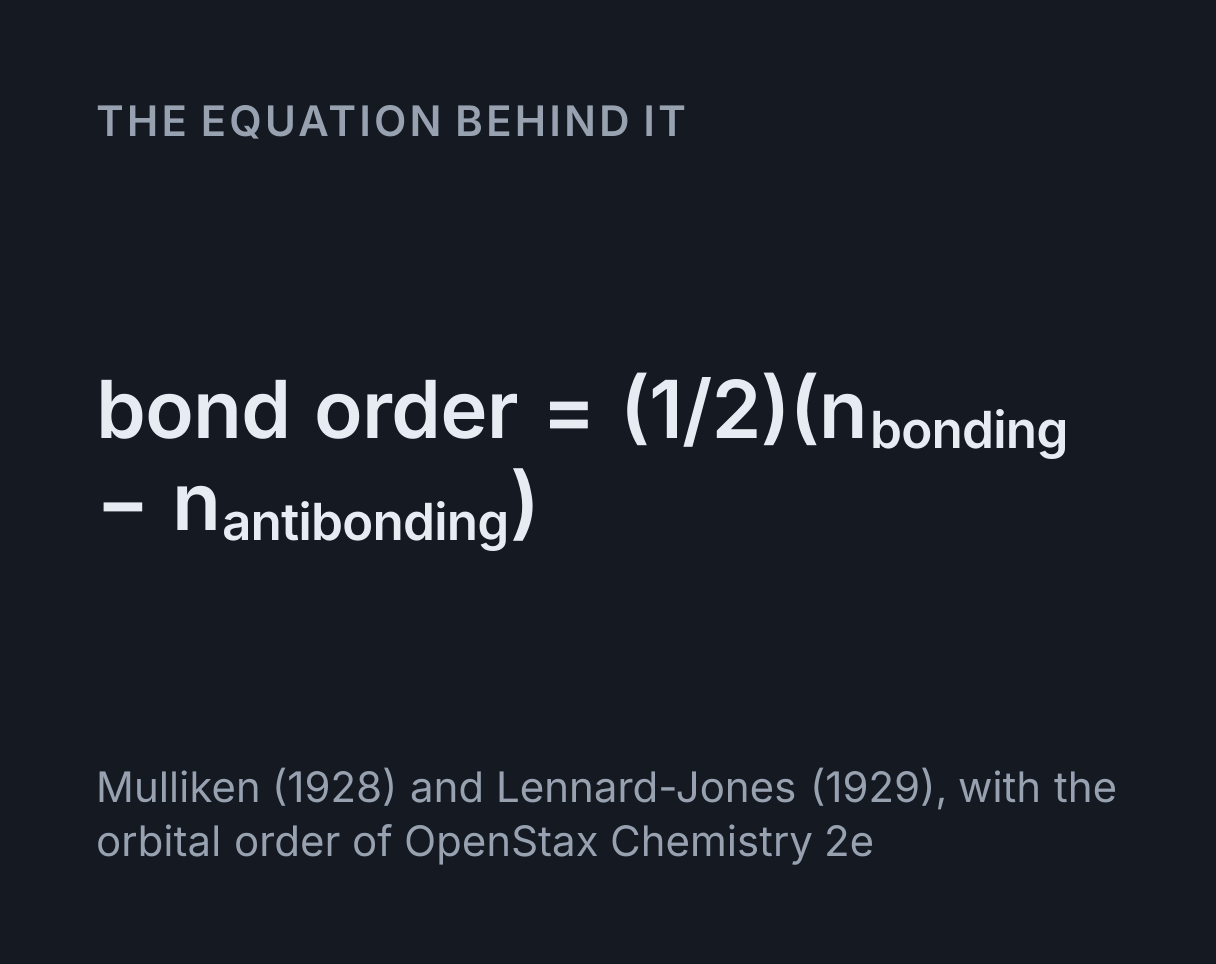
The equation
Mulliken (1928) and Lennard-Jones (1929), with the orbital order of OpenStax Chemistry 2e
What is a molecular orbital diagram?
A molecular orbital diagram shows how the atomic orbitals of two atoms combine into molecular orbitals, and how the molecule’s electrons fill them. Each pair of overlapping atomic orbitals gives one bonding orbital, lower in energy than either, and one antibonding orbital, higher than either and marked with a star. Electrons fill the molecular orbitals from the bottom up, and the bond follows from the count:
bond order = ½ × (bonding electrons − antibonding electrons)
A bond order of 1 is a single bond, 2 a double bond and 3 a triple bond. Halves are possible, as in O₂⁺ at 2.5, and 0 means no bond is expected. The same filling says whether the molecule is paramagnetic: if any orbital holds a single electron, the molecule is drawn into a magnetic field, and if every electron is paired, it is diamagnetic. Neither answer needs more than counting arrows, but both depend on putting the orbitals in the right order, which is where most diagrams go wrong.
How the orbitals combine
Two 1s orbitals give σ1s and σ*1s, and two 2s orbitals give σ2s and σ*2s. The 2p orbitals give six. The pair pointing along the bond overlap end-on to give σ2p and σ*2p. The two pairs at right angles to it overlap side-on to give two π2p orbitals and two π*2p orbitals, each pair of equal energy. Whether a combination bonds depends on the phase of the lobes that meet: lobes of the same sign add and build up electron density between the nuclei, while lobes of opposite sign cancel there and leave a node. The Atomic Orbitals Visualiser draws the 2s and 2p orbitals with their two phases in different colours.
Three rules then place the electrons, the same three the Electron Configuration Calculator applies to atoms. The Aufbau principle fills the lowest orbitals first. The Pauli principle allows two electrons to an orbital, with opposite spins. Hund’s rule puts one electron in each orbital of an equal-energy pair, with parallel spins, before either orbital takes a second.
Using the visualiser
Pick a molecule and the diagram fills itself. The atoms’ own orbitals sit at the sides with the atoms’ electrons in them, and the molecular orbitals sit in the middle, joined by dashed lines to the atomic orbitals they come from. Bonding orbitals are drawn in one colour and antibonding orbitals in another, and an unpaired electron is drawn in a third, so a paramagnetic molecule shows it at a glance. The HOMO, the highest occupied molecular orbital, is shaded, and the LUMO, the lowest unoccupied one, is outlined.
The charge control, or the Add an electron and Remove an electron buttons, makes ions. Every electron added or removed goes to or from the top of the filling, so each one changes the bond order by a half. The orbital order control forces either order of σ2p and π2p, to show what the other order would predict. Symmetry labels rename the levels as photoelectron spectra do, 3σg for σ2p and 1πg for π*2p, and the 1s core can be drawn below a break in the energy axis. With the diagram focused, the arrow keys step through the molecules and add and remove electrons.
The readouts give the bond order with its working, the magnetism and the number of unpaired electrons, the bonding and antibonding counts, the HOMO and LUMO, and the measured bond length where there is one, from Huber and Herzberg’s Constants of Diatomic Molecules (1979). The plot under the diagram gives the bond order for every count of valence electrons, the whole second period in one zigzag.
Worked example: the O₂ molecular orbital diagram
The visualiser opens on O₂. Each oxygen atom has 8 electrons, 2 in its 1s core and 6 in the valence shell, so the molecule has 16 electrons, 12 of them valence electrons to place.
-
Oxygen is past the switch in order, so σ2p lies below π2p. Filling from the bottom gives
(σ2s)² (σ*2s)² (σ2p)² (π2p)⁴ (π*2p)², with the 1s core written as KK. - Bonding electrons, in σ2s, σ2p and π2p:
2 + 2 + 4 = 8. - Antibonding electrons, in σ*2s and π*2p:
2 + 2 = 4. - Bond order:
(8 − 4)/2 = 2, a double bond. - The two π*2p electrons go one to each π*2p orbital with parallel spins, by Hund’s rule, so there are 2 unpaired electrons and O₂ is paramagnetic.
- The HOMO is π*2p and the LUMO is σ*2p. An added electron would pair up in π*2p, which still has room, but neither π*2p orbital is empty.
The readouts agree: bond order 2, 2 unpaired electrons, and a measured bond length of 121 pm. The two unpaired electrons are the result a Lewis structure cannot reach. Drawn as O=O with two lone pairs on each atom, oxygen has every electron paired and should be diamagnetic, yet liquid oxygen poured between the poles of a strong magnet is caught and held there. The molecular orbital diagram explains it with nothing more than Hund’s rule, and the ground state of O₂, written ³Σg⁻, is the triplet that the two parallel spins make.
The N₂ molecular orbital diagram and s-p mixing
Switch to N₂ and two levels change places: π2p now lies below σ2p. The σ orbitals made from 2s and from 2p have the same symmetry, so they mix, and the mixing pushes σ2p up and σ*2s down. It matters when an atom’s 2s and 2p energies are close, as they are early in the period, and it fades as the 2s level drops away from 2p across the period. OpenStax Chemistry 2e, section 8.4, puts the switch between N₂ and O₂, so Li₂ to N₂ take the order with π2p first, and O₂, F₂ and Ne₂ the order with σ2p first.
N₂ has 10 valence electrons: (σ2s)² (σ*2s)² (π2p)⁴ (σ2p)². That is 8 bonding and 2
antibonding, so the bond order is (8 − 2)/2 = 3, the triple bond, with every electron
paired. Here the order changes neither the bond order nor the magnetism, but it does change the HOMO,
which is σ2p rather than π2p. Photoelectron spectroscopy settles it: the first electron N₂ loses, at
15.58 eV, comes from σ2p, and the π2p electrons take more energy to remove. The
Photoelectron Spectroscopy Visualiser
shows how a spectrum like that maps onto orbital energies.
Two molecules decide the question by magnetism. With σ2p first, B₂ would put its last two electrons
in σ2p and be diamagnetic, and C₂ would end in (σ2p)² (π2p)² with two unpaired
electrons. Experiment finds the opposite: B₂ has two unpaired electrons and C₂ has none. Set the
orbital order to σ2p below π2p and the note under the configuration says what each would become.
Bond order across the second period
Step through the homonuclear molecules and the bond order climbs and falls, as the electrons go first into bonding orbitals and then into antibonding ones:
- Li₂: bond order 1, 267 pm, two valence electrons in σ2s.
- Be₂: bond order 0, with σ*2s cancelling σ2s.
- B₂: bond order 1, 159 pm, with two unpaired electrons in π2p.
- C₂: bond order 2, 124 pm, with π2p full.
- N₂: bond order 3, 110 pm, the strongest bond in the row.
- O₂: bond order 2, 121 pm, with two unpaired electrons in π*2p.
- F₂: bond order 1, 141 pm, with π*2p full.
- Ne₂: bond order 0, with every bonding electron cancelled.
The plot draws the same zigzag for every count of valence electrons, up by a half for each bonding electron and down by a half for each antibonding one. It peaks at 3 with 10 valence electrons, the count N₂, CO, NO⁺ and C₂²⁻ share. Species with the same count and the same order fill the diagram the same way, which is why all four have triple bonds.
Ions: adding and removing electrons
An electron added or removed goes into or comes out of the highest level, so what happens to the bond
depends on what kind of orbital that is. Take one electron from O₂ and it leaves π*2p, an antibonding
orbital: O₂⁺ has bond order (8 − 3)/2 = 2.5, and its bond shortens from 121 pm to
112 pm. Added electrons go into π*2p too, so superoxide, O₂⁻, has bond order 1.5, and peroxide,
O₂²⁻, has 1, with π*2p full and every electron paired.
N₂ goes the other way. Its HOMO is σ2p, a bonding orbital, so N₂⁺ loses a bonding electron, its bond
order falls to (7 − 2)/2 = 2.5, and its bond lengthens from 110 pm to 112 pm. The same
reasoning explains why NO gives up an electron so readily: its eleventh valence electron sits alone
in π*2p, and removing it makes NO⁺, with bond order 3 and a bond of 106 pm against 115 pm in NO.
Paramagnetic or diamagnetic?
Count the unpaired electrons in the filled diagram. One or more makes the molecule paramagnetic, and it is pulled into a magnetic field; none makes it diamagnetic, and it is weakly pushed out. Two shortcuts help. A molecule or ion with an odd number of electrons always has at least one unpaired, so NO, O₂⁺ and N₂⁺ are all paramagnetic. An even count, though, does not make a molecule diamagnetic: a degenerate pair holding two electrons keeps them apart by Hund’s rule, which is what happens in B₂ and O₂. The same filling rules, applied to d orbitals split by the surrounding ligands, give the unpaired electrons of a transition-metal complex in the Crystal Field Splitting Visualiser.
Heteronuclear molecules: CO and NO
CO and NO are drawn with an approximation. Oxygen is more electronegative than carbon or nitrogen, so its atomic orbitals sit lower and the molecular orbitals are lopsided: the bonding ones have more oxygen in them and the antibonding ones more of the other atom. The visualiser keeps the homonuclear labels and the N₂ order, which is how general chemistry texts draw both molecules, and counts bond order the same way.
CO has 10 valence electrons, as N₂ does, and the same filling: bond order 3, every electron paired, and a measured bond length of 113 pm. Its HOMO, σ2p, is mostly a lone pair on carbon, which is why carbon monoxide binds to metals, the iron in haemoglobin among them, through its carbon atom, and its first electron comes out of that orbital at 14.01 eV. Here the simple count starts to strain: σ2p in CO is barely bonding, and CO⁺, which has lost one of those electrons, has a slightly shorter bond than CO rather than the longer one a bond order of 2.5 suggests. NO has 11 valence electrons, bond order 2.5 and one unpaired electron, which makes it one of the few stable molecules with an odd number of electrons.
What this model leaves out
- Real energies. The levels are in the right order but not to scale. The 1s core, for one, lies tens to hundreds of electronvolts below the valence levels, which is why it is drawn below a break.
- How much s-p mixing there is. Mixing grows gradually from fluorine back to lithium, and the gap between π2p and σ2p changes with it. The model treats it as a switch between N₂ and O₂.
- Weak bonds that bond order 0 misses. Be₂ comes out with bond order 0, yet it is bound, weakly, by about 11 kJ/mol at 245 pm (Merritt, Bondybey and Heaven, 2009). He₂ and Ne₂ are held together only by van der Waals forces.
- Near ties and excited states. Filling fixed levels from the bottom gives one configuration. In C₂ the π2p and σ2p levels are so close that a configuration with an electron moved between them lies only a little above the ground state, and the simple picture cannot judge a tie that close.
- The shapes of heteronuclear orbitals. CO and NO borrow the homonuclear diagram, which gets their bond orders and magnetism right but not how their electrons are shared between the two atoms.
- Orbitals beyond 2p. H₂ and He₂ use only 1s, and the others only 1s, 2s and 2p, so He₂ and Ne₂ cannot take another electron here.
Common mistakes
- Using the O₂ order for every molecule. It gives N₂ the wrong HOMO, and B₂ and C₂ the wrong magnetism. From Li₂ to N₂, π2p comes before σ2p.
- Pairing electrons too early. Two electrons in a degenerate π or π* pair go one to each orbital. Put both in one and O₂ comes out diamagnetic.
- Mixing total and valence counts. Count all the electrons, with the 1s core as σ1s² σ*1s², or only the valence ones, but count the core on both sides of the subtraction or on neither. Both ways give the same bond order.
- Getting the charge backwards. A positive ion has fewer electrons: O₂⁺ has 11 valence electrons, not 13.
- Comparing bond lengths across different atoms. Bond order predicts the trend for one pair of atoms, as in O₂⁺, O₂ and O₂⁻. Li₂ and F₂ both have bond order 1, yet the Li₂ bond, at 267 pm, is almost twice as long as the F₂ bond at 141 pm, because lithium is a much larger atom.
- Sending the next electron to the LUMO. In O₂ an added electron joins π*2p, which still has room, not the LUMO, σ*2p.
Common questions
How do you find bond order from a molecular orbital diagram?
Count the electrons in bonding orbitals and in antibonding orbitals, subtract, and halve: bond order = ½(bonding − antibonding). O₂ has 12 valence electrons, 8 in σ2s, σ2p and π2p and 4 in σ*2s and π*2p, so its bond order is (8 − 4)/2 = 2, a double bond. The 1s core can be left out, because it adds two bonding and two antibonding electrons, which cancel. A bond order of 0, as for He₂ and Ne₂, means no bond is expected.
Why is O₂ paramagnetic?
Because two of its electrons are unpaired. The last two go into π*2p, a pair of orbitals with the same energy, and Hund’s rule puts one in each with parallel spins rather than both in one. A Lewis structure with an O=O double bond pairs every electron and so predicts that O₂ is diamagnetic, which is wrong: liquid oxygen poured between the poles of a strong magnet is caught and held there. The molecular orbital diagram gets both facts at once, bond order 2 and two unpaired electrons.
Why are the N₂ and O₂ molecular orbital diagrams different?
Because σ2p and π2p change places between them. The σ orbitals made from 2s and from 2p have the same symmetry, so they mix, and the mixing pushes σ2p up. It is strong when an atom’s 2s and 2p energies are close, as in boron, carbon and nitrogen, so in B₂, C₂ and N₂ the π2p orbitals lie below σ2p. In oxygen and fluorine the 2s to 2p gap is wider, the mixing is weaker, and σ2p stays below π2p. The evidence is that B₂ is paramagnetic and C₂ diamagnetic, which only the N₂ order explains, and that the first electron removed from N₂ comes from σ2p.
What are the bond orders of O₂⁺, O₂⁻ and O₂²⁻?
2.5, 1.5 and 1, against 2 for O₂. The electron removed or added in each case leaves or enters π*2p, which is antibonding, so taking one away strengthens the bond and adding one weakens it. O₂⁺ and the superoxide ion, O₂⁻, each have one unpaired electron and are paramagnetic, while the peroxide ion, O₂²⁻, has π*2p full and is diamagnetic. The bond lengths follow the bond orders: 112 pm in O₂⁺ against 121 pm in O₂, and longer again in superoxide and peroxide salts.
How can you tell if a molecule is paramagnetic or diamagnetic?
Fill its molecular orbital diagram and count the unpaired electrons: one or more makes it paramagnetic, drawn into a magnetic field, and none makes it diamagnetic. Any molecule or ion with an odd number of electrons, such as NO or O₂⁺ with 15, must be paramagnetic. From Li₂ to F₂ only two neutral molecules are paramagnetic, B₂ and O₂, each with two unpaired electrons, those of B₂ in π2p and those of O₂ in π*2p.
Why does He₂ not exist?
Its four electrons fill σ1s and σ*1s equally, two in each, so its bond order is (2 − 2)/2 = 0. The antibonding orbital is raised a little more than the bonding one is lowered, so two helium atoms are better off apart, and the van der Waals attraction between them is far too weak to hold a molecule together at ordinary temperatures. Take one electron away and He₂⁺ has bond order 0.5, and it does exist: it forms in electrical discharges through helium.