Protons, Neutrons and Electrons Calculator
Find the protons, neutrons and electrons in any atom, isotope or ion: protons = Z, neutrons = A − Z, electrons = Z − charge, for Cl-37, Fe³⁺ or O²⁻.
Calculator
A symbol or name, a mass number after a hyphen or before the symbol, and a charge last: Cl-37, ²³⁵U, Fe3+, O2−, ³⁷Cl⁻. Leave out the mass number for the most abundant isotope.
Nuclide symbol ³⁷₁₇Cl⁻: mass number 37 at the top left, atomic number 17 at the bottom left, Cl, charge 1− at the top right.
Chlorine-37
negative ion (anion) of Cl-37, charge 1−, written ³⁷₁₇Cl⁻
- Protons Equal to the atomic number Z, which fixes the element.
- 17
- Neutrons The mass number minus the atomic number, A − Z.
- 20
- Electrons The atomic number minus the charge, Z − q.
- 18
- Mass number A
- 37
- Atomic number Z
- 17
- Charge
- 1−
- Chlorine-37 is not the most abundant natural isotope of chlorine: that is chlorine-35, 75.76 percent of its atoms in NIST’s representative composition.
- Rounding the atomic weight of chlorine, 35.45, to 35 would give 18 neutrons, the count for chlorine-35, not for chlorine-37. The atomic weight is an average over the natural isotopes; neutrons belong to one mass number.
Working, with your numbers
- Cl is chlorine, atomic number Z = 17; mass number A = 37; charge 1−.
- protons = Z = 17
- neutrons = A − Z = 37 − 17 = 20
- electrons = Z − charge = 17 − (−1) = 18
- Chlorine-37 (1−): 17 protons, 20 neutrons, 18 electrons.
Protons = Z, neutrons = A − Z, electrons = Z − charge. Every count is exact.
Citing this tool
Last updated . Add the date you accessed it as well, which a citation of a page that can change asks for. If a specific result matters, cite the permalink from the tool’s share row instead of this page: it reproduces the exact parameters.
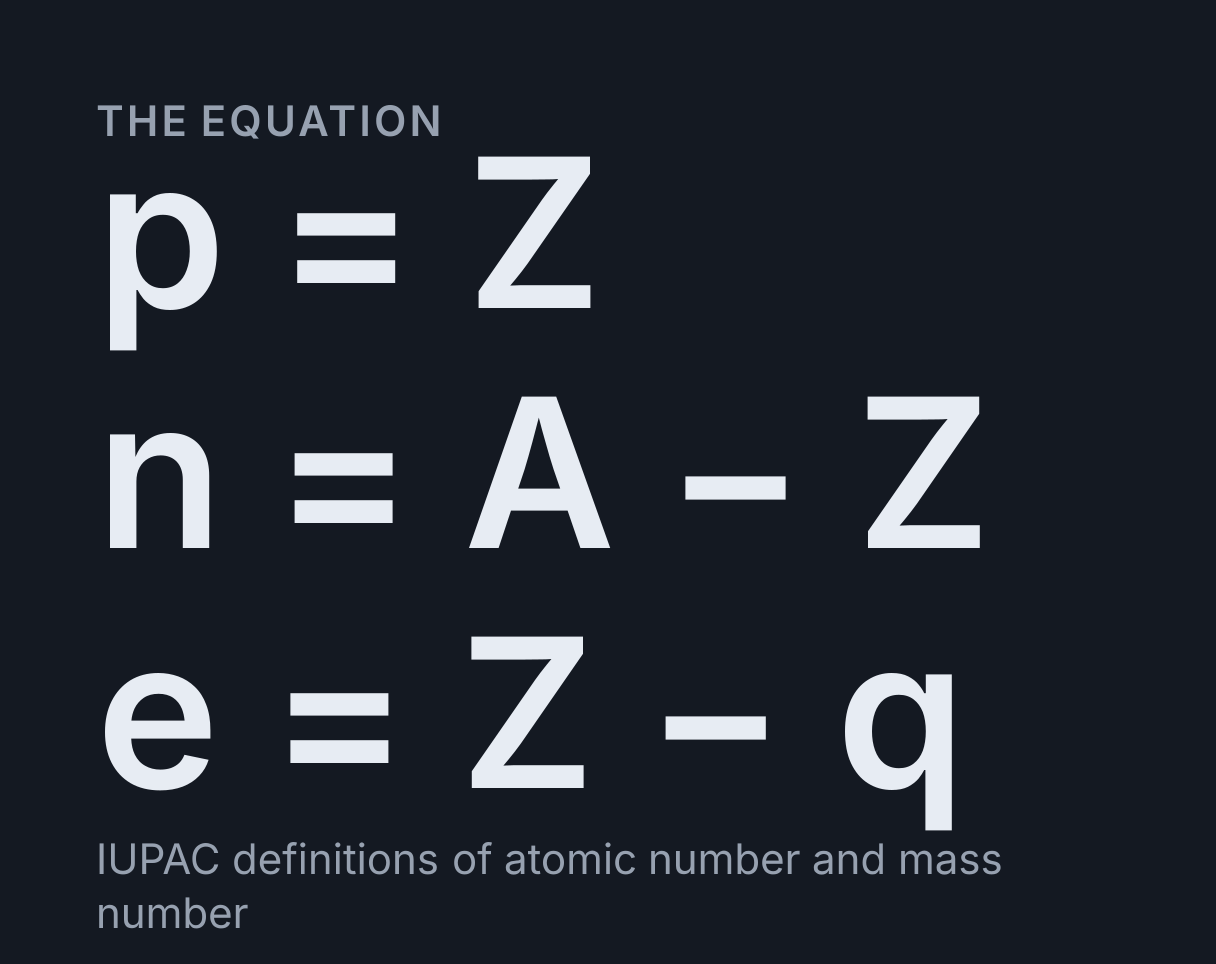
The equation
IUPAC definitions of atomic number and mass number
How to find protons, neutrons and electrons
The number of protons is the atomic number Z, the number of neutrons is the mass number
minus the atomic number, and the number of electrons is the atomic number minus the charge:
p = Z, n = A − Z and e = Z − q. The atomic number
comes from the element, the mass number from the isotope, and the charge from the ion, so a
chlorine-37 chloride ion, ³⁷Cl⁻, has 17 protons, 20 neutrons and 18 electrons.
Those three are definitions, not measurements. The atomic number is the number of protons in the nucleus, and it is what makes an atom chlorine rather than argon. The mass number is the number of protons and neutrons together, the nucleons, and differs from one isotope of an element to the next. A charge is the protons minus the electrons, so a positive ion has lost electrons and a negative ion has gained them, while its nucleus is unchanged.
How to use the calculator
Type the isotope or ion the way a textbook writes it. Cl-37 or
chlorine-37 is hyphen notation, with the mass number after the name;
³⁷Cl or 37Cl puts it before the symbol; and a charge goes last, as
Fe3+, Fe³⁺, O2− or Cl-. Both together
read as ³⁷Cl⁻ or Cl-37-. The result gives the three counts, the
mass number, atomic number and charge, the full nuclide symbol, and the working with your
numbers.
Leave out the mass number and the calculator uses the element’s most abundant natural isotope, from NIST’s isotopic compositions, and says which one it used. To work the other way, choose From particle counts and type the protons, neutrons and electrons: it names the element, gives the mass number and charge, and writes the symbol.
Worked example: the chloride ion ³⁷Cl⁻
Chlorine is element 17, so p = Z = 17. The mass number is 37, so
n = A − Z = 37 − 17 = 20. The charge is 1−, one electron more than the
protons, so e = Z − q = 17 − (−1) = 18. The answer is 17 protons, 20 neutrons
and 18 electrons, the same number of electrons as an argon atom.
Worked example: Fe³⁺ with no mass number
Iron is element 26, and the ion has lost three electrons, so
e = 26 − 3 = 23. The symbol names no isotope, so the neutrons need one: the
calculator takes iron-56, 91.754 percent of natural iron atoms in NIST’s representative
composition, and gives n = 56 − 26 = 30. The answer is 26 protons, 30 neutrons
and 23 electrons, written ⁵⁶₂₆Fe³⁺. For an iron-54 ion type
Fe-54 3+, and only the neutrons change, to 28.
Worked example: from particle counts
A particle with 8 protons, 10 neutrons and 10 electrons is oxygen, because every atom with 8
protons is. Its mass number is A = 8 + 10 = 18 and its charge is
q = 8 − 10 = −2, so it is the oxide ion of oxygen-18, ¹⁸₈O²⁻.
Why the atomic weight does not give the neutrons
Neutrons belong to a mass number, and an atomic weight is not one. It is the average mass of an element’s atoms in a natural sample, weighted by how common each isotope is, so it is rarely a whole number and it describes no single atom. Rounding it and subtracting Z is the commonest wrong method, and it can give a count no atom of the element has.
Chlorine’s atomic weight is 35.45, because natural chlorine is 75.76 percent chlorine-35 and
24.24 percent chlorine-37. Rounded to 35 it gives 35 − 17 = 18 neutrons, right
for chlorine-35 and wrong for chlorine-37, which has 20. Copper’s 63.546 rounds to 64 and
gives 35 neutrons, but natural copper is copper-63 and copper-65, with 34 and 36: no copper
atom in a natural sample has 35. The calculator never rounds the atomic weight, and when the
shortcut would have given a different answer it says so under the result.
The atomic weight is the right number for masses of ordinary samples, which is what the molar mass calculator uses it for. The periodic table gives it for every element, and each element’s own page, such as chlorine, gives the neutron count of its most abundant isotope beside it.
Reading isotope notation
In the full nuclide symbol the mass number is written at the top left, the atomic number at
the bottom left and the charge at the top right, so ²³⁵₉₂U is uranium-235, with
92 protons and 235 − 92 = 143 neutrons, and ²³⁸₉₂U has 146. The
atomic number is often left out, because the symbol already fixes it. Hyphen notation says
the same with the name: carbon-14 has 6 protons and 8 neutrons, carbon-12 has 6 and 6.
Isotopes of one element have the same protons and electrons, and so almost the same chemistry, and differ only in their neutrons, which is where their stability can differ: carbon-12 is stable and carbon-14 is radioactive. The radioactive decay simulator follows an unstable nucleus as it decays, and the Rutherford scattering simulator shows the experiment that found the nucleus. For ions made of several atoms, such as sulfate, see the list of polyatomic ions.
What this does not cover
The calculator does not check that a nuclide exists. It knows the most abundant natural
isotope of 84 elements and the mass number of one long-lived isotope for the
rest, not the full chart of nuclides, so Cl-50 is counted like any other mass
number of at least 17. It refuses only what cannot be: a mass number below the atomic
number, a positive charge larger than the atomic number, which would remove more electrons
than the atom has, and, as a guard against typing slips, a negative charge beyond 4− or a
mass number above 300.
It counts particles and nothing else. The mass of an atom in atomic mass units is close to its mass number but, except for carbon-12, which defines the unit as exactly 12 u, not equal to it: a proton and a neutron each weigh a little more than 1 u, the electrons add a little, and binding the nucleus together takes some mass away. How the electrons are arranged in shells and subshells is a separate question, which the electron configuration calculator answers for any atom or ion. One atom or ion is counted here at a time.
Common mistakes
- Taking the neutrons from the rounded atomic weight. Use the mass number of the isotope in the question.
- Changing the protons when an atom becomes an ion. Only the electrons change: Na⁺ still has 11 protons.
- Getting the sign backwards. A positive charge means electrons lost, so fewer electrons than protons; a negative charge means electrons gained.
-
Reading
O-2as the oxide ion. In hyphen notation the number is a mass number; for the ion write the number and then the sign,O2−. - Swapping the mass number and the atomic number. The mass number is the larger, top-left figure in the nuclide symbol, and it is never smaller than the atomic number.
Common questions
How do you find the number of protons, neutrons and electrons?
Protons equal the atomic number Z, neutrons equal the mass number minus the atomic number, A − Z, and electrons equal the atomic number minus the charge, Z − q. For the chloride ion of chlorine-37, ³⁷Cl⁻, that is 17 protons, 37 − 17 = 20 neutrons and 17 + 1 = 18 electrons. The atomic number comes from the element, the mass number from the isotope and the charge from the ion.
Why can’t I use the atomic mass to find the number of neutrons?
Because the atomic mass printed on a periodic table is the atomic weight, an average over an element’s natural isotopes, while neutrons belong to one isotope’s mass number. Chlorine’s 35.45 rounds to 35 and gives 18 neutrons, right for chlorine-35 but wrong for chlorine-37, which has 20. Copper’s 63.546 rounds to 64 and gives 35 neutrons, a count no atom of natural copper has, since natural copper is copper-63 and copper-65.
How many electrons does an ion have?
The atomic number minus the charge. A positive ion has lost electrons, so Fe³⁺ has 26 − 3 = 23, and a negative ion has gained them, so O²⁻ has 8 + 2 = 10. The protons and neutrons stay as they were, because forming an ion changes only the electrons.
What do the numbers in isotope notation mean?
The top-left number is the mass number A, protons plus neutrons, the bottom-left number is the atomic number Z, the protons, and a charge goes at the top right. So ²³⁵₉₂U is uranium-235, with 92 protons and 143 neutrons. Hyphen notation, uranium-235 or U-235, gives the same mass number after the name, and the atomic number is often left out because the symbol already fixes it.
What if I do not know the mass number?
The calculator then uses the element’s most abundant natural isotope, from NIST’s isotopic compositions, and says which one it used: iron-56 for iron, chlorine-35 for chlorine. For an element with no natural isotopic composition it uses the mass number of one of its longest-lived isotopes, 98 for technetium.