Intramuscular Injection Sites 3D Explorer
See the IM injection sites on a 3D body: deltoid, ventrogluteal and vastus lateralis landmarks, nearby nerves, and sourced needle and volume ranges.
Visualiser
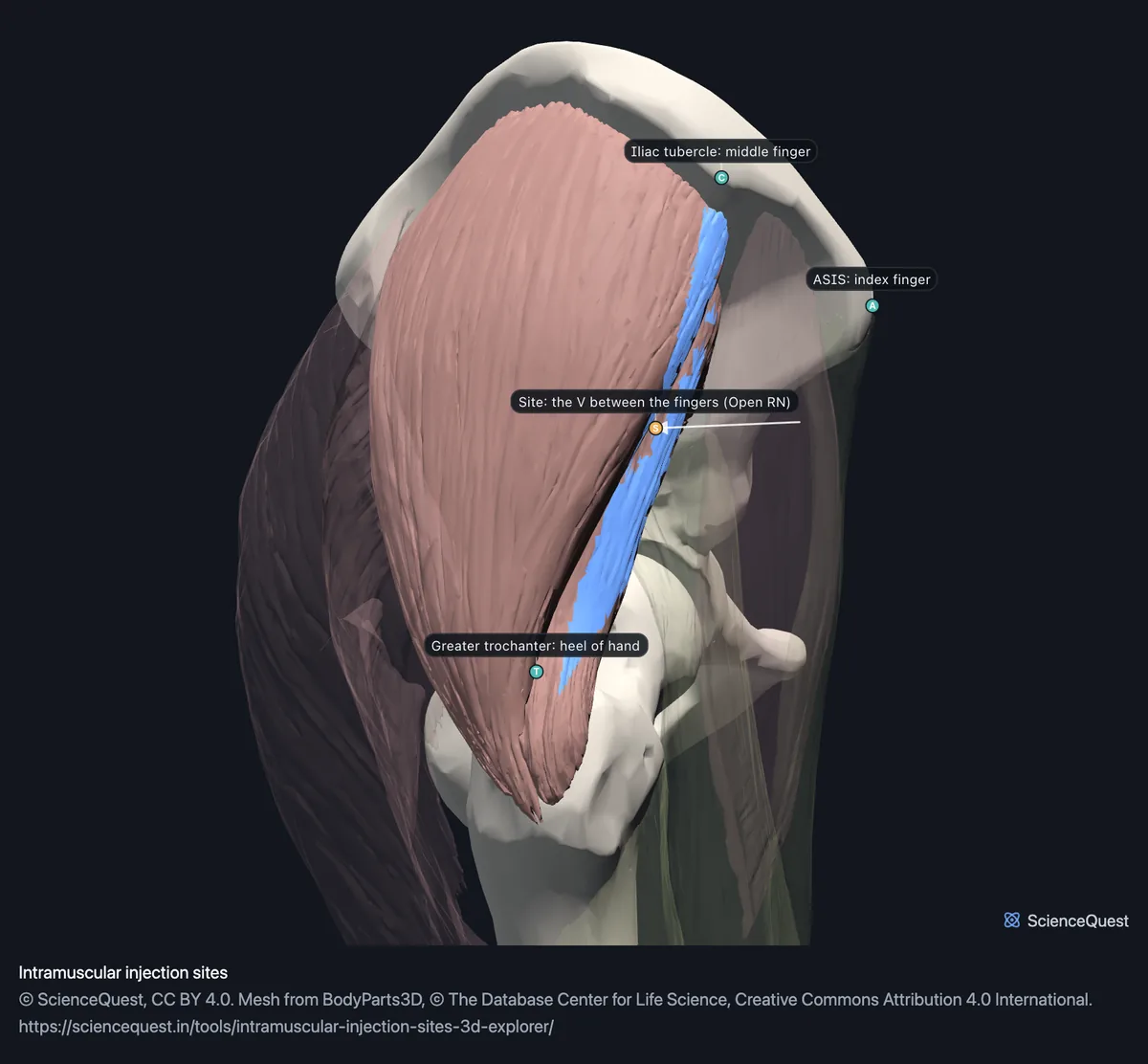
Ventrogluteal site shown.
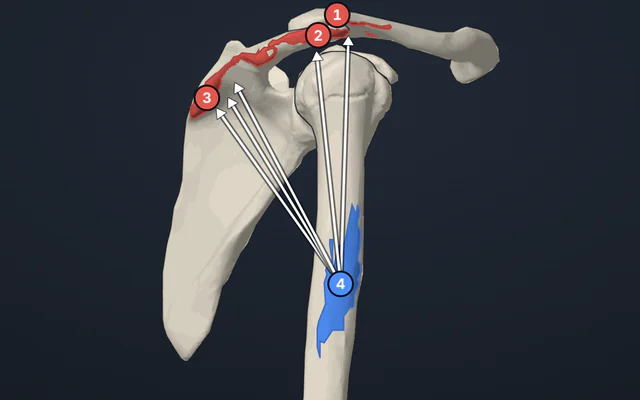
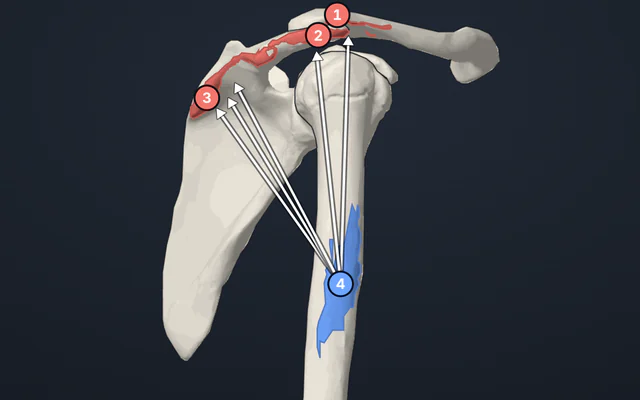
Target zone Avoid or too close Arrow: needle at 90°. Hollow pins mark nerves the dataset does not segment.
Ventrogluteal
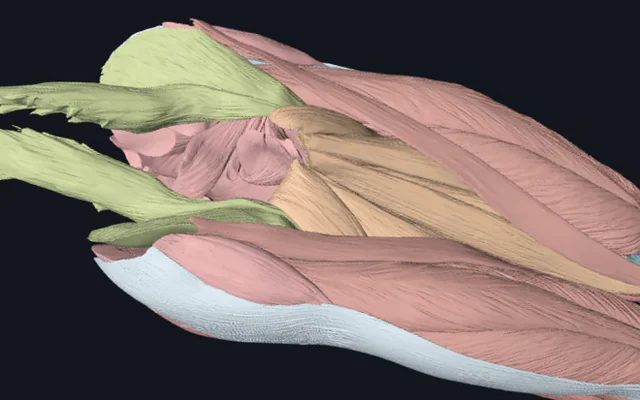
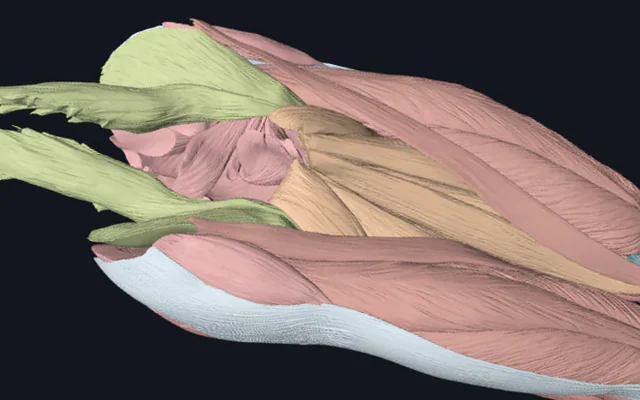
Gluteus medius, with gluteus minimus beneath
The site Open RN generally recommends for IM medicines in adults, and its preferred site for oily or irritating solutions, found by the hand on three bony points.
How to find it
- Lay the patient on the back or side. Use the left hand for the right hip, the right hand for the left. Open RN
- Heel of the hand on the greater trochanter, thumb toward the navel, index finger on the anterior superior iliac spine, middle finger spread toward the iliac crest. Open RN
- Inject in the V between the index and middle fingers. Open RN
- StatPearls puts the middle finger below the iliac crest and injects in the triangle formed by the index finger, the middle finger and the crest. StatPearls
- The CDC’s infant guidance gives the same place as the center of a triangle bounded by the anterior superior iliac spine, the tubercle of the iliac crest and the upper border of the greater trochanter. CDC
Hazards nearby
- Free from penetrating nerves and blood vessels, with the greatest thickness of gluteal muscle and a thin layer of fat; Open RN calls it the safest site for adults and children. Open RN
- Considered the safest IM site because of its thin layer of subcutaneous tissue and relatively large gluteus medius muscle mass. StatPearls
- May be safer than the dorsogluteal site in older adults because of the lower risk of contacting bone. StatPearls
- Vaccines: hepatitis B given to adults at any site other than the deltoid or anterolateral thigh, and rabies vaccine given in the gluteal site, should not be counted as valid doses and should be repeated. CDC
Adults
| Volume | Average adult: up to 3 mL. Open RN |
|---|---|
| Open RN, for any IM site: older adults and thin patients may only tolerate up to 2 mL in a single injection. Open RN | |
| Needle | Thin adult: may need 5/8 to 1 in (16 to 25 mm) Open RN |
| Average adult: may need 1 in (25 mm) Open RN | |
| Larger adult, over 154 lb (Open RN gives 70 kg): may need 1 to 1.5 in (25 to 38 mm) Open RN | |
| Gauge | Aqueous solutions: 20 to 25 gauge Open RN |
| Viscous or oil-based solutions: 18 to 21 gauge Open RN | |
| Sources differ on oily medicines: StatPearls says “suspensions and oily medications cannot be administered”, yet lists benzathine penicillin and testosterone among common IM drugs. StatPearls | |
| Angle | 90° to the skin CDC, Immunize.org, Open RN, StatPearls |
Infants and children
- Children: up to 1 mL at this site. Open RN
- The preferred site for oily and irritating solutions at any age. Children and infants need shorter needles; follow agency policy for length. Open RN
- Vaccines: if a gluteal site must be used in an infant, the CDC names this triangle as one of two options. CDC
Start here
- Pick a site Deltoid, ventrogluteal, vastus lateralis, or the dorsogluteal site to avoid, with landmarks, hazards and sourced ranges.
- Start exploring The zone painted where a needle meets the muscle, landmark pins, and all four sites in one 1.2 MB model.
- Share a site A link opens on the site you were looking at, such as the deltoid.
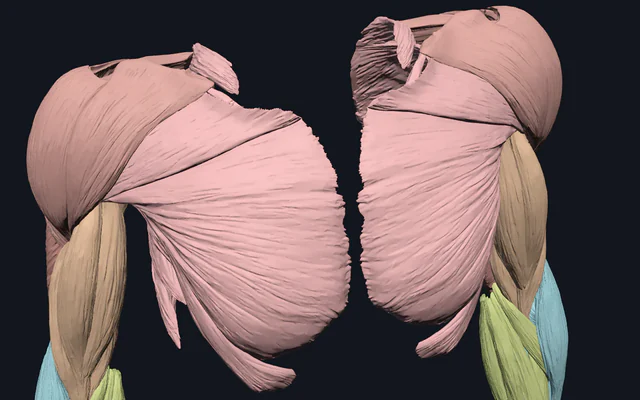
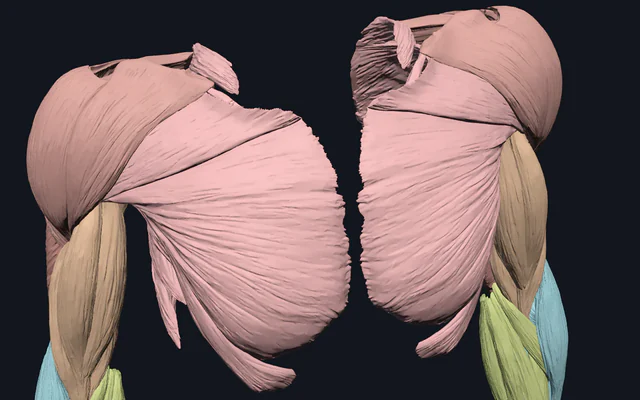
The 16 BodyParts3D meshes the sites are measured on: the right scapula, clavicle, humerus, hip bone and femur, the three parts of the deltoid, gluteus maximus, medius and minimus, piriformis, tensor fasciae latae, rectus femoris, sartorius and vastus lateralis. No nerves: the radial and sciatic nerves are marked with hollow pins at the landmarks their sources give, never drawn, and the axillary and femoral nerves are named in the card. No skin or fat, so the depth a needle must cross is not shown, and no muscle but the ones the sites are measured on. One adult male volunteer: the infant and child notes are text only. Which nerve root supplies the skin over each site is shown in the dermatomes of the upper limb and the lower limb.
Where this comes from
Segmented from MRI of one adult male volunteer, then refined by medical illustrators, who filled in missing detail and sharpened blurred outlines from textbooks and atlases (Mitsuhashi et al., Nucleic Acids Research, 2009). Two consequences worth knowing: it is one person’s anatomy rather than an average, and faint stepping on some surfaces is the resolution of the original scan rather than a rendering fault.
Meshes from BodyParts3D, © The Database Center for Life Science, under Creative Commons Attribution 4.0 International. Names and identifiers are the dataset’s own: Foundational Model of Anatomy identifiers and English labels, as its parts list gives them. Converted meshes are shared under the same licence.
Changes made: Meshes were converted from binary STL to an indexed mesh with 16-bit quantised vertex positions, and surface normals were recomputed from the geometry. No vertex was moved other than by that quantisation, whose worst-case error on any one coordinate is reported on the page. On this page it is at most 0.00796 mm. The model is a ScienceQuest selection of 16 meshes from three BodyParts3D models, simplified from 0.67 million to 0.31 million triangles with no surface moved more than 0.584 mm. The zones are ScienceQuest’s measurement of these simplified meshes: each source’s rule placed on the bony landmarks, taken as extreme points of the bone meshes, and painted on the target muscle where it is the surface nearest the skin in each 3 mm square of the zone. Each model’s file is then compressed without loss, by meshoptimizer’s vertex and index codecs and gzip, and restored exactly before it is drawn.
Latin terms for 13 of the 16 structures come from English Wikipedia anatomy infoboxes, under Creative Commons Attribution-ShareAlike 4.0, joined by Wikidata property P1402, Foundational Model of Anatomy identifier. Only a term a source states for that structure is used, never one constructed from a family name, which is why the rest carry no Latin rather than a guess. A few are corrected to the Terminologia Anatomica form where Wikipedia gives an older one, and where several forms are listed, some may still be older synonyms rather than the Terminologia term.
Cite this tool
Citing this tool
Last updated . Add the date you accessed it as well, which a citation of a page that can change asks for. If a specific view matters, cite the page address as it stands in your browser instead: it records what is selected and shown.
Where are the intramuscular injection sites?
Open RN names three: the deltoid of the upper arm, the ventrogluteal site on the side of the hip, and the vastus lateralis on the outer thigh. Each is found from bony landmarks. StatPearls still lists the dorsogluteal site in the upper outer buttock among the most commonly used, while saying the ventrogluteal site has a better safety profile. The dorsogluteal site is avoided because of the risk to the sciatic nerve: dorsogluteal injections account for most injection injuries of the nerve (StatPearls), the quadrant is easy to misjudge (StatPearls, sciatic nerve), and Open RN says to avoid the site.
Which site is safest, and which is routine
Open RN and StatPearls both call the ventrogluteal site the safest. Open RN says it has the greatest thickness of gluteal muscle, is free from penetrating nerves and blood vessels, and has a thin layer of fat; StatPearls points to its thin subcutaneous layer and relatively large gluteus medius, and says it may be safer than the dorsogluteal site in older adults because of the lower risk of contacting bone. Open RN generally recommends it for IM medicines in adults, and prefers it for oily or irritating solutions at any age. Sources differ on oily medicines: StatPearls lists “suspensions and oily medications cannot be administered” among the disadvantages of IM injection, though it names benzathine penicillin and testosterone among the most common IM medicines. The CDC recommends the deltoid for routine adult vaccines and, for the majority of infants, the anterolateral thigh (the vastus lateralis, in Open RN’s words), and prefers the deltoid from age 3.
How far below the acromion is the deltoid site
About 2 to 3 fingerbreadths, roughly 2 inches, below the acromion and above the level of the armpit, in the thickest part of the muscle, per Immunize.org. StatPearls and Open RN give 1 to 2 inches (2.5 to 5 cm). StatPearls also calls the safest point approximately 7 to 13 cm below the midacromial point and midway between the acromion and the deltoid tuberosity, and cites no source for that figure, so the sources differ on how far down to go. They differ on the landmark too: Nakajima 2017 found the axillary nerve often runs near the site 5 cm below the mid-acromion, called that site unsuitable, and uses the point where a line straight down from the mid-acromion crosses the line joining the upper ends of the anterior and posterior axillary lines, which StatPearls also calls safe. Immunize.org says not to inject too high (near the acromion) or too low, to avoid causing an injury. StatPearls reports shoulder injury and radial nerve injury after deltoid injection, and Cook 2015 says the radial nerve and the anterior branch of the axillary nerve are susceptible to injury from it.
On the model the deltoid’s insertion at the tuberosity is 13.9 cm below the acromion, so midway is about 7 cm, and 13 cm is within 1 cm of the insertion, by the radial nerve pin, which Cook 2015 supports: the nerve is at risk above and in the spiral groove, which ends just below the deltoid tuberosity. Immunize.org, Open RN and StatPearls’s own site description keep to about 2 inches (5 cm) or less. The zone is the band 2.5 to 5 cm below the acromion on the deltoid’s outer face, centered 3.7 cm down. Nakajima 2017 gives the subacromial bursa a mean 4.0 cm in women and 4.1 cm in men from the mid-acromion, inside that band. The band painted as too high, 0.5 to 2 cm below the acromion, is ScienceQuest’s drawing of Immunize.org’s “near the acromion”; no source gives a figure.
Why the dorsogluteal site is avoided
Because of the sciatic nerve. It usually leaves the pelvis through the greater sciatic foramen below piriformis, under the buttock; StatPearls’s sciatic nerve chapter says that in 10% it passes through or above the muscle. If a needle hits it the patient may have partial or permanent paralysis of the leg, so Open RN says to avoid the site and StatPearls says the ventrogluteal site has a better safety profile. The sciatic nerve chapter adds that injecting the inferomedial buttock puts the nerve at risk, and that many people have a fatty bulge there, so the “upper and outer” quadrant is easy to misjudge; the model’s hollow pin sits on piriformis’s lower border at the greater sciatic notch. StatPearls’s intramuscular injection chapter says the sciatic nerve, particularly its peroneal division, is the nerve most often injured by injection, and that dorsogluteal injections account for most of its injection injuries. The CDC’s infant guidance says that if the gluteal muscle is chosen, the injection goes lateral and superior to a line from the posterior superior iliac spine to the greater trochanter, the line the model draws. The zone painted to avoid is that CDC region, not StatPearls’s site 5 to 7.5 cm below the iliac crest.
Volume and needle ranges, and where sources differ
Open RN gives the maximum for a single adult injection as generally 1 mL in the deltoid, 3 mL in an average adult at the ventrogluteal site, and 3 mL in adults at the vastus lateralis. For any IM site, it says older adults and thin patients may only tolerate up to 2 mL, and gives 0.5 to 1 mL at one site in infants and children. Its general statement that adults tolerate 2 to 3 mL is not a deltoid figure, and the CDC, Immunize.org and StatPearls give no deltoid volume. Needle length for vaccines follows the CDC’s Table 6-2, by age and, for adults, by sex and weight, from 5/8 in (16 mm) in a newborn’s thigh to 1.5 in (38 mm) in the deltoid of a woman over 200 lb (90 kg) or a man over 260 lb (118 kg). The sources differ at the edges: under 130 lb (60 kg) the CDC’s table gives 1 in (25 mm) while its text calls 5/8 in sufficient, Open RN calls 1 in sufficient for men up to 260 lb, Immunize.org starts the CDC’s 152 lb rows at 153 lb, StatPearls gives children 25 to 38 mm, and Kutaish 2025, which found a standard needle reached the subacromial space in 51.9% of 177 shoulder-surgery patients, recommends a shorter 15 mm needle for most adults, so the card names each. The CDC, Immunize.org, Open RN and StatPearls all give a 90° angle.
What the model can and cannot show
The ventrogluteal triangle is placed on this body’s own anterior superior iliac spine, the tubercle of its iliac crest (4.6 cm from the spine) and the upper border of its greater trochanter. In this one model, the surface nearest the skin across the triangle is 40.0 percent tensor fasciae latae, 38.5 percent gluteus medius and minimus, and 21.5 percent bare bone at the crest, so on this body tensor fasciae latae covers the front of the triangle. The zone is painted only where gluteus medius or minimus is that surface, which puts its center 1.3 cm behind the center of the triangle, and tensor fasciae latae is drawn as glass. The thigh zone is the middle third of the 36 cm from the greater trochanter to the lateral femoral condyle. The meshes are from one adult male volunteer, segmented from MRI, without skin, fat or nerves: they show where the landmarks are, not how deep a needle must go in anyone.
Sources
CDC and ACIP, General Best Practice Guidelines for Immunization: Vaccine Administration, with Table 6-2 on needle length and site. Immunize.org, How to Administer Intramuscular and Subcutaneous Vaccine Injections, item P2020 (10/17/2026). Munakomi S and Gillespie E, Intramuscular Injection, StatPearls (updated September 13, 2026). Ernstmeyer K and Christman E, editors, Nursing Skills, 2nd edition, Open RN, WisTech Open, 2023, section 18.6, Administering Intramuscular Medications. Giuffre BA, Black AC and Jeanmonod R, Anatomy, Sciatic Nerve, StatPearls (updated November 16, 2023). Nakajima Y, Mukai K, Takaoka K and others, Establishing a new appropriate intramuscular injection site in the deltoid muscle, Human Vaccines and Immunotherapeutics 2017;13(9):2123-2129. Cook IF, Best vaccination practice and medically attended injection site events following deltoid intramuscular injection, Human Vaccines and Immunotherapeutics 2015;11(5):1184-1191. Kutaish H, Bouché PA, Rivera PM and others, More than half of shoulder vaccinations may end up in the subacromial space, NPJ Vaccines 2025;10:229. The zones and landmark positions are this site’s measurement of the BodyParts3D meshes.
Common questions
Which intramuscular injection site is safest?
Open RN and StatPearls both call the ventrogluteal site the safest. Open RN says it has the greatest thickness of gluteal muscle, is free from penetrating nerves and blood vessels, and has a thin layer of fat; StatPearls points to its thin subcutaneous layer and relatively large gluteus medius. The CDC keeps the deltoid as the routine site for adult vaccines, and the anterolateral thigh for most infants.
Why is the dorsogluteal site avoided?
Because of the sciatic nerve. It usually leaves the pelvis below piriformis, under the buttock, and if a needle hits it the patient may have partial or permanent paralysis of the leg, so Open RN says to avoid the site and StatPearls says the ventrogluteal site has a better safety profile.
How far below the acromion is the deltoid injection site?
About 2 to 3 fingerbreadths, roughly 2 inches, below the acromion and above the level of the armpit, in the thickest part of the muscle, per Immunize.org. StatPearls and Open RN give 1 to 2 inches (2.5 to 5 cm). Immunize.org says not to inject too high (near the acromion) or too low, and StatPearls reports shoulder injury and radial nerve injury after deltoid injection.