Head and Neck Explorer
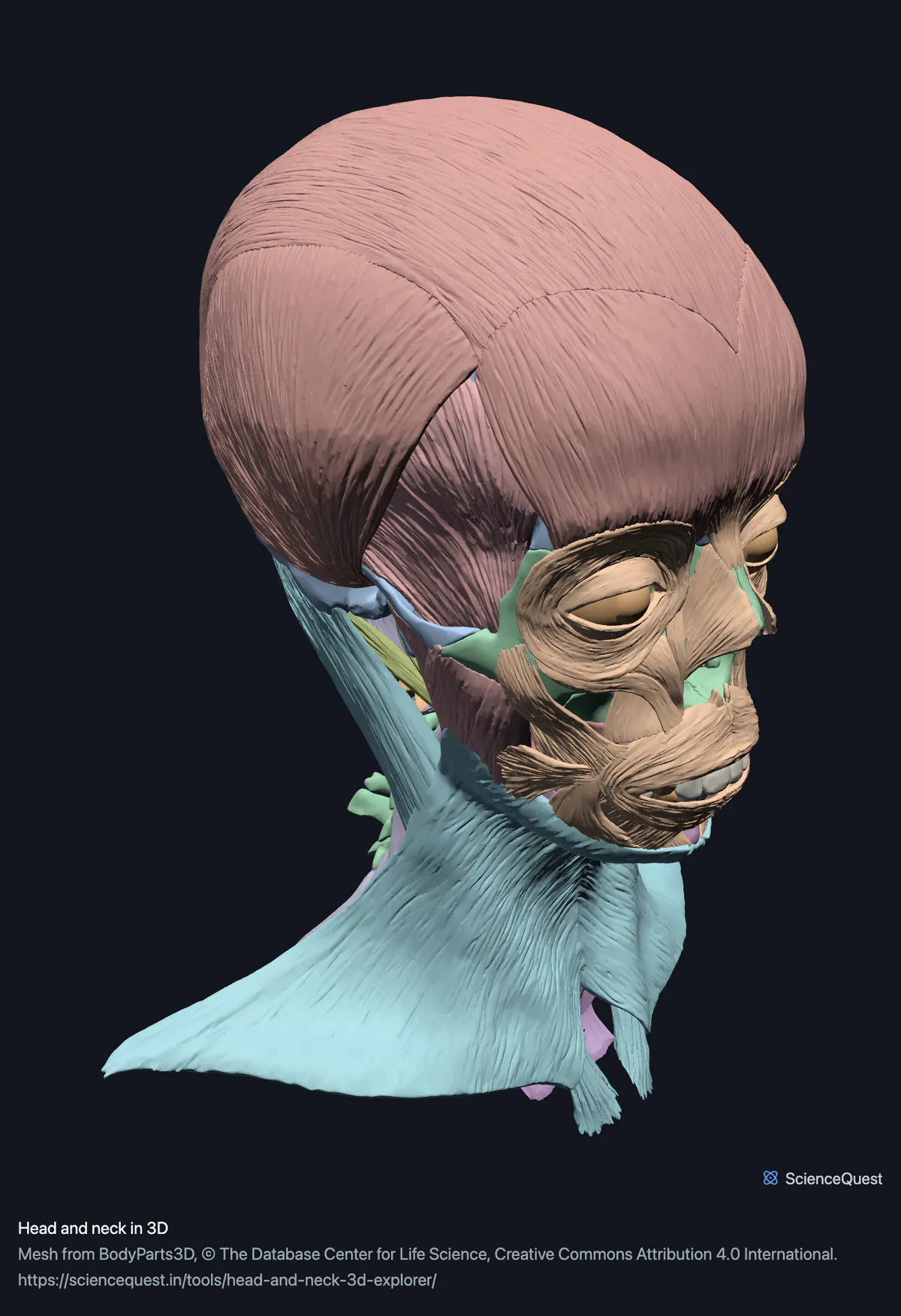
Skull, cervical spine, brain, teeth and the head and neck muscles in one 3D scene: 261 structures to peel, filter by tissue and label.
Visualiser
Skull, 22 bones in 23 meshes
Checking this device for a stored copy.
Start here
- Filter to Bone Lists only the 30 bones: those of the skull and the cervical spine, which arrive as separate models, and the hyoid, a bone of the neck that loads with the skull model. The chips filter the structure list by what a structure is made of rather than by which model it came from, and they leave the 3D view as it is.
- Collapse every model but Brain The structure list groups by model once more than one is loaded. Collapsing the rest turns 261 rows into the 101 the brain contributes.
- Open the Optic pathway band It holds 6 structures: both optic nerves, both optic tracts, the chiasm and the one mesh the dataset gives both eyeballs. The nerves, tracts and chiasm are the only cranial nerve tissue in the dataset, which is why the band is small.
Bone, brain, teeth and muscle. No blood vessels, and no cranial nerve other than the optic. The vessel model reaches the common carotid arteries and the internal jugular veins and stops, so nothing above the neck is segmented at all. Of the twelve cranial nerves the dataset publishes one, arriving with the brain as the optic nerves, their tracts and the chiasm. An absence here is a fact about the segmentation rather than about the body, so it is stated rather than left to be discovered.
Where this comes from
Segmented from imaging of one adult male body, not drawn by an artist, so the shapes are measurements. Two consequences worth knowing: it is one person’s anatomy rather than an average, and faint stepping on some surfaces is the resolution of the original scan rather than a rendering fault.
Meshes from BodyParts3D, © The Database Center for Life Science, under Creative Commons Attribution 4.0 International. Names and identifiers are the dataset’s own: Foundational Model of Anatomy identifiers and English labels, as its parts list gives them. Converted meshes are shared under the same licence.
Changes made: Meshes were converted from binary STL to an indexed mesh with 16-bit quantised vertex positions, and surface normals were recomputed from the geometry. No vertex was moved other than by that quantisation, whose worst-case error on any one coordinate is reported on the page. On this page it is at most 0.00241 mm, the largest among the 5 models the page can load.
Latin terms for 165 of the 261 structures in these models come from English Wikipedia anatomy infoboxes, under Creative Commons Attribution-ShareAlike 4.0, joined by Wikidata property P1402, Foundational Model of Anatomy identifier. Only a term a source states for that structure is used, never one constructed from a family name, which is why the rest carry no Latin rather than a guess.
Citing this tool
Last updated . Add the date you accessed it as well, which a citation of a page that can change asks for. If a specific view matters, cite the page address as it stands in your browser instead: it records what is selected and shown.
Common questions
Why can this show bone, brain and muscle at once without overloading the viewer?
Because it is one region rather than one system. Most models here carry one system each, and a whole system is heavy: the six muscle assets are 18.30 million triangles between them, so any scene holding all the muscle is more than twice the viewer’s 8 million ceiling before a bone arrives. Restrict to the head and neck and the same systems come to 261 structures and 4.64 million triangles, which a laptop holds without complaint. The trade is coverage for completeness, and for learning a region it is the right way round.
Are these new models, or the ones already on the site?
The ones already on the site. This page loads the skull, the cervical spine, the teeth, the brain and the head and neck muscles as five separate assets into one scene, and adds no geometry of its own. That is deliberate rather than lazy: re-cutting five subsets into one new binary would mean a new digest, a new set of colour bands and a fresh chance to get a name or an anatomical axis wrong, to display meshes that have already been checked. It also means anyone who has opened those pages before pays no download at all, because the copies on their device are the same files.
Which cranial nerves are here?
One, and this is the honest answer rather than an evasion. BodyParts3D segments the optic nerves, their tracts and the chiasm, and no other cranial nerve appears anywhere in the dataset. There is no olfactory, trigeminal, facial or vagus nerve to show, because none was ever built. The same goes for blood vessels above the neck: the vessel model reaches the common carotid arteries and the internal jugular veins and stops, so nothing inside the skull is segmented. An absence here is a fact about the segmentation rather than about the body, so it is stated on the page.
How do I get 261 rows down to something readable?
Two controls, and they cut in different directions. The structure list groups by model once more than one is loaded, so collapsing all but the brain leaves the 101 structures it contributes. The tissue chips cut the other way, across the models: each chip lists one tissue on its own, so the bone chip gathers the bones of the skull and the cervical spine into one list although they arrive as separate models. The chips filter the list, not the 3D view. Search narrows further, and every band has its own disclosure.