Formula comparison tables
Each page runs rival formulas on the same inputs with the code our calculators use, and cites the paper or agency behind each formula.
Clinical
-
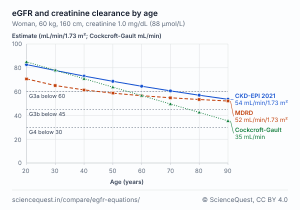
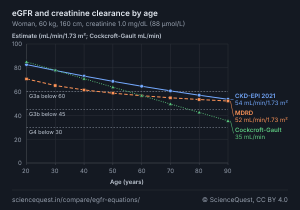 eGFR equations CKD-EPI 2021, MDRD and Cockcroft-Gault For an 85-year-old woman of 60 kg and 160 cm with creatinine 0.8 mg/dL, CKD-EPI 2021 gives 72 mL/min/1.73 m² and MDRD 68.
-
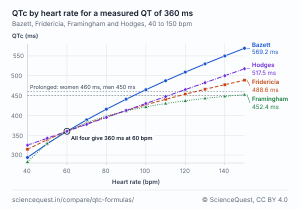
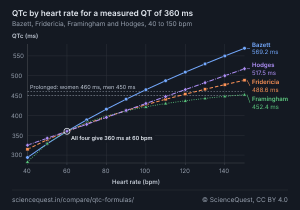 QTc formulas Bazett, Fridericia, Framingham and Hodges A QT of 320 ms at 120 bpm corrects to 452.5 ms by Bazett, 403.2 by Fridericia, 397.0 by Framingham and 425.0 by Hodges, a 55.5 ms spread.
-
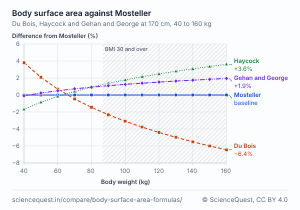
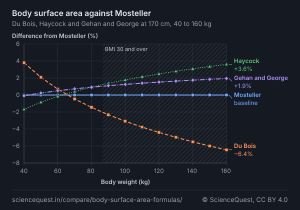 Body surface area formulas Mosteller, Du Bois, Haycock and Gehan-George At 170 cm and 70 kg the four formulas agree within 0.022 m², 1.2 percent of Mosteller.
-
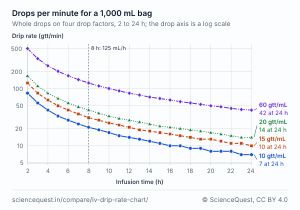
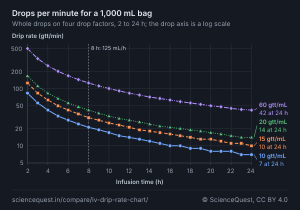 IV drip rate chart Drip rates on 10, 15, 20 and 60 gtt/mL sets, beside the pump rate 1,000 mL over 8 hours is 125 mL/h on a pump.
Exercise and nutrition
-
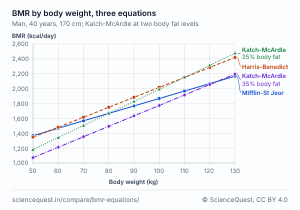
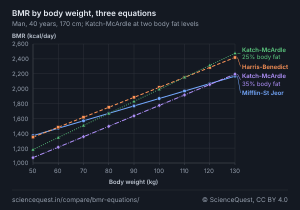 BMR equations Mifflin-St Jeor, revised Harris-Benedict and Katch-McArdle For a 40-year-old man of 80 kg and 170 cm, the revised Harris-Benedict equation gives 1,749 kcal/day and Mifflin-St Jeor 1,668, 81 lower (4.7 percent).
-
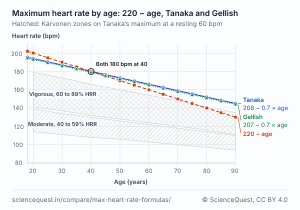
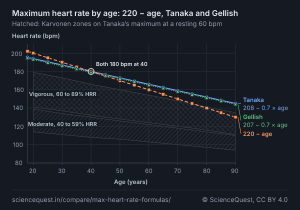 Maximum heart rate formulas 220 − age, Tanaka and Gellish, with Karvonen zones 220 − age and Tanaka’s 208 − 0.7 × age cross at 40, both 180 bpm; Gellish’s 207 − 0.7 × age runs 1 bpm under Tanaka.
-
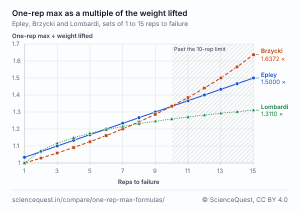
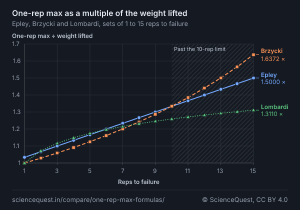 One-rep max formulas Epley, Brzycki and Lombardi Lifted for 10 reps, 100 kg gives a one-rep max of 133.3 kg by Epley and 133.4 kg by Brzycki, but 125.9 kg by Lombardi.
Weather and everyday physics
-
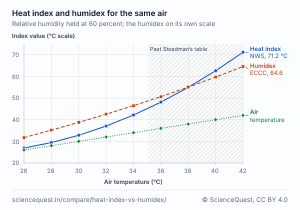
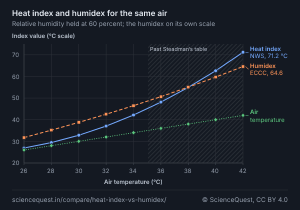 Heat index vs humidex The NWS heat index and Environment Canada’s humidex At 32 °C (89.6 °F) and 60 percent humidity, the NWS heat index is 37.1 °C (98.7 °F) and Environment Canada’s humidex is 42.5, 5.4 higher for the same air.
-
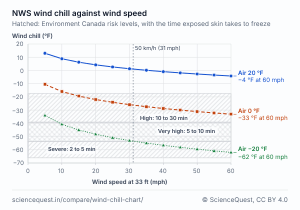
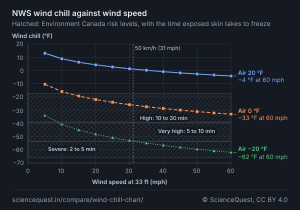 Wind chill chart The NWS and Environment Canada wind chill, with frostbite risk levels At 0 °F in a 15 mph wind the NWS wind chill is −19 °F; at −20 °C and 30 km/h Environment Canada gives −33 °C, High risk: any exposed skin can freeze in 10 to 30 minutes.
-
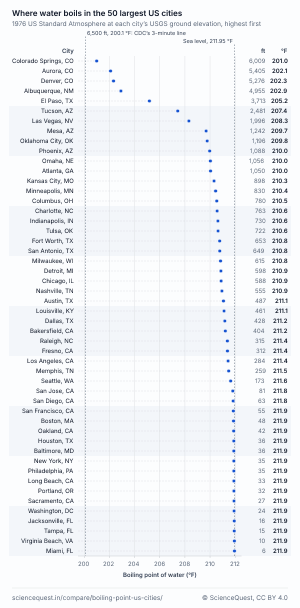
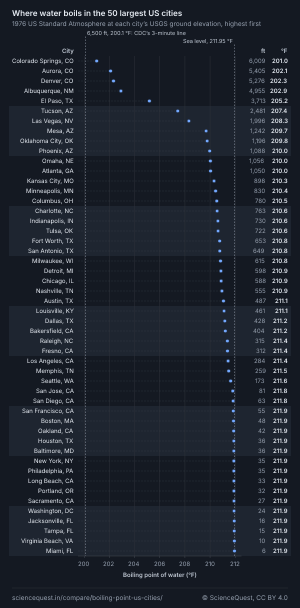 Boiling point by US city The US Standard Atmosphere and water’s saturation curve, at each city’s USGS elevation Water boils at 201.0 °F (93.9 °C) in Colorado Springs, at 6,009 ft the highest of the 50 largest US cities, about 11 °F cooler than at sea level.
Every chart is CC BY 4.0: free to reuse with credit and a link to its page, as the image licence explains. The values are facts and free to use; this page’s selection and presentation are © 2026 ScienceQuest.