IV drip rate chart: drops per minute by volume, time and drop factor
1,000 mL over 8 hours is 125 mL/h on a pump. On a gravity set that is 21 gtt/min at 10 gtt/mL, 31 at 15, 42 at 20 and 125 at 60, so a microdrip set drips 6 times as fast as a 10 gtt/mL set for the same order. Read the factor off the tubing package.
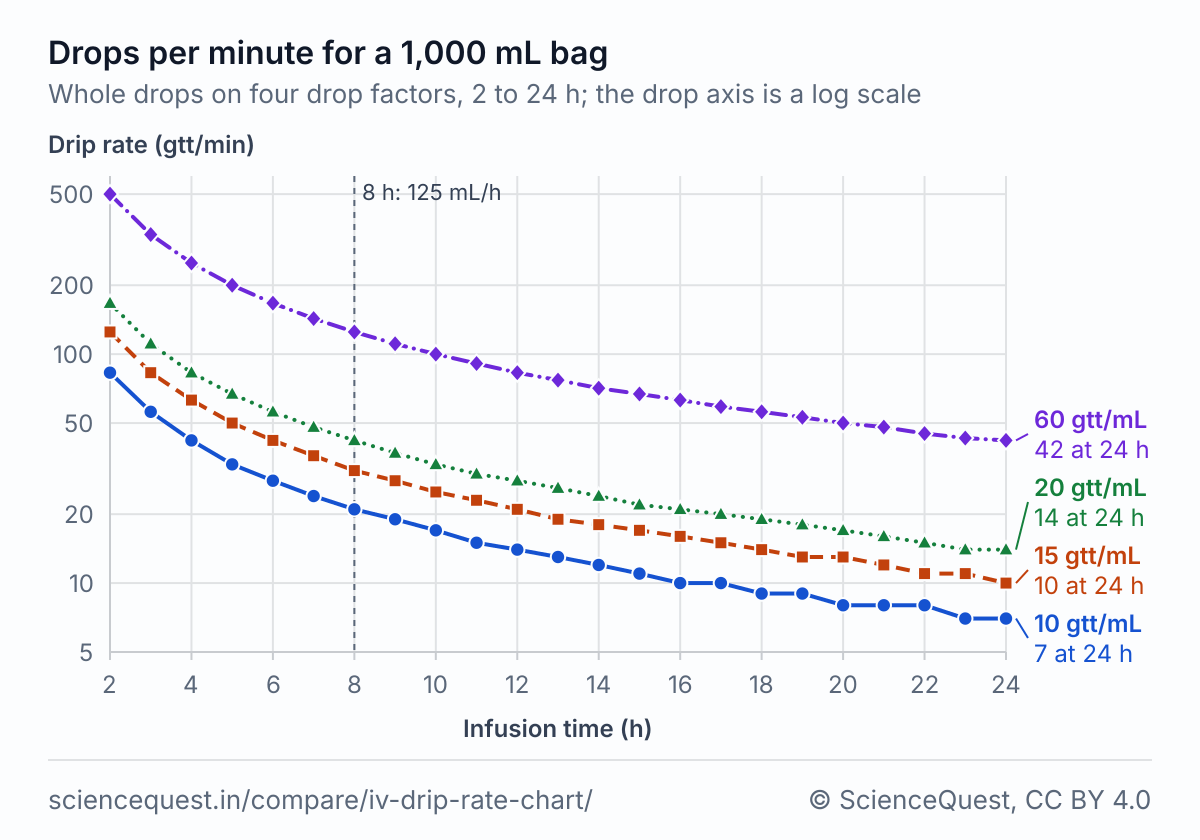
Drip rates for 17 common orders
| Orders (mL/time) | Pump | Gravity set, gtt/min | |||
|---|---|---|---|---|---|
| Rate mL/h | 10 gtt/mL | 15 gtt/mL | 20 gtt/mL | 60 gtt/mL | |
| 1,000/4 h, 500/2 h, 250/1 h | 250 | 42 | 63 | 83 | 250 |
| 100/30 min, 50/15 min | 200 | 33 | 50 | 67 | 200 |
| 1,000/6 h | 166.7 | 28 | 42 | 56 | 167 |
| 1,000/8 h, 500/4 h, 250/2 h | 125 | 21 | 31 | 42 | 125 |
| 1,000/10 h, 100/1 h, 50/30 min | 100 | 17 | 25 | 33 | 100 |
| 1,000/12 h, 500/6 h | 83.33 | 14 | 21 | 28 | 83 |
| 500/8 h, 250/4 h | 62.5 | 10 | 16 | 21 | 63 |
| 1,000/24 h | 41.67 | 7 | 10 | 14 | 42 |
On the 60 gtt/mL microdrip set the drip rate equals the pump rate rounded to a whole drop, because 60 drops make a mL and 60 minutes make an hour. Pump rates to four significant figures, as the IV infusion rate calculator prints them.
A 1,000 mL bag over 1 to 24 hours
| Time (h) | Pump | Gravity set, gtt/min | |||
|---|---|---|---|---|---|
| Rate mL/h | 10 gtt/mL | 15 gtt/mL | 20 gtt/mL | 60 gtt/mL | |
| 1 | 1,000 | 167 | 250 | 333 | 1,000 |
| 2 | 500 | 83 | 125 | 167 | 500 |
| 3 | 333.3 | 56 | 83 | 111 | 333 |
| 4 | 250 | 42 | 63 | 83 | 250 |
| 5 | 200 | 33 | 50 | 67 | 200 |
| 6 | 166.7 | 28 | 42 | 56 | 167 |
| 7 | 142.9 | 24 | 36 | 48 | 143 |
| 8 | 125 | 21 | 31 | 42 | 125 |
| 9 | 111.1 | 19 | 28 | 37 | 111 |
| 10 | 100 | 17 | 25 | 33 | 100 |
| 11 | 90.91 | 15 | 23 | 30 | 91 |
| 12 | 83.33 | 14 | 21 | 28 | 83 |
| 13 | 76.92 | 13 | 19 | 26 | 77 |
| 14 | 71.43 | 12 | 18 | 24 | 71 |
| 15 | 66.67 | 11 | 17 | 22 | 67 |
| 16 | 62.5 | 10 | 16 | 21 | 63 |
| 17 | 58.82 | 10 | 15 | 20 | 59 |
| 18 | 55.56 | 9 | 14 | 19 | 56 |
| 19 | 52.63 | 9 | 13 | 18 | 53 |
| 20 | 50 | 8 | 13 | 17 | 50 |
| 21 | 47.62 | 8 | 12 | 16 | 48 |
| 22 | 45.45 | 8 | 11 | 15 | 45 |
| 23 | 43.48 | 7 | 11 | 14 | 43 |
| 24 | 41.67 | 7 | 10 | 14 | 42 |
A 500 mL bag drips as 1,000 mL over twice the time: 500 mL over 8 h is the 16 h row. The chart draws this table from 2 h.
A pump rate as drops per minute
| Pump rate (mL/h) | 10 gtt/mL | 15 gtt/mL | 20 gtt/mL |
|---|---|---|---|
| 5 | 1 | 1 | 2 |
| 10 | 2 | 3 | 3 |
| 15 | 3 | 4 | 5 |
| 20 | 3 | 5 | 7 |
| 25 | 4 | 6 | 8 |
| 30 | 5 | 8 | 10 |
| 35 | 6 | 9 | 12 |
| 40 | 7 | 10 | 13 |
| 45 | 8 | 11 | 15 |
| 50 | 8 | 13 | 17 |
| 60 | 10 | 15 | 20 |
| 70 | 12 | 18 | 23 |
| 75 | 13 | 19 | 25 |
| 80 | 13 | 20 | 27 |
| 90 | 15 | 23 | 30 |
| 100 | 17 | 25 | 33 |
| 110 | 18 | 28 | 37 |
| 120 | 20 | 30 | 40 |
| 125 | 21 | 31 | 42 |
| 150 | 25 | 38 | 50 |
| 175 | 29 | 44 | 58 |
| 200 | 33 | 50 | 67 |
| 225 | 38 | 56 | 75 |
| 250 | 42 | 63 | 83 |
Each cell is the pump rate × drop factor ÷ 60, rounded to a whole drop. At 60 gtt/mL the drops per minute equal the pump rate, so the table leaves that column out.
Why the drop counts differ
The drop factor counts how many of a set’s drops make 1 mL, so a 10 gtt/mL set forms drops of 0.1 mL and a 60 gtt/mL microdrip set drops of 0.017 mL. To deliver the same 125 mL/h, the microdrip set drips 6 times as often as the 10 gtt/mL set. Each drip column is the pump rate times the drop factor over 60: a sixth of the mL/h figure at 10 gtt/mL, a quarter at 15 gtt/mL and a third at 20 gtt/mL.
You cannot count a fraction of a drop, so the calculators round to whole drops once, at the end, as Open RN’s section 5.5 does. Half a drop is a bigger share of a slow rate. Of the orders, 3 come to 10.42 gtt/min, set as 10, 4.0 percent slow. At that rate, 250 mL over 4 h at 10 gtt/mL would finish 10 minutes late, 500 mL over 8 h at 10 gtt/mL 20 minutes late and 1,000 mL over 24 h at 15 gtt/mL 60 minutes late.
Read a pump’s 125 mL/h as 125 gtt/min on a 20 gtt/mL set and the bag runs at 375 mL/h, 3 times the order; the two figures match on the 60 gtt/mL set alone. Open RN’s section 23.2 gives the risk of error in gravity infusions as the reason many agencies require a pump.
The formulas
V is the volume to infuse, DF the drop factor printed on the tubing package and t the infusion time, with 1 h = 60 min (NIST SP 811, table 6). Each drip rate is then rounded to the nearest whole drop.
Where each relation holds
| Formula | Fitted in | Holds for | Not for |
|---|---|---|---|
| Drip rate | Nothing: the units give V × DF ÷ t, mL × gtt/mL ÷ min | Gravity sets, on the drop factor printed on the tubing package | A pump, which runs in mL/h. A rate set once and left: OpenStax 13.3 has you recount it every one to two hours, if the tubing is bumped and when the patient returns from another department |
| Pump rate | Nothing: V ÷ t is the definition of a flow rate | Infusion pumps, which nurses program in mL/h (Open RN 5.13) | Setting a gravity set, which you count in drops per minute |
| Whole drops | Open RN 5.5: a drop cannot be given as a fraction, and its rule for doses rounds a 5 up | Setting and counting a gravity rate, rounded once at the end, half up: 30 mL/h at 15 gtt/mL is 7.5, set as 8 | Rounding the time or the volume first, or where your course or agency policy sets another rule |
| Drop factor | The set’s drip chamber: 10, 15 or 20 gtt/mL macrodrip and 60 microdrip in sets on sale (BD; FDA device records). Open RN 5.14 also lists 12, but no 12 gtt/mL set appears in FDA records | Their usual use, in Open RN 5.14: macrodrip for general IV solutions in adults, microdrip for precise amounts of medication for children and infants | Another make’s set: 1,000 mL over 8 h is 21 gtt/min at 10 gtt/mL and 42 at 20. A big bag run fast on microdrip: 1,000 mL over 1 h is 1,000 gtt/min, about 17 drops a second |
Calculators and simulators
Sources
- Ernstmeyer K, Christman E, editors. Nursing Skills 2e, section 5.14, IV Infusion by Gravity. Open RN, WisTech Open; 2023. https://wtcs.pressbooks.pub/nursingskills/chapter/5-14-iv-infusion-by-gravity/
- Ernstmeyer K, Christman E, editors. Nursing Skills 2e, section 5.13, Intravenous Infusions. Open RN, WisTech Open; 2023. https://wtcs.pressbooks.pub/nursingskills/chapter/5-13-intravenous-infusions/
- Ernstmeyer K, Christman E, editors. Nursing Skills 2e, section 5.15, IV Infusion by Pump. Open RN, WisTech Open; 2023. https://wtcs.pressbooks.pub/nursingskills/chapter/5-15-iv-infusion-by-pump/
- Ernstmeyer K, Christman E, editors. Nursing Skills 2e, section 5.5, Rounding. Open RN, WisTech Open; 2023. https://wtcs.pressbooks.pub/nursingskills/chapter/5-5-rounding/
- Ernstmeyer K, Christman E, editors. Nursing Skills 2e, section 23.2, Blood Collection and IV Therapy Basics. Open RN, WisTech Open; 2023. https://wtcs.pressbooks.pub/nursingskills/chapter/23-2-iv-therapy-basics/
- BD. Calculating Flow Rates, BD-17095; 2020. https://www.bd.com/content/dam/bd-assets/na/medication-management-solutions/documents/tip-sheet/Calculating-Flow-Rates.pdf
- US Food and Drug Administration. Global Unique Device Identification Database, device records in AccessGUDID. https://accessgudid.nlm.nih.gov/
- Bowen C, et al. Clinical Nursing Skills, section 13.3, Intravenous Infusion. OpenStax; 2024. https://openstax.org/books/clinical-nursing-skills/pages/13-3-intravenous-infusion
- Thompson A, Taylor BN. Guide for the Use of the International System of Units (SI). NIST Special Publication 811, 2008 edition, chapter 5, table 6. https://www.nist.gov/pml/special-publication-811/nist-guide-si-chapter-5-units-outside-si
The values are facts and free to use; this table’s selection and presentation are © 2026 ScienceQuest.